The Challenge or Challange debate confuses writers because correct English spelling matters for clear communication and avoiding spelling mistakes. Many words can confuse writers when two terms appear identical at first glance, but a careful comparison can help readers clearly understand the difference and avoid spelling mistakes.
The correct English spelling is challenge, while challange is a wrong form and a spelling error caused by misspelling, pronunciation, or typing errors. Learning the right form allows people to use the word confidently in writing and conversation while improving grammar, language, communication, correctness, and accurate usage.
Many people wonder which one to choose when picking between these options, and the wrong spelling may appear careless in emails, school papers, work documents, text messages, social posts, and quick notes. When people type fast without checking work, this mistake becomes common, but knowing the right spelling helps them write better, improve accuracy, practice proofreading, develop professional writing skills, and build confidence in written content.
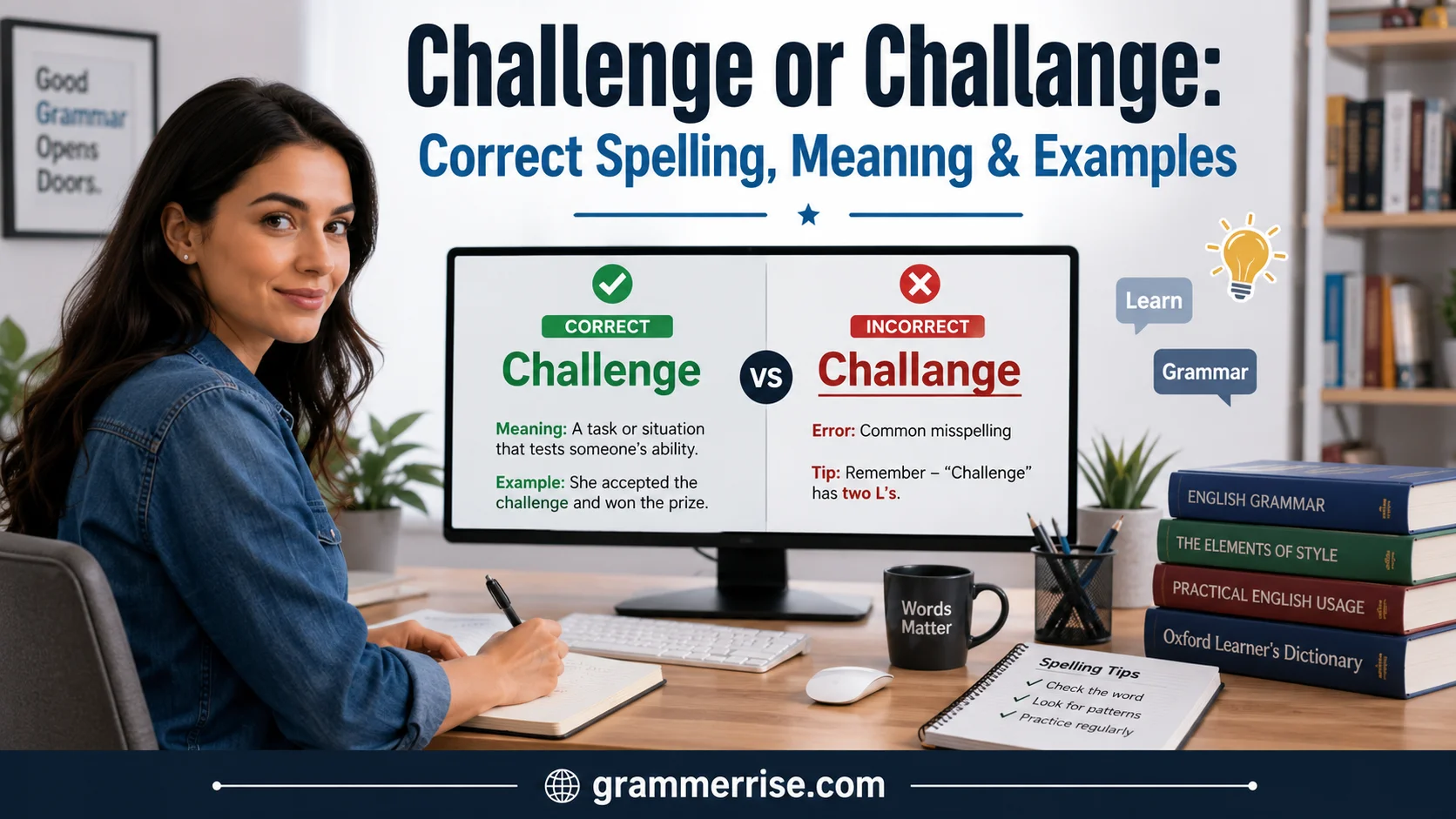
Challenge or Challange: Which Spelling Is Correct?
The correct spelling is challenge.
The word challange is incorrect and does not appear as a standard English word. Although many people write it accidentally, dictionaries recognize only challenge.
| Word | Correct Spelling | Meaning | Example |
| Challenge | ✅ Yes | A difficult task, problem, test, or competition | “Learning a new language is a challenge.” |
| Challange | ❌ No | Incorrect spelling | “Challange” should be corrected to “challenge.” |
The mistake usually happens because people hear the word and assume it follows a spelling pattern with repeated letters. English spelling, however, does not always follow predictable rules.
For example:
- Challenge has one “l.”
- Challenging also has one “l.”
- Challenged keeps the same spelling pattern.
- Challenger follows the same structure.
Once you learn the original word, the entire word family becomes easier.
What Does Challenge Mean?
The word challenge has several meanings depending on how you use it. It can describe a difficult situation, a competition, or even an act of questioning something.
The word works as both a noun and a verb.
Challenge as a Difficult Task or Problem
The most common meaning of challenge is something difficult that requires effort, skill, patience, or determination.
A challenge does not always mean something negative. In many situations, challenges help people improve.
Examples:
- “Completing the marathon was a huge challenge.”
- “Starting a new career can be challenging.”
- “Learning advanced mathematics is a challenge for many students.”
Think of a challenge like climbing a mountain. The climb may feel difficult, but reaching the top creates a sense of achievement.
Common Real-Life Challenges
People experience challenges in many areas:
| Area | Example Challenge |
| Education | Preparing for difficult exams |
| Career | Learning new professional skills |
| Health | Building better habits |
| Finance | Managing expenses |
| Relationships | Improving communication |
| Technology | Learning new software |
A challenge tests your ability and often pushes you beyond your comfort zone.
Challenge as a Test of Ability
Sometimes people use challenge to describe something designed to measure skill or performance.
These challenges often encourage growth.
Examples include:
- Fitness challenges
- Reading challenges
- Coding challenges
- Cooking challenges
- Creative challenges
For example:
A person who joins a 30-day fitness challenge is not only exercising. They are testing discipline, consistency, and motivation.
Similarly, a programmer participating in a coding challenge practices problem-solving skills.
Challenges create opportunities to learn.
Challenge as a Competition
The word challenge can also describe an invitation to compete.
Examples:
- “She challenged her friend to a tennis match.”
- “The champion accepted the challenger’s request.”
- “The team faces a tough challenge this weekend.”
In sports, a challenge creates excitement because it introduces competition between opponents.
A boxing match, chess competition, or racing event can all involve a challenge.
For More Please Visit: Privilege or Priviledge: Which Spelling Is Correct and Meaning?
Challenge as Questioning or Disagreeing
In formal situations, challenge can mean questioning something.
This meaning appears often in law, business, research, and discussions.
Examples:
- “The lawyer challenged the witness’s statement.”
- “Researchers challenged the previous theory.”
- “Employees challenged the company’s decision.”
Here, challenge does not mean a physical fight. It means someone asks for proof, clarification, or reconsideration.
Why Is Challange Incorrect?
Many English mistakes happen because a word looks like it should follow a certain pattern.
The spelling challange feels possible because English contains many words with double letters:
- Successful
- Different
- Address
- Occurrence
However, challenge does not belong to that group.
The correct spelling comes from the original form of the word. Adding another “l” creates a spelling error.
Why People Write Challange Instead
Several reasons explain this common mistake:
Pronunciation Confusion
When people hear challenge, they focus on the sound rather than the letters.
The pronunciation:
CHAL-inj
does not clearly show how many letters appear in the written word.
Similar Word Patterns
People may compare challenge with words like:
- Challenging
- Challenged
- Challenger
They sometimes assume the root contains double letters.
Fast Typing
Online communication encourages quick writing. A person may type “challange” without noticing the mistake.
Lack of Proofreading
Small spelling errors often survive because writers read what they intended to write instead of what appears on the screen.
How to Pronounce Challenge Correctly
The correct pronunciation of challenge is:
CHAL-inj
Phonetic spelling:
/ˈtʃæl.ɪndʒ/
The word has two main parts:
- Chal → sounds like “chal”
- lenge → sounds like “inj”
The pronunciation does not contain an extra “l” sound.
This can help you remember that the spelling also uses only one l.
Easy Ways to Remember the Correct Spelling of Challenge
Spelling becomes easier when you connect words with simple memory tricks.
Remember: “One L Creates One Correct Challenge”
The correct spelling:
C H A L L E N G E
Notice that the word contains:
- One “l” after “cha”
- No extra “l” before “ange”
Actually, the spelling contains two l letters? Let’s break it correctly:
Challenge = C H A L L E N G E
The word has two consecutive l letters?
No. This is where confusion often happens.
The correct spelling is:
C H A L L E N G E
The letters are:
- C
- H
- A
- L
- L
- E
- N
- G
- E
So challenge actually contains “ll.”
The mistake is not adding an extra “l” after the existing double “l” pattern.
Incorrect:
❌ Challange
Correct:
✅ Challenge
The middle section changes:
- Challenge → ll + e
- Challange → ll + a
The key difference is the letter after “ll.”
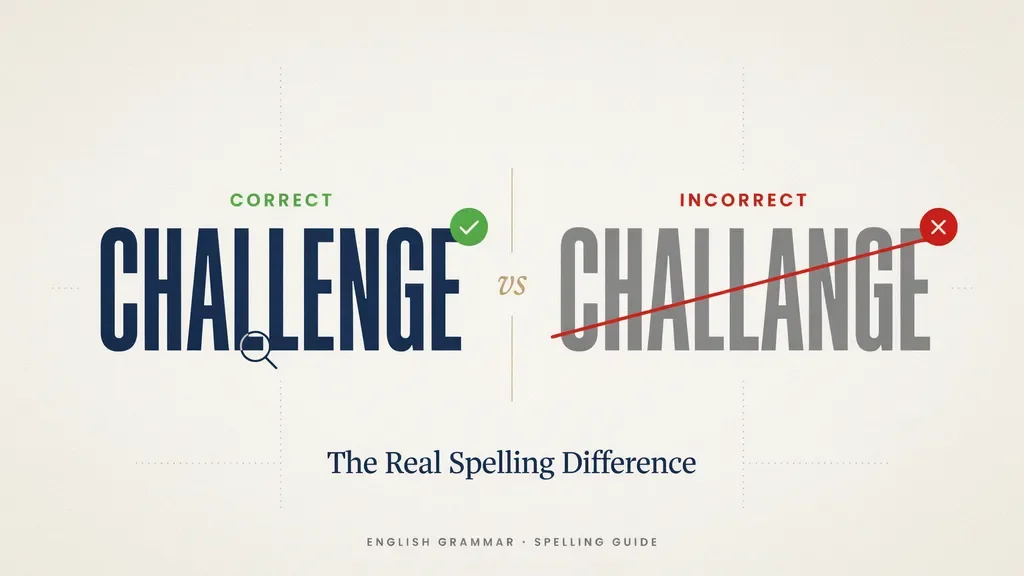
Challenge vs Challange: The Real Spelling Difference
Many people focus only on the number of “l” letters, but the actual mistake happens with the vowel combination.
Compare:
| Correct | Incorrect |
| Challenge | Challange |
| Ends with “enge” | Ends with “ange” |
| Contains “lenge” sound | Creates incorrect spelling |
The correct ending is:
-lenge
Not:
-lange
Common Mistakes With Challenge
Understanding common errors helps you avoid them.
Writing Challange Instead of Challenge
Incorrect:
“This project is a big challange.”
Correct:
“This project is a big challenge.”
Confusing Challenge With Challenging
Many writers mix up these words.
| Word | Type | Meaning | Example |
| Challenge | Noun | A difficult task | “The exam was a challenge.” |
| Challenging | Adjective | Something difficult | “The exam was challenging.” |
Incorrect:
“This task is a challenge tasking.”
Correct:
“This task is challenging.”
Using Challenge Incorrectly in Sentences
Incorrect:
“This is very challenge for me.”
Correct:
“This is a big challenge for me.”
or
“This is very challenging for me.”
Challenge Word Family Explained
The word challenge creates several related words.
| Word | Grammar Type | Meaning | Example |
| Challenge | Noun/Verb | Difficult task or questioning action | “I accepted the challenge.” |
| Challenges | Plural noun | Multiple difficult situations | “Life brings many challenges.” |
| Challenging | Adjective | Difficult or demanding | “The project was challenging.” |
| Challenged | Verb form | Tested or questioned | “They challenged the decision.” |
| Challenger | Noun | Person who competes | “The challenger entered the match.” |
Learning the entire word family improves spelling and vocabulary.
Challenge Examples in Everyday Sentences
Personal Life Examples
- “Moving to a new city can be a challenge.”
- “She accepted the challenge of learning piano.”
- “Building confidence takes time and effort.”
Workplace Examples
- “Managing a large project creates many challenges.”
- “The company faces challenges during expansion.”
- “Finding creative solutions is part of the job.”
School Examples
- “Writing a research paper was a challenge.”
- “The student overcame the challenge through practice.”
Sports Examples
- “The athlete welcomed the challenge.”
- “The team prepared for a difficult challenge.”
Challenge in Different Fields
The meaning of challenge changes depending on the situation.
Business Challenges
Companies face challenges such as:
- Increasing competition
- Changing customer needs
- Managing costs
- Developing new products
A successful business does not avoid every challenge. Instead, it learns how to handle them.
Technology Challenges
Technology creates new problems that require solutions.
Examples:
- Cybersecurity risks
- Software development issues
- Data management problems
- Artificial intelligence challenges
Technology professionals often solve complex challenges every day.
Personal Growth Challenges
Personal challenges often create the biggest changes.
Examples:
- Learning a new skill
- Improving health habits
- Becoming more organized
- Building confidence
Growth usually happens when people face something difficult and continue moving forward.
Is Challange Ever Correct?
No.
Challange is never considered the correct spelling in standard English.
Whether you use American English or British English, the correct word remains:
✅ Challenge
If you see challange in a message, article, or social media post, it is simply a spelling mistake.
Challenge Synonyms and Similar Words
Different situations require different words.
| Word | Meaning | Example |
| Difficulty | Something hard | “The task created difficulty.” |
| Problem | Something needing a solution | “We solved the problem.” |
| Obstacle | Something blocking progress | “Money became an obstacle.” |
| Test | Something measuring ability | “The exam was a test.” |
| Trial | A difficult experience | “The journey was a trial.” |
Although these words are similar, they do not always mean exactly the same thing.
A challenge often suggests growth or improvement, while a problem usually focuses on something that needs fixing.
Challenge Antonyms
Opposite words include:
| Antonym | Meaning |
| Ease | Lack of difficulty |
| Simplicity | Something easy to understand |
| Solution | An answer to a problem |
| Support | Help that reduces difficulty |
Example:
- “The challenge was difficult.”
- “The solution made the task easier.”
Frequently Asked Questions About Challenge or Challange
1. Is “challenge” or “challange” the correct spelling?
Challenge is the correct spelling in English. Challange is a common misspelling and is not recognized as a proper English word. Using challenge ensures your writing remains accurate and professional.
2. Why do people often write “challange” instead of “challenge”?
Many people write challange because the pronunciation can make the spelling confusing. The extra “a” often appears due to typing habits, spelling confusion, or remembering the word incorrectly.
3. What does the word “challenge” mean?
Challenge can be used as both a noun and a verb. As a noun, it means a difficult task, test, or competition. As a verb, it means to question something, invite someone to compete, or try to overcome a difficulty.
4. Can using “challange” affect my professional writing?
Yes. Using challange in emails, resumes, academic papers, or work documents can make your writing appear less polished. Correct spelling helps create a better impression and improves communication.
5. What are some easy ways to remember the correct spelling of challenge?
A simple trick is to remember that challenge contains “enge” at the end, not “ange.” Regular reading, proofreading, and using spelling tools can also help you avoid this mistake.
6. Is “challenge” used differently in formal and informal writing?
The word challenge works in both formal and informal writing. It can describe personal struggles, professional tasks, competitions, or situations that require effort. However, challange should be avoided in all types of writing because it is incorrect.
Conclusion
Words may look similar, but their correct usage can make a big difference in effective communication. The confusion between challenge and challange is a perfect example of how a small spelling mistake can affect the quality and professionalism of your writing. While many people make this error because of pronunciation or typing habits, remembering that challenge is the correct spelling will help you write with confidence.
Whether you are preparing a professional email, completing an academic paper, creating online content, or simply writing a message, using the right word shows attention to detail. Good writing is not only about sharing ideas; it is also about presenting them clearly and accurately. By understanding the meaning, spelling, and usage of challenge, you can avoid common errors and improve your overall language skills.
The next time you hesitate between challenge or challange, choose challenge without doubt. A little awareness and careful proofreading can help you build stronger writing habits and communicate your thoughts in a more polished and professional way.

Hussain Abid is an English language writer with over 10 years of experience in grammar, spelling, vocabulary, and writing. He specializes in creating clear, well-researched content that helps readers improve their English with confidence. At GrammarRise, Hussain writes practical guides, grammar explanations, and word comparison articles based on trusted language sources and real-world usage. His mission is to make English learning simple, accurate, and accessible for everyone