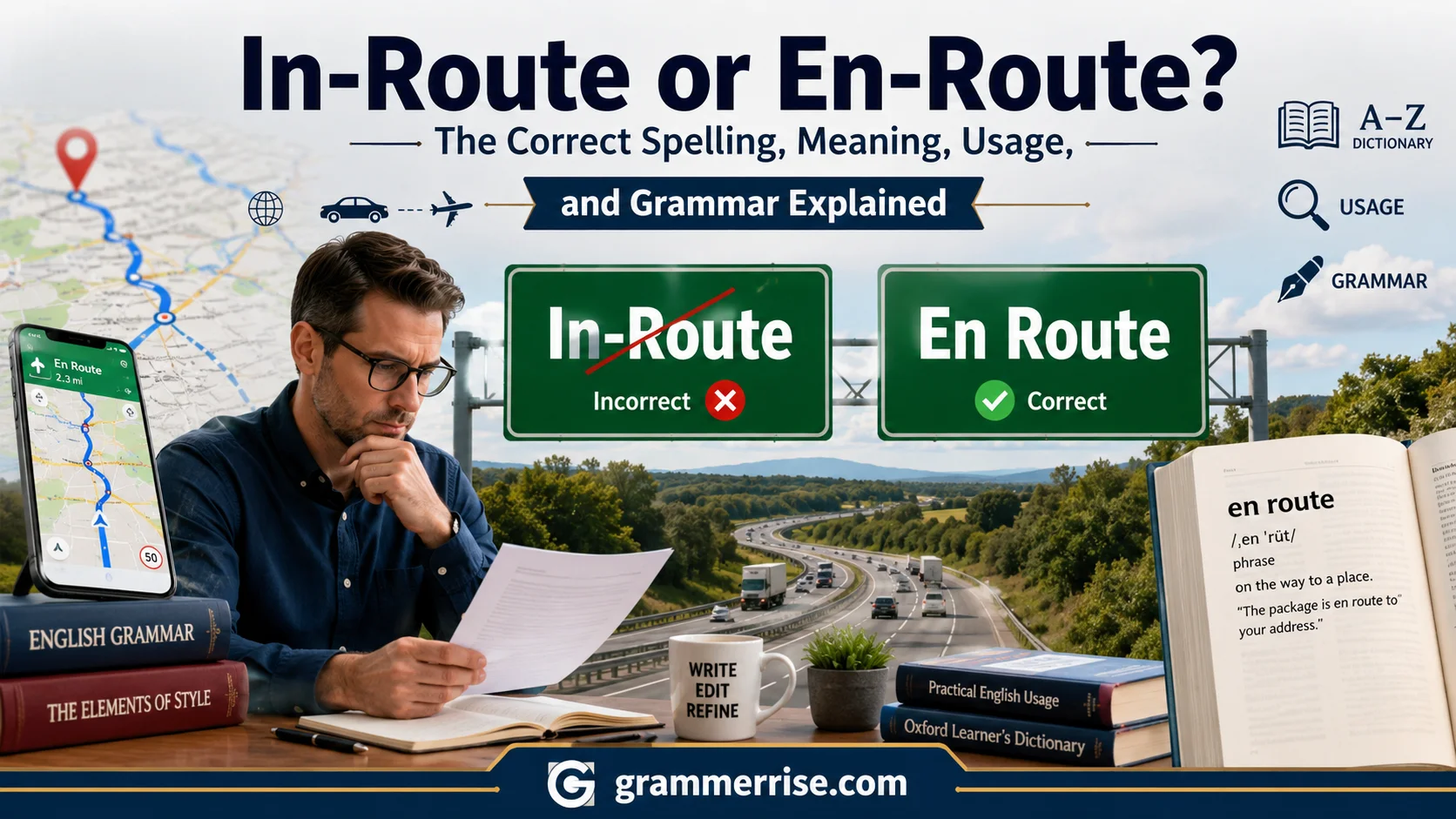
In-Route or En-Route explains the difference between travel phrases as learners choose correct English usage for clear communication and writing. Understanding the difference between in route and en route helps language learners avoid a common mistake in English grammar because these phrases may sound similar while they relate to travel, movement, and a journey. The standard and widely accepted English phrase is En Route, which comes from the French language and means on the way or in transit toward a destination.
In my experience with writing, speaking, and communication, many writers pause because this simple choice creates confusion. The correct phrase improves clear communication, English usage, and professional accuracy in formal English, everyday English, and real-life communication. Using In Route as the incorrect phrase can confuse readers in formal writing, academic contexts, professional writing, and travel-related contexts.
The usage of En Route appears in travel writing, aviation, navigation systems, travel updates, delivery updates, and professional communication worldwide. Understanding the meaning, spelling, grammar rules, and contextual meanings makes sentence construction easier in different situations.
Quick Answer
En route is the correct and standard English phrase. It means “on the way” or “in transit.” In route and in-route are generally considered incorrect when you mean that someone or something is traveling toward a destination.
- ✅ We are en route to the airport.
- ✅ The package is en route.
- ❌ We are in route to the airport.
- ❌ The package is in-route.
The easiest way to remember it is: En route = on the way. The phrase comes from French and has been adopted into English with its original spelling.
In-Route vs. En-Route: What’s the Difference?
The debate over in-route or en-route comes down to one important fact: only one version has a recognized place in standard English.
The Short Answer
The accepted expression is:
En route
The commonly mistaken versions are:
- In route
- In-route
Most dictionaries, grammar guides, and style manuals recognize en route as the proper phrase.
Quick Comparison Table
| Feature | En Route | In Route |
| Standard English | Yes | No |
| Dictionary Approved | Yes | Rarely |
| Professional Writing | Recommended | Not Recommended |
| Business Communication | Common | Incorrect |
| Origin | French | Misinterpretation |
| Academic Writing | Accepted | Avoid |
If you’re writing an email, article, report, or text message and want to be grammatically correct, choose en route.
What Does En Route Mean?
The phrase en route means:
“On the way to a destination.”
It describes someone or something currently traveling toward a particular place.
Dictionary Definition
Most major dictionaries define en route as:
“In the course of traveling” or “on the way.”
The phrase can refer to:
- People traveling
- Vehicles moving
- Packages being delivered
- Emergency responders
- Aircraft
- Military units
Examples
- We are en route to the airport.
- The package is en route to your address.
- Firefighters are en route to the scene.
- The ambulance is en route to the hospital.
In each example, movement toward a destination is taking place.

Common Situations Where People Use En Route
The phrase appears in many industries and daily situations.
Travel and Tourism
Travelers often use it when updating friends or family.
Examples:
- We’re en route to New York.
- Our train is en route to Chicago.
- The cruise ship is en route to the Bahamas.
Shipping and Logistics
Tracking systems frequently display the status.
Examples:
- Your order is en route.
- The shipment is en route to the warehouse.
- Goods remain en route to the customer.
Aviation
Pilots and air traffic personnel use the phrase regularly.
Examples:
- Flight 451 is en route to Denver.
- The aircraft is en route at cruising altitude.
Emergency Services
Police, firefighters, and paramedics use the term because it provides a quick status update.
Examples:
- Officers are en route.
- EMS personnel are en route to the location.
Business Communication
Managers and employees often use it in emails and messages.
Examples:
- I’m en route to the meeting.
- The documents are en route via courier.
Synonyms for En Route
Sometimes you may want variety in your writing.
Here are several alternatives.
| Phrase | Meaning |
| On the way | Traveling toward a destination |
| In transit | Being transported |
| Heading toward | Moving toward a place |
| Bound for | Directed toward a destination |
| Traveling to | Going somewhere |
| On course | Following a planned route |
| Underway | Journey has begun |
Example Comparison
Instead of:
- The package is en route.
You could write:
- The package is in transit.
- The package is on the way.
- The package is heading toward its destination.
Each option works slightly differently depending on context.

The Origin and History of En Route
Understanding where the phrase comes from helps explain why in route is incorrect.
French Roots
The expression comes directly from French.
The word en means:
- In
- On
- Along
The word route means:
- Road
- Route
- Path
- Way
Together:
En route = on the road or on the way
English borrowed the phrase centuries ago and retained its original spelling.
How It Entered English
English has adopted thousands of French expressions.
Examples include:
- Bon voyage
- Déjà vu
- Faux pas
- À la carte
- En route
These expressions often preserve their original French spelling.
Historical Usage
Linguistic records show en route appearing in English publications during the 18th and 19th centuries. Over time, it became especially common in military, transportation, and travel contexts.
Today, it remains one of the most widely used French expressions in English.
Why English Kept the Original Spelling
Many borrowed phrases become fully anglicized.
However, some remain unchanged because:
- They are widely recognized.
- Their meanings remain clear.
- Writers prefer the traditional form.
En route falls into this category.
Changing it to in route alters the original phrase and creates a version that grammar authorities generally reject.
Is In Route Ever Correct?
This is where confusion begins.
Why People Write In Route
When spoken aloud, en route often sounds like:
“on root”
or
“in root”
As a result, many people assume the first word should be in.
That assumption feels logical. Unfortunately, it’s incorrect.
The Grammar Behind the Mistake
English contains many phrases beginning with “in.”
Examples include:
- In progress
- In motion
- In transit
- In line
Because of these patterns, writers sometimes substitute in for en.
The substitution creates a phrase that lacks historical and grammatical support.
What Dictionaries Say
Major dictionaries consistently recognize:
✅ En route
They generally do not recommend:
❌ In route
❌ In-route
When grammar experts discuss the phrase, they overwhelmingly favor en route.
How to Use En Route Correctly
Using the phrase properly is simple once you understand its role.
En Route as an Adverbial Phrase
Most often, it functions as a phrase describing movement.
Examples:
- We stopped for coffee en route.
- She called while en route.
- The driver encountered traffic en route.
En Route Before a Destination
The phrase often appears before a destination.
Examples:
- We are en route to Miami.
- The plane is en route to Seattle.
- The shipment is en route to California.
This structure is extremely common.
Capitalization Rules for En Route
In normal sentences:
✅ We are en route.
Avoid:
❌ We are En Route.
Capitalize Only When Appropriate
Examples:
- En Route to Success (book title)
- En Route Home (article title)
Otherwise, lowercase is preferred.
Punctuation Guidelines
The phrase rarely requires special punctuation.
Correct:
- We are en route to the hotel.
- The package remains en route.
Incorrect:
- We are, en route, to the hotel.
Extra commas usually create unnecessary interruptions.
Real-World Examples of Correct Usage
Personal Travel
- We are en route to the beach.
- They are en route home.
Workplace Communication
- I’m en route to the conference room.
- Our representative is en route now.
Shipping
- The package is en route to the sorting facility.
- Your order remains en route.
Emergency Response
- Fire crews are en route.
- Paramedics are en route to the location.
Quick Fix Table
| Incorrect | Correct |
| In route to work | En route to work |
| In-route home | En route home |
| Package is in route | Package is en route |
| Driver is in-route | Driver is en route |
En Route in Business, Logistics, and Transportation
Few phrases appear more frequently in logistics than en route.
Shipping Industry
Tracking systems often display statuses such as:
- Order received
- Processing
- Shipped
- En route
- Delivered
Customers instantly understand that a package is moving toward its destination.
Aviation
Airlines use the term because it communicates location efficiently.
Example:
Flight 212 is en route to Los Angeles.
Fleet Management
Transportation companies track vehicles using GPS.
Statuses often include:
- Parked
- Loading
- En route
- Delivered
Customer Service
Businesses frequently send messages such as:
Your technician is en route.
This wording sounds professional and familiar.
Emergency Dispatch
Dispatch centers use short, standardized phrases.
Example:
Unit 24 is en route.
The phrase communicates movement without unnecessary detail.
Read More: Challenge or Challange: Correct Spelling, Meaning and Examples

En Route vs. Similar Travel Expressions
Several expressions appear similar but carry different meanings.
En Route vs. In Transit
En route emphasizes movement toward a destination.
In transit emphasizes transportation status.
Example:
- The package is en route to Chicago.
- The package is currently in transit.
Both can be correct.
En Route vs. On the Way
On the way sounds more conversational.
En route sounds slightly more formal.
Example:
- I’m on the way.
- I’m en route.
Both are acceptable.
En Route vs. Bound For
Bound for highlights the destination.
Example:
- The vessel is bound for Miami.
En Route vs. Underway
Underway emphasizes that movement has started.
Example:
- The voyage is underway.
Comparison Table
| Phrase | Meaning | Tone |
| En Route | Moving toward destination | Professional |
| On the Way | Traveling toward destination | Casual |
| In Transit | Being transported | Logistics |
| Bound For | Directed toward destination | Formal |
| Underway | Journey has begun | Technical |
Common Grammar Mistakes Related to En Route
Even experienced writers occasionally make mistakes.
Writing In Route
This remains the most common error.
Always use:
✅ En route
Adding Unnecessary Hyphens
Many writers use:
En-route
While some publications allow it, most dictionaries prefer:
En route
Incorrect Capitalization
Avoid:
- En Route
- EN ROUTE
Unless used in a title.
Using It as a Noun
Incorrect:
❌ The en route was delayed.
Correct:
✅ The shipment was en route.
Should You Write En Route or En-Route?
This question generates frequent debate.
Preferred Form
Most modern dictionaries prefer:
En route
Hyphenated Form
Some publications occasionally use:
En-route
However, it is less common.
Style Guide Preferences
Many professional style guides favor:
- En route
without a hyphen.
Recommendation
For most writing situations:
✅ Use en route
Avoid:
⚠️ En-route unless a specific style guide requires it.
Quick Reference Table
| Form | Correct? | Recommended? |
| En route | Yes | Yes |
| En-route | Sometimes | Usually No |
| In route | No | No |
| In-route | No | No |
How Dictionaries and Style Guides Treat En Route
Leading language authorities consistently support the traditional spelling.
Dictionary Consensus
Most major dictionaries recognize:
- En route
They define it as:
- On the way
- In transit toward a destination
Editorial Style Guides
Professional editors generally recommend:
- En route
because it reflects established usage.
Language Trends
Search behavior shows many people still type:
- In route
- In-route
Yet published writing overwhelmingly favors:
- En route
This pattern demonstrates that public confusion exists even though the standard form remains unchanged.

Why En Route Dominates Modern English
Several factors explain its continued popularity.
It Is Universally Recognized
Travelers, businesses, airlines, and delivery companies understand it instantly.
It Is Concise
Instead of saying:
“The package is currently traveling toward the destination.”
You can simply write:
“The package is en route.”
It Sounds Professional
The phrase appears polished without sounding overly formal.
Easy Memory Tricks to Remember the Correct Spelling
If you frequently forget which version is correct, these techniques help.
Remember the French Origin
Think:
French phrase = en route
Not:
English phrase = in route
Connect It to Other French Expressions
Examples:
- Bon voyage
- Déjà vu
- Faux pas
- En route
The pattern becomes easier to remember.
Visual Trick
Picture a road sign:
EN ROUTE
Seeing the phrase visually can reinforce the correct spelling.
Simple Mnemonic
“En route means you’re on the route.”
The phrase sticks surprisingly well.
Case Study: A Common Workplace Mistake
Imagine a project manager sends an email:
“I’m in-route to the client meeting.”
Most readers understand the message.
However, the wording contains a grammatical error.
A corrected version would read:
“I’m en route to the client meeting.”
The revised sentence appears more polished and professional.
While the mistake won’t usually cause confusion, repeated errors can affect credibility in formal communication.
My Personal Experience as an English Specialist: Understanding “In Route” vs. “En Route”
As an English specialist, I’ve noticed that even simple travel expressions can cause surprising confusion. I remember coming across “in route” in a piece of writing and immediately pausing to check whether it was actually correct. The phrase looked natural at first glance, especially because English has expressions such as “in transit” and “in motion.” However, the correct expression is “en route,” meaning “on the way” or “traveling toward a destination.”
That experience reminded me that English grammar isn’t always predictable. Some expressions come from other languages and keep their original form. En route is one of those expressions. Since then, whenever I see “in route” or “in-route,” I recognize it as a common mistake and replace it with “en route.”
For example, I would write:
- We are en route to the airport.
- The package is en route to the customer.
- The ambulance is en route to the hospital.
The more I worked with English learners and professional writing, the clearer this distinction became. En route is the standard form, while in route is generally not accepted in standard English.
FAQs
1. Is “In Route” ever correct in English?
No, “In Route” is generally considered incorrect in standard English. “En Route” is the accepted expression used to mean “on the way” or “in transit.”
2. Why do people confuse “In Route” and “En Route”?
The confusion happens because both phrases sound similar and relate to travel or movement. Many people assume “in” fits naturally in English, but the correct phrase comes from French.
3. Can I use “En Route” in professional emails?
Yes. “En Route” is widely used in professional emails, business communication, delivery updates, and travel-related messages because it is clear and grammatically correct.
4. Is “En Route” formal or informal?
“En Route” works in both formal and informal situations. You can use it in academic writing, workplace communication, travel reports, or everyday conversations.
5. Do navigation apps and airlines use “En Route”?
Yes. Many navigation systems, aviation services, logistics companies, and travel platforms use “En Route” to indicate that a person, vehicle, or shipment is currently on the way.
6. How can I easily remember the correct phrase?
A simple trick is to remember that “En Route” is the original French expression adopted into English. If you mean “on the way,” choose “En Route” and avoid “In Route.”
Conclusion
The choice between In Route and En Route is simpler than it first appears. While many people use both terms interchangeably, En Route is the correct and widely accepted expression in modern English. It carries the meaning of being on the way to a destination and is commonly used in travel updates, professional communication, aviation, and everyday conversations.
By understanding the origin, meaning, and proper usage of the phrase, you can avoid a common grammar mistake and communicate more clearly. Whether you are writing an email, sharing a travel update, or preparing academic content, choosing En Route helps your message sound accurate, professional, and easy to understand.
Quick Cheat Sheet
| Question | Answer |
| Correct form | En route |
| Incorrect forms | In route, In-route |
| Meaning | On the way |
| Origin | French |
| Hyphen required? | Usually no |
| Formal writing | Yes |
| Casual writing | Yes |
| Business emails | Yes |
| Shipping updates | Yes |
| Travel communication | Yes |