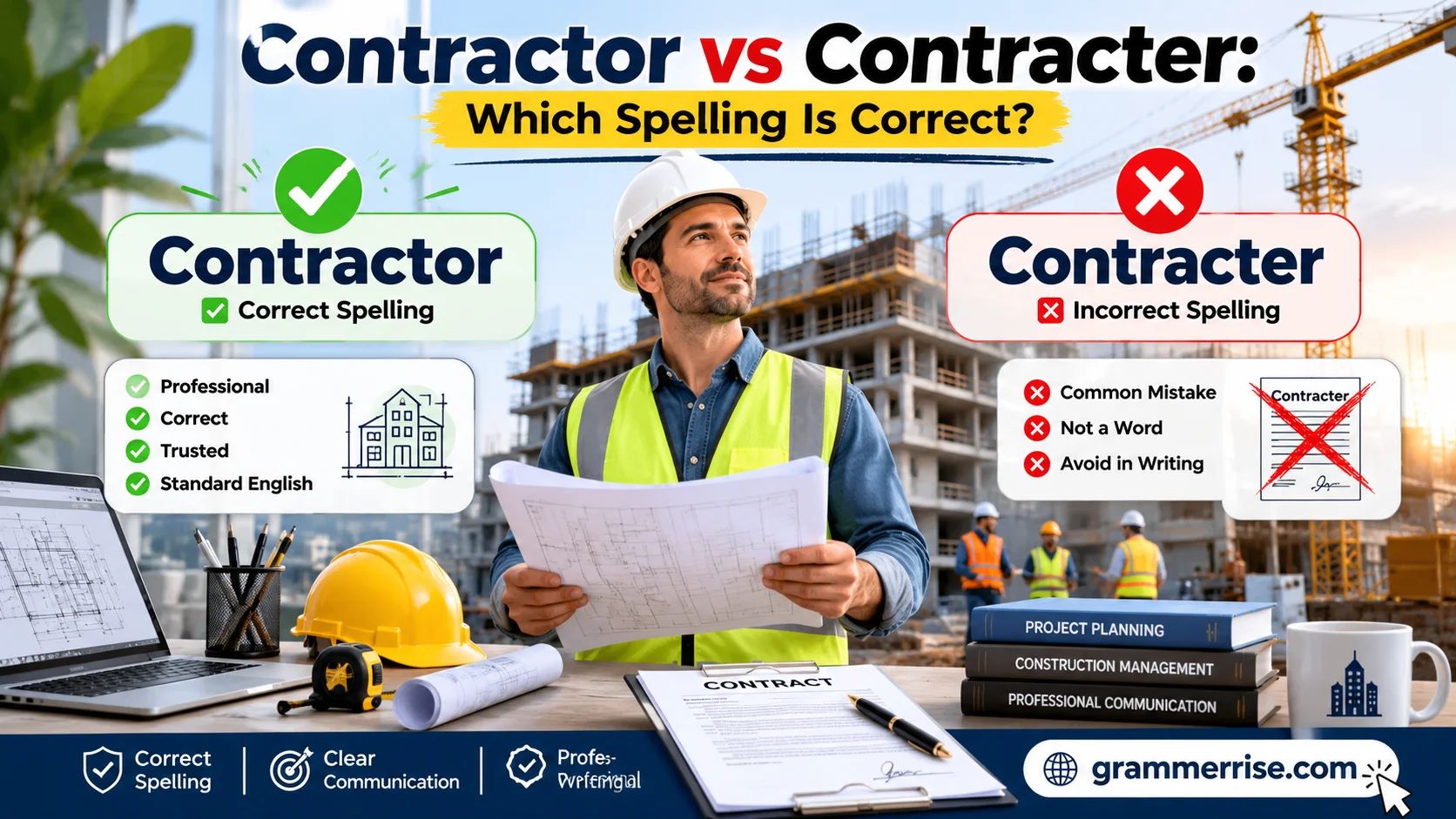
Contractor vs Contracter difference often confuses English learners and writers because both spellings look similar, but only Contractor is correct. Many people have paused while choosing between these words because they sound almost the same when spoken. This common confusion appears in professional writing, business documents, and online content. The correct spelling is accepted in standard English, while Contracter is an incorrect form and a frequent misspelling that does not exist in formal dictionaries. Understanding the difference helps improve spelling accuracy and allows people to choose the right word confidently.
Contractor Meaning, Usage, and Common Writing Mistakes
The meaning of Contractor describes someone who is hired to complete a specific job or project through a formal agreement. This guide helps break the topic down in a simple and practical way by exploring the definition, usage, grammar rule, and origin of the “-or” ending. Real examples provide a clear explanation and show how to avoid common mistakes in legal uses, resumes, job postings, and everyday communication. Proper pronunciation tips and careful checking of the word can prevent misunderstandings and maintain credibility in professional work.
Contractor vs Contracter: The Quick Answer
The answer is simple:
| Word | Correct Spelling | Meaning |
| Contractor | ✅ Correct | A person or company that agrees to complete work under a contract |
| Contracter | ❌ Incorrect | A misspelling of contractor |
The correct word is always contractor.
The word comes from contract, which means a formal agreement between two or more parties. A contractor is someone who performs work according to that agreement.
For example:
- A homeowner hires a contractor to renovate a kitchen.
- A company hires an IT contractor to build software.
- A government agency hires a contractor to complete a public project.
The spelling contracter may look logical because many English words use the -er ending, such as teacher, builder, and designer. However, contractor follows a different pattern.
The ending -or is common in words that describe someone who performs an action or professional role.
Examples:
- Actor
- Creator
- Editor
- Director
- Contractor
What Does Contractor Mean?
A contractor is an individual, group, or business that provides services based on an agreement called a contract.
Unlike traditional employees, contractors usually work independently. They often complete specific projects, provide specialized skills, or deliver a particular service within an agreed timeframe.
A contractor may work alone as a freelancer or operate as a larger company with multiple workers.
Simple Definition of Contractor
Contractor: A person or organization hired to perform work or provide services under a legal agreement.
Examples of Contractors in Everyday Life
Imagine you want to build a new house.
You might hire:
- An architect to design the building
- A construction contractor to manage the project
- Electricians and plumbers to complete specialized work
The construction contractor coordinates the work and ensures the project follows the agreed requirements.
Another example:
A company wants to create a mobile app. Instead of hiring a full-time developer, it may hire an independent software contractor to complete the project.
Common Types of Contractors
The word contractor covers many professions. It is not limited to construction.
Construction Contractor
Construction contractors are among the most familiar examples.
They handle projects such as:
- Building homes
- Remodeling offices
- Repairing structures
- Managing construction teams
- Coordinating subcontractors
A general contractor often oversees the entire project while specialized contractors handle specific tasks.
For example:
A general contractor may manage a home renovation while hiring:
- Electrical contractors
- Plumbing contractors
- Roofing contractors
- Flooring specialists
Independent Contractor
An independent contractor works for themselves rather than as an employee of a company.
They usually:
- Choose their clients
- Set their own schedules
- Manage their own workload
- Handle their own taxes
- Provide specialized services
Common independent contractors include:
- Writers
- Designers
- Developers
- Consultants
- Photographers
- Marketing specialists
Government Contractor
Governments often hire contractors for large projects.
Government contractors may provide:
- Construction services
- Defense technology
- Transportation systems
- Consulting services
- IT solutions
These contracts can involve millions or even billions of dollars because they often support major public projects.
IT Contractor
Technology companies frequently hire contractors for specialized skills.
Examples include:
- Software developers
- Cybersecurity experts
- Cloud engineers
- Data analysts
An IT contractor may join a company for six months to help launch a new platform and then move to another project.
Is Contracter a Real Word?
The short answer is no.
Contracter is not the accepted spelling in standard English.
Although people sometimes write “contracter,” dictionaries and professional writing standards recognize contractor as the correct form.
The confusion happens because English has many words ending in -er.
Examples:
- Teacher
- Worker
- Painter
- Driver
- Builder
Because of these patterns, people naturally assume:
Contract + er = Contracter
But English does not always follow predictable rules.
Some words use the -or ending because of their Latin origins and historical development.
Examples:
- Creator
- Operator
- Administrator
- Investigator
- Contractor
The correct spelling developed over time and became the accepted professional form.
Why Do People Confuse Contractor and Contracter?
The confusion between contractor vs contracter happens for several reasons.
Similar Pronunciation
When people hear the word, the ending sounds like “ter.”
Someone saying:
“I hired a contractor”
may sound similar to:
“I hired a contracter”
The pronunciation does not clearly reveal the spelling.
English Spelling Patterns Create Confusion
Many job titles use -er.
For example:
| Word | Meaning |
| Teacher | Someone who teaches |
| Builder | Someone who builds |
| Painter | Someone who paints |
| Writer | Someone who writes |
Because of this pattern, people often assume every profession follows the same rule.
However, English contains many exceptions.
The Influence of Other Words
People may compare contractor with words like:
- Collector
- Instructor
- Translator
- Educator
Many professional words use -or, especially those connected with formal roles.
Contractor Word Origin and History
The word contractor comes from the word contract.
The word contract comes from the Latin word contractus, meaning “drawn together” or “agreement.”
The Latin root comes from:
- con- meaning “together”
- trahere meaning “to draw”
Over time, the word developed into the modern English term contract.
A person who enters into a contract became known as a contractor.
The -or ending historically developed from Latin forms used to describe a person who performs an action.
Similar examples include:
- Operator — someone who operates
- Director — someone who directs
- Contractor — someone who contracts
Contractor vs Contracter Examples
Understanding the difference becomes easier when you see examples.
Correct Examples Using Contractor
✅ After reviewing several proposals, the company hired a contractor to redesign its website.
✅For the home renovation project, we contacted a local contractor with proven experience.
✅ Ahead of schedule, the contractor completed the bridge construction successfully.
✅Working with several businesses, she serves as an independent contractor providing specialized services.
✅ Following a detailed selection process, the government chose a contractor for the transportation project.
Incorrect Examples Using Contracter
❌ We hired a contracter to repair the roof.
✅ We hired a contractor to repair the roof.
❌ The contracter submitted the final invoice.
✅ The contractor submitted the final invoice.
❌ He works as a freelance contracter.
✅ He works as a freelance contractor.
Contractor vs Employee: Understanding the Difference
Many people confuse contractors with employees because both complete work for organizations.
However, their working relationships differ.
| Feature | Contractor | Employee |
| Work Agreement | Contract-based | Employment agreement |
| Schedule | Often flexible | Usually fixed |
| Benefits | Usually responsible personally | Often provided by employer |
| Taxes | Usually manages own taxes | Employer handles payroll taxes |
| Independence | Higher | Lower |
| Project Length | Often temporary | Usually ongoing |
Example Scenario
A company needs a new website.
Option one:
The company hires a full-time web developer.
That person becomes an employee.
Option two:
The company hires a freelance developer for three months.
That person becomes an independent contractor.
Both people perform valuable work, but their employment structures differ.
Read more: Appendices or Appendixes: The Complete Guide to Usage
Contractor vs Contractee: What Is the Difference?
Another commonly confused term is contractee.
A contractor performs the work.
A contractee receives the service or enters the agreement with the contractor.
| Person | Role |
| Contractor | Provides the service |
| Contractee | Receives the service |
Example
A homeowner hires a builder.
- Builder = Contractor
- Homeowner = Contractee
The contractor completes the construction work while the homeowner pays for the service according to the agreement.
Common Spelling Mistakes Related to Contractor
Many people misspell contractor in different ways.
Common incorrect forms include:
- Contracter
- Contrator
- Contractorr
- Contractur
The correct spelling is:
✅ Contractor
A useful habit is to slow down when writing professional words. Many spelling errors happen because people type quickly without checking.
How to Remember the Correct Spelling of Contractor
Remembering the correct spelling does not have to feel difficult.
Try these simple tricks.
Think of Actor
The word actor uses “-or.”
A person who acts is an actor.
A person who works under a contract is a contractor.
Actor → Contractor
Use the Word Formula
Remember:
Contract + or = Contractor
Not:
Contract + er = Contracter
Create a Mental List
Professional words often use “-or”:
- Actor
- Creator
- Editor
- Director
- Contractor
This pattern can help you recognize the correct spelling.
Why Correct Spelling of Contractor Matters
Spelling may seem like a small detail, but professional communication depends on accuracy.
A spelling mistake can create a poor impression, especially in situations where trust matters.
Places Where Correct Spelling Matters
- Business websites
- Job applications
- Contracts
- Invoices
- Emails
- Marketing materials
- Professional profiles
Imagine a construction company advertising:
“We are experienced contracters.”
A potential customer may question the company’s attention to detail.
Good spelling shows professionalism.
Contractor vs Contracter in American English
American English uses:
✅ Contractor
The spelling does not change in different regions.
British English also uses:
✅ Contractor
Canadian English uses:
✅ Contractor
Australian English uses:
✅ Contractor
There is no major English variety where contracter is considered the standard spelling.
Real-World Case Study: Why Professional Words Matter
Consider two construction companies competing for the same client.
Company A writes:
“We provide reliable contractor services with 20 years of experience.”
Company B writes:
“We provide reliable contracter services with 20 years of experience.”
Even though the spelling mistake seems minor, Company B may appear less professional.
Clients often judge businesses through small details.
Correct spelling helps build confidence before a conversation even begins.
Frequently Asked Questions About Contractor vs Contracter
1. Is Contractor or Contracter the correct spelling?
Contractor is the correct spelling in standard English. Contracter is considered a misspelling and does not appear as an accepted term in formal dictionaries. When writing professional documents, resumes, or business communication, always use Contractor to maintain accuracy and credibility.
2. Why do people confuse Contractor and Contracter?
People often confuse Contractor and Contracter because both words look and sound very similar. The confusion usually happens because many English words use endings like “-er” for people who perform actions, so writers may incorrectly assume that “contracter” follows the same pattern. However, the correct ending for this word is “-or.”
3. What does Contractor mean?
A Contractor is a person or company hired to complete a specific job, service, or project under an agreement. Contractors commonly work in fields such as construction, technology, consulting, repair services, and many other professional industries where specialized skills are required.
4. Is Contracter ever acceptable in English?
No, Contracter is not accepted as the standard spelling in English. Although some people may use it informally due to spelling confusion, it is considered incorrect. Using Contractor is the proper choice for professional, academic, and legal writing.
5. What grammar rule explains the “-or” ending in Contractor?
The word Contractor follows a common English pattern where certain nouns describing a person who performs an action end with “-or.” Similar examples include actor, creator, and operator. The “-or” ending helps form a noun from a verb or action-related word.
6. How can I remember the correct spelling of Contractor?
A simple way to remember it is to associate Contractor with professional roles and official agreements. Think of a person who works through a contract as a Contractor. Remembering that the word ends with “-or,” not “-er,” can help you avoid the common spelling mistake.
Conclusion
Choosing between Contractor vs Contracter may seem like a small spelling issue, but using the correct word makes a big difference in professional communication. Contractor is the only accepted spelling in standard English, while Contracter is a common mistake that should be avoided in formal writing.
Understanding the meaning, grammar pattern, and usage of Contractor helps you write with greater confidence and accuracy. Whether you are preparing a resume, creating business documents, writing online content, or discussing professional services, using the correct spelling shows attention to detail and improves your credibility. A simple spelling choice can make your writing look clearer, more reliable, and more professional.