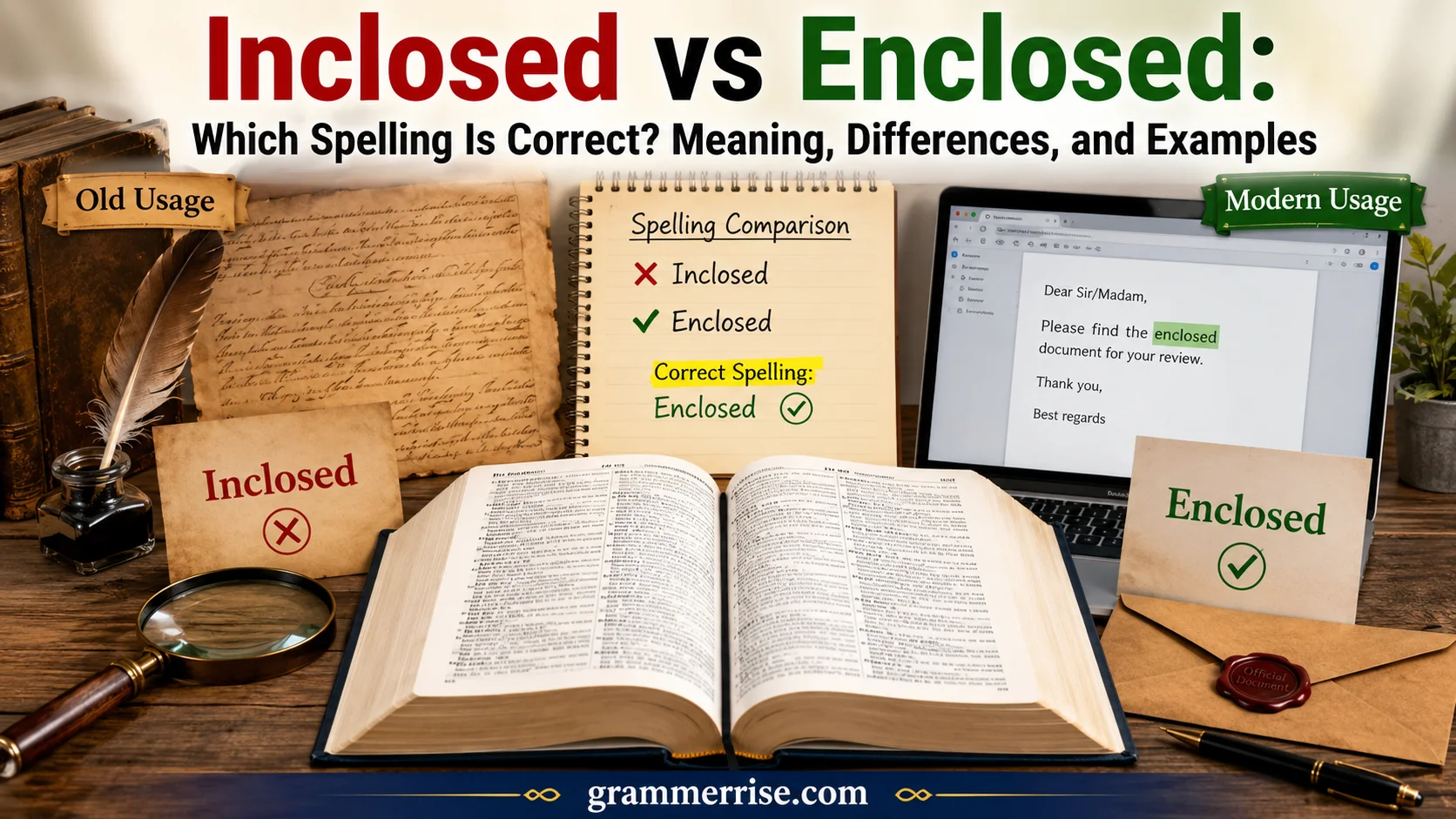
Understanding the Inclosed vs Enclosed difference helps writers avoid confusion because these similar terms have different usage in modern English. These words often create confusion because of their similar spelling, similar meanings, and links to older texts. This guide explains the meanings, differences, and proper usage of these terms in modern English using a simple and practical way. Many writers, students, and professionals wonder if inclosed is only an old spelling of enclosed, but selecting the wrong form can appear as a mistake in emails, formal documents, academic papers, and everyday communication.
The historical background reveals the key differences between these forms. Enclosed remains the correct form for most modern situations, while Inclose, inclosing, inclosure, and other variants are mainly found in historical origins, older literature, and poetic contexts. Research from English-language books, published essays between 1800 and 2000, and ngram graphs shows that enclosed became the preferred verb to insert, shut in, or surround items like an envelope, mailed package, or enclosure.
Practical Writing Tips for Choosing Enclosed
In practical writing, choosing the right word improves clarity, precision, and authority. I have learned that reviewing terms, usage, examples, and sources can prevent second-guessing and improve writing standards. When you enclose important details, legal papers, a small thing, or a big document, your message becomes more polished, credible, and professional. Enclosed is widely accepted in business, legal, and academic writing, while inclosed has faded into limited poetic and historical contexts.
Avoiding misspelling, understanding accepted variants, and following guides about the history of terms helps improve correspondence, including letters, essays, academic correspondence, workplace instructions, and technical documentation. The distinction is critical because misusing these words may create misunderstandings when context, frequency, and the purpose of communication differ. Correct usage examples show that the modern choice supports credible writing, polished writing, and modern writing without unnecessary confusion or common mistakes.
Inclosed vs Enclosed: The Quick Answer
The main difference between inclosed and enclosed is not their meaning. Both words describe something that is surrounded, contained, or included within something else.
The difference comes from modern usage and spelling preference.
| Word | Meaning | Modern Usage |
| Enclosed | Surrounded, contained, or included inside something | Common and recommended |
| Inclosed | Older spelling of enclosed | Rare and mostly historical |
If you are writing a business email, school assignment, article, legal document, or professional message, choose enclosed.
Examples:
✅ Correct modern usage:
Please find the enclosed document for your review.
The garden is enclosed by a wooden fence.
I have enclosed a copy of my application.
Older usage:
The letter inclosed a small note from the author.
The second example may appear in historical writing, but it sounds unusual to most modern readers.
What Does Enclosed Mean?
The word enclosed means something is surrounded, covered, or placed inside another object or area.
It comes from the verb enclose, which means “to close in” or “to surround.”
People use enclosed in many situations, including physical spaces, documents, packages, and written communication.
Common meanings of enclosed include:
- Something placed inside an envelope
- Something surrounded by walls, fences, or boundaries
- Something included with another item
- Something protected or separated from outside elements
For example:
The enclosed file contains the information you requested.
Here, enclosed means the file is included with the message.
Another example:
The animals stayed in an enclosed area for safety.
In this sentence, enclosed means the area has boundaries around it.
Common Uses of the Word Enclosed
The word enclosed appears frequently in everyday and professional writing.
Enclosed Documents
One of the most common uses appears in formal letters.
Example:
Please review the enclosed contract before signing.
This tells the reader that a contract has been included with the letter.
Enclosed Spaces
The word can also describe physical areas.
Examples:
- An enclosed balcony
- An enclosed parking area
- An enclosed garden
- An enclosed playground
These spaces have some type of barrier separating them from the outside.
Enclosed Packages
Businesses often use the term when shipping products or sending paperwork.
Example:
The enclosed receipt confirms your purchase.
The receipt exists inside the package or envelope.
What Does Inclosed Mean?
Inclosed is an older form of the word enclosed.
Although many people assume it is simply a spelling mistake, that is not entirely accurate. The word appeared in older English writing before spelling became more standardized.
English has changed significantly over hundreds of years. Many words once had multiple accepted spellings.
For example:
- Publick → Public
- Musick → Music
- Inclosed → Enclosed
As dictionaries, education systems, and publishing standards developed, some spellings became preferred while others faded away.
Today, inclosed survives mostly in historical contexts.
Where You Might See Inclosed
You may find inclosed in:
- Old letters
- Historical newspapers
- Antique books
- Genealogy records
- Archived government documents
- Classic literature
For example:
The author mentioned the papers inclosed with the original letter.
This sentence may appear in an old document, but a modern writer would usually replace it with:
The author mentioned the papers enclosed with the original letter.
Why Did English Change From Inclosed to Enclosed?
The shift from inclosed to enclosed happened gradually.
English spelling was not always fixed. Before modern dictionaries became popular, writers often spelled words based on pronunciation, regional habits, or personal preference.
Over time, English speakers began favoring enclosed because it connected more clearly with the word close.
The prefix en- means “to put into” or “to cause to be.”
Examples:
- Enlarge = make larger
- Enrich = make richer
- Enclose = close inside
The spelling became easier for readers to recognize and understand.
Evolution of Usage
| Time Period | Common Usage |
| Earlier English periods | Inclosed and enclosed both appeared |
| 1700s–1800s | Both existed, but enclosed gained popularity |
| 1900s | Enclosed became the standard form |
| Today | Enclosed is the accepted modern spelling |
Modern English values consistency. That is why enclosed appears in dictionaries, professional writing guides, and everyday communication.
Is Inclosed Incorrect?
The answer depends on the situation.
Technically, inclosed is not a completely incorrect word. It has historical roots and appears in older writing.
However, using it today can make your writing look outdated or unfamiliar.
Think of it like using an old-fashioned phrase. People may understand it, but it does not sound natural in modern conversation.
Use Enclosed When Writing:
- Emails
- Articles
- Reports
- Resumes
- Business letters
- School assignments
- Websites
- Marketing materials
Inclosed May Appear When:
- Studying historical documents
- Quoting old authors
- Researching language changes
- Analyzing classic literature
For almost every modern writing situation, enclosed is the better choice.
Enclosed vs Attached: Are They the Same?
Many people confuse enclosed and attached, especially when writing emails.
Although they can sometimes have similar meanings, they are not always interchangeable.
| Word | Meaning | Common Situation |
| Enclosed | Included inside something | Letters, envelopes, packages |
| Attached | Connected digitally or physically | Emails and files |
| Included | Added as part of something | General communication |
| Contained | Held inside something | Objects, spaces, information |
Examples:
Traditional letter:
I have enclosed the payment receipt.
Email:
I have attached the payment receipt.
The first sentence suggests a physical document inside a letter.
The second sentence suggests a digital file attached to an email.
Read more: Of Course or Ofcourse: Meaning, Rules and Examples
Is “Please Find Enclosed” Still Correct?
Yes, but it sounds formal.
The phrase “Please find enclosed” has been used in business writing for many years. It tells someone that a document is included.
Example:
Please find enclosed the completed application form.
This sentence is grammatically correct.
However, modern business communication often prefers simpler wording.
Instead of:
Please find enclosed the report.
You could write:
I have attached the report for your review.
or:
I’ve included the report below.
Modern writing often focuses on being direct and easy to understand.
Common Mistakes With Inclosed and Enclosed
Many writers make mistakes because the two spellings look nearly identical.
Mistake: Using Inclosed in Modern Professional Writing
A writer may use inclosed because it appears in an old book or document.
However, readers today usually expect enclosed.
Better:
The enclosed documents provide additional details.
Not:
The inclosed documents provide additional details.
Mistake: Thinking Enclosed Only Applies to Documents
Some people believe enclosed only refers to papers inside envelopes.
That is incorrect.
You can describe:
- Enclosed spaces
- Enclosed gardens
- Enclosed areas
- Enclosed structures
- Enclosed information
Mistake: Using Enclosed When Attached Is More Natural
In email communication, “attached” often sounds better.
Example:
Less natural:
Please see the enclosed file.
Better:
Please see the attached file.
Enclosed Grammar Rules and Usage
The word enclosed works mainly as an adjective or a past participle.
Enclosed as an Adjective
It describes something surrounded or included.
Examples:
The enclosed room has no windows.
The enclosed instructions explain how to install the product.
Enclosed as a Verb Form
It can also show an action that happened.
Example:
I enclosed a copy of my identification documents.
Here, “enclosed” means “included.”
Sentence Placement Examples
Beginning:
Enclosed with this letter is your membership card.
Middle:
The enclosed information explains the next steps.
End:
Please review the documents enclosed.
Words Related to Enclosed
Several words have similar meanings, but they are not always identical.
| Word | Meaning | Example |
| Enclosed | Surrounded or included | The enclosed letter contains details |
| Included | Added as part of something | Breakfast is included |
| Attached | Connected to another item | The file is attached |
| Inserted | Put inside something | The card was inserted into the envelope |
| Contained | Held within boundaries | The box contained tools |
Choosing the right word improves clarity.
Inclosed vs Enclosed in American English
American English strongly favors enclosed.
Major dictionaries and modern writing standards recognize enclosed as the normal spelling.
The word inclosed may still appear in American historical documents, but most readers consider it old-fashioned.
For modern American audiences:
- Use enclosed for formal writing.
- Use attached for email files.
- Use included for general information.
Real-World Examples of Enclosed Used Correctly
Business Example
Dear Customer,
Please review the enclosed warranty information included with your purchase.
The company uses enclosed because the information comes with a physical product.
Legal Example
The enclosed agreement outlines the terms and conditions.
Legal professionals commonly use enclosed when referring to included documents.
Personal Example
I have enclosed a birthday card with a small gift.
The card exists inside the package.
Construction Example
The building features an enclosed parking area.
Here, enclosed describes a physical structure.
Should You Ever Use Inclosed Today?
For most writers, the answer is no.
There is rarely a reason to choose inclosed in modern communication.
However, language researchers and historians may use it when discussing older texts.
Appropriate Uses:
- Academic research about historical English
- Reproducing original documents
- Studying old spelling patterns
Avoid Using It For:
- Blog posts
- Emails
- Business documents
- School work
- Professional communication
Using enclosed keeps your writing natural and current.
Easy Way to Remember the Difference
A simple memory trick:
Enclosed = English today
The letter E in enclosed can remind you that it is the everyday modern spelling.
If you are unsure, choose enclosed.
It works in almost every modern situation.
Frequently Asked Questions About Inclosed vs Enclosed
1. Is “inclosed” a correct spelling in English?
Yes, inclosed is a real word, but it is considered an old-fashioned or archaic variant of enclosed. It appeared more often in older books, historical documents, and some forms of literature. In modern English writing, enclosed is the preferred and widely accepted spelling.
2. What is the main difference between inclosed and enclosed?
The main difference is their usage and popularity. Both words can mean something is surrounded, contained, or included, but enclosed is commonly used today in emails, business letters, legal documents, and academic writing. Inclosed has mostly disappeared from everyday communication and is usually found in historical or poetic contexts.
3. Should I use “enclosed” in a formal letter or email?
Yes, you should use enclosed in formal communication. For example, you can write, “Please find the enclosed document” when attaching papers or information. Using inclosed may make your writing seem outdated or unfamiliar to modern readers.
4. Why do people confuse inclosed and enclosed?
People often confuse these words because they have similar spelling, similar meanings, and the same historical connection. Many readers see “inclosed” in older texts and assume it is another modern spelling option, but English usage has changed over time, making enclosed the standard choice.
5. Is “inclose” still used anywhere today?
Inclose is rarely used in modern English. You may still find it in old literature, historical records, or texts that preserve older language styles. Most writers today choose enclose, enclosed, or enclosure because these forms are clearer and more familiar.
6. How can I remember whether to use inclosed or enclosed?
A simple way to remember is to choose enclosed for almost all modern writing situations. Whether you are writing an email, report, essay, or business letter, enclosed is the safer and more professional option. Use inclosed only when discussing historical language or quoting older sources.
Conclusion
Understanding the difference between inclosed vs enclosed helps you make better choices in modern English writing. Although both words share similar meanings and were once used in similar ways, their usage has changed over time. Enclosed is now the accepted and preferred form for everyday communication, including emails, business letters, legal documents, and academic writing.
While inclosed is not completely incorrect, it belongs mostly to older literature, historical records, and poetic writing. Choosing the right word improves the clarity, professionalism, and credibility of your message. When you write today, using enclosed will help your readers understand your meaning without confusion. By learning these small language differences, you can avoid common mistakes and create writing that feels accurate, polished, and modern.

Hussain Abid is an English language writer with over 10 years of experience in grammar, spelling, vocabulary, and writing. He specializes in creating clear, well-researched content that helps readers improve their English with confidence. At GrammarRise, Hussain writes practical guides, grammar explanations, and word comparison articles based on trusted language sources and real-world usage. His mission is to make English learning simple, accurate, and accessible for everyone