Of Course or Ofcourse difference often confuses English learners but the correct phrase is of course, not ofcourse, in standard English writing today. Many English learners, native speakers, and native writers experience confusion when making a comparison between of course and ofcourse. This article explains the simple truth that of course is the correct phrase, while ofcourse is the wrong form and a common spelling mistake.
From my experience helping people improve their English writing skills, I have noticed this common error in professional email, exam, business content, online writing, and digital content.
This small spelling choice may seem like a small detail, but it matters because accuracy, clarity, and professional credibility depend on the right spelling. The correct spelling follows standard English, written English, and language standards. This guide breaks down the issue, clears up the confusion, and shows when, how, and why to use the right one with confidence.
The answer comes from grammar, grammar knowledge, language rules, spelling rules, and word usage because of course is a fixed phrase made of separate words, not a single word combination.The phrase of course has a solid history in the English language, and its phrase history reflects normal linguistic usage in spoken English, everyday conversations, emails, and formal writing.
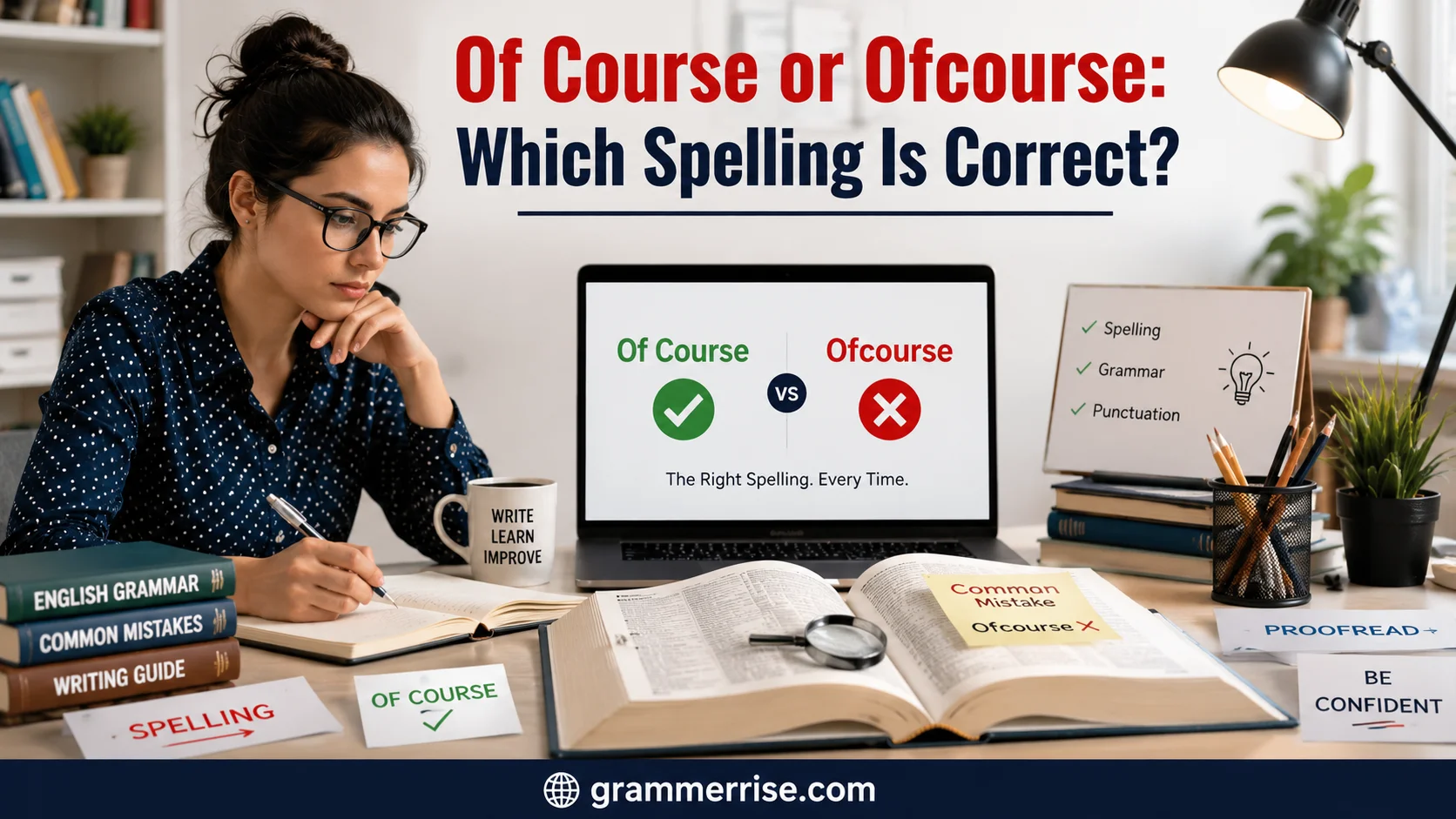
Of Course or Ofcourse: Which Spelling Is Correct?
The correct spelling is:
✅ Of course
The incorrect spelling is:
❌ Ofcourse
The phrase “of course” consists of two separate words that work together to express certainty, agreement, or something obvious.
Examples:
- Of course, I can help you with your project.
- She will attend the event, of course.
- “Do you want some coffee?” “Of course!”
The word “ofcourse” does not appear as an accepted standard English word in major dictionaries. Although many people write it this way because the phrase sounds connected when spoken, correct English keeps the two words separate.
| Spelling | Correct or Incorrect | Explanation |
| Of course | ✅ Correct | Standard English phrase |
| Ofcourse | ❌ Incorrect | Not recognized as a standard English word |
| Of-course | ❌ Incorrect | Hyphen is unnecessary |
What Does “Of Course” Mean?
The phrase “of course” has several meanings depending on the situation. Most often, it expresses certainty or agreement.
“Of Course” Means Certainly
When you say “of course,” you often mean “certainly” or “definitely.”
Examples:
- “Can you help me move this table?”
- “Of course, I can help.”
Here, the speaker shows willingness and confidence.
Another example:
- “Will you remember my birthday?”
- “Of course!”
The phrase shows that the answer feels obvious.
“Of Course” Means Naturally or Obviously
Sometimes, people use “of course” when something is expected or logical.
Examples:
- Of course, plants need water to survive.
- She was tired after running a marathon, of course.
In these examples, the speaker suggests that the information is natural or expected.
“Of Course” as a Polite Response
In everyday conversations, “of course” can make your response sound friendly and helpful.
Compare these two responses:
Without “of course”:
- “Yes, I can send the file.”
With “of course”:
- “Of course, I can send the file.”
The second version sounds warmer and more welcoming.
Why Do People Write “Ofcourse” Instead of “Of Course”?
The confusion happens because spoken English often combines sounds.
When people say “of course” quickly, the words blend together. Your brain hears one smooth sound, which can make it feel like one word.
This happens with many English phrases.
For example:
- A lot → Often written incorrectly as “alot”
- At least → Sometimes written incorrectly as “atleast”
- Of course → Sometimes written incorrectly as “ofcourse”
However, pronunciation does not always determine spelling. English contains many phrases that sound connected but remain separate in writing.
The Grammar Behind “Of Course”
Understanding how the phrase works can help you remember the spelling.
The phrase contains two words:
| Word | Type | Function |
| Of | Preposition | Shows relationship or connection |
| Course | Noun | Refers to a path, direction, or sequence |
The two words have their own meanings, so English keeps them separate.
Think of it like a team. The words work together, but each player still has a separate identity.
How to Remember “Of Course” Correctly
A simple memory trick can prevent this common mistake.
Remember:
Of + Course = Of Course
The phrase is made from two normal English words.
Another useful trick is replacing the phrase with a similar word.
Example:
- Of course, I will attend.
- Certainly, I will attend.
Since “certainly” replaces the entire phrase, you know “of course” is functioning as a phrase rather than one word.
How to Use “Of Course” in a Sentence
The phrase “of course” can appear at the beginning, middle, or end of a sentence.
Using “Of Course” at the Beginning
When it starts a sentence, it usually introduces agreement or confidence.
Examples:
- Of course, you can borrow my laptop.
- Of course, learning a new language takes time.
- Of course, everyone wants to succeed.
A comma often follows “of course” when it begins a sentence because it separates the introductory phrase from the main statement.
Using “Of Course” in the Middle
The phrase can add extra information inside a sentence.
Examples:
- The solution is, of course, more complicated than it looks.
- She is, of course, one of the best players on the team.
Here, removing “of course” does not change the basic meaning of the sentence. It simply adds emphasis.
Using “Of Course” at the End
You can also place it at the end to emphasize that something is obvious.
Examples:
- He knew the answer, of course.
- You can join us anytime, of course.
This placement often creates a conversational tone.
Common Mistakes With “Of Course”
Many spelling mistakes happen because people rely on sound instead of grammar.
Writing “Ofcourse” as One Word
Incorrect:
Ofcourse I understand your point.
Correct:
Of course I understand your point.
The correct version separates the two words.
Adding a Hyphen
Incorrect:
Of-course I agree.
Correct:
Of course I agree.
The phrase does not need a hyphen.
Using Incorrect Capitalization
Incorrect:
Of Course, I will help.
Correct:
Of course, I will help.
Unless it appears in a title, only the first word should normally be capitalized.
Of Course vs Similar Words
Many English expressions have similar meanings, but they create slightly different tones.
| Phrase | Meaning | Tone |
| Of course | Certainly; naturally | Friendly and common |
| Certainly | Definitely | Slightly more formal |
| Absolutely | Strong agreement | Enthusiastic |
| Sure | Yes | Casual |
Examples:
Friendly:
- Of course, I’ll help you.
Formal:
- Certainly, we can arrange a meeting.
Enthusiastic:
- Absolutely! That sounds amazing.
Of Course vs Ofcourse: Examples in Real Situations
Workplace Example
Incorrect:
Ofcourse, I will complete the report today.
Correct:
Of course, I will complete the report today.
Professional communication requires accurate spelling because small errors can affect how readers view your attention to detail.
Academic Writing Example
Correct:
The results were, of course, influenced by several factors.
Academic writing often uses the phrase when discussing something expected or logical.
Everyday Conversation Example
Correct:
“Can you watch my dog this weekend?”
“Of course!”
The phrase sounds natural because it shows kindness and agreement.
Read More: Challenge or Challange: Correct Spelling, Meaning and Examples
Interesting Facts About “Of Course”
- “Of course” has remained a two-word phrase throughout modern English usage.
- The phrase appears frequently in conversations because it quickly expresses agreement.
- Many spelling errors happen because English pronunciation changes faster than spelling rules.
- Similar mistakes happen with other phrases that sound like single words.
Why Correct Spelling Matters
Some people think small spelling mistakes do not matter. However, spelling affects communication.
Correct spelling helps you:
- Build credibility
- Communicate clearly
- Appear professional
- Avoid misunderstandings
- Create better content
Imagine reading a business email filled with spelling mistakes. Even if the message is understandable, readers may question the writer’s attention to detail.
Good writing is built from small choices.
Quick Guide: Of Course or Ofcourse
| Question | Answer |
| Is “ofcourse” correct? | No |
| What is the correct spelling? | Of course |
| Is “of course” one word? | No |
| Can “of course” start a sentence? | Yes |
| Does “of course” need a hyphen? | No |
| What does “of course” mean? | Certainly, naturally, or obviously |
FAQs
1. Is “of course” or “ofcourse” the correct spelling?
Of course is the correct spelling in English. It is written as two separate words because it is a fixed phrase. Ofcourse is considered an incorrect spelling and should be avoided in formal and informal writing.
2. Why do people write “ofcourse” instead of “of course”?
Many people write ofcourse because they pronounce the phrase quickly and it sounds like one word when spoken. Fast typing, casual messages, and social media conversations can also lead to this common spelling mistake.
3. What does “of course” mean?
Of course is a phrase used to show certainty, agreement, permission, or politeness. It can mean “certainly,” “yes,” or “naturally” depending on the context of the sentence.
4. Can I use “of course” in professional writing?
Yes, of course is suitable for professional emails, business content, academic writing, and formal communication. Using the correct phrase helps maintain accuracy and shows strong language skills.
5. Is “ofcourse” accepted in any English dictionary?
No, ofcourse is not accepted as a standard English spelling. Reliable dictionaries and grammar guides recognize only of course as the correct form.
6. How can I remember the difference between “of course” and “ofcourse”?
A simple way to remember is that of course contains two separate words, just like other phrases made with “of.” Whenever you write it, check that both words appear separately before sending your message or publishing your content.
Conclusion
Understanding the difference between of course or ofcourse is a small but important part of improving your English writing. While both forms may look similar, only of course is the correct phrase accepted in standard English. The incorrect form ofcourse usually appears because of fast typing, casual communication, or the way people pronounce the phrase in everyday conversations.
Using the right spelling helps your writing look more professional, clear, and accurate. Whether you are writing an email, completing an exam, creating online content, or having a conversation, choosing of course shows attention to proper grammar and language rules. Once you remember that the phrase contains two separate words, avoiding this common mistake becomes simple.

Hussain Abid is an English language writer with over 10 years of experience in grammar, spelling, vocabulary, and writing. He specializes in creating clear, well-researched content that helps readers improve their English with confidence. At GrammarRise, Hussain writes practical guides, grammar explanations, and word comparison articles based on trusted language sources and real-world usage. His mission is to make English learning simple, accurate, and accessible for everyone