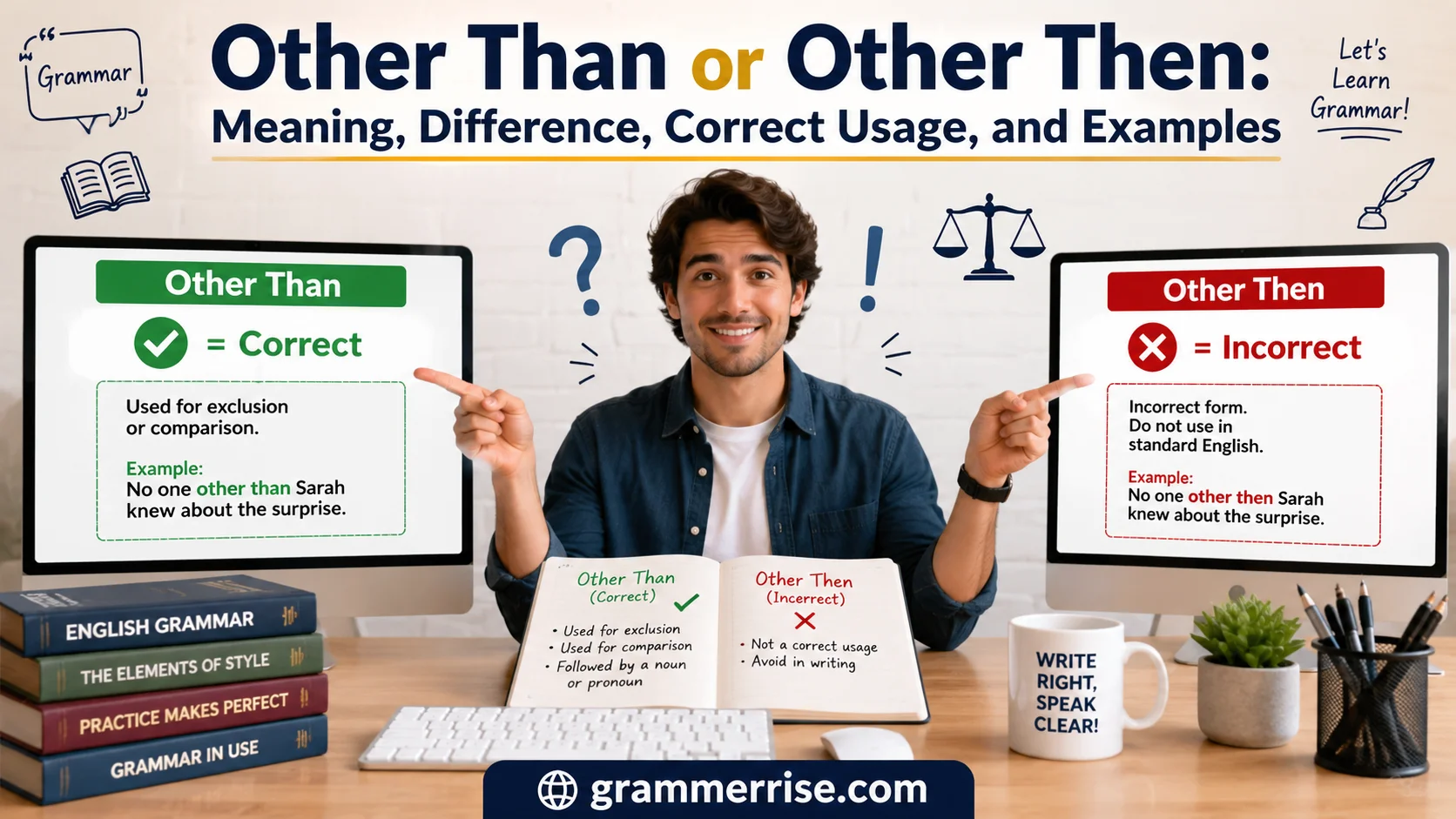
Other Than or Other Then creates confusion because than shows comparison, while then relates to time, sequence, or consequence in English grammar.
The main grammar concepts are simple because than focuses on comparison, while then connects with time, sequence, and consequence. The phrase other than works as a comparison phrase and exclusion phrase because it can show something is different from or excluded from another thing. On the other hand, other then combines words differently, changing the word meaning and making the phrase grammatically incorrect in most situations.
Learning these easy rules, simple grammar rules, and real-life examples improves sentence structure, sentence clarity, and correctness. Better proofreading, error detection, correction, and writing accuracy help create stronger academic writing, professional documents, and online content where editors, teachers, and Google content systems may notice mistakes. This language learning approach builds grammar knowledge, vocabulary, word choice, phrase choice, and effective writing skills.
Other Than or Other Then: Quick Difference Explained
The easiest way to separate these two expressions is to look at what they do in a sentence.
| Phrase | Meaning | Correct Use | Example |
| Other than | Except, besides, different from | Used when excluding or comparing something | Nobody other than Sarah knew the answer. |
| Other then | Other + then used separately | Rarely appears when “then” refers to time or order | There was no other option then available. |
Here is the simple rule:
Use “other than” when you mean “except for.”
Use “then” when you are talking about time, order, or what happens next.
For example:
Other than pizza, what would you like to eat?
This means:
Except for pizza, what else would you like?
However:
I had no other option then.
Here, then refers to that specific moment in the past.
What Does “Other Than” Mean?
The phrase other than is one of the most common expressions in English. It works as a preposition and helps you explain exceptions, alternatives, or differences.
You can think of other than as a small bridge connecting one thing to everything outside that thing.
For example:
Everyone attended other than Mark.
The phrase removes Mark from the group.
The meaning is:
Everyone attended except Mark.
Other Than Meaning “Except”
The most common use of other than is to show an exception.
Examples:
- Nobody other than the manager can approve this request.
- I don’t eat anything other than vegetables.
- She has no hobbies other than painting.
- Nothing other than patience can solve this problem.
In each example, other than creates a boundary. It tells the reader what is excluded.
Other Than Meaning “Besides”
Sometimes other than means “in addition to.”
Examples:
- Do you need anything other than coffee?
- What other than experience can prepare someone for leadership?
- He studies subjects other than mathematics.
Here, the phrase asks about additional things.
Other Than Meaning “Different From”
The phrase can also show that something is not the same as another thing.
Examples:
- His opinion was completely other than mine.
- The result was other than what we expected.
- This version is other than the original design.
This usage appears less often in casual conversation, but it remains grammatically correct.
Why Is “Other Than” Used So Often?
English speakers use other than because it is flexible. It works in simple conversations and formal writing.
You will find it in:
- Business emails.
- Research papers.
- News articles.
- Everyday conversations.
- Instructions and guidelines.
For example:
Professional writing:
No department other than accounting can access these records.
Casual conversation:
Is there anything other than pizza you want for dinner?
The structure stays the same even though the situation changes.
What Does “Other Then” Mean?
Unlike other than, the phrase other then is not normally used as a fixed expression.
Instead, it is simply two separate words placed together:
- Other = different or additional.
- Then = at that time, next, or as a result.
Because of this, other then only makes sense when the sentence naturally requires both words.
For example:
There was no other option then available.
Here:
- Other = different option.
- Then = at that time.
The words are not working together as a phrase. They simply happen to appear beside each other.
However, many sentences that use “other then” are actually spelling mistakes.
Incorrect:
I have nothing other then my laptop.
Correct:
I have nothing other than my laptop.
The first sentence tries to express “except for,” so it needs than.
Other Than vs Other Then: Key Differences
The difference becomes clearer when you compare their roles.
| Feature | Other Than | Other Then |
| Common phrase | Yes | No |
| Meaning | Except, besides, different from | Other thing + time reference |
| Grammar function | Fixed expression | Two separate words |
| Frequency | Very common | Very rare |
| Main use | Excluding or comparing | Referring to another time |
A useful test is to replace the phrase with “except for.”
Example:
Nobody other than John helped me.
Replace it:
Nobody except for John helped me.
The meaning stays the same.
That means other than is correct.
Now try:
Nobody other then John helped me.
The sentence does not make sense because “then” does not show time.
Than vs Then: Understanding the Real Difference
Many mistakes with other than or other then happen because people confuse than and then.
Although they differ by only one letter, they serve completely different purposes.
When to Use Than
Use than when making comparisons.
Examples:
- My car is faster than yours.
- This book is better than the last one.
- She is taller than her brother.
A simple memory trick:
Than = comparison
Look for words like:
- Better
- Worse
- More
- Less
- Bigger
- Smaller
- Faster
These often require than.
When to Use Then
Use then when talking about time, order, or results.
Examples:
Time
I lived in Chicago then.
Meaning:
I lived in Chicago at that time.
Sequence
Finish your homework, then watch television.
Meaning:
First homework. After that, television.
Result
If you practice, then you will improve.
Meaning:
Practice leads to improvement.
Memory trick:
Then = Time or Next
How to Remember Other Than vs Other Then Easily
Small tricks can make confusing words easier.
Memory Trick: Than Compares
Think about comparison words:
- More than
- Less than
- Better than
If the sentence compares something, use than.
Example:
This option is better than the previous one.
Memory Trick: Then Follows Time
Think:
- First this.
- Then that.
Example:
We ate dinner, then we watched a movie.
The “Except For” Test
This is one of the best methods.
If replacing the phrase with except for works, choose other than.
Example:
Nobody other than Lisa attended.
Replacement:
Nobody except Lisa attended.
Correct.
Common Mistakes With Other Than and Other Then
Even though the rule is simple, these mistakes appear frequently.
Mistake: Writing Other Then Instead of Other Than
Incorrect:
I have no choice other then waiting.
Correct:
I have no choice other than waiting.
Why?
The sentence means:
I have no choice except waiting.
It does not describe a time or event.
Mistake: Using Then in Comparisons
Incorrect:
This phone is cheaper then that one.
Correct:
This phone is cheaper than that one.
The sentence compares two phones, so it needs than.
Mistake: Using Than for Time
Incorrect:
We finished dinner and than went home.
Correct:
We finished dinner and then went home.
The sentence describes what happened next.
Other Than Grammar Rules and Sentence Examples
Understanding sentence patterns makes correct usage much easier.
Other Than + Noun
Examples:
- Nobody other than Alex knows the truth.
- I need something other than sugar.
- No animal other than birds can fly like this.
Other Than + Verb
Examples:
- I have nothing to do other than wait.
- She enjoys activities other than reading.
- He does nothing other than complain.
Other Than in Negative Sentences
This structure appears often:
- Nothing other than…
- Nobody other than…
- No one other than…
Examples:
Nothing other than hard work creates success.
Nobody other than the owner can make changes.
These sentences emphasize that only one option exists.
Other Than vs Except vs Besides
These words overlap, but they are not always interchangeable.
| Word | Meaning | Example |
| Other than | Except or different from | I like all sports other than boxing. |
| Except | Excludes something | Everyone came except John. |
| Besides | In addition to | Besides English, she speaks French. |
When to Use Other Than
Use it when you want a natural way to exclude something.
Example:
I don’t drink anything other than water.
When to Use Except
Use it when the exclusion is direct.
Example:
Everyone passed except Tom.
When to Use Besides
Use it when adding information.
Example:
Besides writing, she enjoys photography.
Other Than or Other Then in Formal Writing
Correct word choice matters even more in professional settings.
A small mistake in a report, email, or article can affect credibility.
Academic Writing
Students often use other than when discussing exceptions.
Example:
No evidence other than these results supports the theory.
Business Communication
Professionals use the phrase to clarify limitations.
Example:
No employee other than authorized staff can access this information.
Online Content
Blog posts, websites, and articles need accurate grammar because readers notice mistakes.
Clear writing builds trust.
Read More: Privilege or Priviledge: Which Spelling Is Correct and Meaning?
Real-Life Examples of Other Than
Workplace Examples
- No employee other than the supervisor can approve expenses.
- The company offers benefits other than salary increases.
School Examples
- She studies subjects other than science.
- Nobody other than the teacher understood the question.
Daily Conversation Examples
- Do you want anything other than tea?
- I have no plans other than relaxing today.
Shopping Examples
- Do you have a color other than black?
- Is there another size other than medium?
Quick Reference: Other Than or Other Then
| Question | Answer |
| Which phrase is usually correct? | Other than |
| What does other than mean? | Except, besides, different from |
| Is other then a common phrase? | No |
| When do you use then? | Time, order, results |
| When do you use than? | Comparisons |
Frequently Asked Questions About Other Than or Other Then
1. Is “other than” the correct phrase to use?
Yes, other than is the correct phrase in English. It is used when talking about something different from, excluding something, or making a comparison. For example, “I do not eat anything other than vegetables” means vegetables are the only thing included.
2. Why do people confuse “other than” and “other then”?
People often confuse these phrases because than and then sound very similar when spoken. However, they have different meanings. Than is related to comparison, while then usually refers to time, order, or sequence.
3. Is “other then” ever grammatically correct?
In normal English writing, other then is considered incorrect. The word then does not work with “other” to create the meaning people usually intend. In most cases, replacing it with other than will fix the sentence.
4. How can I remember the difference between than and then?
A simple memory trick is to connect than with comparison words like “more than” or “less than.” Remember that then is connected with time or events, such as “first this happened, then that happened.”
5. Can using “other then” affect professional writing?
Yes, using other then instead of other than can make writing appear less accurate. In emails, academic assignments, articles, and professional documents, correct grammar helps maintain clarity and credibility.
6. What is an easy example showing the difference?
A sentence like “Everyone came other than John” means John was excluded. A sentence using “then” would discuss timing, such as “I finished my work, then I went home.” These examples show that the two words have separate roles.
Conclusion
Understanding the difference between other than or other then makes English writing clearer and more accurate. Although these phrases look almost identical, their meanings and functions are completely different. Other than is the correct phrase used for comparison and exclusion, while other then is usually a grammar mistake caused by mixing up than and then.
By remembering that than connects with comparison and then connects with time or sequence, you can quickly avoid this common error. Whether you are writing emails, assignments, professional documents, or online content, choosing the right phrase improves your grammar accuracy, strengthens your communication, and helps your writing appear more polished and professional.