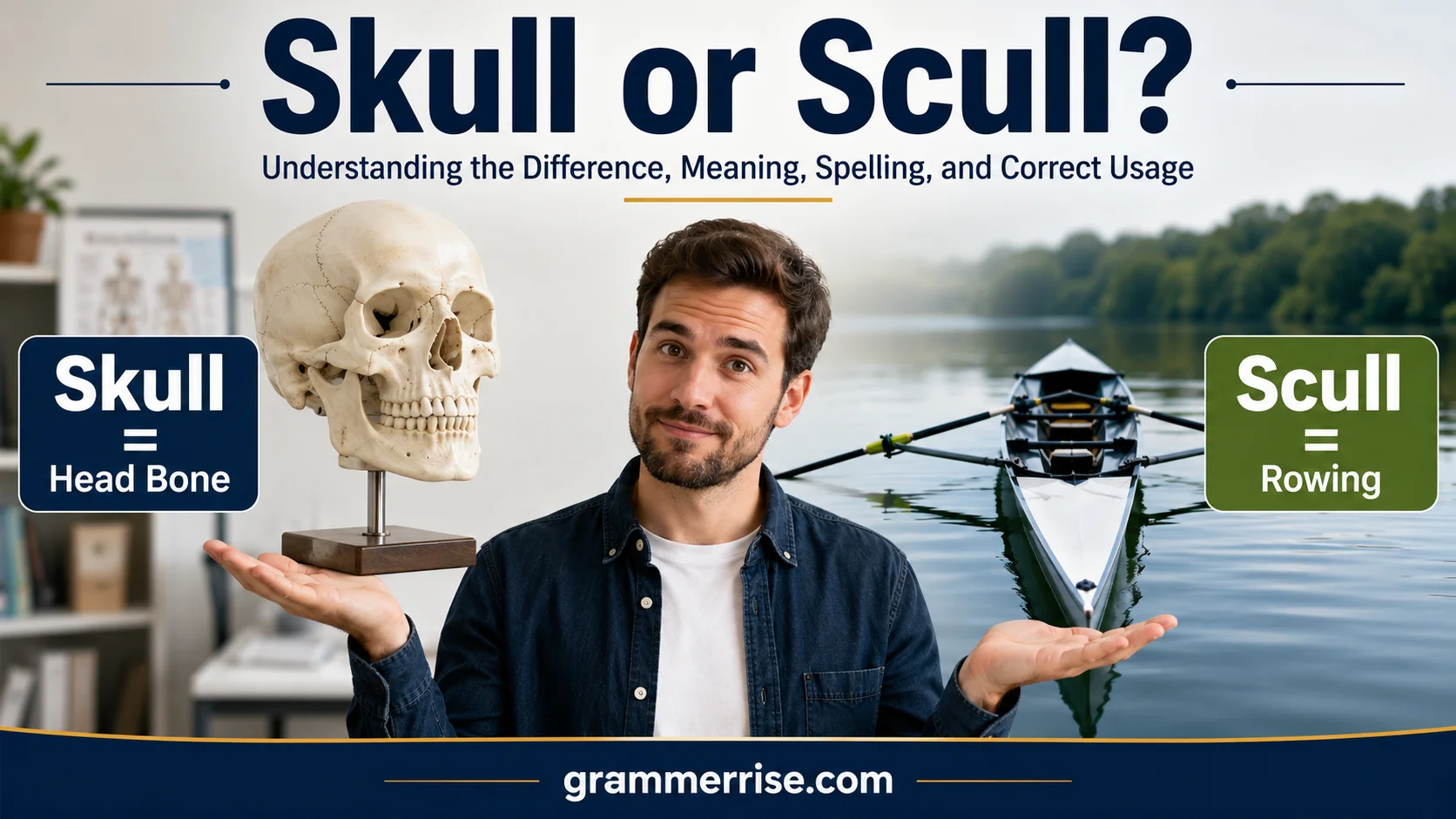
The topic Skull or Scull helps English learners and native speakers understand why these similar words create confusion in spelling and usage. Many people notice that skull and scull have matching spelling patterns and sound almost the same, but their meanings are completely different. The skull refers to a bony structure of the human body, connected with human anatomy, bone, and bones forming the head. In contrast, scull relates to boating, rowing, an oar, and a single oar movement. These terms appear in different contexts such as anatomy, archaeology, symbolism, sports, and literature, which makes correct usage important.
From my experience learning and explaining language, I have found that this tricky word choice issue affects communication skills, written communication, professional writing, and academic writing. A clear guide with definitions, examples, explanation, and comparison helps readers remember the origins, history, and pronunciation of both words. I first encountered scull through rowing activities, where verbs like row and nouns like oars are common, while skull describes an anatomical structure. Understanding these differences, types, and word meanings improves clarity, clear writing, and accuracy, while reducing common mistakes, errors, and miscommunication in academic papers, workplace reports, and casual writing.
Skull or Scull: Quick Difference Explained
The easiest way to understand skull or scull is to remember what each word represents.
| Word | Meaning | Field | Example |
| Skull | The framework of bones that protects the brain and forms the head | Anatomy, medicine, biology | The helmet protected his skull during the crash. |
| Scull | A rowing oar, a small rowing boat, or the act of rowing with two oars | Sports, boating | She learned how to scull on the lake. |
The key difference is simple:
A skull protects your brain. A scull helps you move through water.
Although these words look almost identical, the single letter difference changes everything.
The k in skull connects the word to the human body. The c in scull connects it to rowing and water activities.
What Does Skull Mean?
The word skull refers to the hard bone structure that forms the head and protects the brain. It is one of the most important parts of the human skeletal system.
Your skull works like a natural helmet. It surrounds and protects the brain from physical damage while also supporting important facial structures.
The human skull contains 22 bones in total:
| zSkull Section | Number of Bones | Main Function |
| Cranial bones | 8 | Protect the brain |
| Facial bones | 14 | Support facial structure and features |
The skull does much more than simply protect the brain. It provides attachment points for muscles, supports the eyes and nose, and helps form the shape of the face.
The Anatomy of the Human Skull
The human skull has two major sections:
The Cranium
The cranium is the upper portion of the skull that surrounds the brain.
Its main purpose is protection. The brain is extremely delicate, so the thick bones of the cranium create a strong barrier against injuries.
The eight cranial bones include:
- Frontal bone
- Two parietal bones
- Two temporal bones
- Occipital bone
- Sphenoid bone
- Ethmoid bone
Each bone connects with others through special joints called sutures. These joints are strong but allow the skull to grow during childhood.
The Facial Skeleton
The facial skeleton forms the front part of the skull. It creates the structure of your face and supports several important organs.
The facial bones include:
- Jawbone (mandible)
- Upper jaw (maxilla)
- Cheekbones (zygomatic bones)
- Nasal bones
- Eye socket bones
Together, these bones allow humans to speak, chew, breathe, and express emotions.
Why Is the Skull Important?
The skull performs several critical functions.
Protects the Brain
The brain controls everything from movement and memory to emotions and decision-making. The skull protects this essential organ from outside forces.
For example, when someone falls while riding a bicycle, a helmet reduces the impact reaching the skull. The skull then provides another protective layer for the brain.
Supports the Face
Without the skull, facial features would not have their structure. The bones create the foundation for:
- Eyes
- Nose
- Mouth
- Teeth
- Facial muscles
Helps With Sensory Functions
The skull contains spaces that protect important sensory organs.
Examples include:
- Eye sockets that protect the eyes.
- Nasal structures that support breathing and smell.
- Ear structures involved in hearing and balance.
Skull Meaning in Medicine and Science
In medical language, skull appears frequently because doctors and researchers study head injuries, diseases, and brain protection.
Common medical terms include:
| Term | Meaning |
| Skull fracture | A break or crack in one or more skull bones |
| Skull scan | Imaging used to examine skull structures |
| Skull base | The lower area where the skull connects with the spine |
| Skull injury | Damage affecting skull bones |
A skull fracture does not always mean the same thing as a brain injury. However, because the skull protects the brain, doctors carefully evaluate skull damage after accidents.
Skull Symbolism and Cultural Meaning
Beyond science, the skull carries many symbolic meanings around the world.
Different cultures use skull imagery to represent:
- Mortality
- Strength
- Protection
- Rebirth
- Change
- Mystery
For example, the skull is an important symbol during Día de los Muertos (Day of the Dead) celebrations in Mexico, where decorated skull designs represent remembrance and honoring loved ones.
In modern culture, skull designs also appear in:
- Fashion
- Jewelry
- Tattoos
- Artwork
- Logos
The meaning depends heavily on the context.
A skull in a medical textbook represents anatomy. A skull on clothing might represent style, rebellion, or artistic expression.
What Does Scull Mean?
The word scull has a completely different meaning from skull.
A scull is connected to rowing. It can describe:
- A type of rowing oar.
- A small rowing boat.
- The activity of rowing with two oars.
Unlike a skull, which relates to the body, a scull belongs to the world of water sports.
Scull as a Rowing Oar
In rowing, a scull is a lightweight oar designed for a specific rowing technique.
When a person sculls, they hold one oar in each hand. Each oar moves independently, allowing the rower to control direction and speed.
This differs from sweep rowing, where one person uses only one long oar.
Sculling vs Sweep Rowing
| Feature | Sculling | Sweep Rowing |
| Number of oars | Two per rower | One per rower |
| Control | One oar in each hand | Both hands control one oar |
| Common events | Single, double, and quadruple sculls | Eight-person boats and sweep events |
| Technique | Balanced and symmetrical | Requires teamwork and timing |
Sculling requires coordination, balance, and strong technique.
Scull as a Boat
The word scull can also describe a small rowing boat.
A single scull is a narrow boat designed for one person. Competitive rowers often use these boats during races.
Common types include:
- Single scull: One rower.
- Double scull: Two rowers.
- Quadruple scull: Four rowers.
These boats are designed for speed and efficiency.
The History and Origin of Skull
The word skull has a long linguistic history.
It developed from older Germanic languages and has been associated with the human head for centuries. Similar words appeared in languages connected to early English, showing how the term evolved over time.
The concept behind the word remained consistent: the protective structure surrounding the brain.
Ancient civilizations studied skulls to understand human anatomy. Archaeologists and scientists still examine skulls today to learn about:
- Human evolution
- Ancient populations
- Health conditions
- Lifestyle patterns
A skull can reveal information about a person who lived thousands of years ago.
The History and Origin of Scull
The word scull developed from traditions surrounding rowing and water travel.
Before modern transportation existed, people relied on boats and oars for fishing, trade, and exploration. Rowing techniques became more advanced over time, eventually developing into organized sports.
Today, sculling is a recognized competitive sport worldwide.
Rowing events featuring sculls appear in major international competitions, including the Olympic Games.
Skull vs Scull Pronunciation: Why Do They Sound the Same?
One reason people confuse these words is pronunciation.
Both words are pronounced:
/skʌl/
They sound identical when spoken.
This happens because English contains many homophones. Homophones are words that have the same pronunciation but different meanings and spellings.
Examples include:
| Word Pair | Difference |
| Sea / See | Water vs using your eyes |
| Right / Write | Correct vs creating words |
| Pair / Pear | Two items vs a fruit |
| Skull / Scull | Head bone vs rowing equipment |
The pronunciation alone cannot tell you which spelling to choose. You must look at the meaning and context.
How to Remember the Difference Between Skull and Scull
Remembering skull or scull becomes much easier when you connect each spelling with a clear image or idea.
A simple memory trick can prevent mistakes:
Skull has a “K” because it connects with your head and your cranium.
Think:
K = Kranium = Skull
Although “kranium” is not the standard spelling of the anatomical term, the unusual K connection helps your brain remember that skull belongs to the body.
For scull, think about water:
Scull = Sailing, rowing, and sports
The letter C can remind you of:
- Canoes
- Competition
- Crew rowing
These associations make it easier to choose the correct word when writing.
A Quick Visual Method
Imagine two different scenes:
Scene 1: Skull
You see:
- A human head.
- A doctor examining an X-ray.
- A helmet protecting someone during a bike ride.
The correct word is skull.
Scene 2: Scull
You see:
- A boat moving across calm water.
- A rower holding two oars.
- An athlete preparing for a race.
The correct word is scull.
When you connect words with pictures, your memory stores meaning instead of just spelling.
Common Mistakes When Using Skull and Scull
Even experienced writers sometimes confuse skull vs scull because the pronunciation gives no clue. The mistake usually happens when someone remembers the sound but forgets the meaning.
Here are the most common errors.
Mistake: Using Scull for the Human Head Bone
Incorrect:
The accident caused damage to his scull.
This sentence changes the meaning completely. A scull has nothing to do with the bones protecting the brain.
Correct:
The accident caused damage to his skull.
The sentence now clearly refers to a head injury.
Mistake: Using Skull for Rowing
Incorrect:
She won the skull competition at the rowing event.
The athlete did not compete with a human bone. The correct word is related to rowing.
Correct:
She won the sculling competition at the rowing event.
Mistake: Confusing Scull With Related Rowing Terms
Many people know that scull relates to rowing but still confuse the related words.
Here is the difference:
| Word | Meaning |
| Scull | A rowing oar, boat, or rowing method |
| Sculler | A person who rows using sculls |
| Sculling | The activity of rowing with two oars |
| Single scull | A one-person rowing boat |
| Double scull | A two-person rowing boat |
Understanding the whole word family makes correct usage easier.
Skull and Scull Examples in Sentences
Seeing words in real sentences is one of the fastest ways to understand them.
Skull Examples
Medical Examples
- The surgeon examined the patient’s skull before planning treatment.
- The X-ray showed a small crack in the skull bone.
- Wearing a helmet helps protect the skull during dangerous activities.
Everyday Examples
- The museum displayed an ancient human skull.
- The cartoon character wore a skull-themed costume.
- The scientist studied the skull to understand human development.
Scientific Examples
- Researchers compared skull structures from different species.
- The animal’s skull showed adaptations for its diet.
- Fossil skulls help scientists study extinct creatures.
Scull Examples
Rowing Examples
- The athlete practiced sculling every morning before the championship.
- She learned how to balance a single scull on the river.
- Professional rowers spend years improving their sculling technique.
Boat Examples
- The small scull moved quietly across the lake.
- He repaired the damaged scull before the race.
- The beginner practiced controlling the scull during training.
Skull and Scull Word Families
Understanding related words helps you recognize the correct spelling faster.
Skull-Related Words
Skullcap
A skullcap is a close-fitting hat that covers the top of the head.
It can refer to:
- A traditional religious cap.
- A protective head covering.
- A small fitted hat.
Skull Fracture
A skull fracture occurs when one or more skull bones break.
Types of skull fractures include:
| Type | Description |
| Linear fracture | A simple crack without movement of bone pieces |
| Depressed fracture | A section of bone pushes inward |
| Basilar fracture | A break near the base of the skull |
| Diastatic fracture | A fracture along skull growth lines |
Skull Bone
This general term refers to any bone that forms the skull structure.
Scull-Related Words
Sculler
A sculler is a person who participates in sculling.
Example:
The young sculler trained six days a week before the tournament.
Sculling
Sculling is the rowing style where athletes use two oars.
It requires:
- Balance.
- Timing.
- Strength.
- Coordination.
Single Scull
A single scull is a competitive rowing boat designed for one athlete.
The rower controls two oars independently.
Skull or Scull in Different Fields
The meaning of these words changes depending on the field where you see them.
Skull in Medicine
Doctors, surgeons, and researchers use skull when discussing:
- Head injuries.
- Brain protection.
- Bone development.
- Medical imaging.
For example, a neurologist may study the relationship between skull structure and brain health.
Skull in Anthropology
Anthropologists study skulls to understand ancient humans and animals.
A skull can reveal clues about:
- Age.
- Diet.
- Health.
- Evolution.
- Physical characteristics.
For example, fossil skull discoveries have helped scientists understand how early human species changed over millions of years.
Scull in Sports
In rowing, sculling is a highly technical sport.
Athletes must master:
- Stroke timing.
- Boat balance.
- Water control.
- Body coordination.
A small mistake can affect the entire movement of the boat.
Competitive sculling includes events such as:
| Event | Participants |
| Single scull | 1 rower |
| Double scull | 2 rowers |
| Quadruple scull | 4 rowers |
Read More: Challenge or Challange: Correct Spelling, Meaning and Examples
Skull vs Scull: Quick Reference Chart
This table provides a fast way to check the difference.
| Question | Answer |
| Which word means the bones protecting the brain? | Skull |
| Which word relates to rowing? | Scull |
| Do both words sound the same? | Yes |
| Are they interchangeable? | No |
| Which word belongs to anatomy? | Skull |
| Which word belongs to boating? | Scull |
| Which word describes a rowing athlete? | Sculler |
A helpful rule:
If you can touch it on your head, it is a skull. If it moves through water, it is a scull.
Real-Life Examples: How Context Changes Meaning
Context determines the correct spelling.
Consider these sentences:
Example 1
The doctor studied the patient’s skull after the accident.
The word refers to anatomy because the sentence involves a doctor and an injury.
Example 2
The athlete practiced sculling before the rowing championship.
The word refers to a sport because the sentence involves training and competition.
Example 3
The museum displayed a prehistoric skull.
The word connects with archaeology and history.
Example 4
The team competed in a double scull race.
The word connects with rowing.
The surrounding words often provide clues.
Look for keywords:
Medical clues:
- Injury
- Brain
- Bone
- Doctor
- X-ray
- Surgery
Usually indicate:
✅ Skull
Sports clues:
- Rowing
- Boat
- Oar
- Race
- Athlete
- Water
Usually indicate:
✅ Scull
Why Spelling Accuracy Matters
Some people think spelling differences between similar words are minor. However, the wrong spelling can create confusion.
Imagine reading a medical report that says:
The patient suffered a scull fracture.
A reader may wonder what the writer means because scull fracture is not the correct term.
Likewise, writing:
The rower competed in a skull event.
makes the sentence sound incorrect.
Precise spelling helps readers understand your message quickly.
This matters especially in:
- Academic writing.
- Medical documents.
- Sports reporting.
- Professional communication.
- Online content.
Frequently Asked Questions About Skull or Scull
1. What is the main difference between skull and scull?
The main difference is their meaning and usage. Skull refers to the hard bone structure that forms and protects the human head, while scull relates to rowing and can mean a type of oar or the action of moving a boat with an oar. Although both words look and sound similar, they belong to completely different contexts.
2. Why do people confuse skull and scull?
People often confuse skull and scull because they have nearly identical spelling patterns and pronunciation. The only difference is one letter, which makes them easy to mix up while writing. Many English learners and even native speakers make this mistake when they do not focus on the meaning and context of the sentence.
3. Is scull related to human anatomy like skull?
No, scull is not related to human anatomy. The word skull is connected to the human body, bones, and the structure that protects the brain. Scull is associated with boating, rowing activities, and an oar used to move a boat through water.
4. How can I remember the difference between skull and scull?
A simple memory trick is to connect skull with the head because both words relate to the human body and anatomy. For scull, remember the extra meaning connected with rowing and an oar. Thinking about a boat whenever you see “scull” can help prevent mistakes.
5. Can skull and scull be used in the same sentence?
Yes, both words can appear in the same sentence when discussing different topics. For example, a sentence may compare a skull found in archaeology with a scull used in rowing. However, they should never be used interchangeably because their meanings are completely different.
6. Why is learning the difference between skull and scull important?
Understanding the difference between skull and scull improves spelling, writing accuracy, and communication skills. Using the correct word helps readers understand your message clearly, especially in academic writing, professional documents, reports, and everyday communication.
Conclusion
Understanding the difference between skull or scull may seem simple, but it plays an important role in improving your English accuracy and communication. While skull refers to the bone structure of the human head, scull belongs to the world of rowing and boating. Their similar spelling and pronunciation often create confusion, but their meanings, contexts, and uses are completely different.
By remembering that skull connects with anatomy and scull connects with an oar or rowing activity, you can easily avoid common spelling mistakes. Whether you are writing academic papers, professional documents, or casual sentences, choosing the correct word helps make your message clearer and more effective. A strong understanding of these small differences can improve your vocabulary and build confidence in everyday English communication.