Ignitor vs Ignite
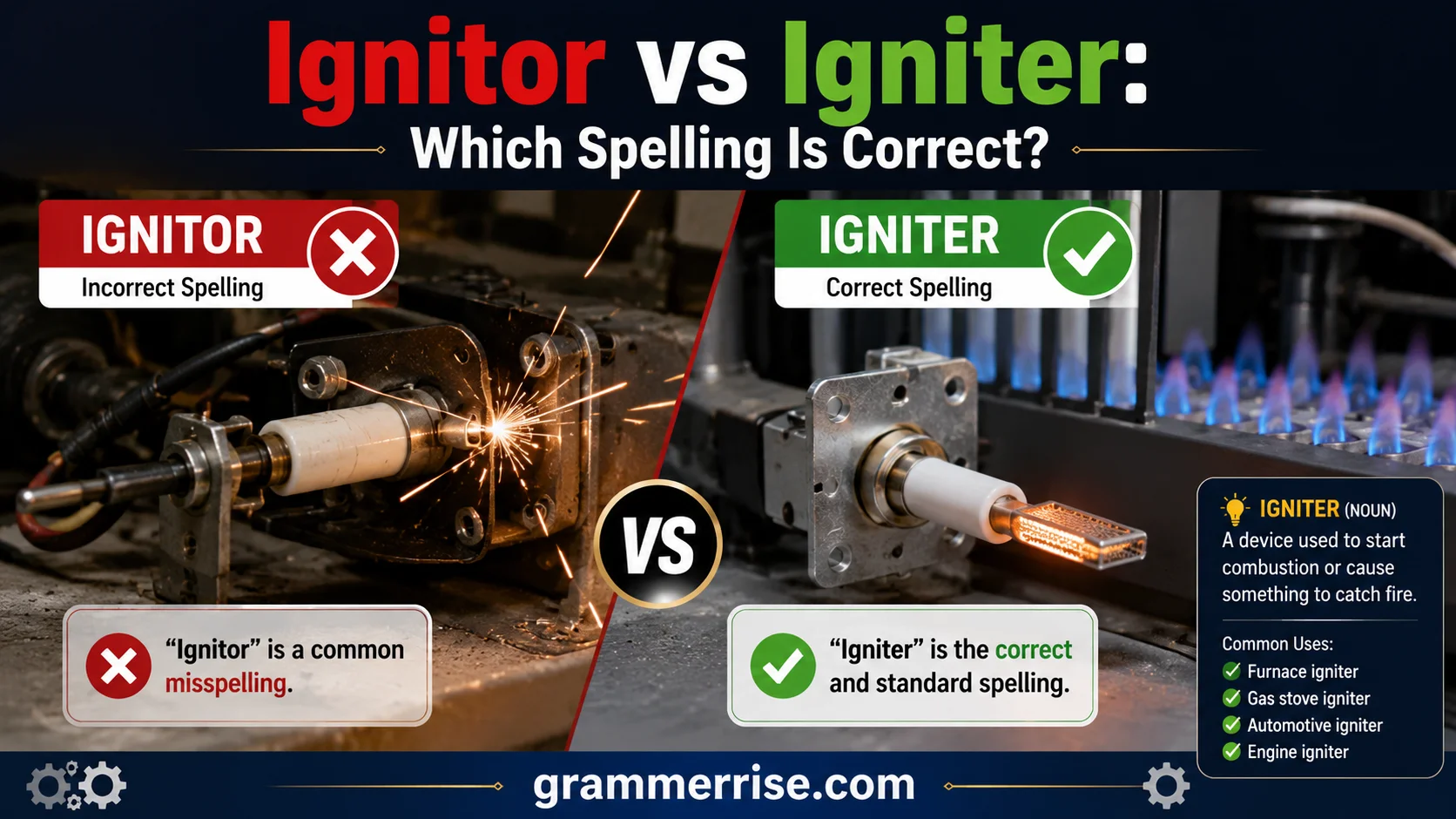
Ignitor vs Igniter creates confusion among Writers, engineers, and students because both terms have similar sound, appearance, and meanings. Many people wonder about the correct spelling, difference, and the best term to choose for different contexts. Both words connect with the verb ignite, which means to start a fire through combustion or combustion initiation. The words are often used interchangeably in everyday usage, product descriptions, and professional writing, but their real distinction depends on usage, application, and audience.
This comparison helps clarify the exact meanings, origins, history, definitions, and technical meaning so readers can understand, learn, and use these words confidently. In modern English, one form may appear more frequently, while regional preference, industry standards, and language habits can vary. A useful guide with examples, tables, and FAQs improves clarity, consistency, and professionalism in writing and speaking about these devices.
In science, technical applications, and practical fields, an igniter or ignitor can describe a device, mechanism, person, or technical tool that initiates a process in engines, stoves, equipment, and laboratory equipment. The choice of spelling becomes important in academic papers, reports, workplace manuals, and technical environments, where proper spelling, grammar, correct-usage, and correct usage support accurate communication. Misusing these words may create mistakes, misusage, and errors in academic assignments, manuals, and professional documents.
Ignitor vs Igniter: Quick Answer
| Word | Correctness | Common Usage | Example |
| Igniter | Correct spelling | Most common in American English | The furnace igniter stopped working. |
| Ignitor | Correct spelling variant | Used in some technical and regional contexts | The gas ignitor needs replacement. |
The simple rule is:
Use “igniter” for most situations. Use “ignitor” when following a specific industry standard or existing terminology.
What Does Igniter Mean?
The word igniter refers to a device, component, or mechanism that starts ignition. In simple terms, an igniter creates the initial spark, heat, or energy needed to begin combustion.
Think of it as the first push that gets a process moving. A small spark from an igniter can start a much larger reaction, just like a tiny match flame can light a candle.
An igniter can appear in many different systems, including:
- Gas stoves
- Furnaces
- Water heaters
- Vehicle engines
- Rockets
- Industrial machines
- Fireworks systems
For example, when you turn on a modern gas stove, you usually hear a clicking sound before the burner lights. That clicking mechanism creates an electrical spark through an igniter.
Without a working igniter, the fuel may be available but the combustion process cannot begin.
Examples of Igniter in Sentences
- The technician replaced the damaged furnace igniter before winter arrived.
- The car’s ignition system failed because the igniter stopped producing a spark.
- The rocket engine uses a powerful igniter to start combustion.
- The gas oven igniter glows before lighting the burner.
What Does Ignitor Mean?
Ignitor has the same meaning as igniter. It describes a device or component that starts ignition.
The difference is only the spelling.
Some manufacturers, engineers, and technical writers prefer the -or ending because many English words use this pattern.
Examples include:
- Generator
- Accelerator
- Operator
- Creator
Because English developed from many languages and writing traditions, some words have more than one accepted spelling. Ignitor is one of those examples.
Examples of Ignitor in Sentences
- The technician inspected the furnace ignitor during routine maintenance.
- The aircraft ignitor requires careful testing before operation.
- The appliance company sells replacement ignitors for several models.
- The industrial ignitor helps start the combustion chamber.
Is Igniter or Ignitor the Correct Spelling?
The good news is that both spellings are correct.
Many people assume one version must be wrong because they look slightly different. However, English contains thousands of words with spelling variations.
The main difference comes from usage frequency.
Igniter appears more commonly in:
- American English writing
- Consumer product descriptions
- Appliance repair information
- Automotive discussions
- General online content
Ignitor appears more commonly in:
- Certain engineering documents
- Older technical references
- Some British English materials
- Industry-specific terminology
If you are writing for a broad audience, igniter will usually feel more natural.
Read more: Ballon or Balloon: Which Spelling Is Correct?
Why Are There Two Spellings: Igniter vs Ignitor?
English spelling often changes depending on historical influences, pronunciation patterns, and regional preferences.
The endings -er and -or both create words that describe something performing an action.
For example:
| Word | Meaning |
| Heater | Something that produces heat |
| Starter | Something that begins a process |
| Generator | Something that creates energy |
| Accelerator | Something that increases speed |
| Igniter/Ignitor | Something that starts ignition |
The word comes from the verb ignite, which means to set something on fire or start combustion.
When English speakers created a noun for something that ignites, different spelling patterns developed.
Similar spelling variations appear in other words:
| Common Variation | Alternative Form |
| Adapter | Adaptor |
| Adviser | Advisor |
| Defender | Defendor (rare) |
These variations show that English does not always follow one fixed spelling pattern.
Igniter vs Ignitor in American English
In the United States, igniter is generally the preferred spelling.
You will commonly find this spelling in product listings, repair guides, and everyday conversations.
Examples:
- Furnace igniter
- Stove igniter
- Grill igniter
- Engine igniter
- Spark igniter
Many American companies use “igniter” because it matches modern consumer language.
For example, if someone searches online for a replacement furnace part, they are more likely to type:
“furnace igniter replacement”
rather than:
“furnace ignitor replacement.”
Both searches make sense, but the first one is more common.
Common American Examples
Home appliances
A gas furnace uses an igniter to start the burner. When the igniter fails, the furnace may stop producing heat.
Automotive systems
Some engines use ignition components that help start combustion inside the engine.
Outdoor equipment
Gas grills often use igniters that create a spark when you press a button.
Igniter vs Ignitor in British English
British English accepts both forms, although usage can vary depending on the industry.
Some technical fields may use ignitor, while general writing may use igniter.
Unlike some spelling differences between American and British English, this one does not have a strict rule.
For example:
- American English: often prefers igniter
- British English: may use igniter or ignitor
The choice usually depends on the writer, company, or technical standard being followed.
Igniter vs Ignitor in Different Industries
The meaning stays the same, but the application changes depending on the industry.
Automotive Industry
Vehicles rely on ignition systems to start combustion inside engines.
An igniter may refer to a component that helps create the necessary spark or ignition signal.
Common examples include:
- Engine ignition systems
- Spark control components
- Fuel combustion systems
A faulty igniter can lead to:
- Difficulty starting the vehicle
- Engine misfires
- Reduced performance
- Increased fuel consumption
Home Appliance Industry
Home appliances are one of the most common places where people encounter this word.
Examples include:
- Gas ovens
- Furnaces
- Water heaters
- Boilers
A furnace igniter usually works by producing enough heat to ignite gas safely.
A failed igniter may cause symptoms such as:
- Clicking sounds without flame
- Furnace shutdown
- Delayed heating
- Error codes on modern systems
Aerospace Industry
Rocket engines require extremely reliable ignition systems.
An aerospace igniter starts the combustion process under highly controlled conditions.
Because rocket engines operate under extreme temperatures and pressure, engineers design igniters with:
- High reliability
- Precise timing
- Strong heat resistance
A small ignition failure can prevent an entire launch, which makes igniter technology a critical part of aerospace engineering.
Industrial Applications
Factories use igniters in many combustion-based systems.
Examples include:
- Industrial furnaces
- Boilers
- Heating systems
- Manufacturing equipment
In these environments, technical teams may use either spelling depending on company standards.
Common Mistakes When Using Igniter and Ignitor
Many writers make the same mistakes when choosing between these words.
Mistake: Thinking Ignitor Is Incorrect
Some people believe “ignitor” is a spelling error.
That is not true.
Ignitor is a recognized spelling variant.
Mistake: Switching Between Spellings
Consistency matters.
A technical manual should not use:
- “Igniter” in one section
- “Ignitor” in another section
unless there is a specific reason.
Choose one spelling and keep it consistent.
Mistake: Using Ignition Instead
Igniter and ignition are related but different.
Compare:
| Word | Meaning | Example |
| Igniter | Device that starts combustion | The igniter created the spark. |
| Ignition | The process of starting combustion | The ignition system failed. |
You cannot replace one with the other.
Incorrect:
- The ignition needs replacement.
Correct:
- The igniter needs replacement.
- The ignition system needs repair.
Igniter vs Ignitor Examples in Real Sentences
Correct Examples
- The technician installed a new furnace igniter.
- The gas stove igniter no longer creates a spark.
- The engineer tested the rocket ignitor before launch.
- The appliance manual explains how to replace the igniter.
Incorrect Examples
- The car needs a new ignition because the small part broke.
Better:
- The car needs a new igniter because the component broke.
- The igniter process failed.
Better:
- The ignition process failed.
Igniter vs Ignitor vs Ignition: Understanding the Difference
These three words are closely connected, but they do different jobs.
| Term | Definition | Example |
| Igniter | A device that starts ignition | The igniter creates the spark. |
| Ignitor | Alternative spelling of igniter | The ignitor starts the burner. |
| Ignition | The act or process of starting combustion | The ignition system activates. |
A simple way to remember:
The igniter causes ignition.
The device is the igniter. The action is ignition.
How to Remember the Difference Between Igniter and Ignitor
Remember this simple trick:
Igniter = the more common everyday spelling.
If you are writing a blog post, article, product description, or general explanation, choose igniter.
If you are copying a technical label or following a company’s terminology, ignitor may be appropriate.
The important thing is not choosing the “perfect” spelling. The important thing is using the correct meaning and staying consistent.
Frequently Asked Questions About Ignitor vs Igniter
1. What is the main difference between ignitor and igniter?
The main difference between ignitor and igniter is mostly related to spelling preference and usage. Both words describe something that starts combustion or creates ignition. Igniter is more commonly used in modern technical writing, while ignitor is also accepted and appears in some industries, regions, and product names. The correct choice depends on the context, audience, and language standards you follow.
2. Is igniter the correct spelling in English?
Yes, igniter is widely recognized as the standard spelling in modern English, especially in technical fields. It commonly refers to a device or tool that starts a fire, engine, stove, or other equipment. However, ignitor is not considered completely wrong and may still appear in engineering documents, product descriptions, and specialized applications.
3. Can ignitor and igniter be used interchangeably?
In many situations, ignitor and igniter can be used interchangeably because they share the same basic meaning. Both refer to a person, device, or mechanism that initiates a process of ignition. However, technical industries may prefer one spelling over the other based on internal standards, manuals, or regional language preferences.
4. Which spelling should I use in professional or academic writing?
For professional writing, academic papers, and technical documents, igniter is usually the safer choice because it appears more frequently in modern English resources. Always consider your audience, industry guidelines, and existing terminology before choosing a spelling. Maintaining consistency throughout your document is more important than switching between both forms.
5. Where are igniters commonly used?
Igniters are commonly found in various devices and systems that require ignition. Examples include engines, gas stoves, heating equipment, laboratory equipment, and industrial machines. These tools help begin combustion safely and efficiently. Understanding their function is important for maintaining equipment performance, safety standards, and proper technical communication.
6. Why do people confuse ignitor and igniter?
People often confuse ignitor and igniter because both words look almost identical, have the same pronunciation, and come from the same root word, ignite. The difference is mainly related to spelling conventions rather than meaning. Since both forms appear in different contexts, users may find it difficult to decide which term provides the most accurate and professional expression.
Conclusion
The difference between Ignitor vs Igniter is mainly found in spelling preference, usage patterns, and technical contexts rather than meaning. Both terms describe something that starts combustion or initiates a process of ignition in devices, machines, and equipment. While igniter is more common in modern English and professional communication, ignitor remains an accepted form in certain industries and regions.
Choosing the right word depends on your audience, writing purpose, and industry standards. Whether you are preparing technical documents, academic assignments, product descriptions, or everyday content, maintaining consistency and using the correct terminology improves clarity. Understanding these subtle differences helps you communicate more accurately and confidently whenever you need to discuss ignition-related devices or processes.