Understanding Sueing or Suing helps English learners and writers identify the correct spelling, grammar rule, and usage in professional communication. Many English learners, native speakers, writers, students, and professionals experience confusion because both forms look similar and sound alike. The difference is that Suing is the correct spelling, while Sueing is an incorrect form and misspelling in standard English. The base word sue follows a common grammar rule where the final e is dropped when adding -ing, creating the correct verb form and present participle suing.
This writing guide explains the correct usage of Suing in different situations, including legal writing, academic writing, emails, social media posts, online writing, and formal documentation. The incorrect version appears frequently because it seems logical, but dictionaries do not accept it as proper English usage.
Learning these spelling rules, pronunciation tips, and expert editing advice improves writing skills, editing skills, and proofreading accuracy. In legal contexts, workplace communication, and everyday communication, correct legal terminology, legal language, and language usage help maintain clarity, professionalism, and prevent misunderstandings through better error correction.
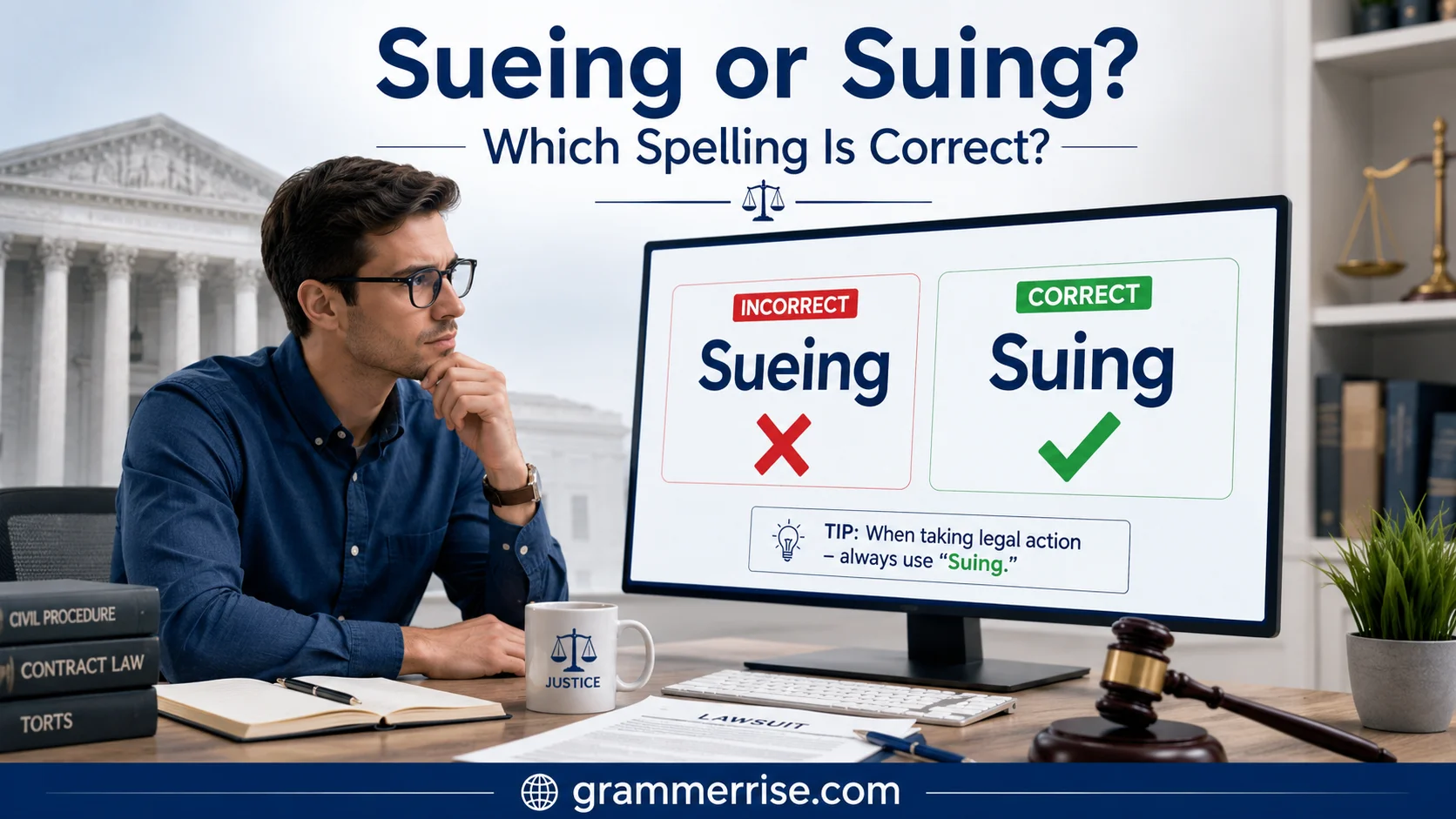
Quick Answer: Is It Sueing or Suing?
The answer is simple:
| Word | Correct? |
| Suing | ✅ Yes |
| Sueing | ❌ No |
The verb sue follows a common English spelling pattern. When a verb ends with a silent e, that e is usually dropped before adding -ing.
Examples include:
- Make → Making
- Use → Using
- Drive → Driving
- Write → Writing
- Sue → Suing
Because of this rule, suing is the only accepted spelling in standard English.
What Does “Suing” Mean?
Before discussing spelling rules, it helps to understand the meaning of the word itself.
Legal Definition of Suing
Suing means taking legal action against a person, company, organization, or government entity through a court of law.
When someone believes they have suffered harm, financial loss, property damage, or another legal wrong, they may decide to sue the responsible party.
For example:
The customer is suing the manufacturer for selling a defective product.
In this sentence, the customer has started a legal claim against the manufacturer.
When People Commonly Use the Word
The word appears frequently in:
- Court cases
- News reports
- Business disputes
- Personal injury claims
- Employment lawsuits
- Consumer protection cases
- Contract disagreements
You will often see headlines such as:
- A former employee is suing the company.
- Residents are suing the city government.
- Customers are suing the airline.
Real-World Examples of Suing
Here are some natural examples:
- She is suing her landlord for failing to make repairs.
- The athlete is suing the publication for defamation.
- Several investors are suing the company over financial losses.
- The family is suing the hospital after the incident.
In each example, suing describes ongoing legal action.
Why Is “Suing” Correct?
Many spelling questions become easier once you understand the grammar rule behind them.
The Silent E Rule Explained
One of the most common spelling patterns in English involves dropping a silent e before adding a suffix that begins with a vowel.
The purpose is partly practical. It prevents awkward letter combinations and keeps words easier to read.
Consider these examples:
| Base Verb | Incorrect | Correct |
| Make | Makeing | Making |
| Write | Writeing | Writing |
| Use | Useing | Using |
| Drive | Driveing | Driving |
| Sue | Sueing | Suing |
Notice the pattern. The silent e disappears.
How English Forms Present Participles
The -ing form of a verb is called a present participle.
Examples include:
- Run → Running
- Walk → Walking
- Read → Reading
- Sue → Suing
These forms often appear in continuous tenses.
Examples:
- She is reading.
- They are walking.
- The customer is suing.
Why “Sue” Becomes “Suing” Instead of “Sueing”
At first glance, sueing seems logical because it preserves the original word.
However, English spelling conventions prioritize consistency.
The language generally removes a silent e before adding -ing. As a result, suing follows the established pattern while sueing breaks it.
That’s why dictionaries recognize suing and reject sueing.
Sueing vs Suing: Side-by-Side Comparison
Many readers find visual comparisons helpful.
| Feature | Suing | Sueing |
| Correct spelling | ✅ Yes | ❌ No |
| Found in dictionaries | ✅ Yes | ❌ No |
| Used by lawyers | ✅ Yes | ❌ No |
| Accepted in academic writing | ✅ Yes | ❌ No |
| Used in professional documents | ✅ Yes | ❌ No |
| Follows grammar rules | ✅ Yes | ❌ No |
The comparison makes the answer clear.
Always choose suing.
Why Do So Many People Write “Sueing”?
The mistake is understandable.
Several factors contribute to the confusion.
The Spelling Looks More Natural
Many people assume that adding -ing means simply attaching it to the existing word.
Following that logic:
- Sue + ing = Sueing
The reasoning feels sensible even though the grammar rule says otherwise.
Common Typing Habits
Writers often focus on pronunciation rather than spelling patterns.
Since the pronunciation remains unchanged, people may accidentally preserve the e.
Misunderstanding English Grammar Rules
English contains dozens of spelling exceptions.
As a result, many people become uncertain about when to keep or remove letters.
Without knowing the silent e rule, sueing can appear correct.
Influence of Similar-Looking Words
Some English words create confusion because they retain vowels in unexpected ways.
For example:
- Queue → Queueing
- Canoe → Canoeing
These exceptions sometimes lead writers to assume that sueing should also be acceptable.
However, standard English still recognizes suing as the correct form.
How to Use “Suing” Correctly in a Sentence
Knowing the spelling is only part of the process.
You also need to know how to use the word naturally.
Everyday Examples
- My neighbor is suing a contractor over unfinished work.
- She is suing for damages after the accident.
- They are suing because the agreement was violated.
Business Examples
- Investors are suing the company for misleading statements.
- Several partners are suing over contract disputes.
- The supplier is suing for unpaid invoices.
Legal Examples
- The plaintiff is suing the defendant for negligence.
- The client is suing for breach of contract.
- The family is suing the institution for compensation.
News and Media Examples
Journalists frequently use the word in headlines.
Examples include:
- Celebrity Suing Former Manager
- Customers Suing Major Retailer
- Residents Suing Local Authority
The word remains one of the most common legal verbs in modern news reporting.
Common Mistakes Related to “Suing”
Spelling isn’t the only area where writers struggle.
Using “Sueing” in Formal Writing
This remains the most common error.
Professional documents should always use suing.
Confusing “Suing” and “Lawsuit”
Many people treat these terms as interchangeable.
They are related but not identical.
| Term | Type | Meaning |
| Sue | Verb | To start legal action |
| Suing | Verb form | Currently taking legal action |
| Lawsuit | Noun | The legal case itself |
Example:
- Correct: She is suing the company.
- Correct: The lawsuit was filed yesterday.
Mixing Up Verb Tenses
Incorrect:
- He sue yesterday.
Correct:
- He sued yesterday.
Incorrect:
- They are sueing.
Correct:
- They are suing.
Incorrect Sentence Construction
A sentence should clearly identify who is taking legal action.
Good example:
The employee is suing the employer for unpaid wages.
Poor example:
Suing because wages.
The second sentence lacks clarity and completeness.
Sue, Suing, Sued, and Lawsuit: Understanding the Difference
These words often appear together.
What Is “Sue”?
Sue is the base form of the verb.
Example:
I may sue the contractor.
What Is “Suing”?
Suing describes ongoing legal action.
Example:
I am suing the contractor.
What Is “Sued”?
Sued is the past tense.
Example:
I sued the contractor last year.
What Is a Lawsuit?
A lawsuit is the legal case itself.
Example:
The lawsuit lasted two years.
Quick Comparison Table
| Word | Function |
| Sue | Base verb |
| Suing | Present participle |
| Sued | Past tense |
| Lawsuit | Noun |
Understanding these distinctions helps improve both writing accuracy and legal vocabulary.
Is “Sueing” Ever Considered Correct?
This question appears frequently online.
The short answer is no.
Historical Usage and Misspellings
Older texts occasionally contain unusual spellings. However, those instances generally reflect historical inconsistencies rather than accepted modern standards.
Today, editors and grammar authorities treat sueing as an error.
What Modern Dictionaries Say
Major dictionaries consistently list:
- Sue
- Suing
- Sued
They do not recognize sueing as the standard spelling.
Why Professional Writers Avoid It
Professional writing values consistency.
Using the incorrect spelling can:
- Reduce credibility
- Trigger spell-check warnings
- Create confusion
- Make documents appear less polished
For those reasons, lawyers, journalists, academics, and business professionals use suing.
British English vs American English
Some spelling differences depend on location.
For example:
- Colour vs Color
- Centre vs Center
- Organise vs Organize
Is There a Regional Difference?
No.
Both American English and British English use suing.
Which Spelling Do Both Countries Use?
The accepted spelling remains identical:
✅ Suing
❌ Sueing
Unlike many other spelling debates, there is no regional variation here.
Words That Follow the Same Grammar Pattern
Learning related examples makes the rule easier to remember.
Use → Using
Correct:
She is using the computer.
Incorrect:
She is useing the computer.
Make → Making
Correct:
He is making dinner.
Incorrect:
He is makeing dinner.
Drive → Driving
Correct:
They are driving home.
Incorrect:
They are driveing home.
Write → Writing
Correct:
She is writing a report.
Incorrect:
She is writeing a report.
Sue → Suing
Correct:
The client is suing the corporation.
Incorrect:
The client is sueing the corporation.
A pattern emerges quickly.
The silent e disappears.

Similar Spelling Confusions People Search For
English contains many spelling traps.
Lieing or Lying
Correct: Lying
Incorrect: Lieing
Ageing or Aging
Both spellings appear depending on style and region.
Dyeing or Dying
These words have different meanings.
- Dyeing = coloring material
- Dying = approaching death
Queueing or Queuing
Both forms appear in certain style guides.
Judgement or Judgment
Usage varies between legal and general writing contexts.
These examples show why spelling questions remain common.
Easy Tricks to Remember the Correct Spelling
Simple memory tools often work best.
The Drop-the-E Method
Think of the process this way:
Sue
↓
Drop the E
↓
Add ING
↓
Suing
Memory Hacks That Actually Work
Compare it to familiar words:
- Use → Using
- Drive → Driving
- Make → Making
- Sue → Suing
Once you recognize the pattern, the spelling becomes easy to remember.
A Helpful Phrase
“If the E is silent, let it disappear before ING arrives.”
It isn’t a perfect rule for every English word, but it works well here.
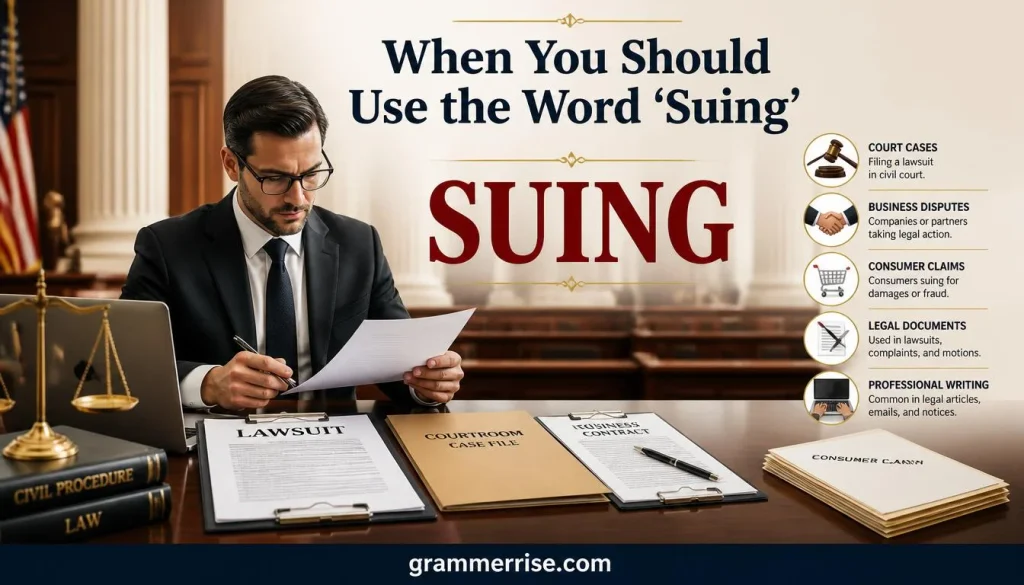
When You Should Use the Word “Suing”
The word appears in many situations.
Legal Documents
Attorneys frequently use the term when describing active litigation.
Court Cases
Judges, lawyers, and reporters often discuss parties who are suing.
Business Disputes
Contract disagreements regularly lead to lawsuits.
Consumer Claims
Customers may sue businesses over defective products or unfair practices.
Professional Writing
Writers covering legal topics should use the term accurately and consistently.
Read More for More: In-Route or En-Route? Meaning, Usage and Grammar Explained
My Personal Experience With “Suing or Sueing”
While working on English spelling, I came across the “Suing or Sueing” confusion and initially understood why both forms could look correct. After checking the spelling rule, I learned that “Suing” is the correct form because the silent e in sue is dropped before adding -ing.
That small discovery reminded me that even familiar English words can cause mistakes when spelling rules are overlooked.
Frequently Asked Questions
1. Is “Sueing” a correct spelling in English?
No, Sueing is not the correct spelling in standard English. The correct spelling is Suing. The mistake happens because many people think the word sue should keep the final e when adding -ing, but English spelling rules require the silent e to be removed.
2. Why do people confuse Suing and Sueing?
People often confuse Suing and Sueing because both words look almost identical and the base word is sue. Many English learners and even native speakers assume that adding -ing means simply attaching it to the original word. However, verbs ending in a silent e usually drop that letter before adding -ing.
3. What is the grammar rule for changing sue into suing?
The grammar rule is that when a verb ends with a silent e, the e is usually removed before adding -ing. For example, make becomes making, write becomes writing, and sue becomes suing. This rule helps create the correct present participle form.
4. Can I use “Sueing” in legal documents or professional writing?
No, Sueing should not be used in legal documents, professional writing, academic assignments, or formal communication. Since it is considered a spelling error, using it may affect the clarity and professionalism of your writing. The correct term is always Suing.
5. How can I remember the correct spelling of Suing?
A simple way to remember it is to think about the silent e rule. When adding -ing to sue, remove the final e first. Remember: sue + ing = suing, not sueing. Practicing similar examples can make the spelling pattern easier to remember.
6. Does the pronunciation of Suing and Sueing change?
No, both forms may look different in writing, but they are generally pronounced the same. The difference is only in spelling. Suing is the accepted written form, while Sueing is an incorrect spelling that should be avoided in English usage.
Conclusion
Understanding the difference between Suing or Sueing helps writers avoid a common spelling mistake and improve their overall English accuracy. While both forms may look similar, only Suing is accepted as the correct spelling in standard English because the final e in sue is removed before adding -ing.
Using the correct form is especially important in legal writing, professional communication, academic work, and online content where accuracy and clarity matter. By learning this simple spelling rule and applying proper proofreading habits, writers can strengthen their language skills, avoid misunderstandings, and create more professional and reliable communication.

Hussain Abid is an English language writer with over 10 years of experience in grammar, spelling, vocabulary, and writing. He specializes in creating clear, well-researched content that helps readers improve their English with confidence. At GrammarRise, Hussain writes practical guides, grammar explanations, and word comparison articles based on trusted language sources and real-world usage. His mission is to make English learning simple, accurate, and accessible for everyone