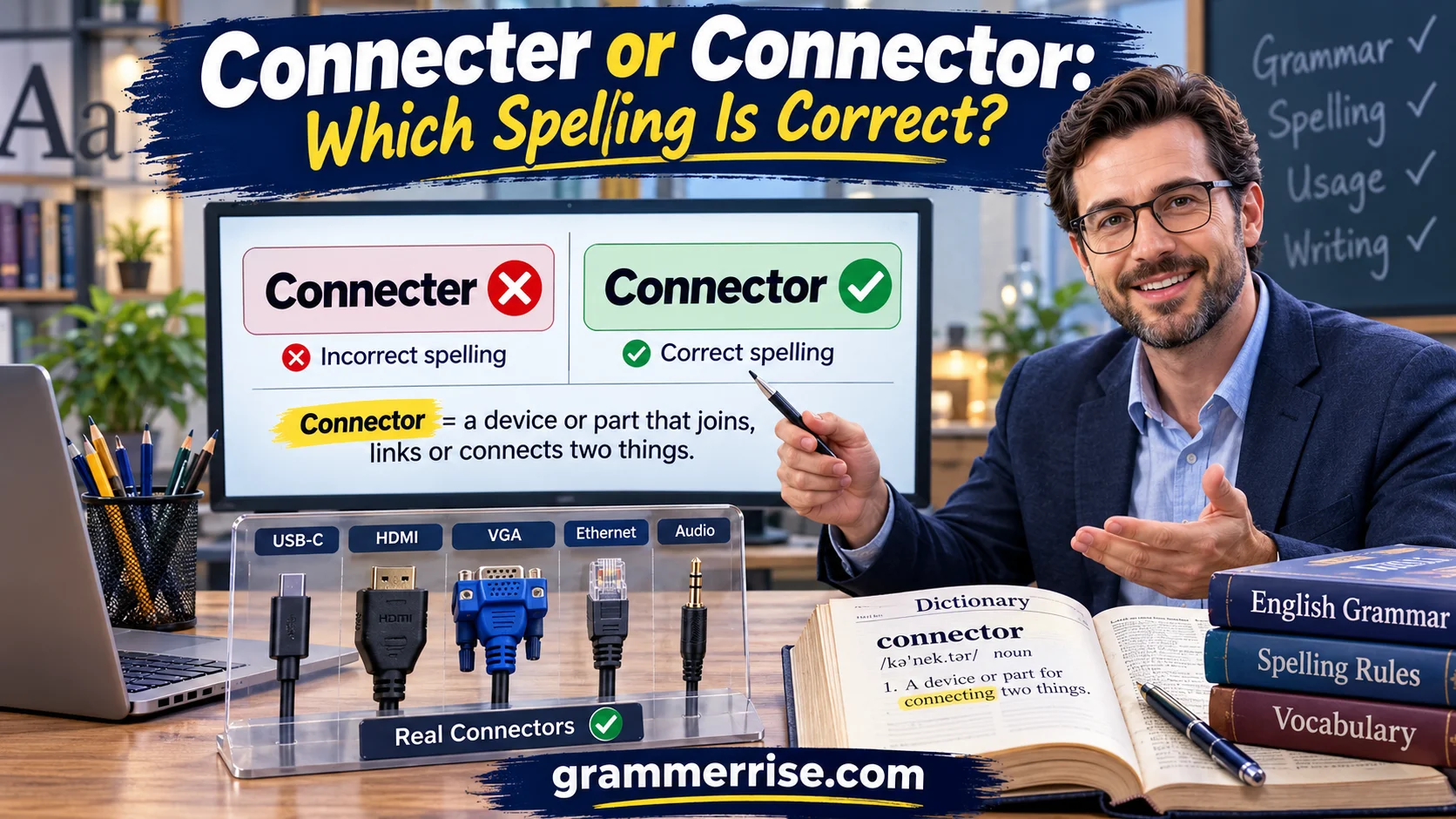
Connecter or Connector: Many people wonder which spelling is correct because both come from connect, but modern English accepts connector today. The words look similar, but the difference matters in professional writing, academic writing, technical writing, and everyday communication. The word connector is the correct and widely accepted spelling, while connecter is a rare variant and generally incorrect in most modern contexts.
Over time, English language usage has changed, and writers, professionals, and language learners now prefer the accepted form because it improves clarity, accuracy, and communication. Understanding this spelling choice helps avoid mistakes in digital content, search queries, and online queries where correct word usage influences content quality and credibility.
A connector is a noun that describes something used to link or join parts, including a physical device in technology, a linguistic linking word in writing, or a structural component in engineering. The connector meaning is connected with joining, linking, and creating a connection, while the connecter meaning is rarely used in professional documents. This guide helps break down the correct usage, grammar rules, and usage rules with practical examples backed by linguistic rules, data, and expert insight.
Connecter or Connector: The Quick Answer
The preferred spelling is connector.
A connector is a person, device, or thing that connects two or more things together.
For example:
- A USB connector links a cable to a device.
- A business connector introduces people who can help each other.
- A transition connector links one idea to another in writing.
The word connecter is not completely impossible. It follows a logical pattern because English often creates nouns by adding -er to verbs.
Examples:
- Teach → Teacher
- Write → Writer
- Drive → Driver
Following that pattern, someone might think:
Connect + er = connecter
However, English contains many exceptions. Some words use -or instead.
Examples:
- Create → Creator
- Operate → Operator
- Translate → Translator
- Connect → Connector
That is why connector became the standard form.
Is Connector the Correct Spelling?
Yes, connector is the correct and commonly used spelling.
Modern English strongly favors connector across different fields.
You’ll find this spelling in:
- Technology documentation
- Engineering manuals
- Product descriptions
- Business communication
- Academic writing
- News articles
When people talk about cables, devices, systems, or relationships, they almost always use connector.
Examples of Connector in Real Sentences
- The technician replaced the damaged connector inside the computer.
- This charger uses a USB-C connector.
- She is a natural connector who introduces talented people to each other.
- Transition words act as connectors between paragraphs.
Each example uses the same basic idea:
Something or someone creates a link between two things.
Is Connecter a Real Word?
Yes, connecter can appear in English, but it is uncommon.
It usually refers to:
- A person who connects things
- Someone who joins separate parts together
- A device or object performing a connecting action
The problem is not that connecter is impossible. The issue is that most English speakers do not use it.
Language depends heavily on common usage. A word may be technically understandable yet still feel unusual.
For example, if someone says:
“He is a professional connecter.”
Most people will understand the meaning. However, many readers will expect:
“He is a professional connector.”
The second version sounds natural because it matches common English patterns.
Connector Meaning and Definition
The word connector has several related meanings depending on the situation.
At its core, a connector is something that creates a link.
Basic Definition
A connector is:
A person, object, or device that joins, links, or attaches two things together.
The connection can be physical or abstract.
A cable connector physically joins devices.
A person connector joins people through relationships.
A transition word connects ideas in writing.
Different Types of Connectors
Connectors appear in many areas of life.
| Type of Connector | Meaning | Example |
| Electrical connector | Joins electrical components | Power plug connector |
| Technology connector | Links digital devices | USB connector |
| Communication connector | Links ideas or sentences | However, therefore |
| Social connector | Builds relationships between people | Business networker |
| Mechanical connector | Joins physical parts | Pipe connector |
Although these connectors look different, they share the same purpose:
They bring separate things together.
Technology Connectors Explained
Technology is one of the most common places where you’ll see the word connector.
Modern devices rely on connectors every day.
Think about your phone charger.
The small piece that attaches your charging cable to your phone is a connector.
Without it, electricity cannot move between the charger and the device.
Common Technology Connectors
Some well-known examples include:
- USB connectors
- USB-C connectors
- HDMI connectors
- Audio connectors
- Ethernet connectors
- Display connectors
USB Connector Example
A USB connector allows devices to communicate and transfer power or data.
You might use one to:
- Charge a smartphone
- Transfer files
- Connect a keyboard
- Attach external storage
The connector acts as the bridge between two systems.
Electrical Connectors Explained
Electrical systems depend heavily on reliable connectors.
An electrical connector joins wires, cables, or circuits.
Without proper connectors, electrical systems can fail.
Common Electrical Connector Types
| Connector Type | Common Use |
| Plug connector | Household electricity |
| Terminal connector | Electrical panels |
| Wire connector | Joining cables |
| Circuit connector | Electronic equipment |
Engineers carefully choose connectors based on:
- Voltage requirements
- Current capacity
- Safety standards
- Environmental conditions
A small connector may seem simple, but it plays a critical role in keeping systems working.
Read more: Inter vs Intra: What’s the Difference?
Human Connectors: People Who Bring Others Together
Not every connector is a piece of hardware.
Some connectors are people.
A human connector helps create relationships between individuals, businesses, or communities.
For example:
- A recruiter connects companies with talented workers.
- A mentor connects students with opportunities.
- A business leader connects partners and investors.
These people often have strong communication skills and large networks.
Example
Sarah became a valuable connector because she introduced entrepreneurs to investors who could support their ideas.
Here, connector does not describe an object.
It describes someone who creates meaningful links.
Connectors in Writing and Communication
The word connector also appears in grammar and writing.
Writers use connectors to create smoother transitions between ideas.
Examples include:
- However
- Therefore
- Meanwhile
- In addition
- As a result
- For example
These words help readers understand relationships between sentences.
Compare these examples:
Without a connector:
The company changed its strategy. Sales improved.
With a connector:
The company changed its strategy. As a result, sales improved.
The second version creates a clearer relationship between the ideas.
Connecter vs Connector: Key Difference
The biggest difference between connecter and connector is usage.
Both words can describe something that connects. However, connector is the accepted and commonly used form.
| Feature | Connecter | Connector |
| Correct spelling | Technically possible | Standard spelling |
| Common usage | Rare | Very common |
| Used in technology | Almost never | Frequently |
| Professional writing | Usually avoided | Recommended |
| Dictionary recognition | Limited | Widely recognized |
For everyday writing, choose connector.
It is clearer, more familiar, and more widely accepted.
Why Do People Confuse Connecter and Connector?
The confusion happens because English spelling patterns are not always predictable.
Several reasons explain this mistake.
The Verb-to-Noun Pattern Creates Confusion
Many English words form nouns by adding -er.
Examples:
- Run → Runner
- Paint → Painter
- Build → Builder
- Teach → Teacher
Because connect is a verb, adding -er feels natural.
Connect → Connecter
The logic makes sense.
However, English also uses -or endings for many words.
Examples:
- Act → Actor
- Invent → Inventor
- Direct → Director
- Connect → Connector
The language developed through centuries of borrowing and changing. That history created many spelling patterns that cannot always be predicted.
Pronunciation Makes It Harder
Another reason people confuse these words is that they sound almost identical.
When spoken aloud:
- Connector
- Connecter
They sound very similar.
Because people often hear words before they write them, pronunciation can lead to spelling mistakes.
This happens with many English words.
Examples:
- Their / There
- To / Too / Two
- Principal / Principle
- Rein / Reign
Sound alone does not always reveal spelling.
How English Forms Words Like Connector
To understand why connector is preferred over connecter, it helps to look at how English creates nouns from verbs.
English often changes action words into names for people, tools, or objects. These new words are called agent nouns because they identify something that performs an action.
For example:
| Verb | Agent Noun | Meaning |
| Teach | Teacher | Someone who teaches |
| Design | Designer | Someone who designs |
| Create | Creator | Someone who creates |
| Operate | Operator | Someone who operates |
| Connect | Connector | Something or someone that connects |
The pattern seems simple, but English does not follow one single rule.
Some verbs naturally take -er, while others take -or.
Why Does Connect Become Connector?
The word connect comes from Latin connectere, meaning “to join together.”
Many words that entered English through Latin developed the -or ending.
Examples:
- Educate → Educator
- Calculate → Calculator
- Navigate → Navigator
- Connect → Connector
Because of this history, connector became the accepted form.
The spelling is not random. It reflects how English borrowed and adapted words over time.
Connector vs Connection: Understanding the Difference
Many people confuse connector with connection because both words come from the same root.
However, they describe different things.
A connector is the person or object that creates the link.
A connection is the link itself.
| Word | Meaning | Example |
| Connector | Something or someone that joins things | The HDMI connector is damaged |
| Connection | The relationship or link created | The internet connection is slow |
Real-Life Example
Imagine plugging your laptop into a monitor.
The HDMI cable has a connector at the end.
The communication between the laptop and monitor is the connection.
The connector creates the connection.
This small difference helps you choose the right word.
Common Mistakes With Connector
Even though connector is common, writers still make several mistakes when using it.
Understanding these errors can help you avoid them.
Using Connecter in Technical Writing
Technical fields almost always use connector.
You will find the word in:
- Electronics manuals
- Computer guides
- Engineering documents
- Product specifications
Incorrect:
The device requires a special connecter.
Correct:
The device requires a special connector.
Technical language depends on consistency. Using the standard spelling helps readers understand information quickly.
Assuming Every Verb Uses -Er
One of the biggest mistakes comes from applying a simple spelling rule everywhere.
People often think:
If someone does an action, add -er.
That works sometimes.
Examples:
- Drive → Driver
- Paint → Painter
- Teach → Teacher
However, English has many exceptions.
Examples:
- Inspect → Inspector
- Invent → Inventor
- Translate → Translator
- Connect → Connector
Learning common words through usage is often more reliable than depending on one rule.
Confusing Connector With Connection
Another common mistake involves choosing between the two related words.
Incorrect:
The cable connection is broken.
This might be correct depending on the meaning, but if you mean the physical plug, use connector.
Better:
The cable connector is broken.
Another example:
The technician repaired the connector.
He then fixed the damaged physical component.
Afterward, the connection worked properly again.
The technician restored the link or communication.
The context changes the word choice.
Types of Connectors You Should Know
The word connector appears in many industries. Understanding these examples makes the meaning clearer.
Technology Connectors
Technology connectors allow devices to exchange information or power.
Common examples include:
- USB connectors
- HDMI connectors
- Ethernet connectors
- Audio connectors
- Display connectors
USB Connectors
USB connectors are among the most recognizable connectors today.
People use them for:
- Charging devices
- Connecting accessories
- Moving files
- Powering electronics
Different USB versions have different designs and capabilities.
For example:
| Connector Type | Common Use |
| USB-A | Traditional computers and chargers |
| USB-C | Modern phones, laptops, and tablets |
| Micro USB | Older mobile devices |
Electrical Connectors
Electrical connectors create safe connections between wires and components.
They are essential in:
- Homes
- Vehicles
- Industrial machines
- Electronic devices
A poorly designed connector can cause:
- Power loss
- Overheating
- Equipment failure
Engineers carefully select connectors based on the job they need to perform.
Mechanical Connectors
Mechanical connectors join physical parts together.
Examples include:
- Pipe connectors
- Fasteners
- Coupling connectors
- Structural connectors
These connectors help create stable and secure systems.
Communication Connectors
Not every connector is physical.
In writing and speaking, connectors help ideas flow smoothly.
Examples:
- However
- Therefore
- Although
- Meanwhile
- Furthermore
These words act like bridges.
Without them, writing can feel disconnected.
Compare:
The company launched a new product. Customers loved it.
The meaning is clear.
Now add a connector:
The company launched a new product. As a result, customers showed strong interest.
The second version explains the relationship between ideas.
Social Connectors
Some people naturally connect others.
These individuals are often called connectors.
They help build relationships in:
- Business
- Communities
- Education
- Professional networks
A social connector might introduce:
- A job seeker to an employer
- A founder to an investor
- A student to a mentor
These people create opportunities by bringing the right individuals together.
How to Remember Connector Is Correct
Spelling mistakes become easier to avoid when you create a simple mental shortcut.
Here are effective ways to remember connector.
Memory Trick: Think About Technology
Most people interact with connectors every day.
Think about:
- Phone chargers
- Laptop cables
- Headphones
- Internet cables
You almost always see the word written as:
Connector
Technology reinforces the correct spelling.
Memory Trick: Remember Common Professional Usage
If you are writing:
- A report
- A blog post
- A technical guide
- A business document
Choose connector.
It is the version readers expect.
Memory Trick: Connect Creates Connector
Think of this pattern:
Connect → Connector
The word simply adds the -or ending.
Examples:
- Operate → Operator
- Create → Creator
- Connect → Connector
This connection makes the spelling easier to remember.
When Should You Use Connector?
In almost every situation, connector is the best choice.
Use Connector in Everyday Writing
Examples:
- The charger connector broke.
- This cable has a different connector.
- The connector does not fit the device.
Use Connector in Professional Writing
Examples:
- The engineer inspected the electrical connector.
- The software uses a secure data connector.
- The company hired a skilled connector to build partnerships.
Use Connector in Academic Writing
Academic and technical writing values clarity.
Using the standard spelling helps readers focus on the information instead of questioning the word choice.
Case Study: Why Standard Words Matter in Technology
Imagine reading a product manual that says:
Insert the connecter into the device port.
Most readers will understand the meaning. However, the unusual spelling may create doubt.
Now compare:
Insert the connector into the device port.
The second sentence feels professional and familiar.
In technical industries, small details matter. Clear terminology improves trust.
A single spelling choice can influence how readers view the quality of the entire document.
Common English Words With Similar Confusion
The connecter or connector confusion is part of a larger pattern in English.
Many words sound similar but have different spellings or meanings.
Adviser vs Advisor
Both forms exist.
However, usage depends on style preferences and context.
Adviser and Advisor Examples
- She works as a financial adviser.
- The company hired a technology advisor.
Traveler vs Traveller
The difference depends on regional spelling.
- Traveler is common in American English.
- Traveller is common in British English.
Theater vs Theatre
Both are correct.
- Theater is preferred in American English.
- Theatre is often used in British English.
Unlike these examples, connector is the clear standard choice in US English.
Frequently Asked Questions
1. Is connector or connecter the correct spelling?
Connector is the correct and widely accepted spelling in modern English. It is the standard form used in professional writing, academic writing, technical documents, and everyday communication. Connecter exists as a rare variant, but it is not commonly used and may appear incorrect or outdated in most modern contexts.
2. Why do people confuse connecter and connector?
People often confuse connecter and connector because both words come from the verb connect and have similar appearances. The confusion also happens because older texts and online sources sometimes include the less common spelling. However, modern English strongly favors connector as the accepted form.
3. What does connector mean?
A connector is something that links, joins, or connects two or more parts. It can refer to a physical device, such as an electrical connector used in technology, a linking word in writing, or a structural component in engineering. The meaning depends on the context where the word is used.
4. Is connecter ever acceptable to use?
While connecter can occasionally be found in dictionaries as a rare variant, it is generally avoided in professional, academic, and technical writing. Using connector is a safer choice because it follows modern spelling standards and is recognized by most readers.
5. How can I remember the difference between connector and connecter?
A simple way to remember it is that modern English usually adds -or to words that describe a person or thing performing an action, such as connector, creator, or operator. Since a connector is something that performs the action of connecting, the spelling with -or is preferred.
6. Why does correct spelling matter in professional writing?
Correct spelling improves clarity, credibility, and communication. In professional documents, technical writing, academic papers, and digital content, using the accepted spelling helps readers understand your message and makes your writing appear more accurate and reliable.
Conclusion
The difference between connector or connecter may look small, but choosing the right spelling can make a big impact on your writing. In modern English, connector is the correct and widely accepted form used in professional writing, technical documents, academic papers, and everyday communication. While connecter may appear in older texts or rare situations, it is not the preferred choice for clear and accurate writing.
Understanding this difference helps you avoid common spelling mistakes and improves your overall language skills. Whether you are writing an email, creating digital content, preparing a technical document, or completing a school assignment, using connector ensures your message looks professional and follows modern English standards.
Language continues to evolve, and accepted spelling changes with usage over time. By following trusted grammar rules and paying attention to word choices, you can write with greater confidence, clarity, and credibility. When in doubt, remember the simple rule: connector is the standard spelling, while connecter is rarely used.