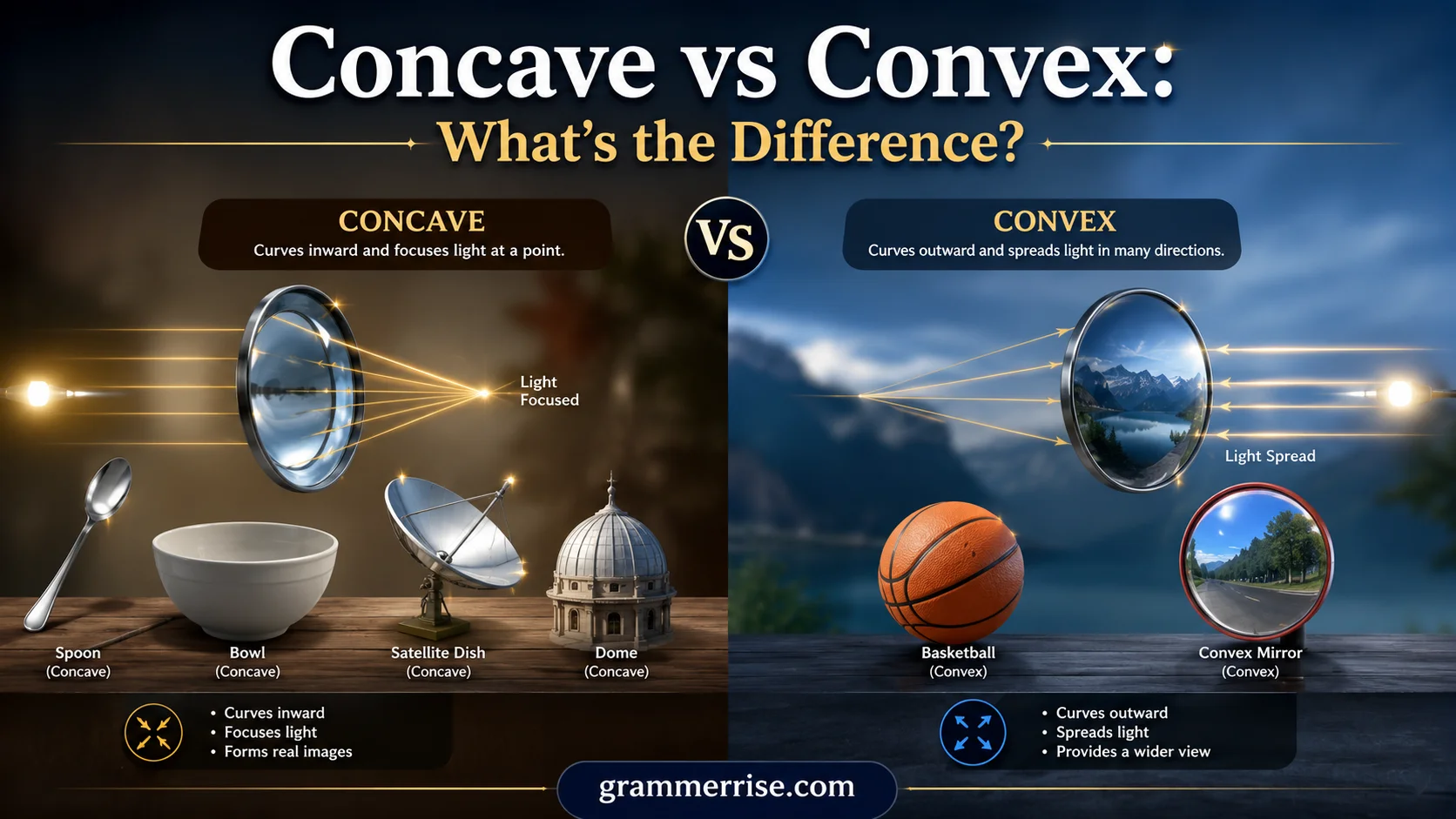
Concave vs Convex explains two opposite curves that describe surface shapes, helping you understand bends, lenses, and real-world structures easily. These terms describe how a surface or shape bends and are commonly used in geometry, optics, and everyday objects. Many people confuse these ideas, but understanding the difference helps you correctly identify shapes, lenses, and real-world structures with ease.
A lens vs another lens can be understood through its curved, transparent piece of glass or plastic that focuses and refracts light rays in a certain manner. The curvature of an object decides the extent of how light is bent and the direction it follows. Spectacles, microscope, and telescopes use these principles, where lenses are grouped by shape. The former brings a parallel beam together, while the latter disperses light.
I have seen this mix-up many times when someone looks at a mirror, lens, or spoon and asks if it is concave or convex. People may freeze for a second because the words sound like they mean the same, but they are not close in meaning. This confusion appears in school, eye exams, shopping, and professional work. The main detail is that a convex curve moves outward like the back of a spoon, while a concave curve goes inward like the inside of a bowl.
Concave vs Convex at a Glance
Before diving deeper, here’s a quick overview.
| Feature | Concave | Convex |
| Direction of Curve | Curves inward | Curves outward |
| Appearance | Hollow or caved in | Bulging or raised |
| Shape Description | Dips toward the center | Swells away from the center |
| Common Example | Inside of a spoon | Back of a spoon |
| Polygon Property | At least one interior angle exceeds 180° | All interior angles are less than 180° |
| Mirror Use | Makeup mirrors, telescopes | Vehicle mirrors, security mirrors |
| Lens Type | Diverging lens | Converging lens |
Easy Memory Trick
Think of the word concave as containing the word cave.
A cave goes inward.
A concave shape curves inward.
Now imagine a hill or dome rising outward.
That outward bulge represents a convex shape.
This simple trick helps many students remember the difference for years.
What Does Concave Mean?
A concave shape curves inward toward its center. It creates an impression of being hollow, sunken, or scooped out.
The word comes from the Latin term concavus, which means “arched inward” or “hollow.”
Key Characteristics of Concave Shapes
A concave object usually has these features:
- Curves inward
- Appears hollow
- May concentrate light or energy
- Can contain interior angles greater than 180°
- Often creates magnification effects in mirrors
Imagine holding a bowl.
The inside surface is concave because it curves inward and can hold water.
Everyday Examples of Concave Objects
Many objects around you are concave.
Examples include:
- Inside of a spoon
- Satellite dishes
- Soup bowls
- Cave entrances
- Certain makeup mirrors
- Reflecting telescopes
- Human eye sockets
Fun Fact
The giant radio telescopes used by astronomers often contain enormous concave dishes designed to collect weak signals from deep space.
What Does Convex Mean?
A convex shape curves outward away from the center.
The term originates from the Latin word convexus, meaning “vaulted” or “arched outward.”
Instead of dipping inward, a convex object pushes outward.
Key Characteristics of Convex Shapes
Convex surfaces generally:
- Bulge outward
- Appear rounded
- Spread light over a larger area
- Have no inward dents
- Are structurally strong
A basketball provides a perfect example.
Its entire surface curves outward.
Everyday Examples of Convex Objects
You’ll find convex shapes almost everywhere.
Common examples include:
- Basketballs
- Soccer balls
- Dome roofs
- Eggs
- Vehicle side mirrors
- Rounded helmets
- Magnifying glasses
Interesting Fact
Many modern stadium roofs use convex designs because outward-curving structures distribute stress efficiently and withstand environmental forces better.
Concave vs Convex: The Core Difference Explained
At their most basic level:
Concave curves inward.
Convex curves outward.
That sounds simple. Yet the distinction affects how light behaves, how buildings are designed, and how mathematical models function.
Visual Comparison
| Aspect | Concave | Convex |
| Shape | Inward curve | Outward curve |
| Appearance | Hollow | Bulging |
| Light Reflection | Can focus light | Usually spreads light |
| Typical Function | Concentration | Distribution |
| Common Shape Analogy | Cave | Hill |
The Cave and Hill Analogy
Picture standing inside a cave.
The walls curve around you. That’s concave.
Now picture standing on top of a rounded hill.
The surface bulges outward. That’s convex.
Once you visualize these two images, identifying shapes becomes much easier.
How to Identify Concave and Convex Shapes Quickly
Several simple tests can help.
The Bowl Test
Ask yourself:
Could this surface hold water?
If yes, it’s likely concave.
If water would slide off, it’s probably convex.
The String Test
Imagine stretching a string between two points on a shape.
For convex shapes, the line remains inside the boundary.
For concave shapes, part of the line may extend outside the shape.
The Shadow Test
Observe how the surface appears under light.
Concave surfaces often create concentrated reflections.
Convex surfaces spread reflections over wider areas.
Common Mistakes
People often confuse:
- Inside versus outside surfaces
- Depth versus curvature
- Optical effects versus shape itself
Remember that the same object can have both concave and convex surfaces.
A spoon is the classic example.
The inside is concave.
The outside is convex.
Concave and Convex Shapes in Geometry
Geometry provides one of the clearest ways to understand these concepts.
What Is a Concave Polygon?
A concave polygon contains at least one interior angle greater than 180 degrees.
This creates an inward indentation.
Examples include:
- Dart shapes
- Arrowhead figures
- Certain irregular pentagons
Properties of Concave Polygons
- At least one reflex angle
- Some diagonals lie outside the polygon
- Interior indentation exists
- More complex geometric behavior
Read more: Connecter or Connector: Meaning, Difference and Examples
What Is a Convex Polygon?
A convex polygon has all interior angles less than 180 degrees.
Every line segment connecting two points remains inside the shape.
Examples include:
- Squares
- Rectangles
- Triangles
- Regular pentagons
- Hexagons
Geometry Comparison Table
| Property | Concave Polygon | Convex Polygon |
| Interior Angles | At least one greater than 180° | All less than 180° |
| Indentation | Present | Absent |
| Diagonals | May extend outside | Always inside |
| Symmetry Potential | Lower | Higher |
| Complexity | Greater | Simpler |
Why Convex Shapes Matter in Engineering
Engineers often prefer convex designs because they:
- Distribute force evenly
- Reduce weak points
- Improve stability
- Simplify manufacturing
Many bridges, tanks, domes, and pressure vessels incorporate convex principles.
Concave vs Convex Mirrors
Mirrors provide one of the most practical demonstrations of these concepts.
What Is a Concave Mirror?
A concave mirror curves inward.
Its reflective surface faces inward like the inside of a bowl.
How Concave Mirrors Work
When light rays strike a concave mirror, they move toward a focal point.
This focusing ability creates magnified images under certain conditions.
Uses of Concave Mirrors
- Makeup mirrors
- Shaving mirrors
- Dental mirrors
- Reflecting telescopes
- Solar furnaces
- Vehicle headlights
What Is a Convex Mirror?
A convex mirror curves outward.
The reflective surface bulges toward incoming light.
How Convex Mirrors Work
Instead of focusing light, convex mirrors spread reflected rays.
This creates a wider field of view.
Uses of Convex Mirrors
- Side-view vehicle mirrors
- Security mirrors
- Parking garage mirrors
- Road intersection mirrors
Mirror Comparison
| Feature | Concave Mirror | Convex Mirror |
| Surface Direction | Inward | Outward |
| Field of View | Narrower | Wider |
| Magnification | Possible | Reduced images |
| Light Behavior | Converges | Diverges |
| Common Use | Magnification | Safety viewing |
Real-World Case Study
Vehicle manufacturers use convex side mirrors because drivers need a broader viewing angle.
A wider field of view reduces blind spots and improves road safety.
That’s why many mirrors include the warning:
“Objects in mirror are closer than they appear.”
Concave vs Convex Lenses
Lenses manipulate light differently than mirrors.
What Is a Concave Lens?
A concave lens is thinner in the middle and thicker at the edges.
It causes incoming light rays to spread apart.
Characteristics of Concave Lenses
- Diverging lens
- Negative focal length
- Creates virtual images
- Corrects nearsightedness
What Is a Convex Lens?
A convex lens is thicker in the center and thinner at the edges.
It bends light inward toward a focal point.
Characteristics of Convex Lenses
- Converging lens
- Positive focal length
- Produces real images
- Magnifies objects
Lens Comparison Table
| Feature | Concave Lens | Convex Lens |
| Center Thickness | Thin | Thick |
| Light Action | Diverges | Converges |
| Focal Length | Negative | Positive |
| Vision Correction | Myopia | Hyperopia |
| Common Use | Eyeglasses | Magnifiers |
Everyday Lens Applications
Convex lenses appear in:
- Cameras
- Microscopes
- Telescopes
- Magnifying glasses
Concave lenses appear in:
- Prescription glasses
- Laser systems
- Optical instruments
Concave and Convex Functions in Mathematics
The concepts extend far beyond physical objects.
In mathematics, concavity and convexity describe graph behavior.
What Is a Concave Function?
A function is concave when its graph bends downward.
Think of an upside-down bowl.
Characteristics
- Diminishing returns
- Maximum points possible
- Downward curvature
What Is a Convex Function?
A convex function bends upward.
Think of a bowl resting normally.
Characteristics
- Increasing marginal effects
- Minimum points possible
- Upward curvature
Why It Matters
Mathematicians use these concepts to:
- Solve optimization problems
- Analyze machine learning algorithms
- Study economic behavior
- Improve decision-making models
Concave vs Convex in Economics and Finance
Economists rely heavily on these concepts.
Utility Functions
Most utility functions are concave.
Why?
Because people experience diminishing satisfaction.
For example:
The first slice of pizza feels amazing.
The sixth slice? Not so much.
This phenomenon creates a concave utility curve.
Risk and Investment
Convexity plays an important role in bond markets.
Investors use convexity measurements to estimate how bond prices react to changing interest rates.
Business Optimization
Companies use convex optimization models for:
- Supply chain management
- Logistics
- Resource allocation
- Pricing strategies
Real-World Example
A delivery company might use convex optimization to determine the most efficient routes while minimizing fuel costs and travel time.
Concave and Convex Structures in Human Anatomy
Nature uses these shapes extensively.
Concave Anatomical Structures
Examples include:
- Eye sockets
- Certain joint surfaces
- Pelvic cavities
- Rib cage interiors
These structures often provide protection or stability.
Convex Anatomical Structures
Examples include:
- Head of the femur
- Shoulder joints
- Skull dome
- Knee surfaces
Convex structures often enhance mobility.
Why Shape Matters
Joint movement depends heavily on the interaction between concave and convex surfaces.
Without this relationship, smooth motion would be impossible.
Real-World Examples of Concave and Convex Objects
Household Items
| Concave | Convex |
| Bowl | Balloon |
| Spoon interior | Spoon exterior |
| Funnel | Orange |
| Measuring cup | Egg |
Transportation
Concave:
- Headlight reflectors
- Satellite navigation dishes
Convex:
- Vehicle mirrors
- Aircraft domes
Architecture
Concave designs:
- Amphitheaters
- Acoustic chambers
Convex designs:
- Domes
- Stadium roofs
- Observatories
Sports Equipment
Concave examples:
- Certain golf club faces
- Specialized training surfaces
Convex examples:
- Balls
- Helmets
- Protective gear
Nature Examples
Concave:
- Cave walls
- Certain leaf structures
Convex:
- Water droplets
- Fruits
- Hills
- Turtle shells
Common Myths About Concave and Convex Shapes
Myth: Concave Always Means Smaller
False.
A giant satellite dish is concave and can be enormous.
Myth: Convex Always Magnifies
False.
Convex mirrors typically make objects appear smaller.
Myth: All Curved Shapes Are Either Concave or Convex
Not necessarily.
Some shapes contain both characteristics.
Myth: Mirrors and Lenses Work the Same Way
Incorrect.
Mirrors reflect light.
Lenses refract light.
The physics differs significantly.
Comprehensive Concave vs Convex Comparison Chart
| Category | Concave | Convex |
| Shape Direction | Inward | Outward |
| Appearance | Hollow | Bulging |
| Memory Trick | Cave | Hill |
| Mirror Type | Converging | Diverging |
| Lens Type | Diverging | Converging |
| Geometry | Indented | No indentation |
| Mathematics | Bends downward | Bends upward |
| Economics | Diminishing returns | Optimization models |
| Examples | Bowl, cave, dish | Ball, dome, mirror |
FAQs
1. What is the main difference between concave and convex?
The main difference is the direction of the curve. A convex surface curves outward and creates a raised or bulging shape, while a concave surface curves inward and forms a hollow or depressed area.
2. How can I easily remember concave vs convex?
A simple trick is to think about a spoon. The back of a spoon is usually convex because it curves outward, while the inside part of a spoon is concave because it curves inward.
3. Are concave and convex lenses used for different purposes?
Yes, they work differently with light. A convex lens brings parallel light rays together and is used in devices like microscopes and telescopes. A concave lens spreads light rays apart and is commonly used in some types of glasses.
4. Where can we see concave and convex shapes in daily life?
You can find these shapes in many everyday objects. Mirrors, spoons, glasses, cameras, and optical instruments often use concave or convex surfaces to control how light behaves.
5. Why do people confuse concave and convex terms?
People often confuse them because both describe curved surfaces. The words sound similar, but they represent opposite directions of bending, which changes how objects reflect or refract light.
6. Why is understanding concave and convex important?
Knowing the difference helps in fields like geometry, physics, architecture, design, and technology. It allows people to correctly select lenses, understand structures, and avoid mistakes in calculations and applications.
Conclusion
Understanding concave vs convex becomes simple once you focus on the direction of the curve. A convex shape bends outward and creates a bulge, while a concave shape bends inward and forms a hollow area. These differences affect how light behaves, which is why they are important in lenses, mirrors, geometry, and many real-world designs. From the back of a spoon to advanced optical tools, these shapes appear everywhere around us. By remembering their basic patterns and practical examples, you can easily identify concave and convex objects and use these concepts confidently in everyday situations, education, and professional fields.