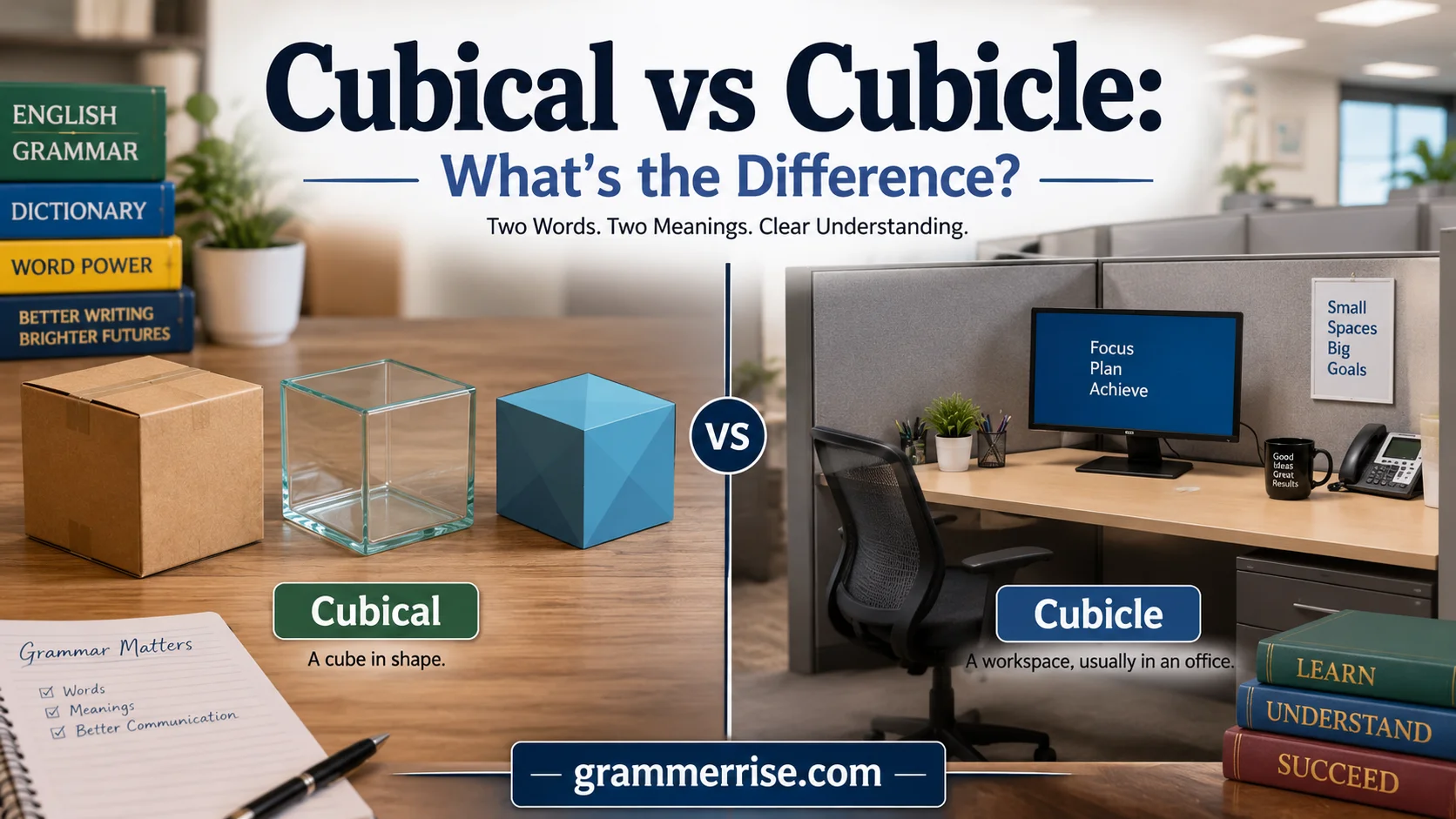
Cubical vs Cubicle creates confusion because many English speakers mix these words while writing about shapes, offices, and everyday situations. The terms look similar and sound almost the same, but their meanings are completely different. A cubical relates to a cube and describes a three-dimensional shape, while a cubicle refers to a physical office space. This difference matters in professional writing, academic contexts, and online communication because using the wrong word can change the meaning of a sentence. Understanding their definitions, origin, and real world usage helps people choose the correct term and improve language clarity.
A cubical describes a geometric object with volume, dimensions, sides, edges, and vertices. Its solid cubic form includes measurable length, width, and height, which are important in mathematics, design, and architecture. These measurements use mathematical formulae, figures, and values to calculate area, properties, symmetry, proportion, scale, and spatial characteristics.
A cubicle, in contrast, belongs to the office environment and workplace environment. It describes a small enclosed space, office workstation, booth, or partitioned area used for communication and organization. From experience, I have seen people make common mistakes because of pronunciation and spelling differences. Learning the correct spelling, context, and proper usage helps avoid misunderstandings and supports effective communication in everyday conversations, academic writing, and professional settings.
Quick Answer
Before diving deeper, here’s the simplest explanation.
| Word | Part of Speech | Meaning |
| Cubical | Adjective | Having the shape of a cube |
| Cubicle | Noun | A small partitioned room or workspace |
Examples
✅ The package arrived in a cubical box.
✅ She spends most of her day working in a cubicle.
❌ She works in a cubical.
❌ The cubicle box sat on the shelf.
A quick way to remember this distinction is:
Cubical describes shape. Cubicle describes space.
That single rule will help you avoid most mistakes.
What Does Cubical Mean?
The word cubical is an adjective. It describes something that resembles a cube or has approximately equal length, width, and height.
Imagine a dice sitting on a table. Its shape is cubical because all sides form a cube.
Definition of Cubical
Cubical means:
Having the form, appearance, or characteristics of a cube.
The term is commonly used in:
- Geometry
- Mathematics
- Engineering
- Architecture
- Product design
- Manufacturing
Although many people understand the word, it isn’t used frequently in everyday conversation.
Examples of Cubical in Sentences
- The architect designed a cubical glass structure.
- We stored the equipment inside a cubical container.
- The sculpture featured a cubical design.
- The storage unit had a nearly cubical shape.
- Engineers tested the cubical prototype before production.
Notice how cubical always describes another noun.
Common Uses of Cubical
You might encounter the word in situations involving shapes and dimensions.
Architecture
Modern buildings sometimes feature cubical forms because they maximize interior space.
Product Packaging
Many shipping boxes have cubical designs to improve stacking efficiency.
Mathematics
Students learn about cubical objects when studying three-dimensional geometry.
Industrial Design
Manufacturers often create cubical storage systems for warehouses.
Interesting Fact About Cubical
The word comes from the root cube, which originated from the Greek word kybos, meaning a six-sided die.
That connection explains why cubical always relates to shape.
What Does Cubicle Mean?
Unlike cubical, cubicle is a noun.
A cubicle refers to a small enclosed area separated by partitions.
Most people immediately think of office workspaces, but cubicles appear in many other places as well.
Definition of Cubicle
Cubicle means:
A small compartment, room, or workspace separated from surrounding areas.
Today, the word is strongly associated with office environments.
Examples of Cubicle in Sentences
- She decorated her cubicle with family photos.
- Every employee received a new cubicle after the renovation.
- The clinic contained several examination cubicles.
- The changing-room cubicles were recently upgraded.
- He spent the afternoon organizing his cubicle.
Where You Commonly Find Cubicles
Offices
The most familiar use of cubicles appears in workplaces.
Hospitals
Medical facilities often use cubicles for examinations and consultations.
Locker Rooms
Changing areas frequently include individual cubicles for privacy.
Libraries
Study cubicles help students focus on research.
Voting Stations
Election centers often provide voting cubicles.
Why Cubicles Became Popular
During the 1960s and 1970s, many businesses adopted cubicle systems because they balanced privacy and cost efficiency.
Companies could accommodate more employees without constructing permanent offices.
Today, cubicles remain common worldwide despite the growing popularity of open-office layouts.
Cubical vs Cubicle: The Key Differences
Although the words differ by only two letters, their meanings are completely different.
Comparison Table
| Feature | Cubical | Cubicle |
| Part of Speech | Adjective | Noun |
| Meaning | Cube-shaped | Small enclosed space |
| Used For | Describing shape | Naming a place |
| Common Context | Geometry, design | Offices, hospitals |
| Example | Cubical box | Office cubicle |
Difference in Meaning
Cubical describes appearance.
Cubicle identifies a location or compartment.
Difference in Grammar
Cubical functions as an adjective.
Example:
- A cubical container
Cubicle functions as a noun.
Example:
- An office cubicle
Difference in Context
Cubical appears more often in technical or academic discussions.
Cubicle appears frequently in workplace conversations.
Difference in Frequency
Most English speakers encounter cubicle far more often than cubical.
That’s one reason people accidentally substitute one word for the other.
Why People Confuse Cubical and Cubicle
The confusion doesn’t happen by accident.
Several factors contribute to the mix-up.
Similar Spellings
Compare the words:
- Cubical
- Cubicle
At a glance, they look almost identical.
Similar Pronunciation
In casual speech, many people pronounce them so similarly that listeners may not notice the difference.
Shared Root Word
Both words originate from the concept of a cube.
That shared history makes them feel related.
Workplace Influence
People frequently hear the word cubicle in offices.
When writing about shapes, they sometimes mistakenly use cubicle because it feels more familiar.
Cubical vs Cubicle in Grammar
Understanding grammar makes the distinction crystal clear.
Cubical Is an Adjective
Adjectives describe nouns.
Examples:
- Cubical room
- Cubical package
- Cubical sculpture
Notice that cubical adds information about shape.
Cubicle Is a Noun
Nouns name people, places, things, or ideas.
Examples:
- The cubicle needs cleaning.
- Her cubicle faces the window.
- The cubicle contains a standing desk.
In each example, cubicle is the thing being discussed.
Correct Usage Examples
| Correct Sentence | Why It Works |
| The cubical box fit perfectly. | Cubical describes shape |
| She works in a cubicle. | Cubicle names a workspace |
| The building has a cubical design. | Shape description |
| Every employee has a cubicle. | Physical compartment |
Incorrect Usage Examples
| Incorrect Sentence | Correct Version |
| She works in a cubical. | She works in a cubicle. |
| The cubicle package arrived today. | The cubical package arrived today. |
| We purchased cubicle containers. | We purchased cubical containers. |
| He decorated his cubical. | He decorated his cubicle. |
Common Mistakes and How to Avoid Them
Even experienced writers make mistakes with these words.
Mistake: Using Cubical for an Office Workspace
Incorrect:
- My cubical is near the break room.
Correct:
- My cubicle is near the break room.
Mistake: Using Cubicle for Shape
Incorrect:
- The toy came in a cubicle box.
Correct:
- The toy came in a cubical box.
Mistake: Treating Them as Synonyms
These words are not interchangeable.
Changing one to the other changes the meaning completely.
Easy Memory Trick
Think about the ending.
Cubicle ends with “cle.”
Imagine:
Cubicle = compartment for labor and employment.
Both involve people working.
Cubical ends with “al.”
Many adjectives end in “-al”:
- Natural
- Logical
- Musical
- Cubical
That makes it easier to remember its grammatical role.
Cubical vs Cubicle Examples in Everyday Writing
Let’s see how these words appear in real-life situations.
Business Communication
Correct:
The new cubicles were installed over the weekend.
Incorrect:
The new cubicals were installed over the weekend.
Product Descriptions
Correct:
This cubical storage box holds up to 20 pounds.
Incorrect:
This cubicle storage box holds up to 20 pounds.
Educational Writing
Correct:
Students analyzed cubical structures during geometry class.
Workplace Reports
Correct:
Management replaced 50 cubicles during the office renovation.
Construction Documents
Correct:
The architect proposed a cubical building design.
Cubical vs Cubic: Are They the Same?
Another source of confusion involves the word cubic.
Although related, cubic and cubical aren’t always interchangeable.
What Does Cubic Mean?
Cubic usually refers to:
- Volume
- Three-dimensional measurements
- Mathematical calculations
Examples:
- Cubic feet
- Cubic meters
- Cubic inches
Read more: Catalog or Catalogue: Which Spelling Is Correct?
What Does Cubical Mean?
Cubical emphasizes appearance or shape.
Examples:
- Cubical room
- Cubical structure
- Cubical container
Comparison Table
| Word | Primary Use |
| Cubic | Measurements and volume |
| Cubical | Shape and appearance |
Example
- The tank holds 50 cubic feet of water.
- The tank has a cubical design.
Both sentences are correct but communicate different ideas.
The History of Cubical
The word cubical has deep historical roots.
Its origins trace back through:
- Latin: cubus
- Greek: kybos
- Old French influences
- Middle English development
Mathematicians used cube-related terminology for centuries before modern English adopted the adjective cubical.
Because geometry played an important role in architecture and engineering, the word became established in technical language.
The History of Cubicle
Cubicle has a surprisingly different history.
It originates from the Latin word cubiculum, meaning:
A sleeping chamber or small room.
Over time, English speakers adapted the term to describe any small enclosed compartment.
Eventually, businesses adopted the word for partitioned office workspaces.
Today, when people hear “cubicle,” they usually imagine rows of office desks separated by walls.
Real-World Case Study: Office Renovation Confusion
A facilities manager sent an email requesting:
Replace damaged cubicals on the third floor.
The maintenance company initially became confused.
Did the request refer to cube-shaped fixtures or office workstations?
After clarification, the manager corrected the message:
Replace damaged cubicles on the third floor.
The project proceeded without issues.
This example shows how a small spelling error can create misunderstandings in professional communication.
Quick Quiz: Cubical or Cubicle?
Choose the correct word.
Question 1
The package arrived in a ______ container.
Answer: Cubical
Question 2
She personalized her office ______.
Answer: Cubicle
Question 3
The architect proposed a ______ design.
Answer: Cubical
Question 4
Every employee received a larger ______.
Answer: Cubicle
Question 5
The sculpture featured a ______ shape.
Answer: Cubical
If you answered all five correctly, you’ve mastered the difference.
Expert Writing Tips
Professional writers often use a simple editing strategy.
When you encounter either word, ask yourself:
Is It Describing Shape?
If yes, use cubical.
Examples:
- Cubical box
- Cubical room
- Cubical sculpture
Is It Naming a Space?
If yes, use cubicle.
Examples:
- Office cubicle
- Study cubicle
- Medical cubicle
This quick test works nearly every time.
FAQs
1. What is the main difference between cubical and cubicle?
The main difference is their meaning and usage. Cubical is an adjective that describes something related to a cube or a three-dimensional shape. Cubicle is a noun that refers to a small enclosed space, especially an office workspace separated by partitions.
2. Is cubical a correct English word?
Yes, cubical is a correct English word. It is used to describe objects, structures, or shapes that have cube-like qualities. For example, a cubical box has a shape similar to a cube with equal sides.
3. Is a cubicle only used in offices?
No, a cubicle is commonly used for office workspaces, but it can also describe other small partitioned or enclosed areas. For example, voting cubicles and study cubicles are spaces designed for privacy and specific activities.
4. Why do people confuse cubical and cubicle?
People confuse these words because they look almost identical and have a similar pronunciation. However, their meanings come from different contexts. One relates to geometry and shape, while the other relates to a physical space or workplace area.
5. Can I use cubical and cubicle interchangeably?
No, you should not use them interchangeably. Replacing cubicle with cubical can make a sentence incorrect because the words have different grammatical roles and meanings. Choosing the right word improves clarity and accuracy in communication.
6. How can I remember the difference between cubical and cubicle?
A simple way to remember is that cubical contains the idea of a cube shape, while cubicle refers to a place or space. Think of “cube” for geometry and “cubicle” for a workplace or enclosed area.
Conclusion
Understanding the difference between cubical vs cubicle helps you avoid small spelling mistakes that can create major confusion in communication. Although both words appear similar, they belong to different areas of meaning. Cubical describes a cube-like shape, structure, or object connected to geometry, mathematics, and measurements, while cubicle refers to a separate physical space, such as an office workstation or partitioned area.
Using these words correctly improves your writing, speaking, and overall language accuracy. Whether you are discussing a geometric figure or describing a workplace environment, choosing the right term makes your message clearer and more professional. Once you remember that cubical relates to cubes and cubicle relates to spaces, you can confidently use both words without confusion.

Hussain Abid is an English language writer with over 10 years of experience in grammar, spelling, vocabulary, and writing. He specializes in creating clear, well-researched content that helps readers improve their English with confidence. At GrammarRise, Hussain writes practical guides, grammar explanations, and word comparison articles based on trusted language sources and real-world usage. His mission is to make English learning simple, accurate, and accessible for everyone