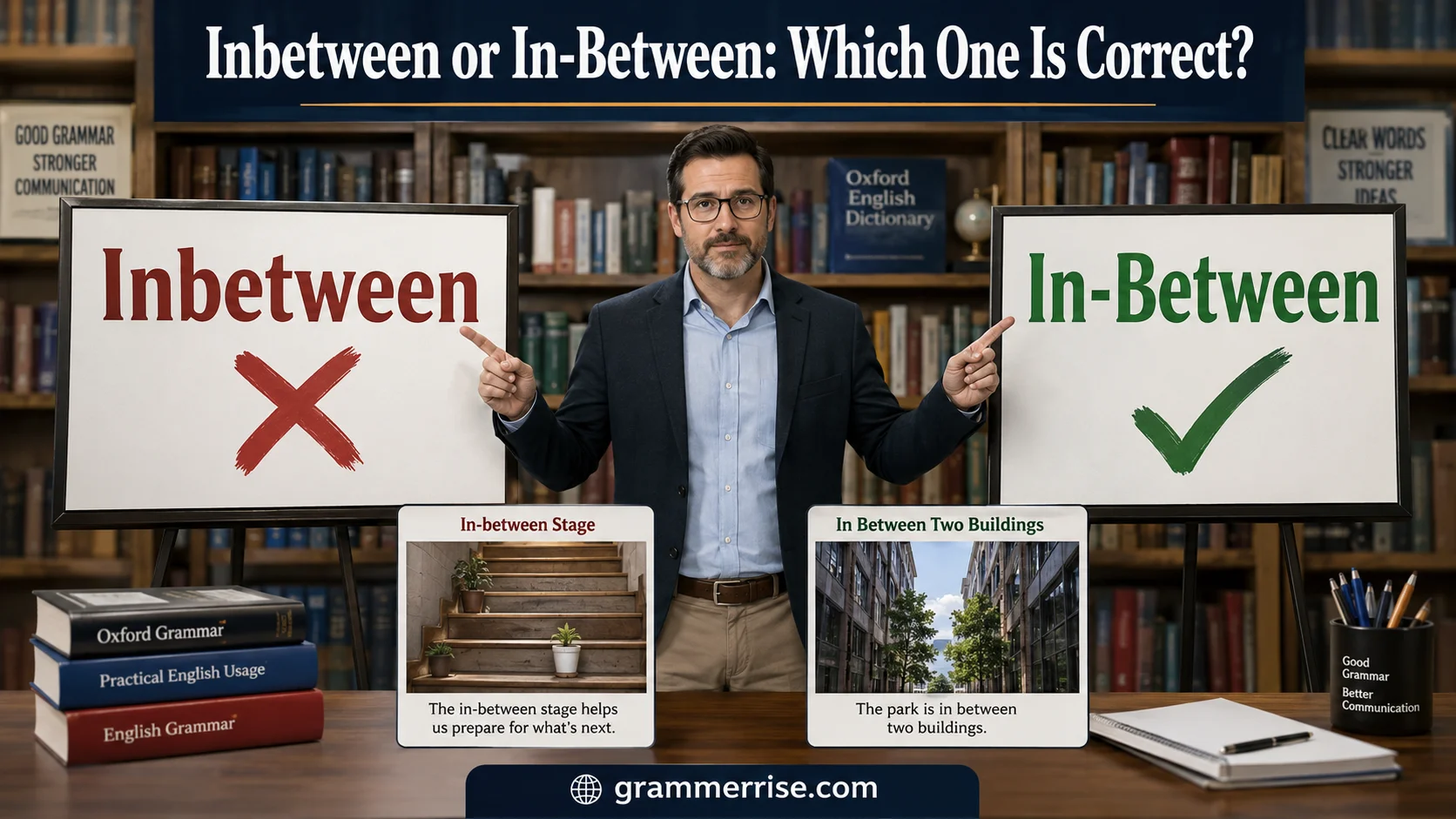
Many writers get confused when deciding between Inbetween or In-Between because the words look almost identical, but the correct choice depends on grammar, structure, and usage. This question appears often in emails, essays, blogs, and professional documents where the expression may be written as one word, with a hyphen as a hyphenated form, or as separate two words.
English has different open compound forms, but selecting the wrong form can make writing seem careless or informal. A complete guide to the difference between inbetween, in-between, and in between helps explain grammar rules, real-world examples, and clear meanings so learners build confidence while choosing the right expression every time.
Understanding these two forms is important for clear English writing because students, professionals, and native speakers often encounter this spelling question. At first glance, both forms may seem reasonable because compound words are easy to misunderstand. However, specific rules help writers avoid mistakes while composing an email, social media post, school assignment, or professional content. A small spelling mistake can affect readability and credibility.
This article explores inbetween vs in-between, explains grammar concepts, provides examples, and highlights common errors. The term in-between refers to something that exists between two extremes, including physical space, time, opinions, and conceptual states.
Quick Answer
If you’re looking for the short answer, here it is:
✅ In-between = Correct when used as a noun or adjective.
✅ In between = Correct when used as a phrase.
❌ Inbetween = Generally considered incorrect in standard English.
Quick Comparison
| Form | Correct? | Usage |
| In-between | Yes | Noun or adjective |
| In between | Yes | Prepositional phrase |
| Inbetween | No | Nonstandard spelling |
Examples
Correct:
- We are in an in-between stage of the project.
- The coffee shop sits in between two office buildings.
Incorrect:
- We are in an inbetween stage of the project.
Most dictionaries, style guides, and professional editors recommend avoiding inbetween in formal writing.
What Does In-Between Mean?
The term in-between describes something that exists in a middle state. It often refers to a transition, a period of uncertainty, or a position that isn’t clearly one thing or another.
Definition of In-Between
As a noun or adjective, in-between means:
- Existing between two points
- Falling between two categories
- Being in a transitional stage
- Occupying a middle position
For example:
- Adolescence is often considered an in-between phase between childhood and adulthood.
- Spring can feel like an in-between season.
In both examples, the word describes a state that isn’t fully one thing or another.
Pronunciation
Most speakers pronounce it as:
in-bi-TWEEN
The pronunciation remains the same whether it’s written as in-between or in between.
Origin of the Word
The concept comes from combining the words in and between.
English often creates compound expressions this way. Some compounds eventually become one word, while others retain a hyphen. In the case of in-between, the hyphen remains the standard form when the term acts as a noun or adjective.
Why Is Inbetween Incorrect?
Many English learners assume that if two words frequently appear together, they can be merged into one word. Sometimes that’s true.
For example:
- Every day → Everyday
- Any time → Anytime
- Back up → Backup
However, language doesn’t follow a universal rule.
Why People Write Inbetween
Several factors contribute to the mistake:
- Fast typing habits
- Autocorrect errors
- Lack of familiarity with hyphenated compounds
- Influence from social media and informal writing
- Confusion with similar compound words
Because people frequently see variations online, the incorrect spelling spreads quickly.
What Dictionaries Say
Major dictionaries generally recognize:
- In between
- In-between
They do not list inbetween as the preferred standard spelling.
That means professional editors will usually correct it before publication.
When Should You Use In-Between?
Understanding the function of the word makes the choice easy.
Using In-Between as an Adjective
An adjective describes a noun.
Examples:
- We entered an in-between period.
- She wears an in-between clothing size.
- The company is in an in-between growth stage.
Here, in-between directly describes another noun.
Using In-Between as a Noun
Sometimes the term becomes a thing itself.
Examples:
- Many people struggle with the in-between.
- The story explores life’s in-between.
- The novel focuses on emotional in-betweens.
In these cases, the word functions as a noun.
Common Situations Where In-Between Appears
You often see it in discussions about:
- Personal growth
- Career changes
- Relationships
- Education
- Business transitions
- Life stages
For example, graduating from college often creates an in-between period where someone is no longer a student but hasn’t yet settled into a long-term career.
Read more: Cubical vs Cubicle: What’s the Difference?
In Between vs In-Between: The Difference Explained
This is where most confusion occurs.
Although the terms look nearly identical, they perform different grammatical jobs.
In Between (Two Words)
In between functions as a phrase.
It usually indicates position, location, or relationship.
Examples:
- The library sits in between two apartment buildings.
- She stood in between her parents.
- The answer lies in between the two extremes.
The phrase explains where something is located or positioned.
In-Between (Hyphenated)
In-between acts as a noun or adjective.
Examples:
- We are in an in-between phase.
- The film explores the in-between.
- He occupies an in-between role.
Side-by-Side Comparison
| Sentence | Correct Form |
| The cafe is ___ two banks. | In between |
| We entered an ___ stage of development. | In-between |
| She stood ___ her friends. | In between |
| The book explores life’s ___. | In-between |
Simple Rule
Ask yourself:
Am I describing a location or position?
If yes, use in between.
Am I describing a state, stage, or condition?
If yes, use in-between.
Is Inbetween Ever Accepted?
In standard English, not really.
However, there are exceptions in special situations.
Brand Names
Companies sometimes create unique spellings.
Examples might include:
- Product names
- Business names
- Website names
- App names
In those cases, spelling follows branding rules rather than grammar rules.
Usernames and Online Handles
People frequently use:
- inbetweenlife
- inbetweenworlds
- inbetweendesign
These are stylistic choices rather than grammatical examples.
Creative Writing
Novelists occasionally bend language rules for artistic effect.
Still, professional editors generally prefer in-between unless there is a specific reason not to.
Professional Recommendation
For academic, business, and professional writing:
Use “in-between” or “in between.” Avoid “inbetween.”
Common Examples of In-Between in Sentences
Learning through examples helps the rule stick.
Everyday Conversation
- I’m in an in-between stage right now.
- Life feels a little in-between after moving.
- The weekend sits in between two busy workweeks.
Workplace Examples
- The company is going through an in-between phase.
- Our office sits in between two major highways.
- We need a plan for this in-between period.
Academic Examples
- Adolescence represents an in-between developmental stage.
- The researcher found differences in between the groups.
- The study focused on in-between identities.
Creative Writing Examples
- She lived in the in-between, neither here nor there.
- The old bridge stood in between two worlds.
- His journey explored life’s hidden in-betweens.
Words Commonly Confused With In-Between
English contains many similar word pairs.
Understanding them helps prevent mistakes.
Into vs In To
| Correct Form | Example |
| Into | She walked into the room. |
| In to | She checked in to the hotel. |
Everyday vs Every Day
| Correct Form | Example |
| Everyday | An everyday occurrence |
| Every day | I exercise every day |
Anytime vs Any Time
| Correct Form | Example |
| Anytime | Call me anytime |
| Any time | I don’t have any time left |
Backup vs Back Up
| Correct Form | Example |
| Backup | We need a backup plan |
| Back up | Please back up your files |
These examples show why compound words often create confusion.
Synonyms for In-Between
Sometimes another word fits better.
Useful Alternatives
| Synonym | Best Context |
| Intermediate | Formal writing |
| Transitional | Change and progress |
| Middle | General use |
| Midway | Position |
| Borderline | Classification |
| Between | Simple alternative |
| Median | Statistics |
| Central | Location |
| Connecting | Relationships |
| Bridge | Metaphorical usage |
Example Replacements
Instead of:
We are in an in-between stage.
You could write:
We are in a transitional stage.
Or:
We are in an intermediate stage.
The meaning remains similar while the wording changes.
Grammar Rules to Remember
Grammar becomes much easier when broken into practical rules.
Rule One: Use In Between for Position
Examples:
- The restaurant sits in between two stores.
- The child stood in between her siblings.
Think about physical or conceptual location.
Rule Two: Use In-Between as a Noun
Examples:
- The story explores the in-between.
- Nobody likes the uncertainty of the in-between.
Rule Three: Use In-Between as an Adjective
Examples:
- We entered an in-between season.
- It’s an in-between period in the market.
Real-World Examples From Published Writing
Professional writers regularly use these forms correctly.
News Writing
Journalists often write:
- An in-between election period
- An in-between season
- A state in between economic extremes
Business Publications
Corporate reports frequently discuss:
- Transitional periods
- In-between market conditions
- Phases in between major product launches
Literature
Authors often use the in-between to describe:
- Emotional uncertainty
- Personal transformation
- Spiritual journeys
- Transitional moments
This usage gives the phrase symbolic power.
Easy Memory Tricks
Grammar rules are easier to remember with shortcuts.
The Location Test
Ask:
Can I point to where something is?
If yes:
Use in between.
Example:
- The school sits in between two parks.
The Stage Test
Ask:
Am I describing a condition or phase?
If yes:
Use in-between.
Example:
- We entered an in-between stage.
The Replacement Trick
Replace the phrase with transitional.
If the sentence still works, use in-between.
Example:
- An in-between period
- A transitional period
Both make sense.
Common Mistakes to Avoid
Even experienced writers make these errors.
Combining Everything Into One Word
Incorrect:
- Inbetween phase
- Inbetween state
Correct:
- In-between phase
- In-between state
Confusing Phrase and Adjective Forms
Incorrect:
- The house is in-between two buildings.
Better:
- The house is in between two buildings.
Overusing Hyphens
Not every appearance requires a hyphen.
Compare:
- The office sits in between two banks.
- We are in an in-between period.
Different sentence structures require different forms.
Why This Mistake Matters
Some spelling errors barely affect readability.
This isn’t one of them.
Professional writing relies on consistency and accuracy.
Whether you’re writing:
- Blog articles
- School essays
- Business reports
- Marketing copy
- Website content
Using the correct form shows attention to detail.
Readers may not consciously notice correct grammar. However, they often notice mistakes.
Strong writing builds trust one sentence at a time.
FAQs
1. Is “inbetween” a correct English word?
No, “inbetween” is generally not accepted as a standard English word. The correct forms are usually “in-between” when used as an adjective and “in between” when used as a phrase showing position, time, or a middle point. Writing inbetween as one word is a common mistake caused by informal writing habits and spoken language.
2. What is the difference between “in-between” and “in between”?
The main difference is how they function in a sentence. “In-between” is commonly used as a descriptive word before a noun, such as “an in-between size.” On the other hand, “in between” works as a phrase that describes a location, position, or relationship, such as “The shop is in between the bank and the school.”
3. Why do people write “inbetween” instead of “in between”?
Many people write inbetween because English has many compound words that combine two separate words into one. Since words like “inside” and “into” exist, writers may assume that inbetween follows the same pattern. However, grammar rules do not recognize it as the standard form in most situations.
4. Can “in-between” be used in formal writing?
Yes, in-between can be used in formal writing when it works as an adjective. For example, phrases like “an in-between stage” or “an in-between position” are acceptable. However, writers should avoid replacing the phrase in between with the hyphenated form when describing a location or relationship.
5. What are common mistakes when using in-between?
The most common mistake is using inbetween as a single word in professional documents, academic papers, or online content. Another mistake is using in-between and in between interchangeably without considering their grammatical role in a sentence. Understanding their purpose helps improve clarity and accuracy.
6. How can I remember the correct usage of in-between?
A simple way to remember is to check the role of the expression. If it describes something, use in-between with a hyphen. If it shows a position, place, or connection between two things, use in between as two words. Practicing with real examples can make choosing the correct form easier.
Conclusion
Understanding the difference between inbetween or in-between helps you write with more accuracy and confidence. Although these forms look similar, they do not always serve the same purpose in English grammar. In most cases, in between is the correct choice when describing a position, space, time, or relationship between two things, while in-between is used when it works as an adjective before a noun.
Many spelling mistakes happen because spoken English makes these expressions sound identical. However, paying attention to grammar rules, sentence structure, and context can help you avoid confusion. Whether you are writing an email, academic paper, blog post, or professional document, choosing the right form improves readability and credibility.
Remember that small language details can make a big difference in communication. By practicing examples and understanding how in-between and in between work, you can confidently use the expression correctly in everyday and formal writing.

Hussain Abid is an English language writer with over 10 years of experience in grammar, spelling, vocabulary, and writing. He specializes in creating clear, well-researched content that helps readers improve their English with confidence. At GrammarRise, Hussain writes practical guides, grammar explanations, and word comparison articles based on trusted language sources and real-world usage. His mission is to make English learning simple, accurate, and accessible for everyone