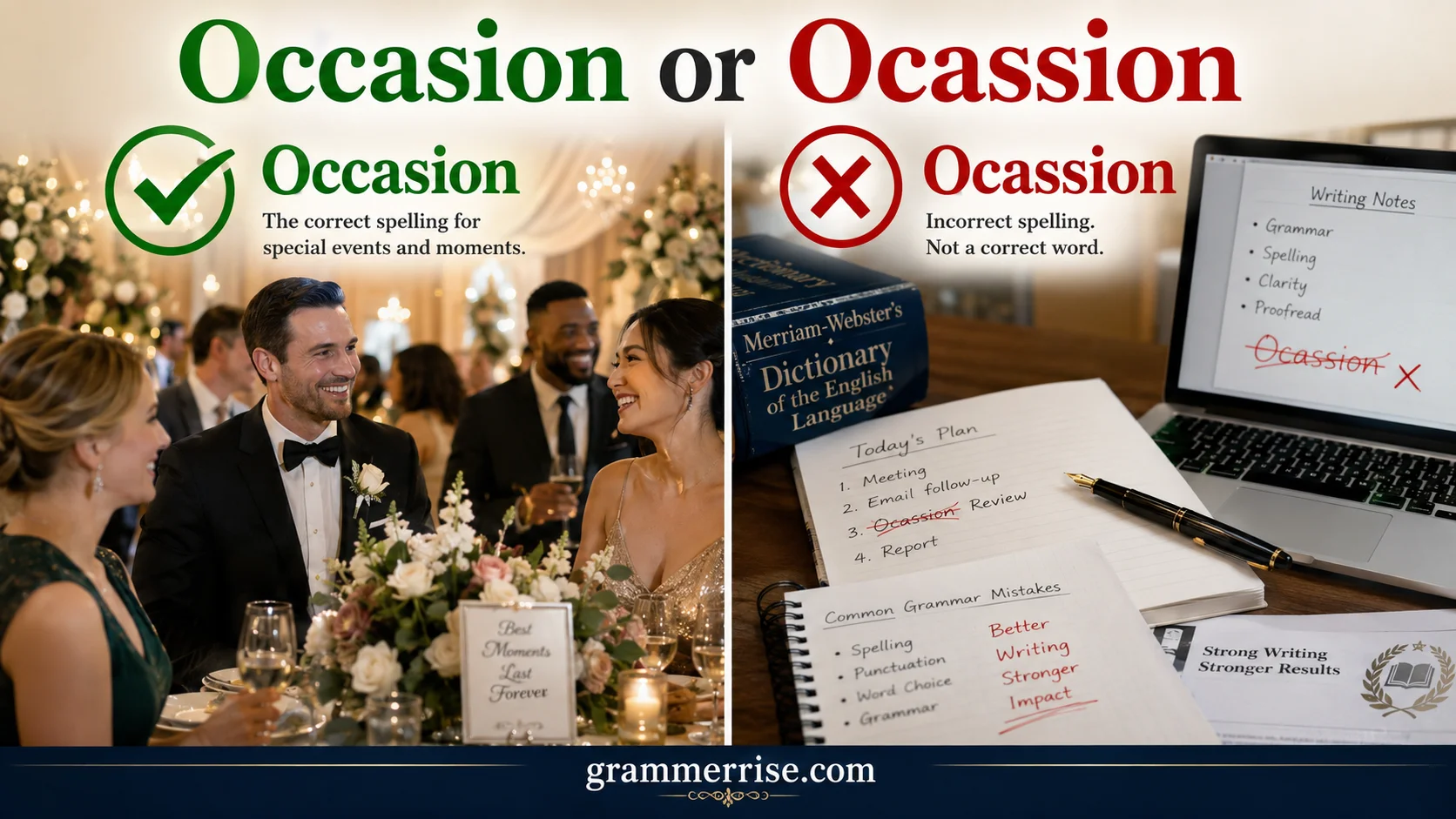
Many writers search “Occasion or Ocassion” because this spelling confusion appears in writing, emails, and formal messages when choosing a word. I have also faced this mistake while preparing professional documents and checking my own work. The incorrect version can look acceptable at first glance because the pronunciation does not clearly reveal the double letters.
After seeing the word marked as wrong in a document, I decided to fix the error by learning a simple rule. The correct spelling is occasion, and it follows the proper letter order. Regular daily writing practice and proofreading helped remove this spelling mistake while improving my writing skills, accuracy, and language learning.
The main spelling confusion happens because occasion contains double consonants that are easy to misplace. The correct form uses double c followed by sion, while the incorrect version swaps the letters and creates an error. Thousands of people search this exact question every month because even experienced writers can confuse this frequently misspelled word. The good news is that the answer is straightforward: only one spelling is accepted in English dictionaries, academic writing, business communication, and professional publications.
Quick Answer
If you’re wondering whether occasion or ocassion is correct, the answer is simple: occasion is the only correct spelling. Ocassion is a common misspelling and isn’t recognized as a valid English word. Use occasion whenever you’re referring to a special event, celebration, important moment, reason, or opportunity. A simple way to remember it is two Cs come before one S. Once you learn that pattern, you’ll spell occasion correctly every time.
Occasion or Ocassion: Which One Is Correct?
The answer is simple.
Occasion is the correct spelling.
Ocassion is a misspelling and should never appear in formal or informal writing.
Whether you’re writing an academic paper, sending a business email, creating a wedding invitation, or posting on social media, occasion is always the correct choice.
| Word | Correct | Meaning |
| Occasion | ✅ Yes | A particular event, time, reason, or opportunity |
| Ocassion | ❌ No | Incorrect spelling of occasion |
Many spelling errors happen because people rely on pronunciation instead of memorizing the word’s letter pattern. In spoken English, the two c letters blend together, making it easy to mistakenly write a double s instead.
Remember this simple rule:
Two Cs come before one S.
That pattern never changes.
Here are a few correct examples:
- Today is a special occasion.
- We celebrated the happy occasion with family.
- Thank you for attending this important occasion.
- This is a rare occasion.
- They dressed formally for the occasion.
Incorrect examples include:
- ❌ Today is a special ocassion.
- ❌ It was a memorable ocassion.
- ❌ Thank you for this wonderful ocassion.
Replacing ocassion with occasion immediately fixes the mistake.
What Does Occasion Mean?
The word occasion has several related meanings. Although the exact definition changes slightly depending on the sentence, the central idea remains the same. An occasion refers to a particular event, time, reason, or opportunity.
Because the word has several meanings, you’ll see it used in everyday conversations, books, newspapers, legal writing, business communication, and formal speeches.
Occasion as an Event
The most common meaning describes an event or happening.
Examples include birthdays, weddings, graduations, anniversaries, award ceremonies, family gatherings, and national celebrations.
For example:
- Our graduation was a memorable occasion.
- The award ceremony became a historic occasion.
- Everyone smiled throughout the joyful occasion.
In these examples, occasion simply means an event.
Occasion as a Special Celebration
Many celebrations are described as occasions because they bring people together for an important purpose.
Examples include:
- Wedding occasions
- Birthday occasions
- Holiday occasions
- Religious occasions
- Cultural occasions
- Retirement occasions
- Graduation occasions
Each one represents a meaningful event worth celebrating.
For example:
Christmas is a special occasion celebrated around the world.
Another example:
Their fiftieth wedding anniversary was a wonderful occasion for the entire family.
Occasion as a Reason
Sometimes occasion means a reason or cause for doing something.
Consider these examples:
- There is no occasion to worry.
- We had every occasion to celebrate.
- She found no occasion to complain.
Here, the word means reason rather than event.
This usage appears frequently in formal English and literature.
Occasion as an Opportunity
Another meaning refers to an opportunity or suitable moment.
Examples include:
- This is the perfect occasion to thank your parents.
- The meeting provided an occasion to discuss future plans.
- The conference created an occasion for international cooperation.
Although this meaning is slightly less common than “event,” it remains correct and widely accepted.
Why Do People Spell Occasion as Ocassion?
Misspellings usually happen for understandable reasons. Ocassion isn’t a random mistake. Several factors make this word difficult to spell correctly.
Double Letters Cause Confusion
English contains many words with repeated letters.
Examples include:
- Accommodation
- Necessary
- Committee
- Opportunity
- Successful
- Occasion
Because these words don’t always follow obvious pronunciation patterns, writers often guess where the double letters belong.
With occasion, people mistakenly double the s instead of remembering the double c.
Pronunciation Doesn’t Reveal the Spelling
When someone says occasion, you don’t clearly hear two separate c sounds.
Instead, the pronunciation flows smoothly.
As a result, many writers spell the word exactly as they hear it, leading to the incorrect form ocassion.
Typing Quickly Increases Errors
Fast typing often creates spelling mistakes.
Many people know the correct spelling mentally yet accidentally type ocassion because their fingers move faster than their brain processes each letter.
Spell-check usually catches the mistake, although handwritten work doesn’t have that advantage.
Similar English Words
Several English words contain similar sounds.
For example:
- Passion
- Mission
- Session
- Discussion
These words use double s, so writers sometimes assume occasion follows the same pattern.
It doesn’t.
Instead, occasion follows its own spelling pattern with double c followed by a single s.
How to Spell Occasion Correctly
Breaking a word into smaller parts often makes it easier to remember.
Here’s the correct spelling.
O C C A S I O N
Notice the structure carefully.
- O
- CC
- A
- S
- I
- O
- N
There are:
- Two C’s
- One S
- Nine total letters
Many students remember it by grouping the letters instead of memorizing each one individually.
Think of it like this:
Oc + ca + sion
That pattern stays consistent in every form of the word.
Related words also keep the same spelling.
| Word | Correct Spelling |
| Occasion | ✅ |
| Occasional | ✅ |
| Occasionally | ✅ |
| Occasioned | ✅ |
| Occasioning | ✅ |
Every one of these words begins with Occ.
That consistency makes the spelling easier to remember once you recognize the pattern.
Easy Memory Tricks to Remember Occasion
Simple memory techniques often work better than repeatedly checking a dictionary.
Here are several tricks that help many English learners remember the correct spelling.
Think “Two Cs Before One S”
This is the easiest memory trick.
Repeat it whenever you write the word.
Two Cs before one S.
You’ll quickly build the habit of spelling it correctly.
Remember the Beginning
Nearly every spelling mistake happens near the beginning of the word.
Instead of focusing on the entire word, simply remember:
Occ…
Once you’ve written Occ, the rest becomes much easier.
Connect It With Related Words
Notice how these words all begin the same way.
- Occur
- Occurrence
- Occupy
- Occupation
- Occasion
Seeing this repeating Occ pattern strengthens your memory.
Read more: Inbetween or In-Between: Meaning, Grammar Rules and Examples
Use a Sentence
Create a memorable sentence.
On every Occasion, two Clever Cats Smile.
The phrase Clever Cats reminds you to write two C’s before the S.
Funny memory tricks often stay with you longer than spelling rules.
Practice Through Repetition
Writing the word correctly several times helps build muscle memory.
For example:
- Occasion
- Occasion
- Occasion
- Occasion
- Occasion
After enough repetition, your brain automatically recognizes the correct spelling without hesitation.
Origin and Etymology of Occasion
Understanding a word’s history often explains why it has an unusual spelling.
The word occasion comes from the Latin word occasio, which meant a favorable opportunity, chance, or occurrence. It developed from the Latin verb occidere, meaning to fall before or happen in certain historical contexts.
Later, the word entered Old French as occasion before becoming part of Middle English. Over time, English kept the spelling with the double c, which explains why today’s correct form remains occasion instead of ocassion.
Although English pronunciation has evolved over centuries, the spelling has remained remarkably stable. That historical consistency is one reason dictionaries and style guides continue to recognize only occasion as correct.
The spelling may look unusual compared with how the word sounds, yet it reflects centuries of linguistic development rather than modern pronunciation.
Pronunciation of Occasion
Knowing the correct spelling is only part of using occasion confidently. Pronouncing it correctly helps you communicate more naturally in conversations, presentations, and formal speeches.
American Pronunciation
Occasion is pronounced:
/əˈkeɪʒən/
You can break it into three parts:
uh – KAY – zhun
The stress falls on the second syllable.
Examples:
- It’s a special occasion.
- We celebrated the happy occasion together.
- Every occasion deserves appreciation.
British Pronunciation
The British pronunciation is almost identical:
/əˈkeɪʒən/
The difference lies mainly in accent rather than pronunciation.
Pronunciation Tips
If you’re learning English, try these tips:
- Don’t pronounce both c letters separately.
- Make the middle sound like KAY.
- End with a soft zhun sound, similar to the ending of vision or decision.
Say it slowly first.
uh – KAY – zhun
Then speed up naturally.
Reading the word aloud several times will help connect its spelling with its pronunciation.
Common Collocations With Occasion
A collocation is a natural combination of words that native English speakers frequently use together. Learning collocations makes your writing sound more fluent and natural.
Below are some of the most common collocations with occasion.
| Collocation | Meaning | Example |
| Special occasion | An important event | We bought a cake for the special occasion. |
| Happy occasion | A joyful event | Graduation was a happy occasion. |
| Formal occasion | An event requiring formal behavior or clothing | He wore a tuxedo for the formal occasion. |
| Rare occasion | Something that happens infrequently | On rare occasions, the museum stays open late. |
| Historic occasion | An event with historical importance | The treaty signing became a historic occasion. |
| Memorable occasion | An event people remember | It was a memorable occasion for everyone. |
| Family occasion | A gathering with relatives | Thanksgiving is a family occasion. |
| Public occasion | An event open to the public | The mayor attended the public occasion. |
| Social occasion | A gathering for interaction | Weddings are popular social occasions. |
| Suitable occasion | The right time or event | This is a suitable occasion to thank your team. |
These combinations appear frequently in books, newspapers, speeches, and business communication.
Occasion in Everyday Conversation
In daily life, people often use occasion when talking about celebrations or important events.
Examples include:
- That’s a special occasion.
- We don’t celebrate this occasion every year.
- It was a wonderful occasion.
- Thank you for joining us on this occasion.
- Everyone enjoyed the occasion.
These expressions sound natural because they follow common English usage.
Occasion in Invitations
The word frequently appears in invitations.
Examples:
- We request the pleasure of your company on this joyous occasion.
- Join us as we celebrate this special occasion.
- We warmly invite you to this memorable occasion.
- We hope you’ll share this important occasion with us.
Because invitations often have a formal tone, occasion fits perfectly.
Occasion in Business Writing
Businesses use occasion in emails, announcements, and speeches.
Examples:
- We’d like to mark this important occasion by thanking our customers.
- The company celebrated the occasion with a charity event.
- This occasion represents another milestone in our growth.
The word adds professionalism without sounding overly complicated.
Occasion in Academic Writing
Students and researchers also use occasion in essays and reports.
Examples include:
- The speech marked an important political occasion.
- The ceremony became a significant cultural occasion.
- The occasion highlighted changing social attitudes.
Academic writing often uses occasion to describe historical events or significant moments.
Occasion in Different Contexts
One reason occasion remains such a valuable English word is its flexibility. It fits naturally into both casual and formal situations.
Let’s explore how its meaning changes across different contexts.
Everyday Life
Most people encounter the word when discussing celebrations.
Examples include:
- Birthday parties
- Weddings
- Graduation ceremonies
- Baby showers
- Family reunions
- Holiday dinners
- Retirement parties
Example:
Our family gathers every year for this special occasion.
Professional Settings
Companies often celebrate achievements and milestones.
Examples include:
- Product launches
- Award ceremonies
- Retirement celebrations
- Company anniversaries
- Corporate dinners
Example:
The CEO addressed employees on the occasion of the company’s twentieth anniversary.
Education
Schools regularly organize occasions that bring students, teachers, and parents together.
Examples include:
- Graduation
- Prize distribution
- Science fairs
- School festivals
- Orientation programs
Example:
Parents attended the occasion to celebrate their children’s achievements.
Government and Public Events
Governments organize many official occasions throughout the year.
Examples include:
- National holidays
- Independence Day ceremonies
- Military parades
- Official inaugurations
- Memorial services
These occasions often carry historical and cultural importance.
Religious Celebrations
Many religions observe important occasions that hold spiritual meaning.
Examples include:
- Christmas
- Easter
- Eid
- Diwali
- Hanukkah
- Vesak
Each occasion reflects traditions, beliefs, and community values.
Occasion as Different Parts of Speech
Although occasion usually functions as a noun, it can also serve as a verb in formal English.
Understanding both uses helps you recognize the word in different contexts.
Occasion as a Noun
This is the most common usage.
It refers to an event, reason, opportunity, or particular time.
Examples:
- It was a joyful occasion.
- We celebrated the occasion with friends.
- The occasion called for formal clothing.
- There was no occasion for concern.
- This occasion deserves recognition.
In everyday English, you’ll almost always encounter occasion as a noun.
Occasion as a Verb
As a verb, occasion means to cause or to bring about something.
This usage appears mostly in formal writing, journalism, legal documents, and academic texts.
Examples:
- The storm occasioned widespread flooding.
- His resignation occasioned public debate.
- The accident occasioned significant delays.
- The announcement occasioned widespread excitement.
Although grammatically correct, this verb form is less common in everyday conversation.
Most people would simply say:
- The storm caused flooding.
- His resignation started public debate.
Both versions communicate the same idea, although occasioned sounds more formal and literary.
Synonyms of Occasion
The English language offers several alternatives to occasion, but each carries a slightly different meaning. Choosing the right synonym depends on the context. While some words describe celebrations, others emphasize a reason, opportunity, or specific point in time.
The table below highlights the most common synonyms and when to use them.
| Synonym | Best Used For | Example |
| Event | A general happening | The sporting event attracted thousands of fans. |
| Celebration | A joyful gathering | The celebration lasted all evening. |
| Ceremony | A formal event | The graduation ceremony began at noon. |
| Function | An organized social or business gathering | The hotel hosted a charity function. |
| Gathering | People meeting together | The family gathering brought everyone together. |
| Festival | A public celebration | The music festival welcomed visitors from around the world. |
| Milestone | An important achievement | Their tenth anniversary was a major milestone. |
| Opportunity | A favorable chance | The internship created a valuable opportunity. |
| Reason | A cause for something | There was no reason to cancel the trip. |
| Moment | A particular point in time | It was a moment to remember forever. |
Which Synonym Should You Choose?
Although these words are related, they are not always interchangeable.
When use the occasion of referring:
- Special celebrations
- Important life events
- Formal ceremonies
- Meaningful moments
- A reason for doing something
Use event when discussing:
- Sports competitions
- Conferences
- Concerts
- Public activities
- Scheduled programs
Use celebration when the focus is on happiness and enjoyment.
Examples:
- We organized a celebration after winning the championship.
- The birthday celebration included music, games, and dinner.
Use ceremony when describing formal traditions.
Examples:
- The award ceremony honored outstanding teachers.
- The wedding ceremony took place in a historic church.
Selecting the right synonym makes your writing more precise and engaging.
Antonyms of Occasion
Unlike synonyms, antonyms for occasion depend on its meaning within a sentence. Since occasion can mean an event, reason, or opportunity, different opposites apply in different situations.
Here are some commonly used antonyms.
| Antonym | Opposite Meaning |
| Ordinary day | Not a special event |
| Routine | Everyday activity without significance |
| Impossibility | No opportunity exists |
| Prevention | Stops something from happening |
| Obstacle | Blocks an opportunity |
| Nonoccurrence | Something that never happened |
| Inaction | No event or activity takes place |
Examples:
- Instead of a special occasion, it was just an ordinary day.
- The financial crisis became an obstacle rather than an opportunity.
- There was no reason for celebration because the event never occurred.
These antonyms appear less frequently because occasion usually carries a positive or neutral meaning.
Real-Life Example Sentences Using Occasion
Reading examples is one of the fastest ways to master a new word. The following sentences show how occasion naturally fits into everyday English.
Everyday Conversation
- Every family has a special occasion worth celebrating.
- This is the perfect occasion to thank your parents.
- We don’t dress this formally on every occasion.
- She smiled throughout the entire occasion.
- They invited all their neighbors to the occasion.
School Examples
- Graduation was an unforgettable occasion for every student.
- The principal welcomed parents on the special occasion.
- The science fair became a memorable occasion.
- Students prepared speeches for the important occasion.
- Everyone applauded during the award occasion.
Business Examples
- The company marked the occasion by donating to local charities.
- Employees received bonuses on the occasion of the firm’s anniversary.
- The CEO delivered an inspiring speech for the occasion.
- Investors attended the formal occasion.
- The launch became an important occasion in the company’s history.
Family Examples
- Our grandparents’ anniversary was a joyful occasion.
- Thanksgiving is always a wonderful family occasion.
- We gathered for the happy occasion despite the heavy rain.
- Every birthday is another occasion to create memories.
- Their new home gave everyone an occasion to celebrate.
Formal Writing Examples
- The occasion highlighted the importance of international cooperation.
- The president addressed the nation on the occasion of Independence Day.
- The ceremony marked an occasion of national significance.
- The agreement represented an historic occasion for both countries.
- The event became an occasion for meaningful discussion.
Common Mistakes to Avoid
Many people understand the meaning of occasion yet continue making spelling or grammar mistakes. Avoiding these common errors will make your writing more professional.
Writing “Ocassion”
This is by far the most common mistake.
❌ Ocassion
✅ Occasion
Always remember:
Two C’s come before one S.
Forgetting the Double C
Some writers accidentally remove one c.
❌ Ocasion
✅ Occasion
The word always begins with Occ.
Adding an Extra S
Another frequent mistake is doubling the s.
❌ Occassion
✅ Occasion
Only one s belongs in the word.
Misspelling Related Words
If you misspell occasion, you’ll probably misspell its related forms as well.
Correct versions include:
- Occasional
- Occasionally
- Occasioned
- Occasioning
Each one starts with Occ.
Using Occasion When Event Fits Better
Although the words are similar, they aren’t identical.
Example:
✅ The football event attracted thousands of fans.
This sounds more natural than:
⚠️ The football occasion attracted thousands of fans.
Sports competitions are generally referred to as events, while weddings, anniversaries, and graduations are usually called occasions.
Confusing Occasion With Opportunity
Remember the difference:
- Occasion = the event or moment.
- Opportunity = the chance created by that event.
Correct:
- The conference was an excellent occasion for networking.
- The conference gave participants an opportunity to meet experts.
Using the right word improves clarity and makes your writing sound more polished.
Case Study: How One Misspelled Word Changed a Professional Impression
Imagine a small business preparing invitations for its grand opening. The owner spends weeks planning the event, hires a designer, and prints hundreds of elegant invitation cards.
The headline reads:
“Join Us for This Special Ocassion.”
Most guests still understand the message, but many immediately notice the spelling mistake. A few quietly question the company’s attention to detail. Others mention it on social media, and one local reviewer even points out the typo in an otherwise positive review.
The business eventually reprints every invitation, which costs both time and money.
Now compare that with the corrected version:
“Join Us for This Special Occasion.”
The message appears polished, professional, and trustworthy.
This simple example shows why correct spelling matters. One misplaced letter may seem minor, yet it can influence how readers perceive your credibility. Whether you’re writing an email, designing a website, publishing a blog, or printing marketing materials, using occasion instead of ocassion leaves a much stronger impression.
FAQs
1. Is “occasion” or “ocassion” the correct spelling?
The correct spelling is occasion. The word ocassion is a common spelling mistake and is not accepted in standard English. Remember that occasion has a double c followed by sion, which makes the spelling different from the incorrect version.
2. Why do people often write “ocassion” instead of “occasion”?
Many people write ocassion because the pronunciation of occasion does not clearly show where the double letters appear. Since the word contains similar sounds and repeated letters, writers may accidentally switch the letter order while typing or writing.
3. How can I remember the correct spelling of occasion?
A simple way to remember occasion is to focus on the structure: oc + casion. Think of the double c appearing before sion. Regular reading, writing practice, and proofreading can also help you avoid this common spelling error.
4. Can “ocassion” be used in formal writing?
No, ocassion should not be used in formal writing, academic work, business communication, or professional publications. Since it is an incorrect spelling, it can affect the clarity and credibility of your writing.
5. What does the word “occasion” mean?
Occasion refers to a particular event, time, or situation. It can describe special events like celebrations, meetings, or important moments. For example, “The wedding was a joyful occasion” uses the word to describe a special event.
6. How do I use “occasion” correctly in a sentence?
You can use occasion when talking about an event, opportunity, or specific time. Examples include: “This occasion is important for our team” or “She wore a special dress for the occasion.” Using the correct spelling helps your message look professional and clear.
Conclusion
Understanding the difference between occasion or ocassion helps you avoid one of the most common English spelling mistakes. Although both words may look similar and sound almost identical, only occasion is the correct spelling accepted in dictionaries, academic writing, and professional communication.
The key to remembering this word is the simple spelling rule: occasion contains a double c followed by sion. With regular writing practice, careful proofreading, and attention to letter order, you can remove this error from your everyday communication. Whether you are writing emails, essays, social media posts, or professional documents, using the correct spelling of occasion improves your accuracy, confidence, and clarity as a writer.

Hussain Abid is an English language writer with over 10 years of experience in grammar, spelling, vocabulary, and writing. He specializes in creating clear, well-researched content that helps readers improve their English with confidence. At GrammarRise, Hussain writes practical guides, grammar explanations, and word comparison articles based on trusted language sources and real-world usage. His mission is to make English learning simple, accurate, and accessible for everyone