In the English language, Halves or Halfs is a common spelling question because words can change meaning by part of speech and function.
Halve is a verb, half is a noun, and halves is the correct plural. Halfs is a misspelling, not a real word in standard English. This grammar rule explains why the regular rule of adding -s does not apply: half → halves. Students, learners, writers, and professionals often face confusion when choosing the right form. The correct spelling matters in English writing, especially in essays, emails, reports, and blog posts.
A useful guide should explain the correct form with clear examples, comparison, and practical usage. Real-life examples can show how halves works in a sentence, while context helps readers understand the intended meaning. Both British English and American English use halves correctly.
Quick Answer
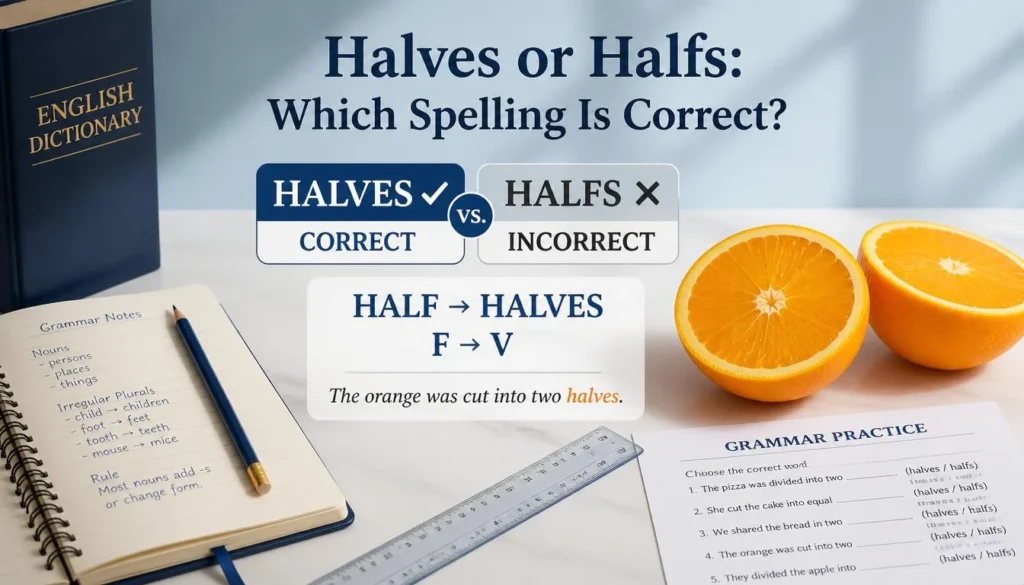
Halves is the correct plural of half. Halfs is not the standard spelling.
For example:
- Correct: The apple was cut into two halves.
- Incorrect: The apple was cut into two halfs.
The spelling changes from f to v: half → halves.
So, when you mean more than one half, always choose halves.
Halves or Halfs: Which One Is Correct?
Halves is correct. Halfs is not the standard plural of half.
The simplest rule is:
half → halves
Here’s the basic comparison:
| Form | Correct? | Use |
| half | ✅ Yes | Singular form |
| halves | ✅ Yes | Plural form |
| halfs | ❌ No | Nonstandard plural |
| halve | ✅ Yes | Verb meaning to divide by two |
Consider these examples:
- I ate half of the sandwich.
- We divided the sandwich into two halves.
- The coach spoke to both halves of the team.
- Please halve the recipe before cooking.
- She bought half a dozen eggs.
The key point is that halves isn’t simply the word half with an s added. Its spelling changes from f to v before the plural ending.
Cambridge’s grammar guidance specifically identifies halves as the plural form and uses examples such as dividing an orange into two halves.
What Does “Half” Mean?
Before looking closely at the plural, it helps to understand what half actually means.
A half is one of two equal parts that make up a whole. In mathematics, it represents 1/2, which equals 50%.
For example:
- Half of 10 is 5.
- Half of 100 is 50.
- Half of a pizza means one of two equal portions.
- Half an hour means 30 minutes.
The word can describe physical parts as well as amounts, periods, distances, and degrees.
Half as a noun
As a noun, half refers to one of two parts.
I ate half of the cake.
Here, half identifies one portion of the whole cake.
When there are two or more such portions, the plural form becomes halves.
We served the two halves separately.
Half as a determiner
You can also place half before a noun to describe an amount.
She drank half the water.
We spent half the afternoon outside.
He finished half the assignment.
In these examples, half doesn’t necessarily describe a physical piece. Instead, it identifies 50 percent of something.
Half as an adjective
Half can also modify another word.
We took a half-hour break.
She paid half price.
He ate a half sandwich.
The exact construction can vary depending on the noun and sentence structure.
Half as an adverb
The word can also mean partly or not completely.
The room was half empty.
She was half asleep.
He half expected the answer.
Cambridge Dictionary recognizes these different grammatical uses of half, including noun, adjective, adverb, pronoun, and related determiner uses.
Why Does Half Become Halves?
This is where the spelling gets interesting.
If English followed the most basic plural pattern, you might expect:
half + s = halfs
But standard English doesn’t use that form. Instead, the spelling changes:
half → halves
The f changes to v, and then the plural ending is added.
This type of spelling change occurs in several familiar English nouns.
| Singular | Plural |
| half | halves |
| calf | calves |
| leaf | leaves |
| knife | knives |
| life | lives |
| loaf | loaves |
| wolf | wolves |
These examples can help you recognize the pattern.
However, don’t treat this as an absolute rule for every English noun ending in -f. English has plenty of exceptions.
For example:
| Singular | Standard plural |
| roof | roofs |
| chief | chiefs |
| belief | beliefs |
| chef | chefs |
| cliff | cliffs |
So the useful lesson isn’t “every word ending in f changes to ves.”
Instead, remember that half has the established plural form halves.
That distinction prevents a common spelling mistake.
Why Is “Halfs” Incorrect?
The problem with halfs is simple: it doesn’t follow the standard plural form of half.
Someone unfamiliar with the irregular pattern might reason:
half + s = halfs
That logic works for many English nouns.
For example:
- book → books
- table → tables
- chair → chairs
- car → cars
But English contains many irregular plural forms. Half belongs to that group.
The standard spelling is:
half → halves
Not:
half → halfs
So if you’re writing an essay, article, school assignment, business document, email, or professional report, use halves.
A quick correction test
When you’re unsure, place the word into a sentence.
❌ The cake was divided into two halfs.
✅ The cake was divided into two halves.
The second sentence sounds and looks natural because halves is the accepted standard plural.
How to Use “Halves” Correctly
The word halves can appear in several everyday contexts. Understanding these contexts makes the spelling easier to remember.
Dividing food into halves
Food provides some of the clearest examples.
Cut the apple into two halves.
She divided the sandwich into two halves.
The recipe calls for four tomato halves.
When one whole object gets divided into two parts, each part is a half. When referring to both parts together, you use halves.
Talking about objects
The same idea applies to physical objects.
The two halves of the box fit together perfectly.
The broken toy had two separate halves.
The artist painted both halves of the wooden panel.
Here, halves refers to multiple pieces that each represent approximately half of an original whole.
Talking about time
Half frequently describes periods of time.
We waited for half an hour.
The meeting lasted an hour and a half.
In sports, half has another specific meaning.
A game can have a first half and a second half. When you refer to both periods, you use halves.
The team played strongly in both halves.
Their performance improved during the second half.
The coach changed tactics between the two halves.
Cambridge Dictionary also identifies half as a sports term for one of two periods into which a game is divided.
Talking about quantities
Halves can describe divided quantities as well.
The children received equal halves.
The measurement was divided into two halves.
Each group received one of the two halves.
The important idea remains the same: each half represents one part of a whole.
Half vs. Halves: Singular and Plural
The difference becomes straightforward once you think about number.
Half refers to one part.
Halves refers to more than one half.
| Word | Number | Meaning | Example |
| half | Singular | One of two parts | I ate half the apple. |
| halves | Plural | Two or more parts | We shared the apple halves. |
Consider a pizza.
If you eat one side of a pizza divided into two equal parts, you eat half.
If someone talks about both portions, they can say:
The two halves of the pizza were equal.
This same principle works with many other nouns.
- half of a page → two halves of a page
- half of an orange → two halves of an orange
- half of a sandwich → sandwich halves
- half of a circle → two halves
- half of a match → two halves
The number of parts determines whether half or halves is appropriate.
Halves vs. Half: A Common Grammar Difference
There’s another detail worth understanding.
You don’t always need the plural halves simply because you’re discussing something divided into two parts.
For example:
Cut the orange in half.
That’s perfectly correct.
You’re describing the action of dividing one orange into two equal parts.
You could also say:
Cut the orange into two halves.
Both constructions are grammatical, but they emphasize the idea differently.
The first focuses on the act of division.
The second focuses more directly on the two resulting pieces.
Cambridge notes both constructions, including in half, in halves, and into halves.
Compare these examples
Fold the paper in half.
Fold the paper and create two halves.
Cut the melon in half.
Place the two melon halves on the plate.
A useful shortcut is this:
in half often describes the division process.
halves usually identifies the resulting parts.
Halves vs. Halve: Don’t Mix Them Up
The spelling of halves can also cause confusion with halve.
They look similar, but they perform different grammatical jobs.
Half is usually a noun, adjective, adverb, determiner, or pronoun depending on context.
Halves is the plural of half.
Halve is a verb.
The verb halve means to divide something into two equal parts or reduce it by 50 percent.
| Word | Meaning | Example |
| half | One of two parts | I ate half the cake. |
| halves | More than one half | The cake was cut into halves. |
| halve | Divide by two | Halve the recipe. |
Look at the difference:
Half the cake was gone.
The cake was divided into two halves.
Halve the ingredients before mixing them.
The words are related, but you can’t freely substitute one for another.
A useful memory trick
Think of the words as a small family:
half → halves → halve
The first two describe the part or parts.
The third describes the action.
That simple distinction can eliminate many mistakes.
Halves in Mathematics
The word half has a precise mathematical meaning.
A half is represented by:
1/2
It also equals:
0.5
or:
50%
If you divide 20 equally into two groups:
20 ÷ 2 = 10
Each group contains half of the original amount.
When talking about multiple portions, you may use halves.
For example:
Two halves make one whole.
This is one of the simplest ways to understand the relationship.
Fractions and halves
A whole can be divided into different numbers of equal parts.
| Fraction | Meaning |
| 1/2 | One half |
| 2/2 | One whole |
| 3/2 | One and a half |
| 4/2 | Two wholes |
If you have two separate 1/2 portions, you have two halves.
So:
1/2 + 1/2 = 1
The terminology remains consistent whether you’re talking about food, measurements, geometry, or numbers.
Halves in Sports
Sports provide another common use of half and halves.
Many sports divide games into two periods. Each period can be called a half.
For example:
- first half
- second half
- both halves
- opening half
- final half
Consider this sentence:
The team dominated the first half but struggled in the second half.
If you want to discuss both periods together, use the plural:
The team performed well in both halves.
This usage isn’t limited to one particular sport. The term appears in contexts where a game or competition is divided into two periods.
Cambridge lists first half and second half as established sports uses of the word.
Example sports sentences
- The defense improved in the second half.
- Both halves were closely contested.
- The team scored twice in the first half.
- Their performance dropped during the final half.
- The coach praised the players for their effort across both halves.
The spelling stays the same regardless of whether you’re talking about football, another team sport, or a general period of play.
Halves in Cooking and Recipes
Recipes frequently use half because ingredients often need to be divided.
For example:
Add half a cup of milk.
If the recipe produces too much food, you might need to halve it.
Halve the recipe to make four servings instead of eight.
After dividing ingredients or portions, you might refer to the resulting portions as halves.
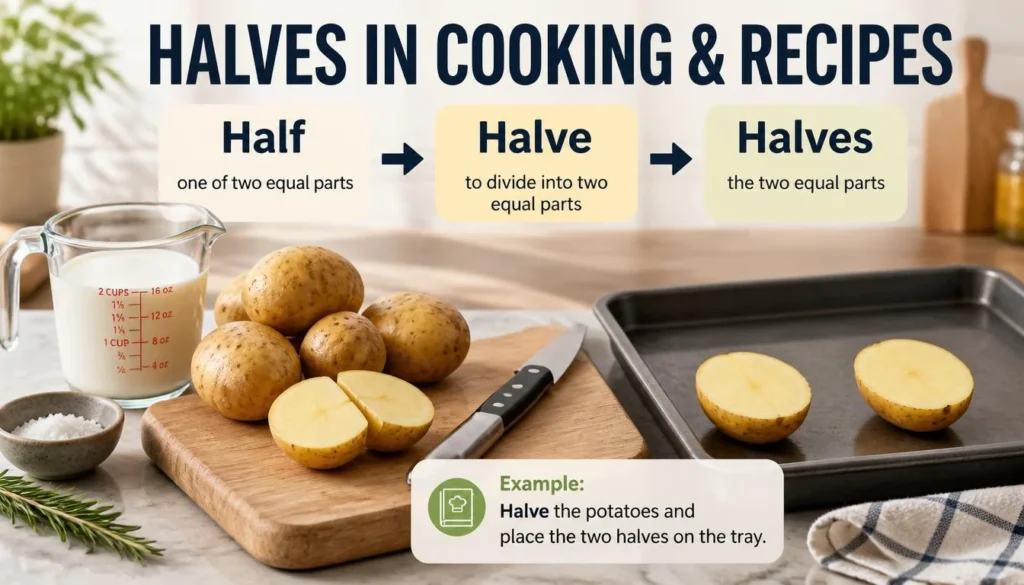
Place the two potato halves on the baking tray.
Notice how all three forms can work together naturally:
Half the potatoes were roasted whole. Halve the remaining potatoes and place the two halves on the tray.
That’s a useful real-world example because it shows the grammatical relationship among the three words.
Pronunciation of Halves
Spelling and pronunciation don’t always line up neatly in English.
The American English pronunciation of half is:
/hæf/
The American English pronunciation of halves is:
/hævz/
Cambridge gives /hævz/ for the American pronunciation of halves.
The important sound change happens with the final consonant.
- half → /hæf/
- halves → /hævz/
The f sound in half becomes a v sound in halves.
The final plural sound is voiced as /z/.
Why pronunciation helps with spelling
This pronunciation difference can actually make the spelling easier to remember.
When you say halves, the middle consonant sounds like v rather than f.
That matches the spelling:
hal-ves
It doesn’t sound like:
half-s
So if you hear the word carefully, the pronunciation provides a useful clue that halves is the correct form.
Half, Halves, Halve, and Halfway
Several related words can appear in the same sentence. Understanding their roles prevents confusion.
| Word | Meaning | Example |
| half | One of two parts | I ate half the sandwich. |
| halves | Plural of half | We divided the sandwiches into halves. |
| halve | Divide by two | Halve the amount of sugar. |
| halfway | At the middle point | We were halfway home. |
These words share the same basic idea of division or proportion. However, their grammatical functions differ.
For example:
We were halfway through the recipe when we decided to halve it and save the two remaining halves for tomorrow.
Each word has a distinct job.
That kind of sentence may look complicated at first, but the meanings become clear when you separate them.
Common Mistakes With Halves and Halfs
Spelling errors often happen because writers apply a familiar rule to a word that doesn’t follow it.
Mistake: Writing “halfs”
❌ We divided the cake into two halfs.
✅ We divided the cake into two halves.
Why? The standard plural of half is halves.
Mistake: Using “halve” as a plural noun
❌ The two halve were placed on the plate.
✅ The two halves were placed on the plate.
Why? Halve is a verb. Halves is the plural noun.
Mistake: Using “halves” for one part
❌ I ate one halves of the orange.
✅ I ate one half of the orange.
Why? One part requires the singular noun half.
Mistake: Assuming every -f noun changes to -ves
It’s tempting to memorize a rule such as:
Words ending in f always change to ves.
That rule isn’t reliable.
Some words use -ves, while others simply add -s.
For example:
- leaf → leaves
- knife → knives
- half → halves
But:
- roof → roofs
- chief → chiefs
- belief → beliefs
English spelling contains patterns, but those patterns often have exceptions.
Real-Life Examples of Halves
Seeing the word in different contexts can make the rule stick.
Food
Cut both oranges into halves.
The children each received one of the apple halves.
Mathematics
Two halves equal one whole.
The teacher drew two equal halves of a circle.
Sports
The players looked stronger in both halves.
The first half ended without a goal.
Time
The lecture lasted two hours and was divided into two halves.
We spent half an hour waiting.
Objects
The two halves of the container snapped together.
The machine consists of two matching halves.
Money and budgets
The project divided its budget into two halves.
The company spent half its budget during the first quarter.
These examples demonstrate an important point: halves isn’t restricted to physical objects. It can describe parts, periods, quantities, and conceptual divisions.
A Practical Case Study: Choosing the Right Word
Imagine you’re writing instructions for a cooking website.
The recipe contains eight servings, but a reader wants to prepare only four.
You could write:
“Halve all the ingredients to make four servings.”
That sentence uses halve because you’re describing an action.
Now imagine the recipe involves two pieces of fruit:
“Place the two orange halves on the tray.”
Here, halves works because you’re naming multiple portions.
Finally:
“Use half of the original amount of sugar.”
Here, half is singular because you’re referring to one portion of the original quantity.
The three words aren’t interchangeable. Their meanings determine which form belongs in the sentence.
A Second Case Study: Writing About a Sports Game
Suppose you’re describing a close game.
You might write:
“The team controlled the first half but lost momentum after halftime.”
Now you’re talking about one period, so half is singular.
If you want to summarize the complete performance:
“The team played consistently across both halves.”
Now you’re referring to more than one period, so halves is correct.
If you’re describing a tactical change:
“The coach decided to halve the number of attacking players.”
The verb halve describes the action of reducing something by 50 percent.
This example makes the distinction easy to visualize:
half = one part
halves = multiple parts
halve = divide or reduce
“Half” in Common Expressions
The word half appears in many familiar expressions.
Half and half
Half and half means equal amounts of two different things.
For example:
Mix the ingredients half and half.
In American English, half-and-half can also refer to a dairy product made from milk and cream.
Go halves
If two people go halves on something, they each contribute half of the cost.
We went halves on the restaurant bill.
This expression uses the plural halves because two people each contribute one half.
Not do things by halves
Someone who doesn’t do things by halves gives something their full effort.
She never does things by halves.
Cambridge Dictionary lists this as an established idiomatic expression.
Halfway
Halfway refers to the middle point of something.
We were halfway through the journey.
Although halfway contains half, it isn’t the plural of anything. It’s a separate word with its own grammatical function.
Why English Has Irregular Plurals
The spelling of halves makes more sense when you understand that English has inherited many older plural patterns.
Modern English contains several nouns whose plural forms don’t simply add -s.
Consider:
- man → men
- woman → women
- child → children
- tooth → teeth
- mouse → mice
- half → halves
These forms developed through the history of the English language rather than through one single modern spelling rule.
That’s why memorizing half → halves is more useful than trying to force every plural into a simple formula.
Language is full of patterns, but it also carries historical fingerprints.
Is “Halfs” Ever Used?
You may occasionally encounter halfs in informal writing, unusual contexts, or nonstandard usage.
However, that doesn’t make it the standard plural.
For formal and standard English, use:
halves
This matters especially in:
- academic writing
- professional documents
- published articles
- school assignments
- business communication
- edited content
- formal correspondence
If a spelling checker flags halfs, don’t automatically assume the software has made a mistake. In standard English, halves is the expected plural.
Quick Comparison: Halves or Halfs?
| Question | Answer |
| What is the singular of halves? | Half |
| What is the plural of half? | Halves |
| Is halfs standard English? | No |
| What does halve mean? | To divide or reduce by half |
| What is 1/2 as a percentage? | 50% |
| How is halves pronounced in American English? | /hævz/ |
| Does half follow the normal add-s plural? | No |
| Can half describe time? | Yes |
| Can half describe sports periods? | Yes |
| Can halve be used as a verb? | Yes |
Easy Ways to Remember “Half” and “Halves”
A simple memory trick can save you from repeating the same spelling mistake.
Think:
One half, two halves.
Then connect it with another familiar pair:
one calf, two calves
The spelling pattern isn’t universal across all -f words, but it works for half.
Another useful trick is to connect the spelling with pronunciation:
half → /hæf/
halves → /hævz/
The v sound in halves matches the v in the written form.
Remember the three forms
Half = one part.
Halves = multiple parts.
Halve = divide by two.
If you keep those three meanings separate, the spelling becomes much easier.
My Personal Experience With an English Specialist
I once struggled with whether halves or halfs was correct. My English specialist explained that halves is the standard plural of half. The simple rule is half → halves.
For example, “The apple was cut into two halves” is correct, while “two halfs” is incorrect. I also learned that halve is a verb meaning to divide something into two equal parts.
This explanation helped me remember the difference: half = one part, halves = more than one part, and halve = divide by two. Since then, I’ve found it much easier to use halves correctly in my writing.
FAQs
Is “halves” the correct plural of “half”?
Yes. Halves is the correct plural form of half. For example, “Cut the apple into two halves.”
Is “halfs” a correct English word?
No. Halfs is considered incorrect in standard English. The correct plural is halves.
Why does “half” become “halves”?
Half changes to halves because English has several irregular plural forms. Instead of simply adding -s, the spelling changes from f to v before adding -es.
Is “halve” the same as “half”?
No. Halve is a verb meaning to divide something into two equal parts. Half is usually a noun or adjective referring to one of two equal parts.
Do British and American English use “halves”?
Yes. Both British English and American English use halves as the standard plural of half. There’s no difference in the plural spelling.
How can I remember “halves” instead of “halfs”?
Think of the pattern half → halves. Remembering a few examples, such as “two halves of an orange” or “both halves of the team,” can make the correct spelling feel natural.
Conclusion
Getting halves or halfs right is simple once you remember the basic rule: half becomes halves in the plural. Although halfs may look natural, it isn’t the standard spelling. Keep halves in mind when writing essays, emails, reports, recipes, or everyday messages. Understanding the difference between half, halves, and halve can also make your writing clearer and more confident. When in doubt, choose halves.