Whose or Who’s can confuse English learners, writers, and native speakers because these two words sound exactly the same.
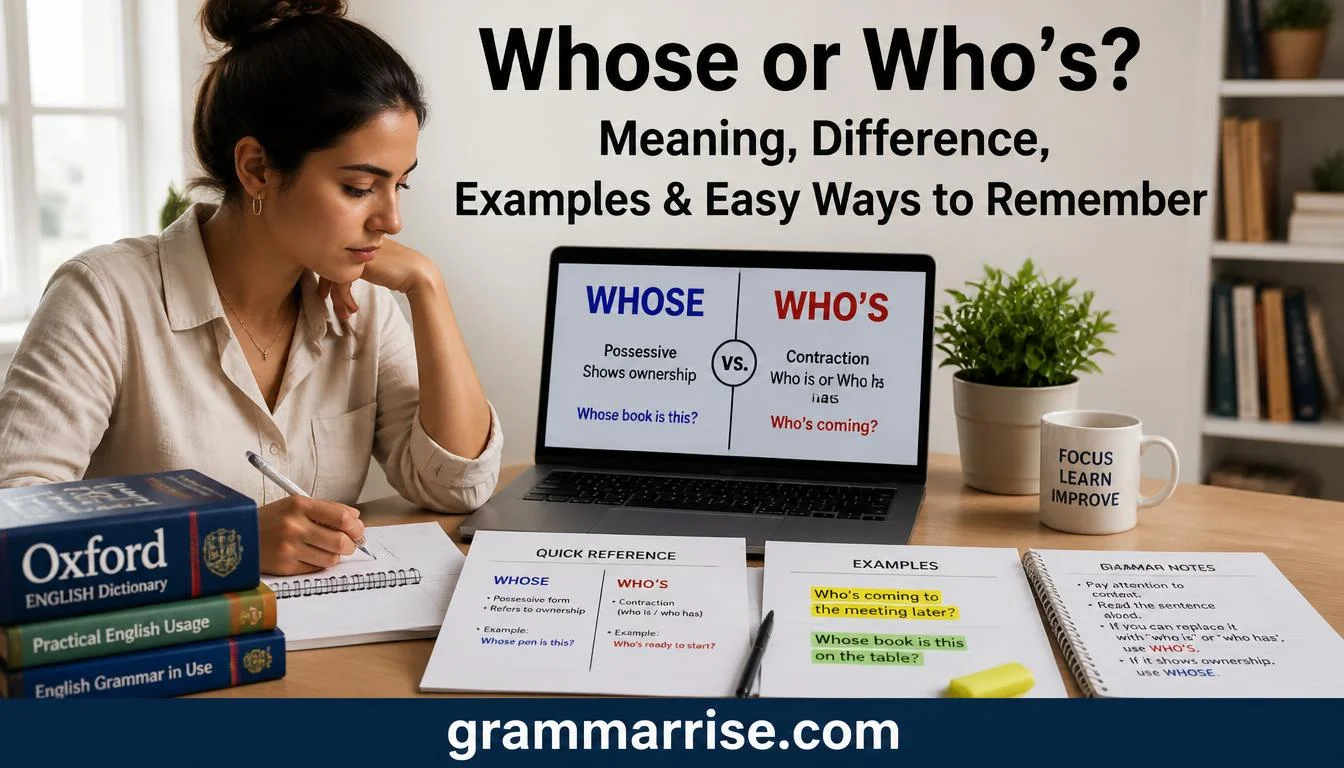
Their meanings and functions are completely different, though, so understanding this difference is essential for clear, correct English. In grammar, whose is a possessive word that shows ownership, while who’s is a contraction for who is or who has. A simple grammar ninja trick is to check the apostrophe and ask what the word means in the sentence. This makes correct usage easier and helps learners avoid misuse, word confusion, incorrect punctuation, and spelling problems. Once you quickly understand the difference, it becomes easy to confidently choose the correct form and keep your natural flow without letting grammar restrict your writing.
The confusion is understandable because the words are used differently despite having the same sound. In real-life examples, one reliable check for a common mistake is to replace who’s with who is or who has. This approach also helps with common mistakes, formal communication, online content, and everyday writing. An article can provide audience-based advice in a simple, practical way for anyone who feels confused. Learning these similar-looking words gives you better control over punctuation, grammar, and context.
Quick Answer
If you’re in a hurry, use this table as your cheat sheet.
| Word | Meaning | Function | Example |
| Who’s | Who is | Contraction | Who’s at the door? |
| Who’s | Who has | Contraction | Who’s finished the work? |
| Whose | Belonging to whom | Possessive | Whose phone is this? |
| Whose | Relationship or association | Possessive/relative | The woman whose car was stolen called the police. |
The easiest way to remember the distinction is to expand who’s.
If you can replace who’s with who is or who has, then who’s is correct.
If the sentence asks about something belonging to someone, use whose.
A few quick examples
Who’s calling?
→ Who is calling?
Who’s already left?
→ Who has already left?
Whose phone is ringing?
→ Who does the phone belong to?
The student whose notebook disappeared looked worried.
→ The notebook belongs to the student.
The MLA Style Center makes the same central distinction: whose is the possessive form of who, while who’s contracts who is or who has.
what does whos mean?
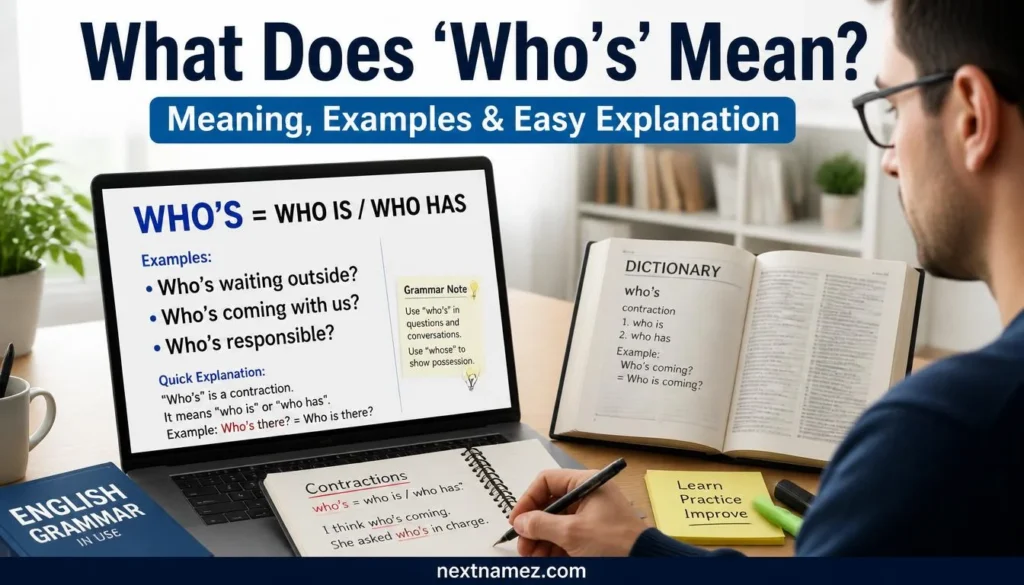
Who’s is a contraction. It combines who with either is or has.
That distinction matters because the meaning changes depending on the verb that follows.
Who’s = Who Is
In many sentences, who’s means who is.
Consider these examples:
- Who’s waiting outside?
- Who’s responsible for this project?
- Who’s your new neighbor?
- Who’s coming with us?
- Who’s at the front desk?
Expand the contraction and each sentence still makes sense:
Who’s waiting outside?
Who is waiting outside?
Who’s your new neighbor?
Who is your new neighbor?
Who’s responsible?
Who is responsible?
This is the most common use of who’s.
Cambridge Dictionary lists examples such as “Who’s going to go first?” and “Who’s in charge?” where who’s means who is.
Who’s = Who Has
Here’s where things get slightly more interesting.
Who’s can also mean who has.
This usually happens when has works as an auxiliary verb before a past participle.
For example:
Who’s finished the assignment?
This means:
Who has finished the assignment?
Another example:
Who’s been using my computer?
This means:
Who has been using my computer?
You can also see it in relative clauses:
She’s the employee who’s completed the training.
Here, who’s means:
She’s the employee who has completed the training.
More examples include:
- Who’s won the competition?
- Who’s taken my notebook?
- Who’s been calling all morning?
- Who’s already eaten?
- Who’s forgotten their password?
Cambridge specifically defines who’s as the short form of both who has and who is.
What Does “Whose” Mean?
Whose expresses possession or a relationship between someone or something and another noun.
It commonly appears in questions:
Whose bag is this?
You’re asking who owns the bag.
You can also use whose to show a relationship:
The woman whose son works here is my neighbor.
The son doesn’t necessarily represent an object that the woman “owns.” Instead, whose connects the woman with her son.
That’s an important point. Possession in grammar doesn’t always mean literal ownership.
Whose Shows Possession
Use whose when you want to identify the person associated with something.
Examples include:
- Whose car is parked outside?
- Whose keys are these?
- Whose phone is on the table?
- Whose idea was this?
- Whose turn is it?
- Whose coat did you borrow?
- Whose name appears on the document?
Notice the structure:
whose + noun
For example:
whose car
whose phone
whose idea
whose jacket
whose name
You could often paraphrase the question using who does … belong to?
Whose car is this?
Who does this car belong to?
Whose jacket is that?
Who does that jacket belong to?
Cambridge describes whose as a word used to ask which person owns or is responsible for something.
Whose Shows Relationships and Associations
Possession isn’t always about ownership.
Consider:
The teacher whose daughter won the scholarship smiled proudly.
The teacher doesn’t own her daughter. Instead, whose establishes a relationship between the teacher and her daughter.
The same pattern appears in:
I met a writer whose books have sold millions of copies.
Here, whose connects the writer with the books.
You can use this construction for:
- family relationships
- professional relationships
- physical characteristics
- responsibilities
- organizations
- places
- objects
- animals
For example:
The dog whose collar was missing ran toward the gate.
We visited a city whose history stretches back centuries.
She joined a company whose products are sold worldwide.
Cambridge Grammar notes that whose can introduce relative clauses showing possession or association involving people, animals, and, in appropriate contexts, things.
Why Do “Whose” and “Who’s” Cause So Much Confusion?
The problem starts with pronunciation.
Whose and who’s are pronounced alike in standard English:
/huːz/
When you hear either word in conversation, you usually can’t determine the spelling from sound alone.
Writing removes that ambiguity. Suddenly, the apostrophe matters.
There’s another psychological trap, too. Many writers learn that apostrophes can indicate possession:
Sarah’s book
John’s car
the dog’s collar
That makes who’s look possessive.
But it isn’t.
In who’s, the apostrophe marks a contraction.
Compare:
- who’s → who is / who has
- whose → possessive form of who
The MLA Style Center points out that this confusion resembles the familiar distinction between it’s and its. The apostrophe in it’s marks the contraction it is, while its is possessive.
So don’t assume that an apostrophe automatically means possession.
That’s one of the most useful grammar habits you can develop.
The Easy “Who Is / Who Has” Test
When you’re unsure about whose or who’s, don’t stare at the sentence and hope the answer suddenly feels right.
Use a test.
Step 1: Replace “who’s” with “who is”
Take this sentence:
Who’s coming to the party?
Replace who’s:
Who is coming to the party?
The sentence works perfectly.
Therefore:
Who’s coming to the party? ✅
Now try:
Who’s responsible for the mistake?
Replace it:
Who is responsible for the mistake?
Again, it works.
Use who’s.
Step 2: Try “who has”
Sometimes who is doesn’t fit because who’s means who has.
For example:
Who’s finished the report?
Try:
Who has finished the report?
That works.
So who’s is correct.
Try another:
Who’s been knocking on the door?
Expand it:
Who has been knocking on the door?
Perfect.
Use who’s.
Step 3: Look for possession or association
Now consider:
Whose laptop is this?
Try replacing whose with who is:
Who is laptop is this?
That doesn’t work.
Try who has:
Who has laptop is this?
That doesn’t work either.
The sentence asks about ownership.
Therefore:
Whose laptop is this? ✅
The test isn’t complicated. It simply exposes what the word actually means.
Why Is “Whose” Correct Without an Apostrophe?
This question deserves special attention because it contradicts a common assumption.
Many people think:
“Possession needs an apostrophe.”
That’s not true in English.
Possessive forms can appear without apostrophes.
Consider:
- my book
- your house
- his car
- her phone
- its color
- our team
- their office
- whose jacket
None of those possessive words require an apostrophe.
An apostrophe appears in possessive nouns such as:
Maria’s book
But whose isn’t a possessive noun. It’s a possessive form of the interrogative or relative pronoun who.
The pattern becomes easier when you compare it with his:
He → his
Likewise:
Who → whose
You wouldn’t write:
he’s shoes
when you mean shoes belonging to him.
You write:
his shoes
Similarly, you shouldn’t write:
who’s shoes
when you mean shoes belonging to someone.
You write:
whose shoes
The MLA Style Center specifically emphasizes that apostrophes don’t always indicate possession.
Common Mistakes With Who’s and Whose
The same mistakes appear repeatedly in emails, essays, social media posts, school assignments, and professional writing.
“Who’s Book Is This?”
❌ Who’s book is this?
This is incorrect when you mean ownership.
✅ Whose book is this?
Why?
Because the question asks who owns the book.
You can think of it as:
Who does this book belong to?
Therefore, whose is the right choice.
“Whose Coming to the Party?”
❌ Whose coming to the party?
✅ Who’s coming to the party?
Here, who’s means who is.
Who is coming to the party?
That sentence makes sense.
Whose doesn’t.
“The Person Who’s Car Was Stolen”
❌ The person who’s car was stolen called the police.
✅ The person whose car was stolen called the police.
The car belongs to or is associated with the person.
So use whose.
This is a classic example of why who’s cannot replace whose merely because both words sound identical.
“Who’s Been Calling?”
✅ Who’s been calling?
This sentence is correct.
Here, who’s means:
Who has been calling?
The word been is a useful clue because the structure commonly uses has been.
“Whose Been Calling?”
❌ Whose been calling?
This doesn’t work.
The intended meaning is:
Who has been calling?
Therefore:
Who’s been calling?
Who’s vs. Whose in Questions
Questions make the difference especially easy to see because whose frequently appears before a noun.
Questions using “who’s”
Use who’s when the sentence means who is or who has.
- Who’s coming?
- Who’s calling?
- Who’s waiting outside?
- Who’s responsible?
- Who’s driving?
- Who’s in charge?
- Who’s already finished?
- Who’s been here before?
Questions using “whose”
Use whose when you’re asking about possession or association.
- Whose car is this?
- Whose phone is ringing?
- Whose idea was that?
- Whose turn is next?
- Whose jacket did you borrow?
- Whose name is on the list?
- Whose house are we visiting?
Here’s the shortcut:
Who’s asks “who is/has?”
Whose asks “belonging to whom?”
That distinction covers a huge number of everyday examples.
Whose vs. Who’s in Relative Clauses
Relative clauses create another common trouble spot.
A relative clause adds information about a person, animal, thing, or other noun.
Whose can introduce a relative clause when the clause expresses possession or association.
Consider:
The student whose laptop broke missed the presentation.
The laptop belongs to or is associated with the student.
Now compare:
The student who’s presenting today arrived early.
Here, who’s means:
The student who is presenting today.
One word changes the grammatical relationship.
Compare these examples
The woman whose brother lives in Texas is my manager.
The brother is related to the woman.
The woman who’s speaking to Mark is my manager.
Who’s = who is.
Another pair:
The company whose offices are downtown hired new staff.
The offices belong to or are associated with the company.
The company who’s expanding rapidly announced several new positions.
Here, who’s = who is.
Cambridge identifies whose as a relative pronoun that indicates possession and notes its use with people, animals, and sometimes things.
Can “Whose” Refer to Things?
Yes.
This point surprises some writers because whose sounds strongly connected with people.
However, modern English can use whose with nonhuman nouns when it expresses a relationship or association.
For example:
The house whose roof was damaged needs repairs.
Here, whose connects the house with its roof.
Other examples include:
- a company whose profits increased
- a book whose cover was damaged
- a city whose population is growing
- a building whose windows were broken
- a machine whose engine failed
- a website whose design needs updating
Cambridge gives examples such as a book whose title is forgotten and explains that whose can sometimes refer to things rather than people.
This usage can sound more natural than forcing an awkward alternative.
For example:
The company whose website crashed apologized to customers.
That’s concise and clear.
Who’s vs. Whose Examples
The following examples show the distinction in everyday English.
| Correct form | Example | Meaning |
| Who’s | Who’s calling? | Who is calling? |
| Who’s | Who’s ready? | Who is ready? |
| Who’s | Who’s finished? | Who has finished? |
| Who’s | Who’s been here? | Who has been here? |
| Whose | Whose bag is this? | Who owns the bag? |
| Whose | Whose idea was it? | Who was associated with the idea? |
| Whose | Whose car are you driving? | Who owns the car? |
| Whose | The woman whose dog ran away called us. | The dog is associated with the woman. |
The visual pattern is simple: who’s contains a missing word, while whose carries a possessive meaning.
Who’s or Whose? Side-by-Side Sentence Pairs
Sometimes the fastest way to understand grammar is to put two similar sentences next to each other.
Pair One
Who’s at the door?
= Who is at the door?
Whose coat is at the door?
= Who does the coat belong to?
Pair Two
Who’s driving the car?
= Who is driving?
Whose car are they driving?
= Who owns the car?
Pair Three
Who’s responsible for the project?
= Who is responsible?
Whose project is this?
= Who does the project belong to?
Pair Four
Who’s finished the assignment?
= Who has finished it?
Whose assignment is on the desk?
= Who owns or submitted the assignment?
These pairs demonstrate an important point: the surrounding words often reveal the intended meaning.
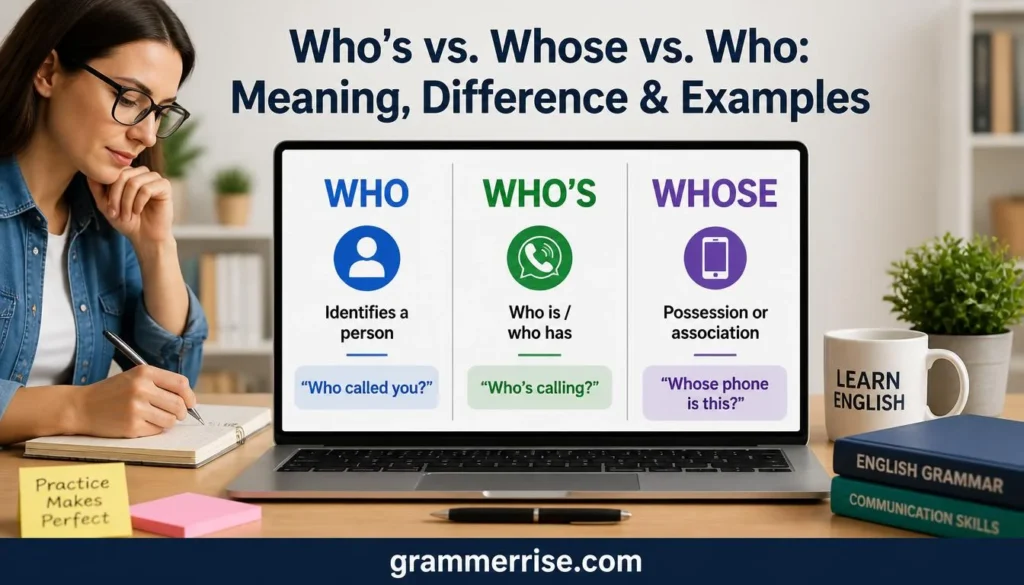
Who’s vs. Whose vs. Who
Adding who to the comparison makes the grammar even clearer.
| Word | Main function | Example |
| Who | Identifies a person | Who called you? |
| Who’s | Who is / who has | Who’s calling? |
| Whose | Possession or association | Whose phone is this? |
Who
Use who when you’re asking about a person.
- Who called?
- Who lives here?
- Who wrote this article?
Who’s
Who’s is a contraction of who is or who has. You can use it when the sentence describes someone or asks about an action or state.
- Who’s calling?
- Who’s responsible?
- Who’s finished?
Whose
Use whose to ask about possession or show a relationship between a person and something that belongs to them.
Whose book is this?
The person whose car was stolen filed a report.
Cambridge classifies who, whom, whose, which, and what among English interrogative pronouns or wh-words.
Who’s vs. Whose vs. Whom
Whom belongs to the same broader family of words, but it performs a different job.
In traditional grammar, who functions as the subject while whom functions as the object.
For example:
Who called you?
Here, who performs the action.
Whom did you call?
Here, whom receives the action.
In everyday American English, however, many speakers use who instead of whom, particularly in casual conversation.
The important point for this article is that whom isn’t an alternative to whose or who’s.
Compare:
Who’s coming?
Whose car is this?
Whom did you invite?
Each word answers a different grammatical need. The MLA Style Center explains the subject-object distinction between who and whom in formal writing.
A Quick Decision Guide for Whose or Who’s
When you’re proofreading, use this three-question process.
Does “who is” work?
If yes, choose who’s.
Who’s ready?
→ Who is ready?
Correct.
Does “who has” work?
If yes, choose who’s.
Who’s completed the task?
→ Who has completed the task?
Correct.
Does the sentence show possession or association?
If yes, choose whose.
Whose laptop is this?
The sentence asks who the laptop belongs to.
Correct.
Decision tree
You need a word that sounds like “hooz.”
↓
Can you replace it with “who is”?
→ Yes → who’s
↓ No
Can you replace it with “who has”?
→ Yes → who’s
↓ No
Does it express possession, belonging, responsibility, or association?
→ Yes → whose
That’s the whole trick.
Read more: Halves or Halfs: Which Spelling Is Correct?
A Real-World Editing Example
Imagine you’re writing an email to a coworker:
“Do you know whose responsible for updating the report?”
Something looks slightly wrong.
Apply the test.
Could you say:
“Do you know who is responsible for updating the report?”
Yes.
Therefore:
Do you know who’s responsible for updating the report?
Now consider:
“Do you know who’s report this is?”
Try the expansion:
“Do you know who is report this is?”
No.
The intended meaning concerns ownership.
The corrected version is:
Do you know whose report this is?
This kind of substitution test works particularly well during proofreading because it focuses on meaning instead of appearance.
Practice: Choose Who’s or Whose
Test yourself before looking at the answers.
- ___ coming to the meeting?
- ___ notebook is on my desk?
- Do you know ___ responsible?
- ___ car is blocking the driveway?
- She is the woman ___ brother teaches here.
- ___ finished the project?
- ___ idea was this?
- ___ been using my computer?
- The company ___ logo appears here recently expanded.
- ___ at the front door?
- ___ phone keeps ringing?
- ___ turn is it?
- Do you know ___ already left?
- The author ___ book won the award gave a speech.
- ___ been invited to the ceremony?
Answer Key
- Who’s — Who is coming?
- Whose — The notebook belongs to someone.
- Who’s — Who is responsible?
- Whose — The car belongs to someone.
- Whose — The brother is related to the woman.
- Who’s — Who has finished?
- Whose — The question asks about association or ownership.
- Who’s — Who has been using it?
- Whose — The logo is associated with the company.
- Who’s — Who is at the door?
- Whose — The phone belongs to someone.
- Whose — The question asks about the person associated with the turn.
- Who’s — Who has already left?
- Whose — The book is associated with the author.
- Who’s — Who has been invited?
If several of these felt obvious after using the replacement test, you’re already mastering the distinction.
Memory Trick for Remembering Whose vs. Who’s
Here’s a simple way to keep the two words apart:
Who’s has an apostrophe because it hides a word.
The apostrophe represents missing letters in a contraction.
who + is → who’s
who + has → who’s
Meanwhile:
Whose has no apostrophe because it is already the possessive form.
Think of these pairs:
- who → whose
- he → his
- she → her
- they → their
The possessive form doesn’t need an apostrophe.
The three-second rule
Before choosing the spelling, ask:
“Can I say who is or who has?”
If yes:
who’s
If not, ask:
“Am I talking about belonging or association?”
If yes:
whose
That’s faster than memorizing dozens of isolated examples.
Important Facts About Whose and Who’s
A few facts make the grammar easier to understand.
- Who’s is a contraction.
- Who’s can mean who is.
- Who’s can mean who has.
- Whose expresses possession or association.
- Whose can function as a pronoun.
- Whose can also function before a noun as a determiner.
- Whose can introduce relative clauses.
- Whose can refer to people, animals, and sometimes things.
- Who’s and whose normally sound alike.
- An apostrophe doesn’t automatically signal possession.
- Whose is correct in phrases such as whose book, whose car, and whose idea.
Cambridge’s grammar resources specifically recognize whose as both an interrogative form and a relative pronoun with possessive meaning.
My Personal Experience as an English Specialist
As an English specialist, I’ve often seen learners confuse whose and who’s because they sound exactly the same. I usually recommend one simple trick: expand who’s. If it means who is or who has, use who’s. If it shows possession, belonging, or association, use whose.
For example, “Who’s calling?” means “Who is calling?” while “Whose phone is this?” asks who the phone belongs to. In my experience, this quick test makes the difference much easier to remember.
The key is simple: who’s = who is/who has, while whose = possession or association. Once you focus on meaning rather than the apostrophe, choosing the correct word becomes much easier.
FAQs
1. What is the easiest way to remember whose and who’s?
Remember that whose shows ownership, while who’s is short for who is or who has. If you can replace “who’s” with either phrase and the sentence still makes sense, who’s is usually correct.
2. Does whose always show ownership?
Yes. Whose is used to ask about or describe possession. For example, “Whose jacket is on the chair?” asks who owns the jacket.
3. Why do whose and who’s sound the same?
They are homophones, meaning they have the same pronunciation but different meanings and spellings. The apostrophe in who’s signals that it is a contraction.
4. Can who’s mean who has?
Yes. Who’s can mean who has as well as who is. For example, “Who’s finished the assignment?” means “Who has finished the assignment?”
5. Is whose used only in questions?
No. Whose can appear in both questions and statements. For example, “I met the student whose backpack was missing” uses whose to show a relationship or possession.
6. Which word should I use in formal writing?
Use the word that matches your intended meaning. Whose is correct for possession, while who’s means who is or who has. In formal writing, checking this difference can prevent a simple grammar mistake.
Conclusion
Choosing between whose and who’s becomes much easier once you understand what each word does. Whose shows possession or ownership, while who’s is a contraction of who is or who has. When you’re unsure, try replacing who’s with “who is” or “who has.” If the sentence still makes sense, you’ve likely found the right choice. With a little practice, this small grammar distinction will feel natural, helping you write more clearly and confidently in school, work, emails, and everyday communication.