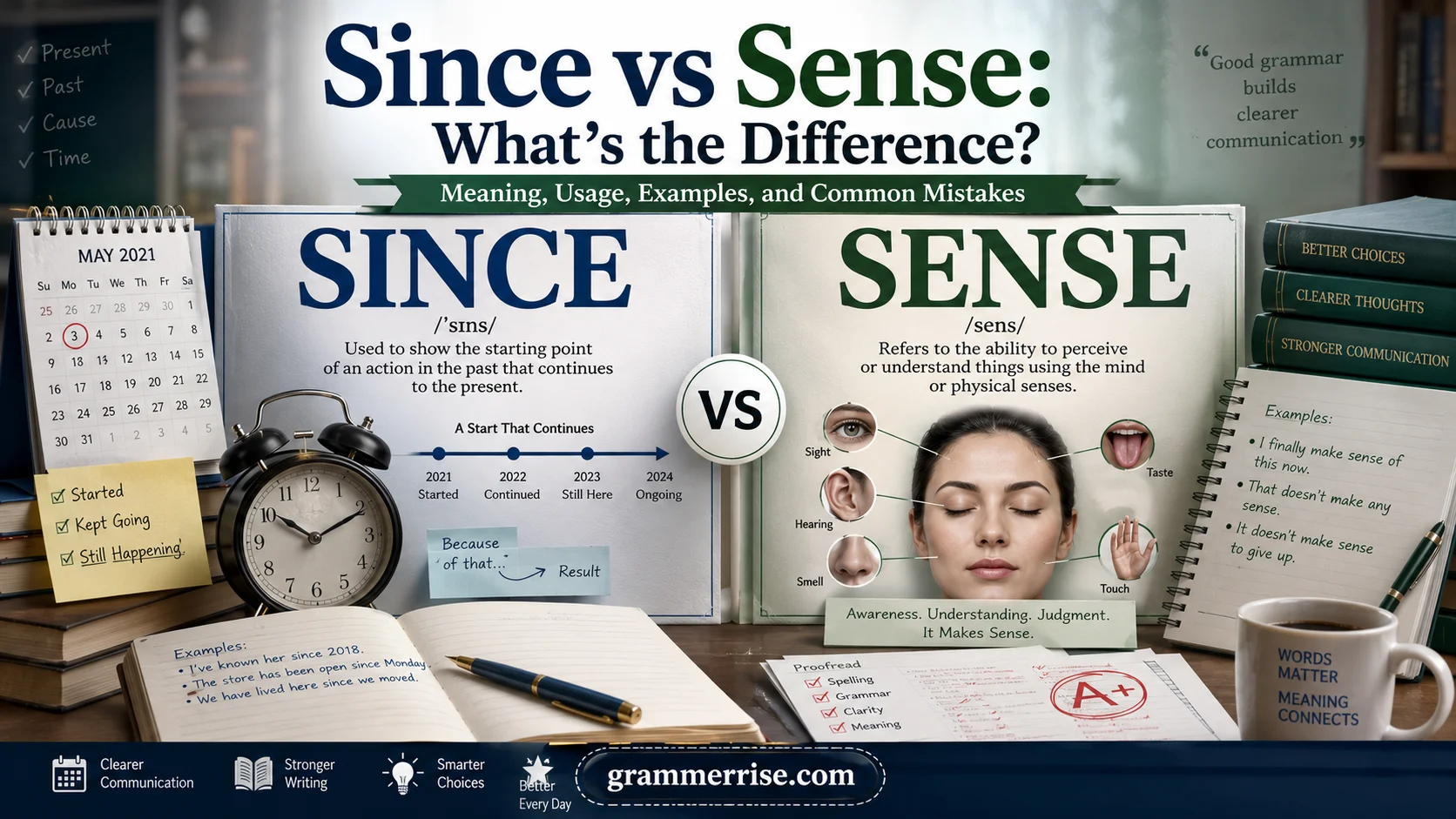
Since vs Sense explains why these two words confuse writers because they sound similar but have different meanings, uses, and grammar rules. Since and sense are two words with different meanings and different uses that many people mix them up while speaking and writing. These homophones have a similar pronunciation but a different word meaning. The since word connects with time, reason, and cause, while the sense word relates to feeling, understanding, logic, perception, and the five senses. Learning the difference between since and sense improves English learning, vocabulary, and language skills by making communication more clear and correct.
The since word works as a time expression, conjunction, and preposition to show a starting point, duration, or explain why something happened. The sense word works as a noun or verb and shows awareness, thought, idea, knowledge, interpretation, comprehension, and human perception.
In my experience studying grammar, I have noticed that this one letter difference creates common mistakes in emails, academic papers, and digital content. This guide helps writers and speakers understand grammar rules, usage rules, and correct word choice through everyday examples, simple tips, and actionable examples. It helps you avoid confusion, avoid errors, improve writing skills, improve writing accuracy, develop speaking accuracy, and confidently master these words in professional contexts, casual contexts, and all communication situations.
Quick Answer
Since and sense may sound similar, but they have completely different meanings.
- Since refers to time or reason.
- Sense refers to perception, awareness, understanding, or judgment.
Examples
✅ I’ve lived here since 2020. (time)
✅ Since it’s raining, we’ll stay inside. (reason)
✅ She has a great sense of humor. (understanding)
✅ My sense of smell is very strong. (perception)
Easy Way to Remember
- Since = Time or Because
- Sense = Feeling or Understanding
If you’re talking about when something started or why something happened, use since.
If you’re talking about awareness, common sense, intuition, or the five senses, use sense.
Since vs Sense at a Glance
Before diving deeper, here’s a quick overview.
| Word | Part of Speech | Meaning | Example |
| Since | Conjunction, preposition, adverb | From a point in time or because | I’ve worked here since 2021. |
| Sense | Noun, verb | Perception, understanding, awareness | She has a strong sense of direction. |
Quick Memory Trick
Think of these simple connections:
- Since = Time or Reason
- Sense = Feeling or Understanding
If you’re talking about a date, period, or cause, use since.
If you’re talking about perception, awareness, judgment, or one of the five senses, use sense.
What Does Since Mean?
The word since serves several important functions in English grammar.
Most commonly, it refers to:
- A starting point in time
- A reason or cause
- A connection between past and present events
Because it performs multiple grammatical roles, understanding context becomes important.
Definition of Since
According to major dictionaries, since means:
From a particular time in the past until now.
It can also mean:
Because or considering that.
Since as a Time Expression
This is the most common use.
When you use since, you’re identifying the exact point when something began.
Examples:
- Since Monday
- Since last year
- Since breakfast
- Since graduation
- Since childhood
Notice something interesting. Since always points back to a starting moment.
Why Since Matters in English Grammar
Native speakers use since constantly because it connects past actions to the present.
Consider this sentence:
I’ve lived in Chicago since 2018.
The sentence tells you:
- The action started in 2018.
- The action continues today.
That’s why since often appears with the present perfect tense.
Examples of Since Showing Time
Here are some practical examples:
- We’ve been friends since elementary school.
- She hasn’t called since Friday.
- They’ve operated the business since 2005.
- The museum has attracted visitors since opening day.
- I’ve loved baseball since I was a kid.
Each sentence points to a clear starting moment.
Since as a Reason or Cause
Besides showing time, since can mean because.
In this context, it explains why something happened.
Examples:
- Since it’s raining, we’ll stay indoors.
- Since traffic is heavy, let’s leave earlier.
- Since you’ve already finished, you can relax.
- Since nobody objected, the proposal passed.
When used this way, since introduces a reason.
Since as an Adverb
Sometimes since appears without directly mentioning a specific time.
Examples:
- He moved away two years ago and I haven’t seen him since.
- She left the company in June and hasn’t returned since.
In these sentences, since means “from that time until now.”
Common Phrases with Since
English speakers frequently use these expressions:
Ever Since
Indicates continuous action from a specific moment.
Example:
- I’ve loved reading ever since I learned the alphabet.
Since Then
Refers to everything after a particular event.
Example:
- The restaurant opened in 2010. Since then, it has become a local favorite.
Since When?
Used to express surprise.
Example:
- Since when do you enjoy spicy food?
Long Since
Usually appears in formal writing.
Example:
- The castle has long since disappeared.
What Does Sense Mean?
Unlike since, sense focuses on perception, awareness, understanding, or judgment.
The word appears in everyday conversations, science, psychology, literature, business, and education.
Definition of Sense
The word sense can mean:
- A physical ability to perceive the world
- Awareness of something
- Sound judgment
- Understanding
- Intuition
Because of its flexibility, sense appears in many different contexts.
Sense as Physical Perception
Most people first learn about sense through the five traditional human senses.
These senses help people gather information about the world around them.
The Five Traditional Senses
| Sense | Purpose |
| Sight | Detects light and images |
| Hearing | Detects sound |
| Smell | Detects odors |
| Taste | Detects flavors |
| Touch | Detects pressure, temperature, and texture |
These sensory systems constantly collect information.
For example:
When you smell fresh coffee in the morning, your sense of smell identifies the aroma before you even take a sip.
Sense as Understanding or Judgment
The word sense often refers to intelligence or practical thinking.
This meaning appears in many common expressions.
Examples:
- Common sense
- Sense of responsibility
- Sense of fairness
- Sense of direction
- Sense of purpose
Common Sense
Among all expressions involving sense, common sense is probably the most famous.
Common sense refers to practical judgment based on everyday experience.
Example:
“Common sense is not so common.” — Voltaire
A person who locks their door before leaving home uses common sense.
No instruction manual is necessary.
Sense of Responsibility
This phrase describes awareness of duties and obligations.
Example:
- The manager showed a strong sense of responsibility during the crisis.
Sense of Humor
This refers to the ability to appreciate and understand humor.
Example:
- His sense of humor made stressful meetings easier.
Sense of Direction
Some people naturally know where they are.
Others get lost in a parking lot.
This ability is called a sense of direction.
Sense as a Feeling or Awareness
Sometimes sense refers to an emotional impression rather than a physical perception.
Examples:
- A sense of danger
- A sense of excitement
- A sense of belonging
- A sense of accomplishment
- A sense of confidence
These phrases describe feelings people experience internally.
Example:
After completing a marathon, runners often experience a strong sense of achievement.
Sense as a Verb
Many learners overlook this usage.
As a verb, sense means to detect or become aware of something.
Examples:
- I sense a problem.
- She sensed tension in the room.
- Investors sensed an opportunity.
- The dog sensed danger before anyone else noticed it.
This use often suggests intuition.
Since vs Sense: The Key Differences
Now let’s compare them directly.
Side-by-Side Comparison
| Feature | Since | Sense |
| Main Meaning | Time or reason | Perception or understanding |
| Grammar Role | Conjunction, preposition, adverb | Noun, verb |
| Related To | Time and cause | Awareness and judgment |
| Example | Since 2020 | Sense of humor |
| Example | Since it rained | Sense of responsibility |
The Simplest Rule
Remember this:
Use since for time or reason.
Use sense for perception, awareness, understanding, or feeling.
That one rule solves most mistakes.
Read more: Analogy vs Allegory: Difference With Clear Examples
Why Do People Confuse Since and Sense?
The confusion isn’t surprising.
Several factors contribute to it.
Similar Pronunciation
In some accents, the words sound very similar.
Fast speech can make the distinction even harder to hear.
Similar Spelling
Compare them:
- Since
- Sense
Only one letter changes.
A quick typo can easily create an error.
Autocorrect Issues
Spell-check programs sometimes miss the mistake because both words are spelled correctly.
For example:
❌ I have worked here sense 2022.
The word sense is correctly spelled. However, it’s the wrong choice.
ESL Learning Challenges
English learners often memorize vocabulary separately.
When similar-looking words appear, confusion naturally follows.
Fortunately, understanding the meaning behind each word usually solves the problem.
When to Use Since
Use since when discussing:
- Time
- Starting points
- Reasons
- Causes
Use Since for Time
Examples:
- Since January
- Since last week
- Since graduation
- Since noon
- Since childhood
Example sentences:
- I’ve known her since middle school.
- They’ve lived here since 2015.
- The company has operated since 1998.
Use Since for Reasons
Examples:
- Since you’re available, let’s begin.
- Since the store is closed, we’ll come back tomorrow.
- Since everyone agreed, the project moved forward.
Grammar Rule: Since with Present Perfect
One of the most important grammar rules involves the present perfect tense.
Structure:
Subject + have/has + past participle + since + starting point
Examples:
- I have worked here since 2020.
- She has studied French since high school.
- They’ve owned the house since 2018.
This structure appears frequently in both spoken and written English.
Since vs For
Many writers confuse these words.
The distinction is simple.
Since = Starting Point
For = Duration
Compare:
| Correct Usage | Meaning |
| Since 2020 | Starting point |
| For three years | Length of time |
| Since Monday | Starting point |
| For a week | Duration |
Example:
- I’ve lived here since 2021.
- I’ve lived here for four years.
Both are correct. They simply emphasize different information.
When to Use Sense
Use sense whenever you’re discussing perception, awareness, understanding, feelings, or intuition.
Use Sense for Physical Perception
Examples:
- Sense of smell
- Sense of taste
- Sense of touch
- Sense of hearing
- Sense of sight
Example:
The loss of smell can significantly affect a person’s sense of taste.
Use Sense for Understanding
Examples:
- Common sense
- Business sense
- Moral sense
- Financial sense
Example:
Strong business sense helped the entrepreneur grow the company.
Use Sense as a Verb
Examples:
- I sense trouble ahead.
- She sensed fear in his voice.
- Scientists sensed changes in atmospheric pressure.
Since vs Sense in Real-Life Situations
Everyday Conversation
Incorrect:
- I’ve lived here sense 2019.
Correct:
- I’ve lived here since 2019.
School Writing
Incorrect:
- Students need common since.
Correct:
- Students need common sense.
Professional Emails
Incorrect:
- Sense our meeting ended early, I finished the report.
Correct:
- Since our meeting ended early, I finished the report.
Business Communication
Incorrect wording can reduce clarity.
Choosing the right word helps maintain professionalism.
Since vs Sense Examples Side by Side
Time vs Understanding
| Incorrect | Correct |
| Sense 2018 | Since 2018 |
| Sense yesterday | Since yesterday |
| Since of humor | Sense of humor |
| Since of direction | Sense of direction |
Example Pair 1
❌ I have worked here sense 2021.
✅ I have worked here since 2021.
Example Pair 2
❌ She has great since of humor.
✅ She has great sense of humor.
Example Pair 3
❌ Sense you arrived, things improved.
✅ Since you arrived, things improved.
Common Mistakes with Since and Sense
Mistake: Using Sense Instead of Since
Wrong:
- I haven’t seen him sense Monday.
Correct:
- I haven’t seen him since Monday.
Mistake: Using Since Instead of Sense
Wrong:
- She has good since.
Correct:
- She has good sense.
Mistake: Confusing Common Sense
The phrase is always:
✅ Common sense
Never:
❌ Common since
Mistake: Misusing Since with Time Expressions
Wrong:
- I’ve lived here since five years.
Correct:
- I’ve lived here for five years.
Correct:
- I’ve lived here since 2020.
Since vs For vs Sense
This comparison helps many learners.
| Word | Purpose | Example |
| Since | Starting point | Since 2021 |
| For | Duration | For five years |
| Sense | Awareness | Sense of humor |
Example:
- I’ve worked here since 2021.
- I’ve worked here for four years.
- I have a strong sense of responsibility.
Each word serves a unique purpose.
Common Expressions Using Since
Ever Since
- I’ve loved baseball ever since childhood.
Since Then
- The company launched in 2015. Since then, revenue has grown steadily.
Since When
- Since when do you drink coffee?
Long Since
- The building has long since been demolished.
Common Expressions Using Sense
Common Sense
Practical judgment.
Sense of Humor
Ability to appreciate jokes.
Sense of Purpose
Feeling that life has meaning and direction.
Sense of Direction
Ability to navigate effectively.
Sixth Sense
An intuitive feeling that something is about to happen.
Memory Tricks to Remember Since vs Sense
The Time Test
Ask:
Am I talking about time?
If yes, use since.
The Understanding Test
Ask:
Am I talking about awareness or judgment?
If yes, use sense.
The Replacement Test
Replace:
- Since → because or from a specific time
- Sense → awareness or understanding
If the replacement works, you’ve chosen the correct word.
Quick Quiz: Since or Sense?
Fill in the blank.
- I’ve worked here _____ 2020.
- She has a great _____ of humor.
- _____ it’s raining, we’ll stay inside.
- He has excellent business _____.
- We’ve been friends _____ college.
- The dog seemed to _____ danger.
- I haven’t visited them _____ last summer.
- Common _____ helps people make better decisions.
- _____ everyone agreed, the proposal passed.
- She has a strong _____ of responsibility.
Answers
| Question | Answer |
| 1 | Since |
| 2 | Sense |
| 3 | Since |
| 4 | Sense |
| 5 | Since |
| 6 | Sense |
| 7 | Since |
| 8 | Sense |
| 9 | Since |
| 10 | Sense |
FAQs
1. What is the main difference between since and sense?
Since and sense have different meanings even though they sound similar. Since usually refers to time, a starting point, or a reason why something happened. Sense relates to feeling, understanding, logic, or the ability to perceive something through the five senses. Understanding this difference helps you use both words correctly in sentences.
2. Why do people confuse since and sense?
People often confuse since and sense because they are homophones, meaning they have a similar pronunciation but different meanings and spellings. The small one letter difference makes it easy to choose the wrong word while speaking or writing. Learning their definitions and usage rules can help avoid these common mistakes.
3. How can I remember when to use since?
A simple way to remember since is to connect it with time or reason. If you are talking about when something started, such as “I have lived here since 2020,” use since. It can also explain a cause, such as “I stayed home since I was tired.”
4. How is sense used in everyday sentences?
Sense is used when talking about awareness, understanding, or perception. For example, “This idea makes sense” shows understanding, while “My sense of smell is strong” refers to one of the five senses. It can also describe logic, judgment, or a feeling about something.
5. Can since and sense be used interchangeably?
No, since and sense cannot replace each other because they have completely different meanings and uses. Using the wrong word can change the entire meaning of a sentence and create unclear communication. Correct word choice is important in professional writing, academic content, and everyday conversations.
6. What is the best way to master since vs sense?
The best way to master since vs sense is through regular practice, reading examples, and understanding their grammar rules. Pay attention to the context of the sentence. If the idea relates to time or cause, choose since. If it relates to understanding, feeling, or perception, choose sense.
Conclusion
Understanding the difference between since vs sense helps you communicate with more confidence and accuracy. Although these words may sound similar, their meanings, grammar roles, and uses are completely different. Since focuses on time, duration, or reason, while sense connects with feeling, understanding, logic, and perception.
By practicing their correct usage and paying attention to sentence context, you can easily avoid common mistakes in writing and speaking. Whether you are creating professional documents, academic papers, or everyday messages, choosing the right word improves clarity and strengthens your English skills. Mastering small differences like since and sense is a simple step toward better vocabulary, stronger communication, and more accurate language use.