Understanding Set or Sit helps English learners avoid confusion between two verbs with similar sounds and different meanings in writing and rules. Many native speakers also struggle with these verbs because their usage rules are different. I once used the wrong verb in my writing, especially in professional emails and instructions, when I wrote “sit the files on the desk.” A colleague gave me correction, and that experience helped me realize the importance of understanding grammar patterns. The set verb is an action verb and transitive verb that requires an object or direct object because it shows a placement action. For example, when you set the book on the table, the book is actively placed in a specific position or location.
The sit verb works differently because it is an intransitive verb that does not take a direct object. When you sit quietly on a chair, you are describing the action of being seated in a seated position. Both verbs are irregular verbs with unique verb forms, and misused forms can create awkward sentences, incorrect usage, and ambiguity in sentences.
Through practicing this simple distinction daily, I improved my emails, reports, social media, and casual writing. This guide offers a complete roadmap to master set vs sit through meanings, grammar rules, examples, idioms, common mistakes, and idiomatic expressions. Learning the exact difference, when to use each verb, and how to remember the rule forever improves spoken English, professional communication, academic communication, and written language with better clarity, precision, credibility, and natural communication.
Quick Answer
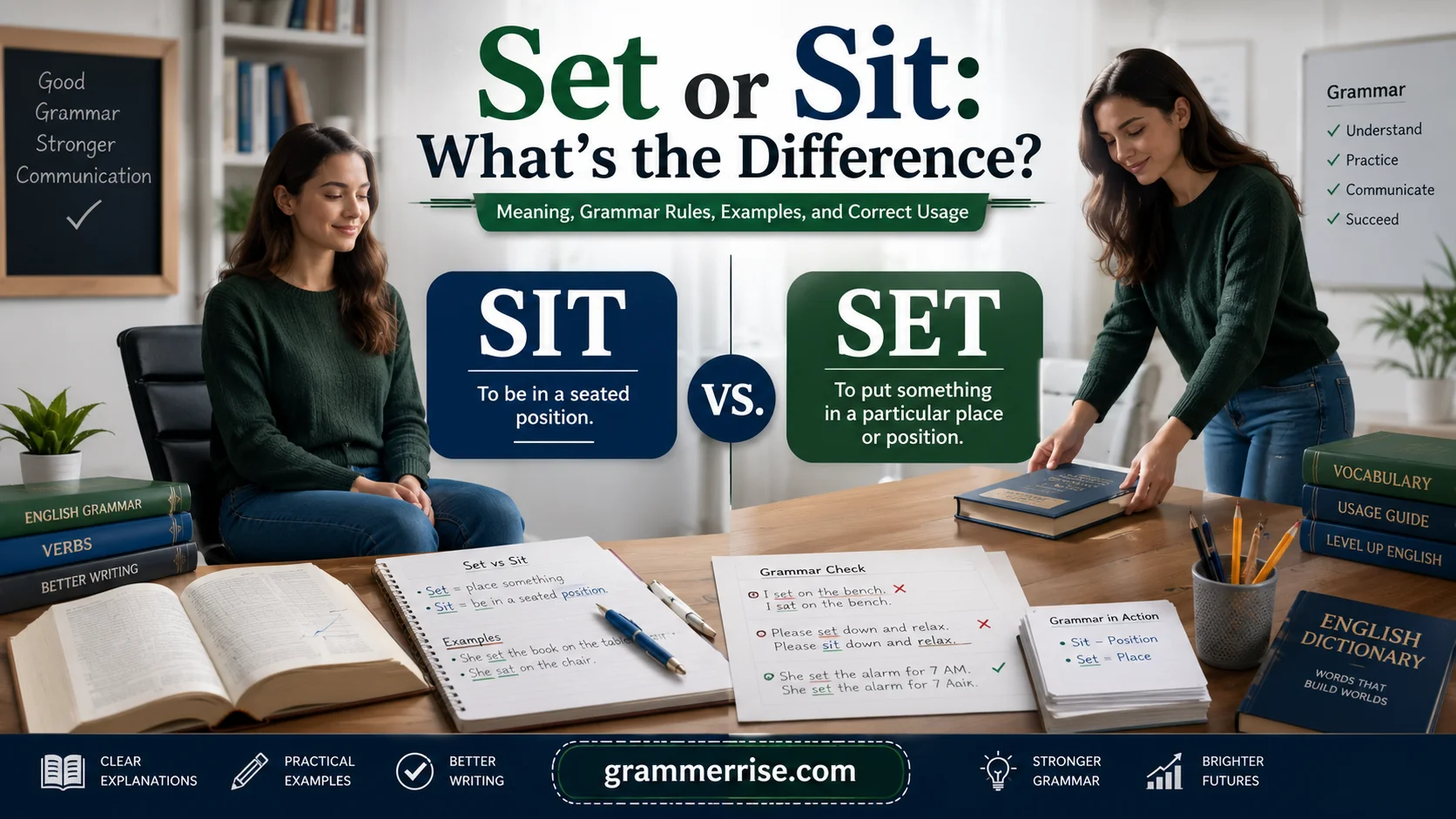
Set and sit both describe placing something in a position, but they work differently.
- Sit means to rest your body in a seated position.
Example: Please sit on the chair. - Set means to place or put something somewhere.
Example: Please set the book on the table.
The easiest way to remember:
✅ You sit yourself.
✅ You set something else.
A person can sit in a chair, but they set a phone, book, or cup on the chair.
Set vs Sit at a Glance
Here is the quick difference between these commonly confused verbs.
| Word | Meaning | Verb Type | Example |
| Sit | To rest in a seated position | Usually intransitive | Please sit here. |
| Set | To place something somewhere | Usually transitive | Set the phone on the desk. |
Quick Memory Trick for Set or Sit
Use this simple rule:
You sit. You set things.
If a person or animal lowers their body into a chair, couch, or surface, use sit.
If someone places an object in a location, use set.
Examples:
Sit:
- Sit on the sofa.
- Sit beside me.
- The dog sat near the door.
Set:
- Set the keys on the counter.
- Set the plate on the table.
- Set the alarm before sleeping.
This small difference solves most confusion.
What Does Sit Mean?
The verb sit describes the action of resting your body in a seated position.
When you sit, your body moves from standing or another position into a place where your weight rests on a surface.
Definition of Sit
Sit means:
To rest with your body supported by your bottom, usually on a chair, floor, or other surface.
The word commonly describes people and animals.
Examples:
- I sit at my desk every morning.
- The child sat quietly during the movie.
- The dog sits beside its owner.
How Sit Works in English Grammar
The verb sit usually works as an intransitive verb.
An intransitive verb does not need a direct object.
You can say:
✅ She sits.
You cannot normally say:
❌ She sits the chair.
Why?
Because the chair is not receiving the action. The person is changing their own position.
The correct sentence is:
✅ She sits on the chair.
Common Meanings of Sit
Although the main meaning involves taking a seat, sit has several uses.
Sit in a Chair or Seat
This is the most common meaning.
Examples:
- Please sit in the front row.
- He sits near the window.
- We sat at the dinner table.
Sit Down
The phrase sit down means to move into a seated position.
Examples:
- Please sit down and relax.
- The students sat down when the teacher entered.
- I sat down after a long day at work.
Sit Quietly
Sometimes sit describes staying in one position.
Examples:
- The baby sat quietly for ten minutes.
- The cat sat still while watching birds.
Sit in a Location
Sit can also describe the position of a place or object.
Examples:
- The cabin sits beside the lake.
- The restaurant sits on a busy street corner.
This usage does not mean someone is physically sitting. It means something is located there.
Common Expressions Using Sit
English uses sit in many everyday phrases.
| Expression | Meaning | Example |
| Sit tight | Wait patiently | Sit tight while I check the information. |
| Sit back | Relax and watch | Sit back and enjoy the show. |
| Sit around | Spend time doing little | Don’t sit around all day. |
| Sit still | Remain motionless | The child couldn’t sit still. |
| Sit on the fence | Avoid choosing a side | He is sitting on the fence about the decision. |
What Does Set Mean?
The verb set means to place, position, arrange, or establish something.
Unlike sit, set usually requires an object because something receives the action.
Definition of Set
Set means:
To put something in a particular place, position, or condition.
Examples:
- Set the glass on the table.
- Set your phone beside the laptop.
- Set the timer for ten minutes.
How Set Works in English Grammar
The verb set usually works as a transitive verb.
A transitive verb needs a direct object.
Example:
✅ Set the book down.
Here:
- Subject = You
- Verb = Set
- Object = Book
The book receives the action.
Without an object, the sentence often feels incomplete.
Common Meanings of Set
The word set has many meanings beyond placing objects.
It is one of the most versatile verbs in English.
Set an Object Down
This means putting something somewhere.
Examples:
- Set your bag near the door.
- Set the cup on the table.
- Set the package outside.
Set the Table
This common phrase means preparing dishes, utensils, and plates for a meal.
Example:
- Can you set the table before dinner?
You are not placing the table itself.
You are arranging items on it.
Set a Goal
Set can also mean creating a target.
Examples:
- She set a goal to run a marathon.
- The company set new sales targets.
- He set a personal record.
Set Rules or Standards
Organizations often set expectations.
Examples:
- Teachers set classroom rules.
- Companies set safety standards.
- Governments set regulations.
Set a Clock or Timer
This refers to adjusting a device.
Examples:
- Set your alarm for 7 a.m.
- Set the timer for thirty minutes.
- I set my watch before the trip.
Common Expressions Using Set
| Expression | Meaning | Example |
| Set up | Arrange or prepare | Set up the meeting room. |
| Set aside | Save for later | Set aside some money. |
| Set out | Begin a journey or explain | She set out early. |
| Set off | Start a trip or trigger something | They set off at sunrise. |
| Set in stone | Fixed and unchangeable | The decision isn’t set in stone. |
| Set the stage | Prepare conditions | The introduction set the stage for success. |
Set vs Sit: The Key Difference
The biggest difference between set and sit comes down to one question:
Are you placing something or positioning yourself?
If you place something:
➡️ Use set
If you position yourself:
➡️ Use sit
Side-by-Side Comparison
| Feature | Sit | Set |
| Main idea | Take a seat | Place something |
| Action performed by | Person or animal | Person acting on an object |
| Needs an object? | Usually no | Usually yes |
| Verb type | Intransitive | Transitive |
| Example | Sit on the couch | Set the book on the couch |
The Object Test
A simple grammar test can help.
Ask:
What is receiving the action?
Example:
“I set the phone on the desk.”
What receives the action?
The phone.
Therefore, set is correct.
Example:
“I sit on the desk chair.”
What receives the action?
Nothing.
You are changing your own position.
Therefore, sit is correct.
Visual Grammar Guide
You lower your body
↓
SIT
You place an object
↓
SET
Why Do People Confuse Set and Sit?
The confusion happens for several reasons.
Similar Meanings
Both words involve position.
You can:
- Sit on a chair.
- Set a book on a chair.
The location might be the same.
The action changes.
Similar Everyday Situations
Imagine a dinner table.
You might:
- Sit at the table.
- Set the plates on the table.
The table connects both actions, which creates confusion.
Verb Forms Create More Confusion
The past tense creates another challenge.
Compare:
- Sit → Sat
- Set → Set
Many learners expect set to change like sit.
However, set remains the same in the past tense.
Examples:
Present:
- I set the cup down.
Past:
- I set the cup down yesterday.
Not:
❌ I sat the cup down yesterday.
When to Use Sit
Use sit when a person or animal takes a seated position.
Correct Situations for Sit
Sitting in a Place
Examples:
- She sits near the window.
- He sat beside his friend.
- The dog sits by the fireplace.
Staying in One Position
Examples:
- Please sit still.
- The audience sat quietly.
- The child sat patiently.
Taking a Seat
Examples:
- Sit here.
- Sit down.
- Have a seat.
Examples of Sit in Sentences
- I usually sit at the kitchen table.
- The students sat quietly during the test.
- My cat likes to sit on the windowsill.
- We sat together during the ceremony.
When to Use Set
Use set when you put, place, arrange, or establish something.
Correct Situations for Set
Placing Objects
Examples:
- Set the keys on the shelf.
- Set the glass beside the sink.
- Set your phone on silent mode.
Creating Plans or Goals
Examples:
- The team set ambitious goals.
- She set a deadline.
- They set new expectations.
Arranging Things
Examples:
- Set the table.
- Set the equipment.
- Set the room for the event.
Set vs Sit in Different Verb Tenses
Understanding verb forms makes writing much easier.
Present Tense
| Verb | Example |
| Sit | I sit here every morning. |
| Set | I set the alarm every night. |
Past Tense
| Verb | Example |
| Sat | I sat in the chair yesterday. |
| Set | I set the book on the desk yesterday. |
Past Participle
| Verb | Example |
| Sat | She has sat there before. |
| Set | He has set the record. |
Present Participle
| Verb | Example |
| Sitting | She is sitting outside. |
| Setting | He is setting the table. |
Sit, Sat, Set, and Setting Explained
These forms often confuse writers.
Sit vs Sat
Sit is present tense.
Example:
- I sit here every day.
Sat is past tense.
Example:
- I sat here yesterday.
Set vs Setting
Set can stay the same in present and past forms.
Examples:
- I set the alarm.
- I set the alarm yesterday.
Setting describes an ongoing action.
Example:
- She is setting the plates on the table.
Quick Reference Table
| Form | Meaning | Example |
| Sit | Present action | I sit here. |
| Sat | Past action | I sat there. |
| Sitting | Ongoing action | She is sitting. |
| Set | Present/past action | I set the book down. |
| Setting | Ongoing placement | He is setting the table. |
Common Mistakes with Set and Sit
Mistake: “Sit the Book on the Table”
Incorrect:
❌ Sit the book on the table.
Correct:
✅ Set the book on the table.
The book cannot sit itself.
Mistake: “Set Down in the Chair”
Incorrect:
❌ Set down in the chair.
Correct:
✅ Sit down in the chair.
You are changing your position, not placing yourself like an object.
Mistake: Using Sat for Objects
Incorrect:
❌ I sat the phone on the desk.
Correct:
✅ I set the phone on the desk.
Mistake: Confusing Past Forms
Incorrect:
❌ I set in the chair yesterday.
Correct:
✅ I sat in the chair yesterday.
Real-Life Examples of Set and Sit
Home
- Sit on the couch.
- Set the remote on the table.
School
- Students sit at desks.
- Teachers set assignments.
Work
- Employees sit during meetings.
- Managers set deadlines.
Restaurants
- Customers sit at tables.
- Staff set the dishes.
During Travel
- Passengers sit in seats.
- Travelers set bags in overhead compartments.
Set and Sit in Common Idioms
Sit Tight
Meaning: Wait patiently.
Example:
- Sit tight while we prepare your order.
Sit Back and Relax
Meaning: Relax without taking action.
Example:
- Sit back and enjoy the movie.
Set the Record Straight
Meaning: Correct false information.
Example:
- She explained the facts to set the record straight.
Set the Tone
Meaning: Establish a mood or direction.
Example:
- The opening speech set the tone for the event.
Set in Stone
Meaning: Cannot easily change.
Example:
- The schedule isn’t set in stone.
Set or Sit Practice Quiz
Choose the correct word.
- Please _____ on the chair.
- _____ the laptop on the desk.
- She _____ quietly during the meeting.
- He _____ new goals every year.
- The dog likes to _____ near the window.
- I _____ the dishes on the counter.
- They _____ together during dinner.
- The manager _____ clear expectations.
Answers
| Question | Answer |
| 1 | Sit |
| 2 | Set |
| 3 | Sat |
| 4 | Sets |
| 5 | Sit |
| 6 | Set |
| 7 | Sat |
| 8 | Set |
FAQs
1. What is the main difference between set and sit?
The main difference is that set usually requires an object, while sit does not. When you set something, you place or position an item somewhere. For example, you set the book on the table. When you sit, you place your body in a seated position, such as sitting on a chair.
2. Is set a transitive verb or an intransitive verb?
Set is generally a transitive verb because it needs a direct object to complete its meaning. You set something, such as a phone, book, or glass, somewhere. Without an object, the sentence often feels incomplete.
3. Why do people confuse set and sit?
People often confuse set and sit because both words have similar sounds and irregular verb forms. However, their meanings and grammar patterns are different. Learning the object requirement for set and the seated action of sit makes the distinction easier to remember.
4. Can sit ever take an object?
No, sit does not normally take a direct object. It describes the action of being seated or resting in a position. For example, you say “I sit on the chair,” not “I sit the chair.” The chair is the location, not the object receiving the action.
5. What are common mistakes with set and sit?
A common mistake is using sit when the meaning requires set. For example, saying “sit the book on the desk” is incorrect because the book is being placed. The correct sentence is “set the book on the desk.” Understanding sentence structure helps prevent these errors.
6. How can I remember when to use set or sit?
A simple memory trick is to ask whether you are placing something or positioning yourself. If you are placing an object somewhere, use set. If you are putting yourself into a seated position, use sit. Regular practice with examples will help you use both verbs correctly.
Conclusion
Understanding the difference between set and sit can greatly improve your English grammar, writing skills, and everyday communication. Although these two verbs look and sound similar, their grammar rules are completely different. Set requires an object because it shows an action of placing something somewhere, while sit describes the position or action of a person being seated.
By remembering this simple rule and practicing regularly, you can avoid common mistakes in emails, academic writing, professional communication, and casual conversations. Once you understand the difference between these verbs, your sentences become clearer, more accurate, and more natural. Mastering set vs sit is a small step that can make a big improvement in your overall English confidence.