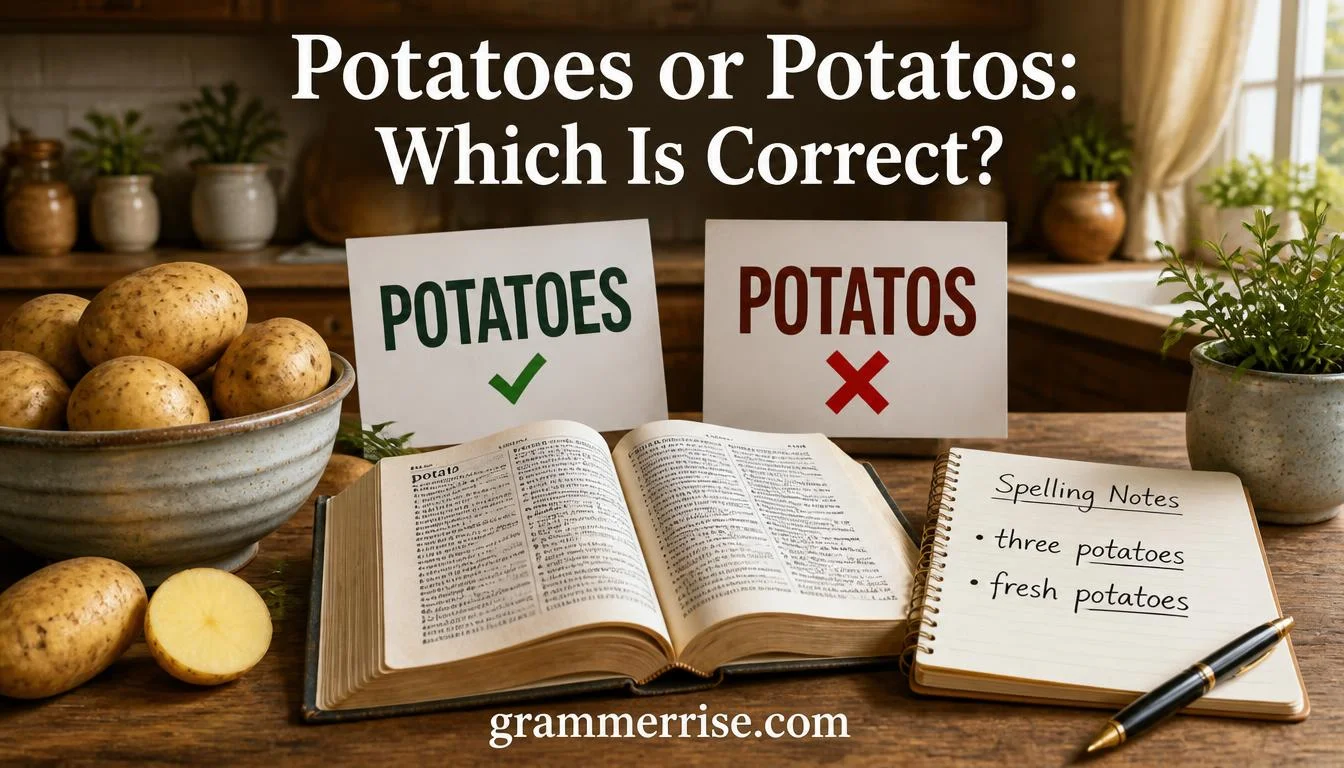
Potatoes or Potatos is a common spelling question for English learners, students, and casual speakers because both words look almost the same.
The small difference is the letter e, but it changes the form completely. Potatoes is the correct spelling, standard, dictionary-approved plural form of potato, while potatos is an incorrect variant. This comparison helps learners understand the spelling rules behind the plural of this starchy root vegetable. As a teacher, I often see this mistake when learners think they only need to add s. A simple way to clear the question is to remember the extra e.
The potato is a root vegetable known for its culinary versatility and frequently appears in everyday communication, casual conversation, written English, online content, food writing, and recipe books. The incorrect spelling often arises from phonetic habits and spelling mistakes. Careful proofreading can remove the error, improving accuracy, correctness, and expression for the writer and reader. Proper usage matters in education, language learning, teaching, professional documents, digital content, educational material, content creation, and publishing, helping build credibility. Understanding the singular form and plural form improves grammar, vocabulary, written communication, and professional writing.
Quick Answer:
If you’re looking for the short answer, here it is:
| Word | Correct? | Meaning |
| Potato | ✅ | One potato |
| Potatoes | ✅ | More than one potato |
| Potatos | ❌ | Incorrect spelling |
Correct Examples
- We bought several potatoes for dinner.
- The farmer harvested thousands of potatoes.
- These roasted potatoes taste amazing.
Incorrect Examples
- We bought several potatos.
- The farmer harvested thousands of potatos.
The word potatos is not accepted in standard English dictionaries and should not be used.
What Does “Potato” Mean?
A potato is a starchy underground tuber that comes from the plant Solanum tuberosum. It is one of the world’s most widely consumed foods and serves as a staple ingredient in countless cuisines.
People use potatoes to make:
- French fries
- Mashed potatoes
- Potato chips
- Baked potatoes
- Potato salad
- Hash browns
- Soups and stews
Because potatoes are commonly discussed in cooking, farming, nutrition, and everyday conversation, knowing the correct plural form matters.
Singular Form: Potato
The singular form refers to one potato.
Examples:
- I bought a potato for lunch.
- The potato was unusually large.
- This potato has a smooth texture.
Plural Form: Potatoes
The plural form refers to more than one potato.
Examples:
- We planted potatoes in the garden.
- The potatoes were ready for harvest.
- She cooked potatoes for the entire family.
Potatoes vs. Potatos: What’s the Difference?
The difference is simple.
Potatoes follows English spelling rules.
Potatos does not.
| Form | Status | Usage |
| Potato | Correct | Singular |
| Potatoes | Correct | Plural |
| Potatos | Incorrect | Misspelling |
Many spelling mistakes occur because writers assume every noun becomes plural by adding -s.
That works for words like:
- books
- tables
- cars
- computers
However, English contains several noun patterns that require different endings.
Potato belongs to one of those patterns.
Why Is “Potatoes” Correct?
The answer lies in English pluralization rules.
When certain nouns end with the letter o, they form the plural by adding -es instead of just -s.
Since potato falls into this category, the correct plural becomes:
Potato + es = Potatoes
The Rule Behind Potato
Many common nouns ending in a consonant followed by o take -es when pluralized.
Examples include:
| Singular | Plural |
| Potato | Potatoes |
| Tomato | Tomatoes |
| Hero | Heroes |
| Echo | Echoes |
| Torpedo | Torpedoes |
Because potato follows this pattern, potatoes becomes the accepted spelling.
Why People Write “Potatos”
The mistake usually happens because people apply the most common English plural rule.
For example:
- Cat → Cats
- Dog → Dogs
- House → Houses
- Book → Books
Writers often assume:
- Potato → Potatos
The logic seems reasonable, but English isn’t always predictable.
That’s why understanding the pattern matters.
A Simple Memory Trick
One of the easiest ways to remember the spelling is to pair it with another familiar word.
Think:
Tomato → Tomatoes
Potato → Potatoes
Since most people already know that tomatoes is correct, remembering potatoes becomes much easier.
Quick Memory Formula
Tomato = Tomatoes
Potato = Potatoes
If you remember one, you’ll remember the other.
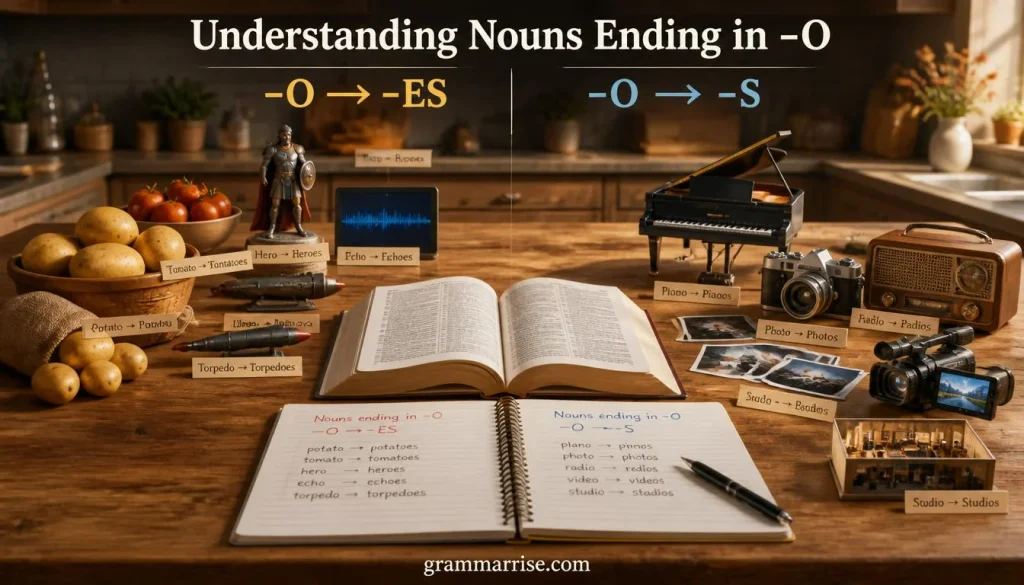
Understanding Nouns Ending in -O
English contains several nouns ending in -o, but they don’t all follow the same plural pattern.
This is where much of the confusion comes from.
Words That Add -ES
| Singular | Plural |
| Potato | Potatoes |
| Tomato | Tomatoes |
| Hero | Heroes |
| Echo | Echoes |
| Torpedo | Torpedoes |
Words That Add Only -S
| Singular | Plural |
| Piano | Pianos |
| Photo | Photos |
| Radio | Radios |
| Video | Videos |
| Studio | Studios |
As you can see, English doesn’t follow one universal rule.
Why English Has Exceptions
English has borrowed vocabulary from dozens of languages over centuries.
Words entered the language from:
- Latin
- Greek
- French
- Spanish
- German
- Italian
As a result, pluralization patterns evolved differently.
Some words kept older forms.
Others adopted simpler endings.
That’s why memorization sometimes becomes necessary.
Is “Potatos” Ever Correct?
In standard English, the answer is no.
Major dictionaries recognize potatoes as the correct plural form.
You may occasionally see potatos online, but that doesn’t make it correct.
Places You Might Encounter “Potatos”
You might see the misspelling in:
- Social media posts
- Online comments
- Student essays
- Text messages
- Informal writing
These examples reflect human error rather than accepted grammar.
Why Accuracy Matters
Correct spelling helps establish:
- Credibility
- Professionalism
- Clarity
- Trustworthiness
A small spelling mistake can distract readers and weaken the impact of your writing.
Potato, Potatoes, and Possessive Forms
Plural forms and possessive forms often confuse writers because they look similar.
Understanding the difference prevents common errors.
Singular Possessive: Potato’s
Use potato’s when something belongs to one potato.
Examples:
- The potato’s skin was rough.
- The potato’s color changed during cooking.
Plural Form: Potatoes
Use potatoes when discussing multiple potatoes.
Examples:
- The potatoes were freshly harvested.
- Several potatoes rolled off the table.
Plural Possessive: Potatoes’
Use potatoes’ when something belongs to multiple potatoes.
Examples:
- The potatoes’ texture improved after roasting.
- The potatoes’ flavor became richer during baking.
Quick Comparison Table
| Form | Meaning |
| Potato | One potato |
| Potatoes | More than one potato |
| Potato’s | Belonging to one potato |
| Potatoes’ | Belonging to multiple potatoes |
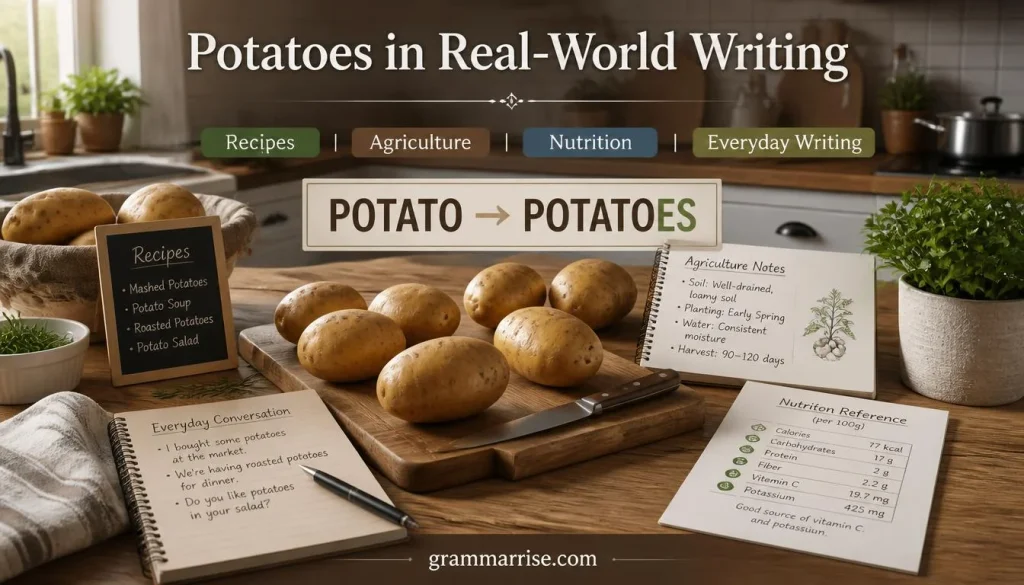
Potatoes in Real-World Writing
The word potatoes appears in many industries and contexts.
In Recipes
Recipes often mention potatoes because they are incredibly versatile.
Examples:
- Boil the potatoes until tender.
- Dice the potatoes into small cubes.
- Roast the potatoes for forty minutes.
In Agriculture
Farmers and agricultural researchers frequently discuss potato production.
Examples:
- Potatoes remain a major global crop.
- Farmers planted potatoes across hundreds of acres.
- Improved irrigation increased potato yields.
In Nutrition
Nutrition experts often analyze potatoes because they provide:
- Carbohydrates
- Fiber
- Potassium
- Vitamin C
- Vitamin B6
Examples:
- Potatoes can be part of a balanced diet.
- Baked potatoes contain valuable nutrients.
In Everyday Conversation
You hear the word regularly in casual speech.
Examples:
- We need potatoes for dinner.
- These potatoes taste fantastic.
- The store ran out of potatoes.
Common Grammar Mistakes People Make
Even native speakers occasionally misuse potato-related forms.
Mistake: Writing Potatos
Incorrect:
❌ We harvested several potatos.
Correct:
✅ We harvested several potatoes.
Mistake: Mixing Singular and Plural Forms
Incorrect:
❌ One potatoes remained.
Correct:
✅ One potato remained.
Mistake: Subject-Verb Agreement
Incorrect:
❌ Potatoes is ready.
Correct:
✅ Potatoes are ready.
Mistake: Incorrect Possessives
Incorrect:
❌ The potatoes skin was crispy.
Correct:
✅ The potato’s skin was crispy.
or
✅ The potatoes’ skins were crispy.
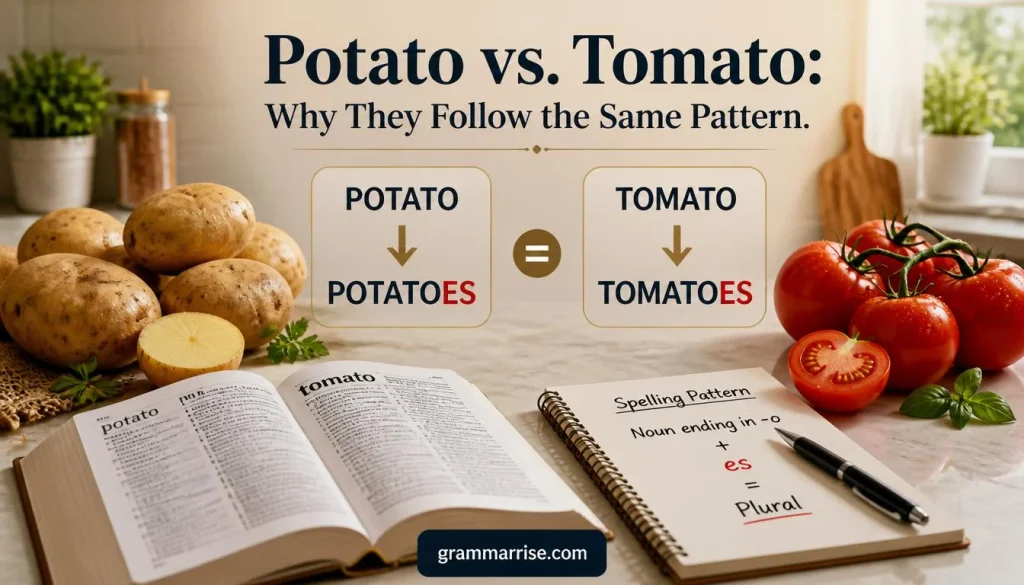
Potato vs. Tomato: Why They Follow the Same Pattern
Few word pairs help explain English spelling better than potato and tomato.
Both nouns:
- End with a consonant plus o
- Use -es in the plural
- Cause similar spelling mistakes
Comparison Table
| Singular | Plural |
| Potato | Potatoes |
| Tomato | Tomatoes |
Because these words behave the same way, they create an easy learning shortcut.
Many teachers encourage students to memorize them together.
Examples of Potatoes Used Correctly
Seeing a word in context often makes spelling rules easier to remember.
Everyday Examples
- We bought potatoes from the local market.
- The potatoes were surprisingly inexpensive.
- Fresh potatoes arrived this morning.
Academic Examples
- Researchers studied disease-resistant potatoes.
- Scientists analyzed potatoes grown under controlled conditions.
- The report compared several potato varieties.
Workplace Examples
- The supplier delivered potatoes ahead of schedule.
- Potatoes represented a major portion of sales.
- The shipment included organic potatoes.
Cooking Examples
- The chef roasted the potatoes with herbs.
- These potatoes pair well with grilled meat.
- The potatoes developed a crisp exterior.
Media Examples
- Rising demand increased potato prices.
- Farmers exported more potatoes this year.
- Potatoes remain a popular staple food.
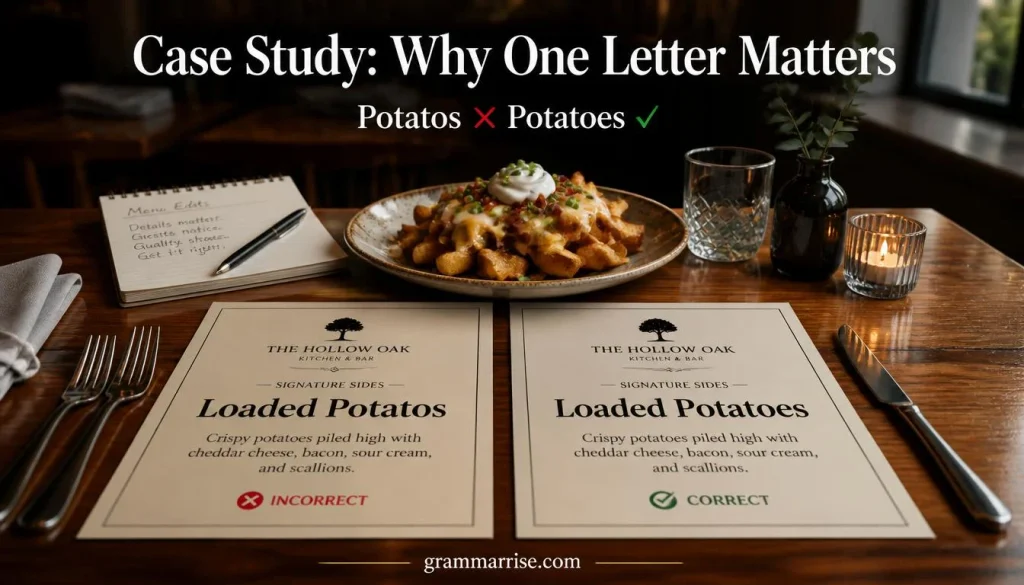
Case Study: Why One Letter Matters
Imagine a restaurant owner creating a menu.
Version One:
Loaded Potatos
Version Two:
Loaded Potatoes
Most customers immediately notice the difference.
Although the food remains the same, the spelling error can make the business appear less professional.
The lesson is simple.
Small details shape perception.
Correct spelling strengthens credibility in schools, workplaces, websites, marketing materials, and business communication.
Mini Quiz: Potatoes or Potatos?
Choose the correct answer.
Question 1
We harvested dozens of ______.
A. potatos
B. potatoes
Question 2
The ______ were baking in the oven.
A. potatoes
B. potatos
Question 3
Farmers exported thousands of ______.
A. potatoes
B. potatos
Answers
- Potatoes
- Potatoes
- Potatoes
If you selected potatoes every time, you’re absolutely correct.
How to Remember the Correct Spelling Forever
Spelling rules stick better when connected to memory techniques.
Use the Tomato Connection
Remember:
- Tomato → Tomatoes
- Potato → Potatoes
The pattern is identical.
Visualize the Extra Letters
Picture the word growing larger as the quantity increases.
One potato.
Many potatoes.
The extra es helps signal plurality.
Read It Aloud
Say the words aloud:
- Potato
- Potatoes
The ending naturally sounds like -oes, which reinforces the spelling.
Create a Quick Reminder
Keep this phrase in mind:
“If tomato needs ES, potato does too.”
Simple. Memorable. Effective.
Read more: Weather or Whether: Which One Should You Use?
Fun Fact About the Word Potato
The English word potato ultimately traces its roots to Spanish influences connected to indigenous American languages.
Potatoes originated in South America thousands of years ago before spreading worldwide.
Today, potatoes rank among the most important food crops on Earth.
Millions of people consume them daily in countless forms.
That makes potatoes one of the most frequently written food-related plural nouns in English.
My Personal Experience as an English Specialist
As an English specialist, I often see learners write “potatos” instead of “potatoes.” I understand the confusion because adding -s is a common plural pattern in English. When I explain this, I usually connect potato with tomato: potato → potatoes and tomato → tomatoes. This simple comparison helps my students remember the extra e.
I have found that using the word in everyday sentences makes the correct spelling easier to remember. After a little practice, most learners stop thinking about the rule and naturally write potatoes correctly.
FAQs
1. Is “potatoes” or “potatos” correct?
Potatoes is the correct spelling. Potatos is a common spelling mistake and should not be used in standard English.
2. Why is “potatoes” spelled with an “e”?
The plural of potato follows a spelling pattern where -es is added instead of simply adding -s. That gives us potatoes.
3. Is “potatos” ever considered correct?
No. In standard English, potatos is considered an incorrect spelling. The accepted plural form is potatoes.
4. What is the singular form of “potatoes”?
The singular form is potato. For example, “I bought one potato,” while “I bought several potatoes” uses the plural.
5. How can I remember the spelling of “potatoes”?
A simple trick is to remember potato + es = potatoes. Think of the e as part of the plural ending rather than leaving it out.
6. Can “potatoes” be used in formal writing?
Yes. Potatoes is perfectly suitable for formal writing, including academic work, professional documents, recipes, educational material, and food-related content.
Conclusion
Knowing the difference between potatoes and potatos is a small but useful part of improving your English spelling. The correct plural form is always potatoes, with the extra e before s. Although potatos may look natural or appear online, it is simply a spelling error. Once you remember the pattern potato → potatoes, the correct form becomes much easier to recognize and use. Whether you are writing a recipe, completing an assignment, creating online content, or preparing a professional document, using potatoes helps your writing look clear, accurate, and polished.