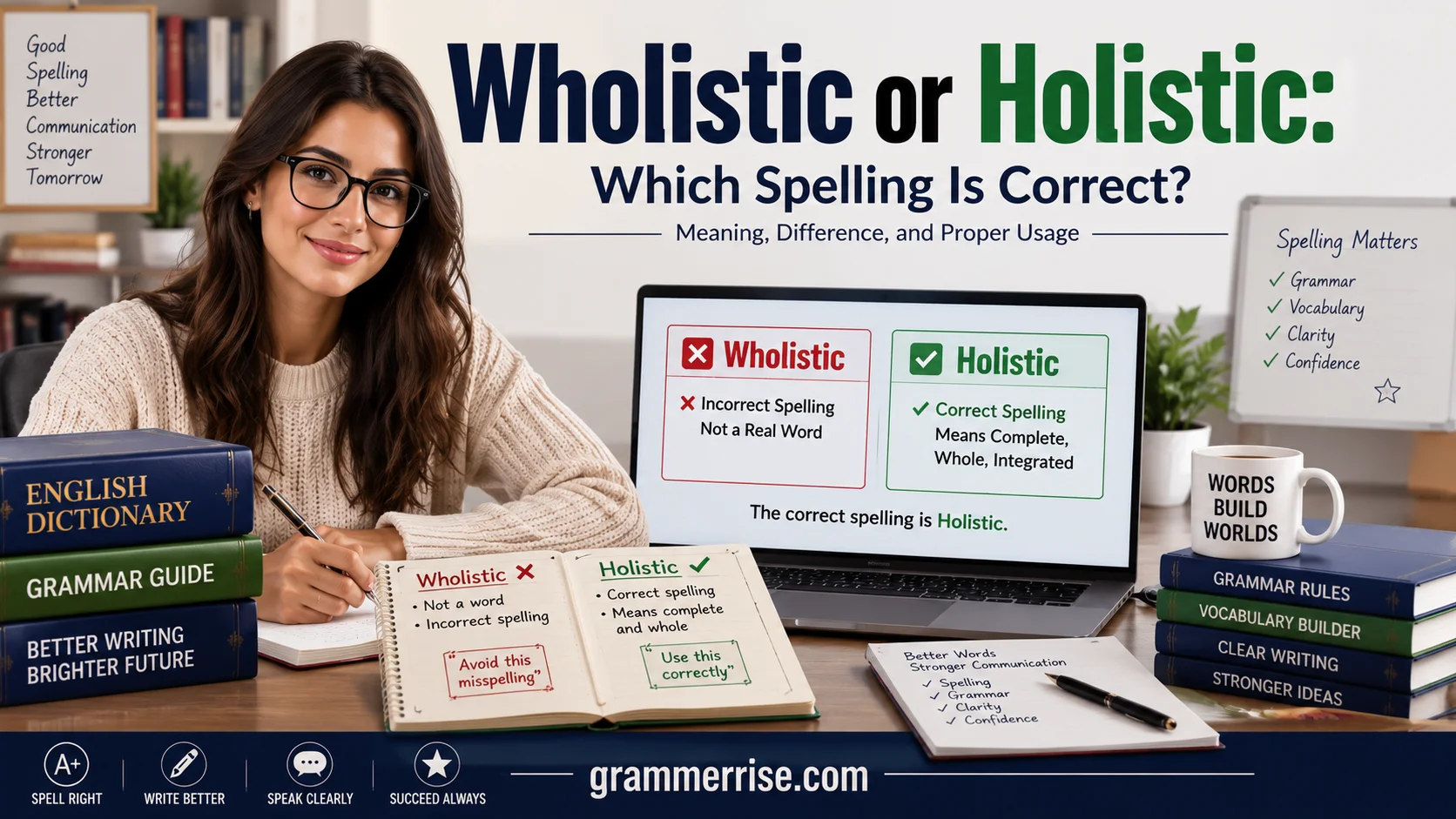
Wholistic or Holistic is a common topic that explains why these words create confusion among writers. Both have a similar sound and appear in related contexts, but their usage differs in modern English.
Holistic is the standard and preferred spelling, while wholistic is a recognized variant that is less common. These words describe a philosophy where all parts of a thing are interconnected. The correct usage depends on the audience, but holistic is widely accepted in academic writing, business communication, and professional publications.
The holistic approach focuses on the whole person and the entire system instead of only individual parts. In healthcare, holistic treatment means viewing and treating the patient by considering the mind, body, spirit, and social factors. Some people think holistic means rejecting modern medicine, but this is a misunderstanding. It includes integrating different solutions for overall health.
Wholistic often appears in lifestyle and spiritual branding because it emphasizes wholeness and a broader philosophy of life. Understanding these common spelling differences, key differences, and origins helps students and professionals avoid mistakes. Through practical examples and real-world examples, you can learn to choose the right word and write confidently in essays, articles, emails, and documents without guesswork.
Quick answer
The correct and most commonly accepted spelling is “holistic.” It means looking at something as a complete whole by considering all connected parts. “Wholistic” is a rare variant that has the same meaning, but it is not the preferred choice in professional or academic writing. When you want your writing to sound clear and standard, use holistic.
Wholistic or Holistic: Which Spelling Is Correct?
The correct and preferred spelling is holistic.
The word holistic describes an approach that looks at something as a complete system rather than focusing on separate parts. It considers how different elements connect and affect each other.
For example, a doctor using a holistic approach does not only look at a single symptom. Instead, the doctor may consider:
- A person’s physical health
- Mental well-being
- Lifestyle choices
- Sleep habits
- Diet
- Environment
- Emotional factors
The spelling wholistic carries a similar meaning, but it is far less common. Some writers use it because it visually connects with the word whole, making the meaning feel easier to understand.
However, in professional and formal writing, holistic is the safer choice.
Quick Comparison: Holistic vs. Wholistic
| Word | Status | Usage Level | Meaning |
| Holistic | Standard spelling | Very common | Considering something as a complete whole |
| Wholistic | Variant spelling | Rare | Having the same general meaning as holistic |
If you are writing a research paper, business document, healthcare article, or professional communication, choose holistic.
What Does Holistic Mean?
The word holistic means looking at something as a complete and interconnected whole.
Instead of examining one small part separately, a holistic approach considers the relationship between all parts.
Think about a car engine. A mechanic cannot always fix a problem by looking at one tiny component. The engine works because many parts cooperate. A problem in one area may affect the entire system.
A holistic approach works in a similar way.
It asks:
- How do different parts influence each other?
- What factors contribute to the overall situation?
- How can we improve the entire system instead of only fixing one issue?
The concept applies to many areas, including:
- Healthcare
- Education
- Business
- Personal development
- Environmental planning
- Psychology
Simple Definition of Holistic
Holistic means understanding something by considering all its connected parts together.
For example:
- A holistic health plan considers the entire person.
- A holistic education system develops academic, emotional, and social skills.
- A holistic business strategy considers customers, employees, finances, and long-term growth.
What Does Wholistic Mean?
The word wholistic has the same basic meaning as holistic. It describes something that considers the entire picture rather than isolated pieces.
The main difference is not meaning. The difference is popularity and acceptance.
Some people prefer wholistic because the spelling immediately reminds readers of the word whole. It feels more intuitive.
For example:
“The company created a wholistic plan for employee development.”
The sentence is understandable. However, most professional writers would choose:
“The company created a holistic plan for employee development.”
The second sentence matches modern standard usage.
Why Do People Use Wholistic?
People often choose wholistic because:
- They connect the word with “whole.”
- They think the “w” makes the meaning clearer.
- They have seen the variant used online.
- They are unaware that “holistic” is the preferred form.
Language naturally changes over time. People sometimes create spellings based on how words sound or what they seem to mean. This explains why variants like wholistic appear.
The Origin and History of the Word Holistic
The history of holistic explains why the spelling does not start with “wh.”
The word comes from the concept of holism, which developed from the Greek word holos, meaning whole, entire, or complete.
The term holism describes the idea that a system is more than just the sum of its individual parts.
A simple example is the human body.
Your body is made up of different systems:
- Heart and circulation
- Brain and nervous system
- Muscles
- Digestive system
- Immune system
Each system has its own role. However, they do not operate separately. They work together to maintain overall health.
A holistic view recognizes these connections.
Important Facts About Holistic
| Fact | Information |
| Word origin | Greek word “holos” meaning whole |
| Related concept | Holism |
| Common spelling | Holistic |
| Main idea | Understanding complete systems |
| Common fields | Healthcare, education, business, psychology |
Holistic vs. Wholistic: Main Differences Explained
Although holistic and wholistic share a similar meaning, several differences separate them.
Spelling Difference
The biggest difference is spelling.
- Holistic → accepted standard form
- Wholistic → uncommon variant
The “h” spelling comes from the Greek origin of the word, not from the English word “whole.”
Dictionary Recognition
Most major dictionaries list holistic as the primary spelling.
Wholistic may appear as a variant, but it does not have the same level of recognition.
This matters because standard spelling improves clarity. Readers instantly recognize familiar terms.
Professional Usage Difference
The word holistic dominates professional fields.
| Industry | Common Usage |
| Medicine | Holistic healthcare |
| Psychology | Holistic approach |
| Education | Holistic learning |
| Business | Holistic strategy |
| Wellness | Holistic lifestyle |
A writer who uses “holistic” aligns with common professional language.
Why Is Holistic More Common Than Wholistic?
The popularity of holistic comes from history, professional adoption, and consistency.
When the concept of holism became more widely discussed, researchers and professionals adopted the “holistic” spelling.
Over time, the word became connected with:
- Alternative medicine
- Whole-person healthcare
- Complete learning approaches
- Integrated business strategies
As more industries used the term, holistic became the recognized spelling.
Meanwhile, wholistic remained a less common alternative.
A useful comparison is:
“Holistic” became the road most people travel. “Wholistic” is a side road that still leads to the same destination.
Read more: Allude vs Elude: Meaning and Correct Usage
Examples of Holistic in Different Contexts
The meaning of holistic changes slightly depending on the field, but the main idea remains the same: looking at the entire picture.
Holistic Healthcare
A holistic healthcare approach focuses on the complete person rather than only treating symptoms.
Traditional symptom-focused care may ask:
- What problem does the patient have?
- What treatment removes the symptom?
A holistic approach may also ask:
- How does lifestyle affect health?
- What role does stress play?
- How does nutrition influence well-being?
- What environmental factors matter?
Example:
“The healthcare provider used a holistic approach by considering the patient’s medical history, lifestyle, nutrition, and mental health.”
Case Study: Managing Stress Holistically
Imagine someone experiencing constant fatigue.
A narrow approach may focus only on medication.
A holistic approach may examine:
| Area | Possible Factor |
| Sleep | Poor sleep schedule |
| Diet | Lack of balanced nutrition |
| Mental health | High stress levels |
| Lifestyle | Limited physical activity |
By looking at the entire situation, the person may find long-term solutions.
Holistic Education
A holistic education approach focuses on developing the whole student.
Education is not only about memorizing information. Students also need:
- Creativity
- Communication skills
- Confidence
- Problem-solving ability
- Emotional intelligence
A holistic classroom may include:
- Academic lessons
- Team activities
- Creative projects
- Social development exercises
Example:
“The school follows a holistic education model that supports students’ intellectual, emotional, and social growth.”
Holistic Business Planning
Businesses also use the word holistic when they want to describe complete strategies.
A company does not grow because of one factor alone.
Growth depends on:
- Product quality
- Customer satisfaction
- Employee performance
- Marketing
- Financial planning
- Market conditions
Example:
“The company created a holistic marketing strategy that combined social media, customer research, and brand development.”
Common Mistakes When Using Holistic and Wholistic
Understanding common mistakes helps you avoid confusion.
Mistake: Thinking Wholistic Is Always Wrong
Many people believe wholistic is completely incorrect.
That is not exactly true.
It exists as a variant spelling. However, it is uncommon, and many readers expect holistic.
Mistake: Thinking Holistic Only Means Natural or Healthy
Some people associate holistic only with wellness or alternative medicine.
However, the word has a much broader meaning.
A holistic approach simply means considering the entire system.
For example:
- A holistic business strategy is not about health.
- A holistic education model is not about medicine.
- A holistic environmental plan is about ecosystems.
Mistake: Confusing Holistic With Similar Words
| Word | Meaning |
| Holistic | Considering the complete system |
| Comprehensive | Including many details |
| Complete | Having all required parts |
| Natural | Related to nature |
These words can overlap, but they are not identical.
Is Wholeistic a Correct Spelling?
Another common confusion is the spelling wholeistic.
The answer is no. Wholeistic is not the standard spelling.
People sometimes create this version because they connect the meaning with “whole.”
However, the accepted spelling remains:
✅ Holistic
Not:
❌ Wholeistic
❌ Wholistic (rare variant)
How to Remember the Correct Spelling
Remembering holistic becomes easier when you understand its origin.
Memory Trick One
Think:
Holistic = Whole idea
The beginning “hol” comes from the Greek word holos, meaning whole.
Memory Trick Two
Remember common phrases:
- Holistic approach
- Holistic health
- Holistic view
- Holistic solution
These phrases appear frequently in modern writing.
FAQs
1. Is “holistic” or “wholistic” the correct spelling?
Holistic is the standard and most widely accepted spelling in modern English. It is commonly used in healthcare, education, academic writing, and professional communication. Wholistic is a recognized variant, but it is less common and often used to emphasize the idea of “wholeness.”
2. What is the main difference between holistic and wholistic?
The main difference is not the meaning but the usage and popularity of each spelling. Both words describe an approach that considers the whole person, system, or situation rather than separate parts. However, holistic is preferred in most formal and professional contexts.
3. Does holistic mean rejecting modern medicine?
No, holistic does not mean rejecting modern medicine. Holistic health focuses on treating the whole person by considering the mind, body, emotions, lifestyle, and social factors. It can include conventional treatments like medication or surgery along with other supportive approaches.
4. Why do people use the word wholistic?
People often use wholistic because the spelling highlights the concept of “whole” or complete well-being. It is sometimes found in wellness, lifestyle, and spiritual branding where the focus is on a broader philosophy of life.
5. Can holistic and wholistic be used interchangeably?
Yes, both terms share a similar meaning and can sometimes be used interchangeably. However, choosing holistic is usually better when writing for academic, professional, or general audiences because it is more familiar and widely accepted.
6. How can I remember which spelling to use?
A simple way to remember is to choose holistic for most writing situations. Whether you are creating an article, essay, email, or professional document, holistic is the safer and more recognized option. Use wholistic only when you intentionally want to emphasize the idea of wholeness.
Conclusion
Understanding the difference between wholistic or holistic helps you make better choices in your writing and communication. While both words share a similar meaning and focus on looking at the complete picture, holistic remains the preferred spelling in modern English. It is widely recognized in healthcare, education, business, and professional discussions.
The word wholistic is still meaningful and can be used when emphasizing the idea of wholeness, especially in lifestyle or wellness settings. However, if you want your writing to sound clear, professional, and familiar to most readers, holistic is usually the best choice. By knowing the context, audience, and purpose of your writing, you can confidently select the right term and avoid common spelling mistakes.

Hussain Abid is an English language writer with over 10 years of experience in grammar, spelling, vocabulary, and writing. He specializes in creating clear, well-researched content that helps readers improve their English with confidence. At GrammarRise, Hussain writes practical guides, grammar explanations, and word comparison articles based on trusted language sources and real-world usage. His mission is to make English learning simple, accurate, and accessible for everyone