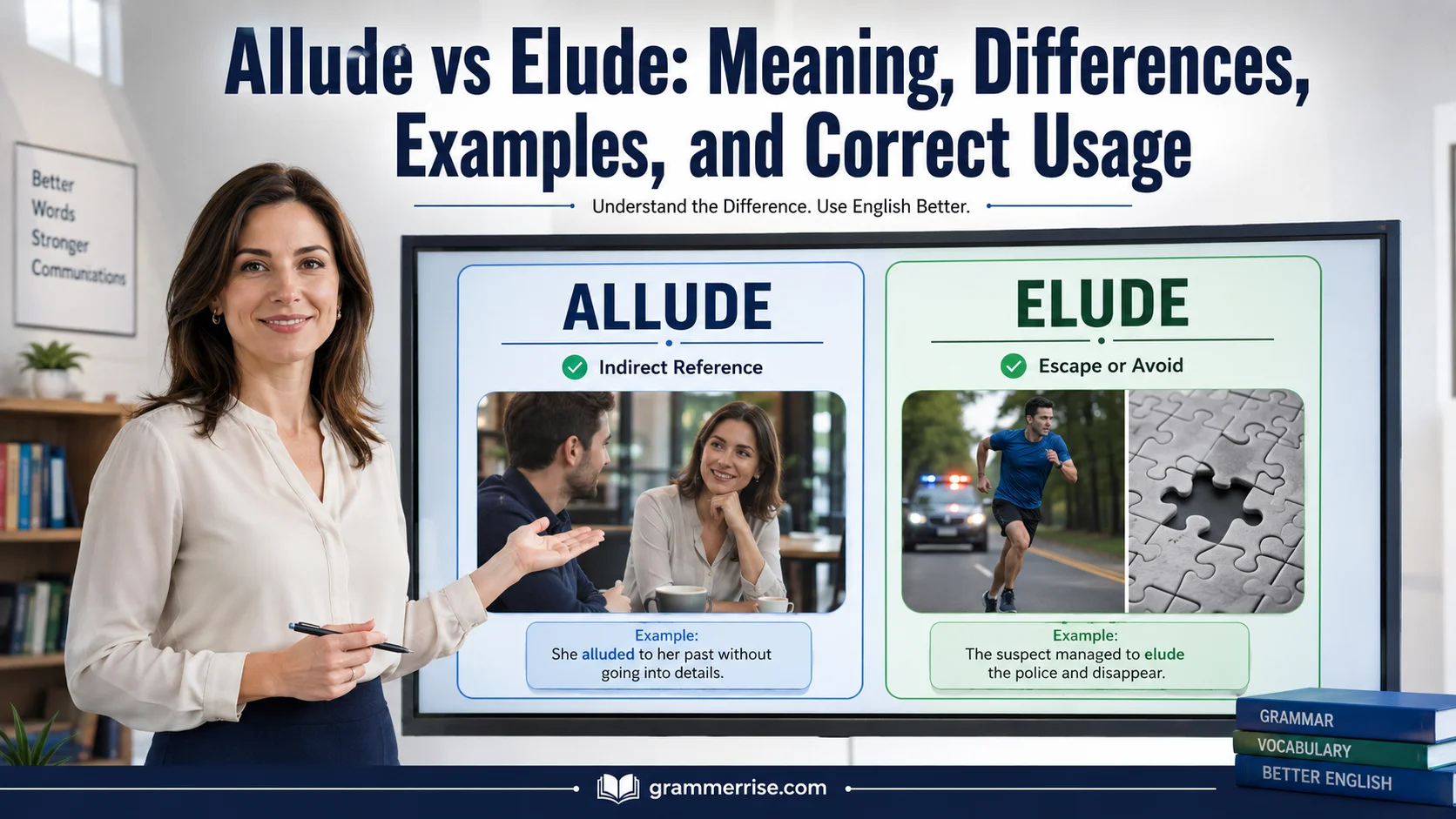
This Allude vs Elude guide helps writers understand two similar verbs, their meanings, differences, and usage to avoid mistakes in English writing. As an editor, I have seen countless beginners and seasoned professionals pause over their keyboards because Allude and Elude look and sound almost identical. This helpful article focuses on helping an eager writer master daily English grammar and writing.
These troublesome verbs share a similar Latin origin, Latin roots, and a similar ending, but their meanings and actions differ completely. They are absolutely not interchangeable, and a wrong choice or wrong word in an academic paper, professional message, professional emails, or academic writing can hurt credibilit, lead to confusion, and create mistakes that confuse readers.
The common mistake between these words is an incorrect habit that is easy to break when you train yourself to spot the difference and understand the vital distinction. In simple terms, Allude is a verb that means to refer or mention something indirectly through an indirect reference. A speaker may hint at an idea or reference in literature, speeches, articles, essays, and creative work without saying it directly. Elude, however, describes escaping, avoiding, or trying to evade something like danger, capture, or being caught. It can also describe something that remain difficult to achieve, grasp, or understand. Many English learners and experienced writers notice the similarity between these words, but they have completely different purposes.
Quick Answer
Allude means to refer to something indirectly or hint at it without stating it outright.
Elude means to escape, avoid, or remain difficult to understand or achieve.
Simple Examples
- Allude: She alluded to a problem during the meeting but didn’t explain it.
- Elude: The answer eluded him despite hours of study.
Easy Way to Remember
- Allude = A = Address indirectly
- Elude = E = Escape
Quick Comparison Table
| Word | Meaning | Example |
| Allude | Hint at or refer to indirectly | He alluded to past mistakes. |
| Elude | Escape, avoid, or remain out of reach | The suspect eluded police. |
In short: If you’re hinting at something, use allude. If something is escaping or avoiding capture or understanding, use elude.
Allude vs Elude at a Glance
Before diving deeper, here’s a quick overview.
| Word | Meaning | Part of Speech | Example |
| Allude | To refer to something indirectly | Verb | She alluded to the issue during the meeting. |
| Elude | To escape, avoid, or remain beyond reach | Verb | The solution eluded the researchers. |
Quick Memory Trick
A simple way to remember the difference:
- Allude = A for “indirectly Address”
- Elude = E for “Escape”
If you’re mentioning something without saying it directly, use allude.
If something gets away, avoids capture, or remains difficult to understand, use elude.
What Does Allude Mean?
The verb allude means to make an indirect reference to something.
Instead of stating something openly, a person hints at it or suggests it subtly.
Definition of Allude
Most dictionaries define allude as:
“To refer to something indirectly or by suggestion.”
When you allude to something, you expect your audience to understand the hidden reference.
Pronunciation
Allude is pronounced:
uh-LOOD
Origin of Allude
The word comes from the Latin word alludere, which means “to play with” or “to refer to indirectly.”
Over time, English speakers adopted the word to describe subtle references in speech and writing.
When to Use Allude
You should use allude when:
- Referring indirectly to a topic
- Hinting at a person or event
- Making literary references
- Suggesting something without stating it openly
- Mentioning sensitive subjects tactfully
Examples of Allude in Sentences
Everyday Conversation
- She alluded to a surprise party but didn’t reveal the details.
- During dinner, he alluded to his upcoming promotion.
Workplace Examples
- The manager alluded to organizational changes.
- The CEO alluded to future expansion plans.
Academic Writing
- The author alludes to ancient Greek mythology throughout the novel.
- Several passages allude to historical events.
Public Speaking
- The politician alluded to past controversies without naming them.
- The speaker alluded to recent economic challenges.
Common Expressions with Allude
People frequently use phrases such as:
- Allude to a problem
- Allude to a relationship
- Allude to an event
- Allude to a possibility
- Allude to a historical figure
One important grammar rule applies here:
✅ She alluded to the issue.
❌ She alluded the issue.
The preposition to is almost always required.
What Does Elude Mean?
The verb elude means to escape, evade, avoid, or remain difficult to grasp.
Unlike allude, which deals with communication, elude involves avoidance or inaccessibility.
Definition of Elude
The word generally means:
“To escape from someone or something or remain beyond understanding.”
Pronunciation
Elude is pronounced:
ee-LOOD
Origin of Elude
Elude comes from the Latin word eludere, meaning “to escape” or “to evade.”
Its historical meaning remains largely unchanged today.
When to Use Elude
Use elude when discussing:
- Escaping capture
- Avoiding detection
- Remaining difficult to understand
- Staying out of reach
- Missing a goal or solution
Examples of Elude in Sentences
Physical Escape
- The suspect eluded police for several days.
- The fox eluded hunters by hiding in dense brush.
Avoiding Detection
- The cybercriminals eluded security systems.
- The spy eluded surveillance teams.
Mental Understanding
- The answer eluded him during the exam.
- The meaning of the poem eluded many readers.
Achieving Goals
- Success continued to elude the startup.
- A championship title eluded the team for years.
Common Expressions with Elude
Some frequently used phrases include:
- Elude capture
- Elude authorities
- Elude understanding
- Elude explanation
- Elude detection
- Elude researchers
Unlike allude, elude usually takes a direct object.
✅ The answer eluded me.
❌ The answer eluded to me.
Key Differences Between Allude and Elude
Although the words sound alike, their meanings belong to entirely different categories.
| Feature | Allude | Elude |
| Meaning | Refer indirectly | Escape or avoid |
| Context | Communication | Avoidance or inaccessibility |
| Grammar Pattern | Allude to something | Elude something |
| Common Usage | Writing and speaking | Pursuit and understanding |
| Example | She alluded to the problem. | The solution eluded her. |
The Simplest Difference
Think of it this way:
Allude = Mention indirectly
Elude = Escape or remain unreachable
That’s the core distinction.
Allude vs Elude in Real-Life Situations
Understanding definitions is useful. Seeing real examples makes the difference easier to remember.
In Business Meetings
Allude
- The executive alluded to budget cuts.
- The manager alluded to upcoming changes.
Elude
- A practical solution eluded the team.
- Profitability continued to elude the company.
In Journalism
Allude
- The article alluded to government corruption.
Elude
- The suspect eluded investigators.
In Education
Allude
- The professor alluded to earlier research.
Elude
- The concept eluded several students.
In Literature
Authors frequently use both words.
Allude often appears when writers reference mythology, religion, or historical events.
Elude often appears when characters struggle to achieve goals or understand mysteries.
Why People Confuse Allude and Elude
Several factors contribute to the confusion.
Similar Pronunciation
Both words end with:
- “-lude”
This similarity causes many writers to pause.
Similar Spelling
The words differ by only one letter at the beginning.
- Allude
- Elude
When typing quickly, mistakes happen easily.
Similar Origins
Both words come from Latin and share related linguistic roots.
Their historical connection contributes to their resemblance.
Lack of Frequent Use
Most people encounter these words less often than common verbs like:
- Mention
- Escape
- Refer
- Avoid
As a result, uncertainty develops.
Common Mistakes and How to Avoid Them
Let’s examine the most frequent errors.
Mistake: Using Allude Instead of Elude
❌ The criminal alluded the police.
✅ The criminal eluded the police.
The sentence involves escape, not indirect reference.
Mistake: Using Elude Instead of Allude
❌ She eluded to the scandal.
✅ She alluded to the scandal.
The speaker hinted at something rather than escaping it.
Mistake: Forgetting “To” After Allude
❌ He alluded the issue.
✅ He alluded to the issue.
This is one of the most common grammar errors.
Mistake: Adding “To” After Elude
❌ The answer eluded to me.
✅ The answer eluded me.
Elude normally takes a direct object.
Quick Correction Table
| Incorrect | Correct |
| She eluded to the problem. | She alluded to the problem. |
| The thief alluded police. | The thief eluded police. |
| He alluded the issue. | He alluded to the issue. |
| The explanation eluded to me. | The explanation eluded me. |
Allude vs Refer
Many people use these words interchangeably.
However, there is a subtle difference.
Refer
A direct mention.
Example:
- The report refers to climate change.
Allude
An indirect mention.
Example:
- The report alludes to climate change.
In short:
| Word | Direct or Indirect |
| Refer | Direct |
| Allude | Indirect |
Allude vs Imply
These words often appear together but perform different functions.
Allude
The speaker hints at something.
Imply
The speaker suggests something without explicitly stating it.
Example:
- She alluded to financial problems.
- Her comments implied the company was struggling.
The difference lies in perspective.
Elude vs Escape
These words overlap but aren’t identical.
Escape
Focuses on getting away.
Elude
Focuses on avoiding capture or remaining beyond reach.
Example:
- The prisoner escaped from jail.
- The prisoner eluded authorities for months.
Elude vs Avoid
Avoid means staying away intentionally.
Elude often implies successful evasion.
| Word | Meaning |
| Avoid | Stay away deliberately |
| Elude | Escape pursuit or understanding |
Example
- He avoided the meeting.
- He eluded reporters after the meeting.
Grammar Rules for Using Allude and Elude
Understanding sentence structure prevents mistakes.
How Allude Functions
Formula:
Subject + allude + to + object
Examples:
- She alluded to the rumor.
- They alluded to past events.
- The article alludes to Shakespeare.
How Elude Functions
Formula:
Subject + elude + object
Examples:
- The answer eluded me.
- Success eluded the company.
- The suspect eluded police.
Side-by-Side Examples
| Allude | Elude |
| He alluded to the issue. | The issue eluded investigators. |
| She alluded to history. | The truth eluded historians. |
| They alluded to concerns. | A solution eluded them. |
Allude and Elude in Literature and Media
Professional writers use these words carefully because they communicate specific ideas.
Literary Allusions
An allusion creates depth.
For example, a writer might allude to:
- Greek mythology
- The Bible
- Shakespeare
- Historical figures
- Famous events
Instead of explaining everything, the writer trusts readers to recognize the reference.
Read more: Requester or Requestor: Which Spelling Is Correct?
Elusive Ideas in Literature
Many novels feature mysteries that elude characters.
Examples include:
- Hidden identities
- Unsolved crimes
- Lost treasures
- Personal truths
The word elude creates tension because something remains just beyond reach.
Famous Example of an Allusion
A novel might describe a character as having an “Achilles heel.”
This phrase alludes to Greek mythology.
The author doesn’t explain the myth. Readers are expected to recognize it.
Case Study: How One Wrong Word Changes Meaning
Consider this sentence:
The senator alluded to corruption.
Meaning:
The senator hinted at corruption.
Now compare it with:
The senator eluded corruption charges.
Meaning:
The senator avoided or escaped the charges.
One letter completely changes the message.
This demonstrates why precision matters in professional writing.
Memory Tricks to Never Confuse Allude and Elude Again
The A and E Method
- A = Allude = Address indirectly
- E = Elude = Escape
Visual Method
Imagine:
Allude
A speaker dropping hints.
Elude
A runner escaping pursuit.
Phrase Method
Remember these mini-sentences:
- I allude to ideas.
- I elude pursuers.
The grammar itself becomes a memory aid.
Practice Quiz
Test your understanding.
Choose the Correct Word
- The professor _______ to earlier research.
- The answer continued to _______ scientists.
- The article _______ to political tensions.
- The fugitive managed to _______ capture.
Answers
- Alluded
- Elude
- Alluded
- Elude
Fill in the Blank
- She _______ to the controversy without mentioning names.
- The solution _______ engineers for years.
- The author _______ to Shakespeare.
- The suspect _______ police.
Answers
- Alluded
- Eluded
- Alluded
- Eluded
FAQs
1. What is the main difference between allude and elude?
The main difference between allude and elude is their meaning and usage. Allude means to mention or refer to something indirectly without saying it clearly. Elude means to escape, avoid, or remain difficult to understand or achieve. While they look similar and sound alike, they describe completely different actions.
2. How can I remember when to use allude?
A simple way to remember allude is to connect it with the word allusion, which means an indirect reference. When someone hints at an idea, person, event, or topic without directly naming it, the correct word is allude. For example, a writer may allude to a famous story in a novel.
3. When should I use elude in a sentence?
Use elude when talking about something that escapes or avoids capture, understanding, or achievement. For example, a criminal may elude the police, or a difficult answer may elude someone’s understanding. It focuses on something that stays out of reach.
4. Why do writers often confuse allude and elude?
Writers often confuse these words because allude and elude have a similar spelling, pronunciation, and Latin origin. Their nearly identical appearance makes them easy to mix up, especially for English learners. However, their meanings are not interchangeable, so choosing the wrong word can change the meaning of a sentence.
5. Can allude and elude be used in academic and professional writing?
Yes, both words can be used in academic writing and professional writing when they are used correctly. Allude works well when discussing indirect references in research, literature, or communication. Elude is useful when describing something that cannot be easily found, understood, or achieved.
6. What is the best way to avoid mistakes between allude and elude?
The best way to avoid mistakes is to focus on the action being described. If someone is making an indirect reference, use allude. If something is escaping, avoiding, or difficult to achieve, use elude. Practicing with examples and reading regularly can help build confidence and improve writing accuracy.
Conclusion
Understanding the difference between allude vs elude can make your writing clearer, more accurate, and more professional. Although these two words look and sound similar, they express completely different ideas. Allude focuses on making an indirect reference, while elude describes escaping, avoiding, or something that remains difficult to achieve or understand.
Many writers, including experienced ones, can confuse these terms because of their similar appearance and pronunciation. However, by paying attention to the meaning behind each word and practicing their usage in different sentences, you can easily avoid this common mistake. Whether you are writing an academic paper, professional email, article, or creative piece, choosing the correct word helps your message stay precise and easy for readers to understand.
With regular practice and a strong understanding of context, allude and elude will no longer feel confusing. Mastering these small but important grammar differences can improve your vocabulary, strengthen your communication skills, and help you become a more confident writer.

Hussain Abid is an English language writer with over 10 years of experience in grammar, spelling, vocabulary, and writing. He specializes in creating clear, well-researched content that helps readers improve their English with confidence. At GrammarRise, Hussain writes practical guides, grammar explanations, and word comparison articles based on trusted language sources and real-world usage. His mission is to make English learning simple, accurate, and accessible for everyone