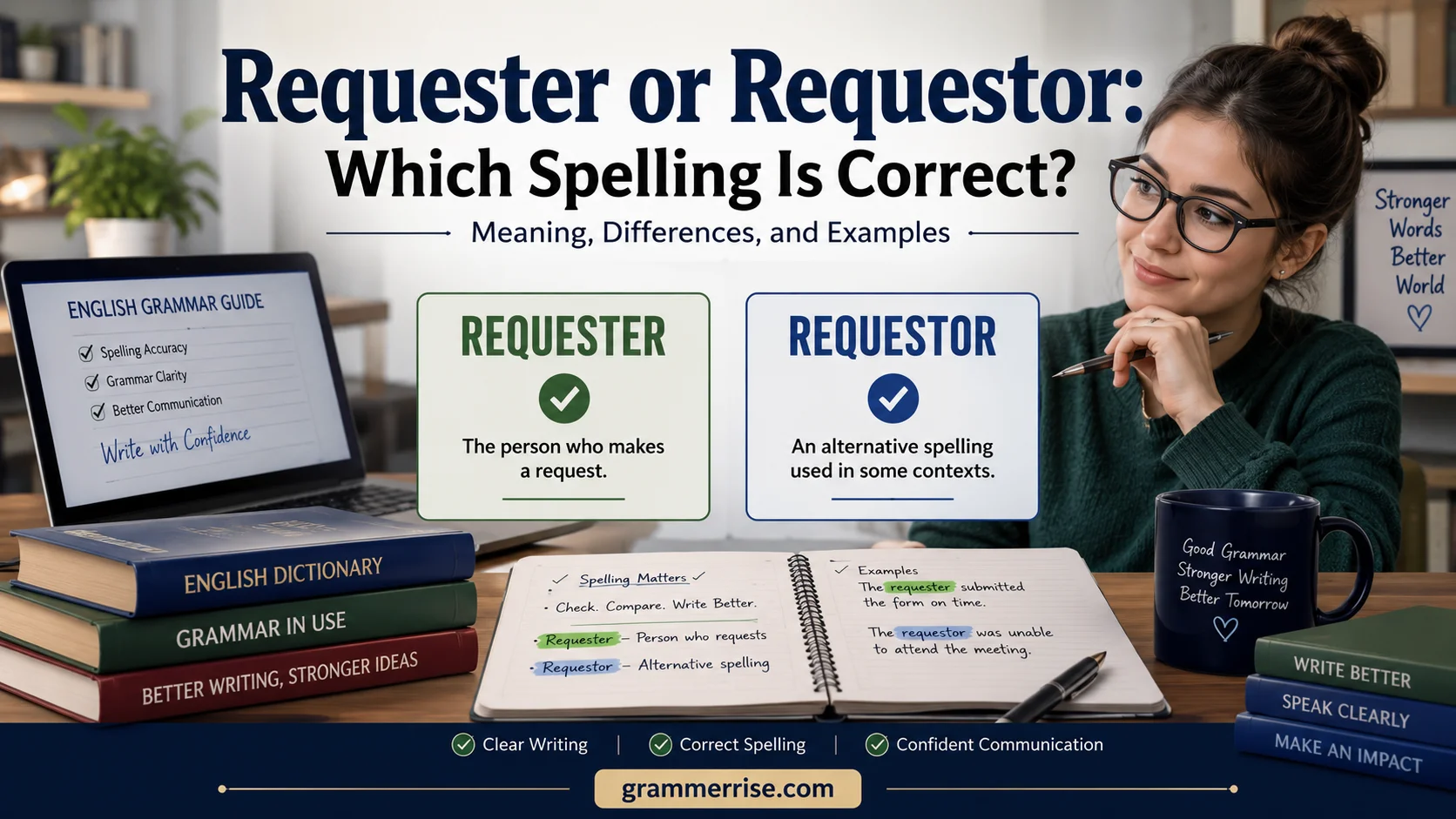
Choosing Requester or Requestor helps writers understand word differences in professional contexts, avoid confusion, and improve clear communication.
The understanding of the difference between requester and requestor is important for clear professional writing in legal, technical, and business contexts. These words appear similar, but they are used differently based on style, formality, and regional preference. This guide explains their meanings, usage, and correct grammatical application in simple terms. Both forms share a basic idea, but the choice can start changing when you review a document, specification, international email, or other written material. Different versions may look right, yet a friendly, deeply researched explanation without fluff creates a more natural US English style with varied sentence structure and a fully human-sounding piece focused on word choice, grammar, spelling, communication, context, language, research, and optimized content.
Many paused mid-sentence situations happen when seasoned writers hesitate because contracts may prefer one version, while emails, software dashboards, and systems follow different rules. The truth is that both spellings exist, but context decides the right choice. An in-depth approach helps you learn the real impact of industry-specific terminology that shapes exact usage. A common workplace example is a digital application using a search query where the correct form can create fewer mistakes. Requester is the standard noun referring to someone who makes a request, while requestor has a similar meaning but is less common and often appears in specialized areas.
Quick Answer
Both requester and requestor are correct English words.
However, the better choice depends on where you use the word.
| Word | Correct Spelling | Common Usage |
| Requester | ✅ Yes | Everyday English, emails, articles, general communication |
| Requestor | ✅ Yes | Technology, legal documents, formal systems, business workflows |
If you are writing a normal article, email, or message, requester is usually the better option because it sounds more natural.
If you are creating software labels, forms, or internal company documentation, requestor may match the terminology your organization already uses.
A quick rule:
Use “requester” for general readers. Use “requestor” when following a technical or formal system style.
What Does Requester Mean?
A requester is someone who makes a request.
The word comes from:
Request + -er = Requester
The suffix -er often describes a person who performs an action.
Examples:
- Teach → Teacher
- Write → Writer
- Drive → Driver
- Request → Requester
A requester can be:
- A person
- A customer
- An employee
- A company
- A user of a service
- An organization
The word does not describe what type of request someone makes. It simply identifies the person or group making that request.
Examples of Requester in Sentences
Here are some examples:
- “The requester provided additional information about the problem.”
- “Each requester must complete the application form.”
- “The customer service team contacted the requester for more details.”
- “The requester asked for a copy of the report.”
In everyday writing, requester feels natural because it follows a common English pattern.
For example, if someone emails a company asking for a refund, you would normally say:
“The requester explained the issue clearly.”
You probably would not say:
“The requestor explained the issue clearly.”
The second sentence is not wrong. It simply sounds more formal and less conversational.
What Does Requestor Mean?
A requestor also means someone who makes a request.
The word follows this pattern:
Request + -or = Requestor
The ending -or appears frequently in formal or specialized words.
Examples:
- Administrator
- Operator
- Investigator
- Coordinator
- Requestor
Many industries prefer requestor because it fits their existing terminology.
You may see it in:
- Software systems
- Employee portals
- Security applications
- Legal forms
- Government processes
- Workflow platforms
Examples of Requestor in Sentences
- “The requestor must provide approval before accessing the system.”
- “The requestor’s information was verified by the administrator.”
- “The requestor submitted a formal document request.”
- “The requestor received an automated confirmation email.”
In these situations, requestor often works because the environment already uses formal labels.
For example, an IT department may have fields such as:
- Requestor Name
- Requestor Email
- Requestor Department
- Requestor ID
These terms are common in business software.
Requester vs Requestor: Key Differences
The biggest difference between requester and requestor is not meaning. Both words identify someone who asks for something.
The difference comes from tone and context.
| Feature | Requester | Requestor |
| Meaning | Person who makes a request | Person who makes a request |
| Grammar status | Correct | Correct |
| Popularity | More common | Less common |
| Tone | Natural and simple | Formal and technical |
| Common audience | General readers | Professionals and systems |
| Used in | Emails, blogs, communication | IT, legal, corporate platforms |
Think of these words like different clothing styles.
A requester is like wearing comfortable everyday clothes. It fits almost anywhere.
A requestor is like wearing business attire. It works well in formal settings.
Why Are There Two Spellings?
English does not always follow one strict formula when creating words.
The suffixes -er and -or both create nouns that describe people who perform actions.
Words Using -er
Examples:
| Verb | Noun |
| Teach | Teacher |
| Run | Runner |
| Paint | Painter |
| Request | Requester |
Words Using -or
Examples:
| Verb | Noun |
| Create | Creator |
| Direct | Director |
| Operate | Operator |
| Investigate | Investigator |
The reason for these differences comes from the history of English.
Many -or words entered English through Latin and French influences. Meanwhile, -er became a very common English pattern.
Because of this history, some words have developed multiple accepted forms.
Requester and requestor are examples of this language flexibility.
Is Requestor a Real Word or a Mistake?
Many people assume requestor is incorrect because they see requester more often.
That assumption is wrong.
Requestor is a valid English word.
It appears in professional environments where organizations prefer formal terminology.
Common places where you may see requestor include:
- IT service management systems
- Data access requests
- Legal applications
- Corporate approval workflows
- Government forms
For example:
An employee submits a request to access confidential files.
The system may display:
Requestor: Sarah Johnson
Request Type: Access Permission
Approval Status: Pending
In this context, requestor fits naturally because the word is part of a structured process.
Is Requester More Common Than Requestor?
Yes. In general English, requester is more common.
Most everyday writers use requester because it sounds simpler and more familiar.
You are more likely to see:
- “The requester contacted support.”
- “The requester submitted feedback.”
- “The requester explained the situation.”
However, companies often choose requestor for internal systems.
For example, a company’s employee portal may use:
- Requestor dashboard
- Requestor profile
- Requestor approval
This does not mean the company chose the “more correct” word. It simply means they created a consistent naming system.
Read more: Addition vs Edition: Meaning and Correct Usage
When Should You Use Requester?
Use requester when your audience includes general readers.
It works well in:
- Blog posts
- Emails
- Customer messages
- Reports
- Educational content
- Conversations
Examples:
Customer service:
“The requester received a response within 24 hours.”
Business communication:
“The requester should include all required details.”
General writing:
“The requester asked for additional information.”
If readers do not work in a specialized field, requester is usually the safest choice.
When Should You Use Requestor?
Use requestor when the word is part of a formal system or industry vocabulary.
Common situations include:
Technology
IT platforms often use requestor as a database or interface label.
Examples:
- Requestor ID
- Requestor account
- Requestor approval
Legal Documents
Formal paperwork may use requestor because it matches traditional legal language.
Example:
“The requestor must provide identification before receiving records.”
Internal Business Processes
Companies may use requestor in workflow systems.
Example:
“The requestor’s manager must approve the expense request.”
The key point:
Do not use requestor just because it sounds more professional. Use it when the context supports it.
Requester or Requestor in Business Writing
Business writing requires clarity.
When writing emails, reports, or customer communication, choose the word your audience understands quickly.
For most business communication:
✅ Requester is usually better.
Example:
“The requester submitted the proposal.”
It feels direct and natural.
However, if your company already uses requestor in its systems, follow that terminology.
Consistency matters.
A document that switches between both words can look careless.
Incorrect:
“The requester submitted the form. The requestor must now wait for approval.”
Better:
“The requester submitted the form and must now wait for approval.”
Or:
“The requestor submitted the form and must now wait for approval.”
Choose one and stay consistent.
Requester or Requestor in Technology and Software
The technology industry frequently uses requestor.
Why?
Because software systems often need standardized labels.
A ticketing system may track:
| Field | Example |
| Requestor Name | Michael Lee |
| Request Type | Password Reset |
| Request Date | July 26, 2026 |
| Status | Completed |
Using requestor creates a formal system language.
Common technology examples:
- IT support tickets
- Access management platforms
- Cloud service requests
- Employee portals
- Workflow automation tools
For developers and system administrators, terminology consistency is often more important than everyday language preference.
Requester or Requestor in Legal and Formal Documents
Legal writing often uses formal terms.
You may find requestor in:
- Information requests
- Government forms
- Compliance documents
- Official applications
Example:
“The requestor must submit supporting documentation.”
However, requester is also acceptable.
The choice depends on the organization’s preferred style.
A legal office may use:
“The requestor shall provide proof of identity.”
A public-facing article may use:
“The requester must provide proof of identity.”
Both communicate the same idea.
Common Mistakes With Requester and Requestor
Assuming Requestor Is Wrong
This is the most common mistake.
Many people believe only requester exists.
However, requestor is a recognized word.
Using Both Forms in One Document
Switching between spellings creates inconsistency.
Choose one style.
Using Requestor Everywhere
Some writers think requestor sounds more professional.
However, formal does not always mean better.
In a friendly customer email, requester usually sounds clearer.
Ignoring Your Audience
Always consider who will read your content.
A software engineer and a general customer may expect different wording.
Requester vs Requestor Examples in Real Sentences
Workplace Examples
Requester:
“The requester submitted a vacation approval form.”
Requestor:
“The requestor needs department approval before processing.”
Customer Service Examples
“The requester explained the problem and provided screenshots.”
Technology Examples
“The requestor account was verified successfully.”
Legal Examples
“The requestor submitted a public records request.”
Requester or Requestor: Which One Should You Use?
Use this simple guide:
| Situation | Best Choice |
| Everyday conversation | Requester |
| Blog writing | Requester |
| Customer emails | Requester |
| General reports | Requester |
| IT systems | Requestor |
| Software labels | Requestor |
| Formal workflows | Requestor |
| Legal documents | Either, depending on style |
When unsure, choose requester.
It is widely understood and works in most situations.
FAQs
1. Is requester or requestor the correct spelling?
Both requester and requestor are considered correct spellings, but requester is more commonly used in general English. Requestor often appears in specific fields such as law, software, and technical documentation.
2. What is the main difference between requester and requestor?
The main difference is usage and context. A requester is simply a person who makes a request, while a requestor is often used in specialized industries where formal terminology or system labels are preferred.
3. When should I use requester in writing?
You should use requester in most everyday and professional writing, including emails, reports, articles, and general documents. It is the more familiar choice for most readers and fits standard English usage.
4. Why do some companies and software systems use requestor?
Many companies and digital systems use requestor because it may be part of established software terminology, database fields, or internal naming conventions. In these cases, consistency is usually more important than changing the spelling.
5. Can using the wrong spelling create a problem?
Using either spelling usually does not create a serious grammar mistake, but choosing the wrong term for a specific context can cause confusion. Legal documents, technical specifications, and workplace systems may require a particular version for accuracy and consistency.
6. How can I remember which word to choose?
A simple way to remember is to choose requester for normal communication and requestor when following a specialized industry style. Always consider your audience, document type, and professional setting before making a choice.
Conclusion
Choosing between requester or requestor becomes much easier when you focus on the context rather than just the spelling. While both words describe someone who makes a request, requester is the more common choice in everyday and professional English, while requestor is often found in legal, technical, and software-related environments.
The best approach is to understand your audience, follow the terminology used in your industry, and stay consistent throughout your writing. Whether you are creating a formal document, sending an email, or working with a digital system, using the right term helps maintain clarity, professionalism, and accurate communication. A small spelling choice can make a big difference in how polished and reliable your writing appears.

Hussain Abid is an English language writer with over 10 years of experience in grammar, spelling, vocabulary, and writing. He specializes in creating clear, well-researched content that helps readers improve their English with confidence. At GrammarRise, Hussain writes practical guides, grammar explanations, and word comparison articles based on trusted language sources and real-world usage. His mission is to make English learning simple, accurate, and accessible for everyone