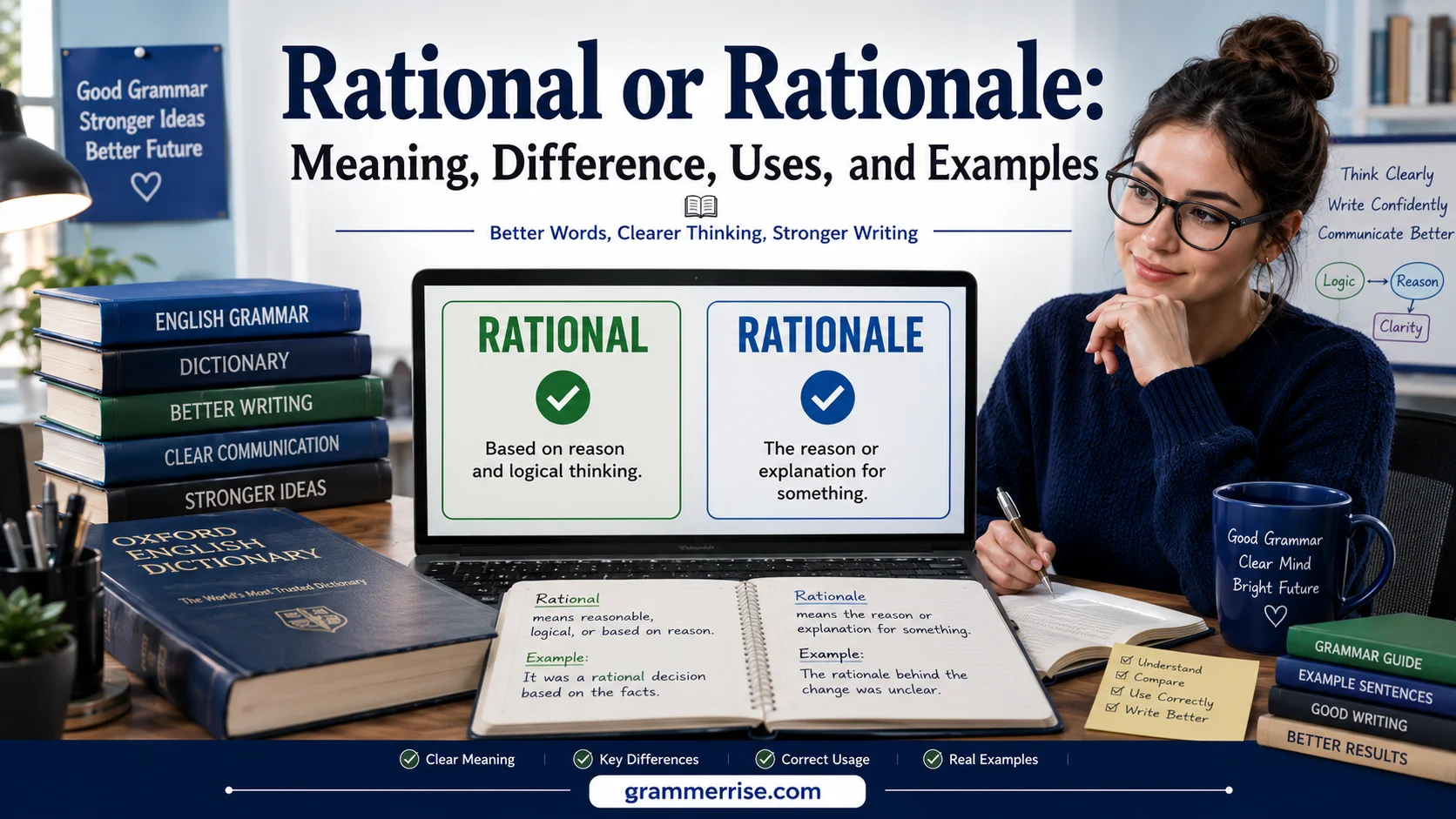
The Rational or Rationale grammar confusion affects writers who second-guess word choice because both terms share roots but serve different roles. The common challenge appears when people are unsure which word to use in a sentence. Through professional discussions, academic papers, and professional writing, it becomes clear that these words derive from the Latin root ratio, connected with the meaning of reason.
Rational works as an adjective for a logical, sensible, and reasonable approach based on facts, logic, and reasoned behavior, while Rationale works as a noun describing the underlying reason, justification, or set of arguments forming a logical basis for a decision, action, or belief. Their linguistic roots are remarkably similar, but their grammatical roles, grammatical purposes, meanings, and appearance remain different.
In the digital world, correct usage matters in emails, reports, social media posts, academic writing, business proposal writing, and everyday communication. Misapplying these terms can create ambiguity, make writing sound awkward, weaken arguments, and reduce clarity, precision, and credibility. Rational comes from the late fourteenth century Latin word rationalis, meaning belonging to reason, while Rationale entered the English language in the 1650s from Late Latin rationale with an exposition of principles. The adverb is rationally, the noun forms include rationalness and rationality, and the verb form is rationalize with related forms like rationalizes, rationalized, rationalizing, and rationalization.
Quick Answer
Rational means logical, reasonable, or based on good judgment. It describes a person, decision, or action.
Rationale means the reason or explanation behind a decision, idea, or action.
Example:
- A rational choice is made after thinking carefully.
- The rationale explains why that choice was made.
Easy way to remember:
Rational = Reasonable
Rationale = Reason behind something.
Rational or Rationale: Quick Difference Explained
The easiest way to understand rational and rationale is to look at what each word does in a sentence.
| Word | Part of Speech | Meaning | Example |
| Rational | Adjective | Based on reason, logic, or clear thinking | She made a rational decision after reviewing the facts. |
| Rationale | Noun | The reason or explanation behind something | The manager explained the rationale behind the new policy. |
The main difference is simple:
- Rational = describes something logical
- Rationale = explains the reason behind something
A person can be rational because they think carefully. A decision can have a rationale because someone provides the reasoning behind it.
For example:
The scientist made a rational choice to repeat the experiment.
The rationale for repeating the experiment was to confirm the results.
In the first sentence, rational describes the choice. In the second sentence, rationale explains the reason.
What Does Rational Mean?
The word rational means using logic, facts, and careful thinking instead of emotions, guesses, or impulses.
When someone behaves rationally, they consider evidence before making a decision. They look at possible outcomes and choose an option that makes sense.
The word often describes:
- Decisions
- Arguments
- Actions
- Thoughts
- People
- Solutions
- Responses
A rational person does not ignore emotions completely. Instead, they balance feelings with facts.
For example, imagine someone wants to buy an expensive car. An emotional decision might be:
“I love this car, so I’m buying it today.”
A rational decision would consider:
- Monthly income
- Maintenance costs
- Fuel expenses
- Long-term financial goals
The rational choice may still be buying the car, but the person reaches that conclusion through careful reasoning.
Examples of Rational in Sentences
Here are some examples showing how to use rational correctly:
- She gave a rational explanation for changing her career path.
- The doctor took a rational approach when diagnosing the patient.
- His response was calm and rational during the disagreement.
- A rational investor studies the market before buying stocks.
- The team created a rational plan based on available data.
Notice that rational describes a quality. It tells us something is logical or reasonable.
What Does Rationale Mean?
The word rationale means the reason, explanation, or justification behind a decision, action, policy, or belief.
It answers the question:
“Why was this done?”
Organizations often use the word rationale in professional settings because it provides the thinking behind a choice.
For example:
A company announces:
“We are changing our remote work policy.”
Employees may ask:
“What is the rationale behind this change?”
They want to know the reasons that influenced the decision.
The rationale might include:
- Improving teamwork
- Increasing productivity
- Reducing operational costs
- Addressing employee feedback
The rationale does not describe whether the decision is good or bad. It simply explains the reasoning behind it.
Examples of Rationale in Sentences
Here are examples of correct rationale usage:
- The teacher explained the rationale behind the new grading system.
- The research paper included a detailed rationale for the study.
- The company shared the rationale for launching the new product.
- The policy document clearly outlines the rationale behind the changes.
- The architect presented the rationale for the building design.
In each sentence, rationale refers to the explanation behind something.
Rational vs Rationale: Key Differences
Many people confuse these words because they come from the same origin. However, their roles in English are different.
| Feature | Rational | Rationale |
| Meaning | Logical or reasonable | Reason or explanation |
| Word type | Adjective | Noun |
| Describes | A person, action, idea, or decision | The reason behind an action or decision |
| Answers | “Is it logical?” | “Why was it done?” |
| Example | A rational solution | The rationale for the solution |
A simple memory trick:
Rational has an “al” ending like many adjectives.
Examples:
- Personal
- Natural
- Practical
- Rational
Rationale ends with “ale” and acts like a thing or concept.
You can think:
- Rational = the quality
- Rationale = the explanation
Rational and Rationale Examples in Real Situations
Understanding these words becomes easier when you see them in everyday situations.
Business Example
A company decides to reduce unnecessary expenses.
A rational statement:
The company made a rational decision to reduce costs because revenue decreased.
The rationale:
The rationale behind the cost reduction was declining sales and increasing expenses.
The decision is rational. The explanation is the rationale.
Read more: Set or Sit: Grammar Rules, Examples and Correct Usage
Education Example
A school changes its teaching method.
Rational:
The school made a rational choice based on student performance data.
Rationale:
The rationale for the new teaching method was to improve learning outcomes.
Personal Life Example
Someone decides to exercise regularly.
Rational:
Choosing a healthier lifestyle is a rational decision.
Rationale:
The rationale behind the decision was improving physical health and energy levels.
Common Mistakes When Using Rational and Rationale
Even experienced writers sometimes misuse these words. Here are the most common errors.
Using Rationale as an Adjective
Incorrect:
The manager made a rationale decision.
Correct:
The manager made a rational decision.
Why?
Because rationale is a noun. It cannot describe a decision.
A decision can have a rationale, but it cannot be rationale.
Using Rational When You Mean Reason
Incorrect:
What is the rational behind this rule?
Correct:
What is the rationale behind this rule?
Why?
The sentence asks for the explanation or reason. Therefore, rationale is correct.
Confusing Rational With Emotional
Some people think rational means having no emotions. That is not accurate.
A rational person can still have feelings. They simply avoid letting emotions completely control important choices.
For example:
A parent may feel worried about a child’s education. However, they can still make a rational decision by comparing schools, costs, and opportunities.
How to Remember the Difference Between Rational and Rationale
A quick trick can help you remember these words forever.
Ask yourself:
Am I describing something?
Use:
Rational
Example:
- A rational argument
- A rational person
- A rational choice
Ask:
Am I explaining why something happened?
Use:
Rationale
Example:
- The rationale for the decision
- The rationale behind the plan
- The rationale of the research
Another helpful comparison:
| Question | Correct Word |
| Is this decision logical? | Rational |
| Why did they make this decision? | Rationale |
The Origin and History of Rational and Rationale
Both words come from the Latin word ratio, which means “reason” or “calculation.”
The word rational entered English through Old French and Latin influences. It developed the meaning of using reason and logical thinking.
The word rationale came later and became associated with explanations and justifications.
Their shared history explains why they seem connected. Both relate to the idea of reason, but English developed them into different forms with different jobs.
Why the Difference Matters in Writing
Using rational and rationale correctly makes your writing more professional and precise.
This matters especially in:
- Academic writing
- Business reports
- Legal documents
- Research papers
- Workplace communication
- Presentations
Compare these examples:
Weak:
The rationale choice was made after discussion.
Correct:
The rational choice was made after discussion.
Better:
The rationale behind the choice was explained during the meeting.
The correct word immediately improves clarity.
Rational vs Rationale in Professional Communication
In workplaces, these words often appear in decision-making conversations.
A manager might write:
“The rationale behind this strategy is to improve customer satisfaction.”
A team member might say:
“This seems like a rational approach because it uses available data.”
Both words appear naturally in professional discussions, but they serve different purposes.
Examples in Workplace Writing
| Situation | Correct Usage |
| Explaining a business strategy | The rationale behind the strategy |
| Describing a smart decision | A rational business decision |
| Explaining research methods | The rationale for the research |
| Describing logical thinking | A rational analysis |
FAQs
1. What is the main difference between rational and rationale?
Rational is an adjective used to describe something logical, sensible, or based on reason and facts. Rationale is a noun that explains the reason, explanation, or justification behind a decision, action, or belief. For example, a person can make a rational choice, but they can provide a rationale for why they made that choice.
2. Is rationale a synonym for rational?
No, rationale and rational are not synonyms. Although both words come from the same Latin root related to reason, they have different grammatical roles. Rational describes a person, idea, or action, while rationale refers to the explanation or reasoning behind something.
3. How can I remember when to use rational or rationale?
A simple way to remember is to look at the word type. If you are describing something as logical or reasonable, use rational. If you are explaining the reason behind a decision or action, use rationale. Think of rationale as the “reason” you give for something.
4. Can rational be used as a noun?
Usually, rational is not used as a noun in modern English. Its common forms include the adverb rationally and nouns such as rationality and rationalness. The word rationale is the standard noun form used when discussing reasons or justifications.
5. Why do writers confuse rational and rationale?
Writers often confuse these words because they look similar, share the same linguistic origin, and both connect to ideas of reasoning and logic. The confusion increases in professional writing, academic papers, and everyday communication where choosing the wrong word can affect clarity and meaning.
6. What is an example of rational and rationale in a sentence?
A rational example would be: “She made a rational decision after reviewing all the facts.” A rationale example would be: “The company explained its rationale for changing the policy.” The first describes the decision, while the second explains the reason behind it.
Conclusion
Understanding the difference between Rational or Rationale helps you communicate with greater accuracy and confidence. While both words are connected to the idea of reason, they serve different purposes in writing. Rational describes a logical, sensible, or fact-based approach, while Rationale explains the reason or justification behind a decision, action, or belief.
Using the correct word improves the clarity, precision, and professionalism of your writing. Whether you are preparing an academic paper, writing a business document, or sharing ideas in everyday communication, knowing when to use each term prevents confusion and strengthens your message. Once you understand their grammatical roles and meanings, choosing between Rational and Rationale becomes simple and natural.