Loses or Losses often confuses students, writers, and English learners because the words look similar and sound alike.
Loses is a verb and action word, while losses is a noun describing a result or outcome. An extra s can change the entire meaning of a sentence. This common grammar mix-up appears in everyday writing, emails, reports, essays, and social media posts, but the rule is simple to learn.
From my experience as an English language specialist, I’ve seen native speakers, learners, and English users confuse loses, losses, Loose, and lose. These homophones have different meanings: Loose describes a lack of tightness, while lose can mean defeat or an inability to find something. Understanding spelling differences, usage differences, and word forms helps you choose the right form confidently, avoid common mistakes, and improve writing skills and write with greater overall clarity.
Loses or Losses: Quick Answer
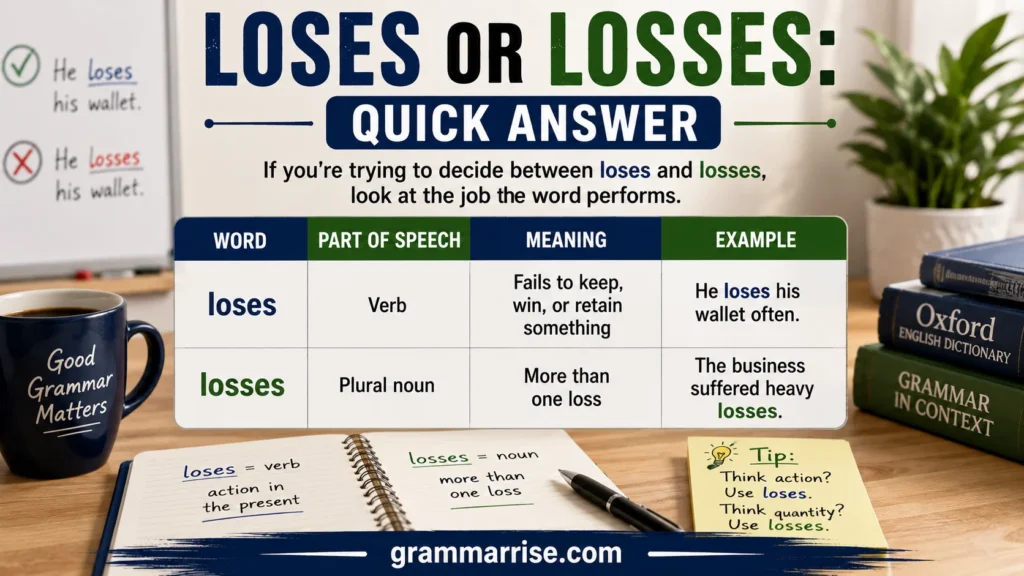
If you’re trying to decide between loses and losses, look at the job the word performs.
| Word | Part of Speech | Meaning | Example |
| loses | Verb | Fails to keep, win, or retain something | He loses his wallet often. |
| losses | Plural noun | More than one loss | The business suffered heavy losses. |
A useful shortcut is:
Loses = an action or condition
Losses = multiple instances or results of losing
Consider these two sentences:
- The player loses the match.
- The player has three losses this season.
The first sentence tells you what the player does. The second tells you about the player’s record.
That’s the central distinction. Once you recognize the grammatical role, the spelling becomes much easier.
What Does “Loses” Mean?
Loses is the third-person singular present-tense form of the verb lose. Dictionary sources list loses as the form used with a singular third-person subject such as he, she, it, or a singular noun.
The verb lose has several meanings. Someone can lose an object, lose a competition, lose money, lose control, lose interest, or lose an opportunity.
For example:
- She loses her phone frequently.
- The team loses another game.
- He loses patience when meetings run late.
- The business loses money during slow months.
- The plant loses its leaves during winter.
- The company loses customers when service quality falls.
In every example, loses describes something that happens.
Why “Loses” Is a Verb
A verb tells you what the subject does, experiences, or becomes.
Compare these sentences:
Maria loses her keys.
Maria forgets her keys.
Both loses and forgets function as verbs. They describe an action involving Maria.
You can also see the difference by changing the subject:
| Subject | Correct Form |
| I | lose |
| You | lose |
| We | lose |
| They | lose |
| He | loses |
| She | loses |
| It | loses |
| The player | loses |
| The company | loses |
This pattern follows the ordinary English present-tense rule in which many verbs take -s with a third-person singular subject.
So:
- I lose
- You lose
- They lose
- She loses
Not:
- She losses
- He losses
- The team losses
Those forms are incorrect when you need the verb lose.
What Does “Losses” Mean?
Losses is the plural form of the noun loss.
A loss refers to something that has been lost or to an instance or result of losing. When there is more than one such loss, the plural form becomes losses. Dictionary.com specifically distinguishes losses as the plural noun used for multiple instances of loss.
For example:
- The company reported financial losses.
- The team suffered four losses this season.
- The storm caused serious property losses.
- Several losses affected the business.
- The investor wants to reduce future losses.
Notice something important: losses doesn’t describe an action performed by the subject. Instead, it names the losses themselves.
Why “Losses” Is a Noun
Nouns name people, places, objects, concepts, events, or conditions.
The word loss names the condition or result of losing. Losses simply makes that noun plural.
You can place words such as several, many, major, financial, and significant before it:
- several losses
- many losses
- major losses
- financial losses
- significant losses
- repeated losses
That behavior gives you another useful clue.
If a word can naturally follow several or many, you’re probably dealing with a plural noun.
The company experienced several losses.
That sentence works because losses is a plural noun.
Loses vs. Losses: The Main Difference
The difference becomes much clearer when you put the words side by side.
| Feature | Loses | Losses |
| Word family | Lose | Loss |
| Part of speech | Verb | Noun |
| Number | Third-person singular | Plural |
| Basic idea | Someone or something loses | Multiple losses occur |
| Example | She loses focus. | The team suffered three losses. |
| Singular form | Lose | Loss |
| Common context | Actions and situations | Results, events, defeats, or negative outcomes |
Here’s another way to think about it:
Loses describes the process. Losses names the results.
That isn’t a rule that covers every possible use of the words. It is simply a useful mental shortcut.
For example:
The company loses money.
The verb tells us what happens.
The company reports financial losses.
The noun identifies the negative financial results.
The two forms can even appear in the same sentence:
The company loses money when its losses exceed its reserves.
Once the grammatical roles become visible, the difference stops looking mysterious.
How to Know Whether to Use Loses or Losses
When you’re stuck, don’t stare at the spelling. Look at the sentence.
Ask yourself one question:
Does the blank need a verb or a noun?
If it needs a verb, loses may be correct.
If it needs a plural noun, losses may be correct.
Use “Loses” When Someone or Something Does Something
Examples:
- He loses his keys.
- She loses interest quickly.
- The team loses the final.
- The company loses customers.
- The clock loses time.
In each case, the word follows a subject and acts as the verb.
Use “Losses” When You Mean Multiple Losses
Examples:
- The team has five losses.
- The company reported financial losses.
- The storm caused significant losses.
- Investors tried to limit their losses.
- The army suffered heavy losses.
Here, losses behaves like other plural nouns.
A Quick Substitution Test
Try replacing the questionable word with another verb.
She loses her phone.
Replace loses with forgets:
She forgets her phone.
The sentence still has a verb in the same position. That confirms the role.
Now try a noun:
The team suffered three losses.
Replace losses with defeats:
The team suffered three defeats.
Again, the grammatical role remains the same.
This little test can save you from guessing.
Loses vs. Losses in Sports
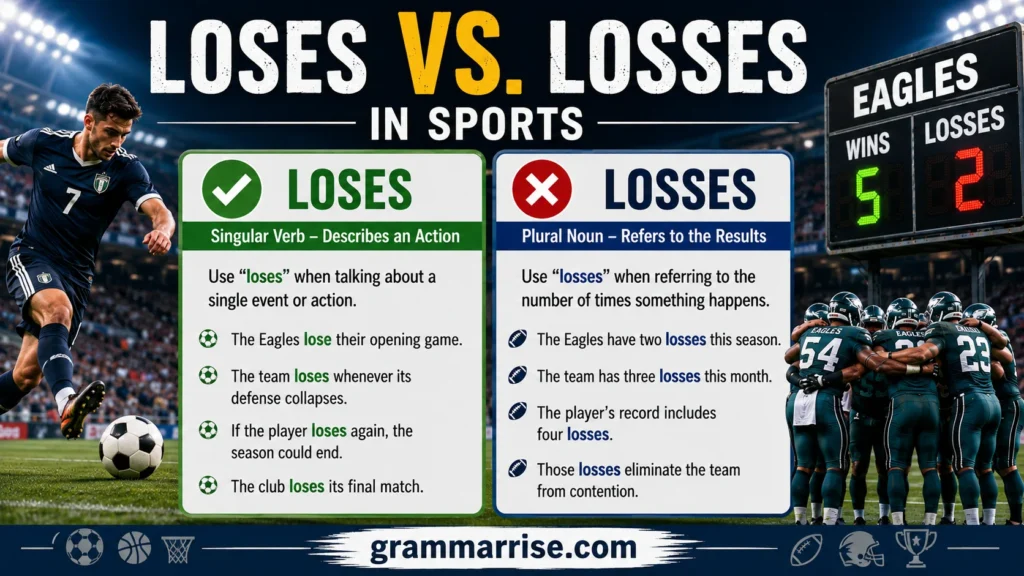
Sports writing provides one of the clearest examples of the distinction.
A player or team loses a game. A team’s record contains losses.
For example:
The Eagles lose their opening game.
The Eagles have two losses this season.
The first sentence describes an event. The second counts the results.
More examples include:
- The team loses whenever its defense collapses.
- The team has three losses this month.
- If the player loses again, the season could end.
- The player’s record includes four losses.
- The club loses its final match.
- Those losses eliminate the team from contention.
The pattern is remarkably consistent.
Verb: The team loses.
Noun: The team records a loss.
Plural noun: The team records several losses.
Loses vs. Losses in Business and Finance
Business writing uses both words frequently. That’s where the distinction becomes especially important.
Consider:
The company loses money when operating costs rise.
Here, loses is a verb.
Now compare:
The company reports financial losses when expenses exceed revenue.
Here, losses is a noun.
Financial language often uses losses because businesses can experience multiple negative results across products, quarters, investments, or operations.
Common expressions include:
- financial losses
- operating losses
- investment losses
- annual losses
- significant losses
- unexpected losses
- net losses
- cumulative losses
For example:
The retailer loses money on some products.
Those products contribute to the company’s overall losses.
The first sentence focuses on what happens. The second focuses on the resulting financial condition.
A Useful Business Example
Imagine a small online store that sells electronics.
During one quarter, shipping costs rise sharply. Several products also sell below their purchase price.
You could write:
The store loses money on several orders.
If you want to describe the financial result, you could write:
The store records significant losses on those orders.
Both sentences communicate related information. Their grammar differs.
Loses vs. Losses in Everyday English
The distinction isn’t limited to sports and finance.
Everyday conversations use loses in many situations:
- She loses her glasses.
- He loses his temper.
- My dog loses interest in the toy.
- The child loses track of time.
- The speaker loses confidence.
Meanwhile, losses can describe multiple negative experiences or outcomes:
- The family experienced several losses.
- The business couldn’t recover its losses.
- The team accepted its losses and moved forward.
- The project suffered unexpected losses.
The context changes. The grammatical distinction doesn’t.
Common Mistakes With Loses and Losses
Most mistakes happen because the two words look closely related. Their spelling encourages people to treat them as interchangeable.
They aren’t.
Mistake: “He Losses His Phone”
Incorrect:
He losses his phone every week.
Correct:
He loses his phone every week.
Why?
Because the sentence needs a verb. The subject he requires the third-person singular form of lose.
The correct sequence is:
lose → loses
Not:
lose → losses
Mistake: “The Company Had Huge Financial Loses”
Incorrect:
The company had huge financial loses.
Correct:
The company had huge financial losses.
Why?
The phrase financial losses needs a noun. The word describes negative financial results.
The singular form is:
a financial loss
The plural form is:
financial losses
Mistake: “She Losses Focus”
Incorrect:
She losses focus during long meetings.
Correct:
She loses focus during long meetings.
Again, the sentence needs a verb.
Mistake: “Several Loses”
Incorrect:
The team suffered several loses.
Correct:
The team suffered several losses.
The word several signals that a plural noun follows.
You wouldn’t normally say:
several defeats? Yes.
several losses? Yes.
several loses? No.
That gives you another fast clue.
Loses vs. Losses vs. Lose vs. Loss
Understanding the entire word family makes the distinction much easier.
| Word | Grammar | Use | Example |
| lose | Base verb | I, you, we, they | They don’t want to lose. |
| loses | Third-person singular verb | He, she, it | She loses often. |
| loss | Singular noun | One loss | It was a painful loss. |
| losses | Plural noun | More than one loss | The team suffered three losses. |
| lost | Past tense/past participle | Past action or state | He lost the game. |
| losing | Present participle/gerund | Ongoing action or activity | They are losing ground. |
This table reveals the pattern:
lose → loses → lost → losing
The noun family works differently:
loss → losses
The verb and noun forms are related in meaning. They aren’t interchangeable.
The Difference Between Lose and Loss
Because loses comes from lose and losses comes from loss, understanding those base words helps.
Lose is a verb.
Don’t lose your keys.
Loss is a noun.
Losing the keys was a frustrating loss.
Dictionary.com describes loss in contexts involving deprivation, defeat, or the state of no longer having something.
You can think of the relationship this way:
You lose something. The result can be a loss.
For example:
The team loses the game.
The game is a loss for the team.
Then, if it happens repeatedly:
The team suffers several losses.
That progression makes the word family easier to remember.
Loses vs. Losses and the Singular “Loss”
A subtle point often causes confusion.
Loss is singular.
Losses is plural.
So:
The team suffered one loss.
But:
The team suffered five losses.
However, loses isn’t the plural form of loss. That’s an important distinction.
The forms belong to different grammatical categories:
- loss → noun
- losses → plural noun
- lose → verb
- loses → third-person singular verb
Think of them as two branches rather than one straight spelling pattern.
Can “Loses” and “Losses” Appear in the Same Sentence?
Absolutely.
In fact, using both together can make the distinction obvious.
The company loses money whenever its financial losses increase.
Another example:
The team loses games but learns from its losses.
And another:
If the player loses again, the additional losses could affect the rankings.
The words work together because they perform different jobs.
Loses tells you what happens.
Losses names the results.
Loses vs. Losses Pronunciation
Pronunciation provides another useful clue.
Loses is pronounced approximately like LOO-ziz. It has two syllables.
Losses is pronounced approximately like LAW-siz in many American accents. It also has two syllables.
The first part differs noticeably:
- loses → begins with the sound of lose
- losses → begins with the sound of loss
Dictionary sources give lose the pronunciation /luːz/ in American English.
This distinction can help when you’re speaking. However, pronunciation alone shouldn’t replace grammar. If you’re writing, always check the word’s function in the sentence.
Loses vs. Losses and the “Loose” Confusion
Another word often enters the picture: loose.
Although lose, loses, loss, and losses look related to loose, they have different meanings.
| Word | Meaning | Example |
| lose | Fail to keep or win | Don’t lose your wallet. |
| loses | Third-person form of lose | She loses her wallet. |
| loss | The result or condition of losing | Losing it was a loss. |
| losses | More than one loss | The company suffered losses. |
| loose | Not tight or firmly fixed | The screw is loose. |
A loose shoelace can cause you to lose your balance. That’s a useful memory connection.
The words may look similar. Their meanings are worlds apart.
A Simple Trick to Remember Loses or Losses
Here’s a quick rule worth keeping:
Loses = does. Losses = things or results.
If someone does something, you may need the verb loses.
He loses.
If you’re talking about several negative results, you may need losses.
He suffered several losses.
Another shortcut uses sentence structure.
If You Can Ask “What Does He/She/It Do?”
Use loses.
What does she do?
She loses her keys.
If You Can Ask “How Many?”
Use losses.
How many did the team suffer?
Three losses.
This isn’t a perfect test for every grammatical situation. Still, it works extremely well for everyday writing.
Loses or Losses: Examples in Sentences
Here are practical examples covering several contexts.
Examples With “Loses”
- He loses his phone whenever he travels.
- She loses concentration when the room gets noisy.
- The team loses another close game.
- The company loses customers because of slow service.
- The machine loses power after several hours.
- The player loses confidence after repeated mistakes.
- The clock loses two minutes each month.
- The business loses money during the off-season.
Examples With “Losses”
- The company reported major financial losses.
- The team has four losses this season.
- The storm caused substantial property losses.
- Investors tried to limit their losses.
- The business recovered after several difficult losses.
- The team learned valuable lessons from its losses.
- Insurance covered some of the losses.
- The organization faced unexpected losses.
Incorrect vs. Correct Examples
| Incorrect | Correct | Explanation |
| He losses his keys. | He loses his keys. | The sentence needs a verb. |
| She losses focus. | She loses focus. | Loses is the verb form. |
| The team had three loses. | The team had three losses. | The sentence needs a plural noun. |
| The company reported financial loses. | The company reported financial losses. | Losses is the plural noun. |
| The player losses the match. | The player loses the match. | A third-person verb is required. |
| The business suffered several loses. | The business suffered several losses. | Several modifies a plural noun. |
These errors become much easier to spot once you stop treating the words as spelling variants.
Case Study: One Sentence Can Reveal the Difference
Consider this short business example:
The retailer loses money on slow-selling products, which contributes to its annual losses.
Why does the sentence use both forms?
Loses comes after the subject retailer and functions as the verb.
Losses follows the possessive determiner its and acts as a plural noun.
Now change the sentence:
The retailer lost money last year.
The tense changes from present to past.
Then:
The retailer reported a loss last year.
The grammatical category changes from verb to noun.
Finally:
The retailer reported several losses last year.
The noun becomes plural.
This small sequence demonstrates how English builds related forms without making them interchangeable.
Practice: Choose Loses or Losses
Fill in each blank with loses or losses.
- She often ______ her keys.
- The company reported significant financial ______.
- The team ______ another game.
- Investors tried to reduce their ______.
- He ______ patience during long meetings.
- The club has five ______ this season.
- The machine ______ power after several hours.
- The storm caused serious property ______.
- If the team ______ tonight, it will be eliminated.
- Several ______ affected the business.
Answer Key
- loses
- losses
- loses
- losses
- loses
- losses
- loses
- losses
- loses
- losses
The pattern is straightforward once you identify the grammatical role.
Questions 1, 3, 5, 7, and 9 need verbs.
Questions 2, 4, 6, 8, and 10 need plural nouns.
Read more: Showed or Shown: When Should You Use Each?
Facts About Loses and Losses
A few facts make the distinction especially easy to remember:
- Loses is the third-person singular present form of lose.
- Losses is the plural form of the noun loss.
- Lose can mean failing to win, misplacing something, or no longer having something.
- Losses frequently appears in sports and financial contexts.
- Loses normally appears with a third-person singular subject.
- Losses can follow words such as many, several, major, and financial.
- Neither word should be used as a substitute for loose.
- Lose and loss belong to different grammatical categories even though they describe related ideas.
My Personal Experience as an English Language Specialist
As an English language specialist, I’ve often seen learners confuse loses and losses because the words look and sound similar. In my experience, the easiest way to understand them is to focus on their grammatical roles. Loses is a verb, while losses is a plural noun.
For example, I explain that “She loses her keys” describes an action, while “The company suffered financial losses” refers to results. I’ve found that this simple comparison helps learners remember the difference quickly. I also remind them not to confuse lose with loose, which has a completely different meaning.
From teaching and reviewing English, I’ve learned that identifying whether a sentence needs a verb or noun is often enough to choose the correct word confidently. Once learners understand this pattern, loses and losses become much easier to use correctly.
FAQs
1. Is “loses” or “losses” correct?
Both loses and losses are correct, but they have different uses. Loses is a verb, while losses is a noun.
2. What does “loses” mean?
Loses means someone or something fails to keep, win, or find something. For example, “He loses his keys often.”
3. What does “losses” mean?
Losses refers to things that are lost or negative results. For example, “The company suffered heavy losses.”
4. Why do people confuse loses and losses?
The words look and sound similar, so it’s easy to mix them up. Their grammatical roles are different, though.
5. Can “loses” be used as a noun?
No. Loses normally works as a verb. If you need a noun, loss or losses is the correct choice.
6. What is an easy way to remember the difference?
Think of loses as an action and losses as a result. If someone performs the action, use loses. If you’re talking about what was lost, use losses.
Conclusion
Knowing the difference between loses and losses becomes much easier once you focus on their roles in a sentence. Loses describes an action, while losses names a result or something that has been lost. A quick check of the surrounding words can prevent a simple spelling mistake from changing your meaning.
With regular practice, you’ll start recognizing the correct form naturally. Whether you’re writing an email, preparing a report, completing an essay, or simply posting online, choosing the right word makes your English clearer, more accurate, and more professional.