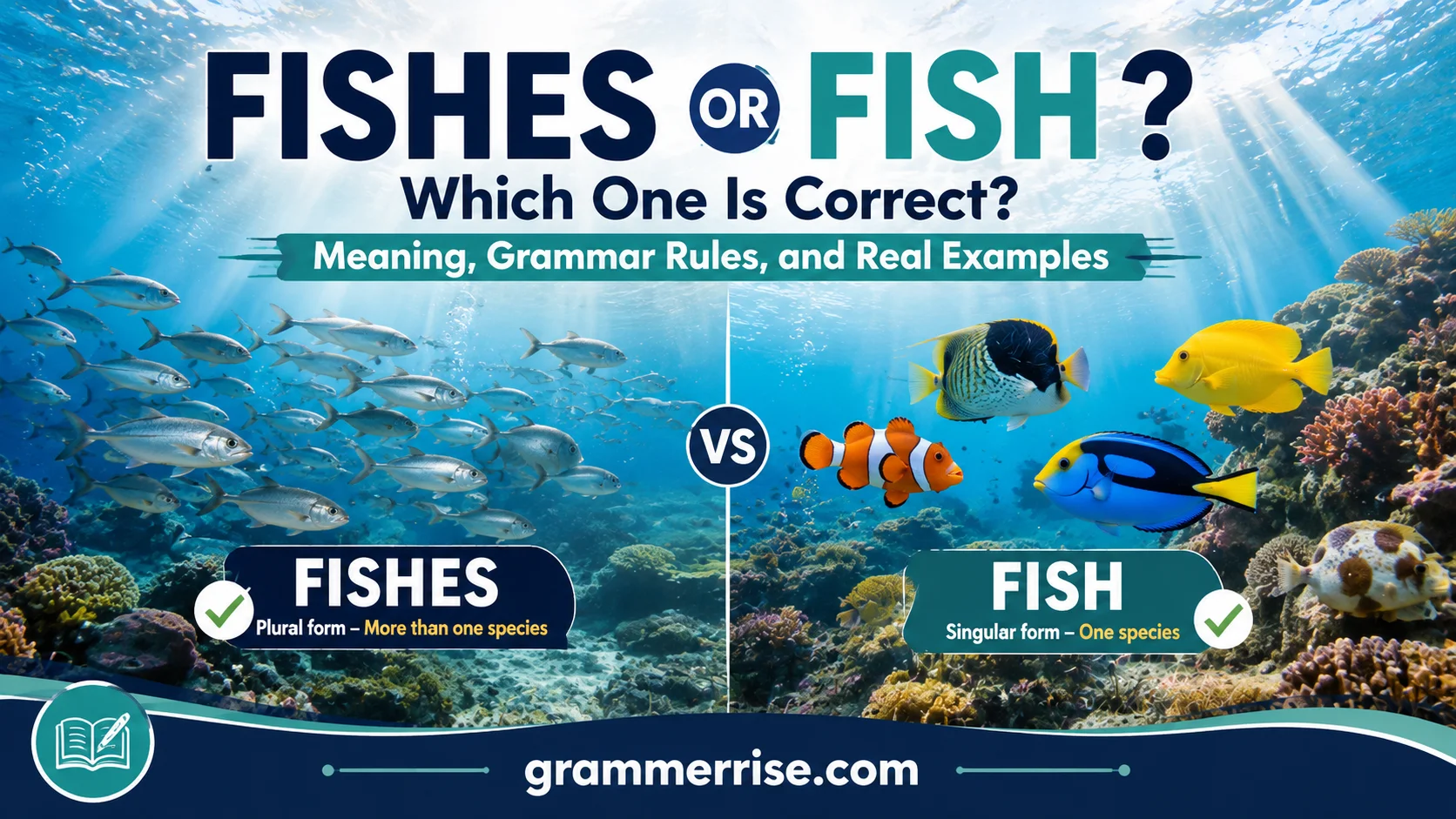
For English learners, students, and writers, Fishes or Fish can seem confusing when correct spelling, meaning, and usage matter.
The word fish works as a noun for an animal and as a verb for an action, including catching while fishing in water. As a noun, fish is the common plural and plural of fish for multiple animals or aquatic animals, while fishes is an acceptable plural in a particular context involving different species of fish, fish species, or types of fish. The plural form can seem unusual because fish follows irregular rules, and its singular and plural forms don’t always follow the usual “-s” pattern. Fishes often appears when marine biologists discuss animal species and different species, which makes these specific rules an important part of English grammar.
In my experience, this common question becomes easier when you understand the context, choose the right word, and learn to use properly each form with confidence. The origin of the words, regional usage, and contextual usage can affect everyday writing, news, social media, and formal documents. A wrong form may sound unprofessional or awkward, but knowing the proper ways to use fish and use fishes clears up the confusion and mystery. The quick answer is that both are correct, but the best choice depends on the writing situation and intended usage.
Quick Answer
The short answer is simple:
- Fish is the standard singular form.
- Fish is also the most common plural form.
- Fishes is used when referring to multiple species of fish.
Here’s a quick overview.
| Situation | Correct Word | Example |
| One fish | Fish | I caught a fish. |
| Multiple fish of the same species | Fish | We saw twenty fish in the pond. |
| Different species of fish | Fishes | The reef contains many fishes. |
| Fish as food | Fish | We ate grilled fish for dinner. |
For everyday conversation, you’ll almost always use fish.
For scientific discussions involving biodiversity, marine biology, taxonomy, or species classification, fishes often becomes the better choice.
What Does “Fish” Mean?
The word fish has several uses in English.
Fish as a Singular Noun
Most commonly, fish refers to one aquatic animal that lives in water and breathes through gills.
Examples:
- I caught a fish from the lake.
- The fish swam under the dock.
- My son keeps a fish in a small aquarium.
In this context, the meaning is straightforward.
Fish as a Plural Noun
Unlike many English nouns, fish often keeps the same spelling in both singular and plural forms.
Examples:
- One fish
- Two fish
- Ten fish
- One hundred fish
This type of noun is called a zero plural noun.
Other examples include:
| Singular | Plural |
| Deer | Deer |
| Sheep | Sheep |
| Moose | Moose |
| Fish | Fish |
Because of this rule, native speakers naturally say:
✅ We caught five fish.
Not:
❌ We caught five fishes.
Fish as Food
The word fish also refers to seafood served as food.
Examples:
- Fish is rich in protein.
- We ordered fish and chips.
- Fresh fish tastes better than frozen fish.
Notice that restaurants, recipes, grocery stores, and nutrition guides almost always use fish, not fishes.
What Does “Fishes” Mean?
Now comes the interesting part.
Many people assume fishes is incorrect. It isn’t.
In fact, the word has existed for centuries and serves an important purpose.
Read more: Loses or Losses: Which Is Correct Meaning?
When “Fishes” Is Correct
Use fishes when discussing different species or categories of fish rather than simply counting individual fish.
Examples:
- The Amazon River contains hundreds of fishes.
- Scientists studied tropical fishes from several habitats.
- The aquarium displays fishes from around the world.
The emphasis isn’t on quantity.
The emphasis is on diversity.
Understanding the Difference
Imagine a pond containing:
- 50 trout
- 30 bass
- 20 carp
You could say:
There are 100 fish in the pond.
You are counting individual animals.
But you could also say:
The pond contains several fishes.
Now you’re talking about different species.
That subtle distinction explains why scientists often prefer fishes.
Why Scientists Use “Fishes”
Marine biologists frequently study:
- Species diversity
- Evolution
- Habitats
- Ecosystems
- Population structures
Because they focus on different species, the term fishes helps communicate that distinction more precisely.
For example:
Coral reefs support thousands of fishes.
This sentence highlights biodiversity rather than population size.
Fish vs. Fishes: What’s the Difference?
The easiest way to remember the rule is this:
Fish = quantity
Fishes = species diversity
Here’s a side-by-side comparison.
| Fish | Fishes |
| Most common plural form | Specialized plural form |
| Used in daily conversation | Used mainly in scientific writing |
| Focuses on number | Focuses on species |
| Ten fish | Several fishes |
| Common in speech | Common in biology |
Example Comparison
Sentence 1:
We counted 500 fish in the lake.
Focus: Total number.
Sentence 2:
The lake contains several native fishes.
Focus: Different species.
Both sentences are correct. They simply communicate different ideas.
Why Is the Plural of Fish Usually “Fish”?
English contains many irregular plurals.
Instead of adding -s or -es, some words stay exactly the same.
Common Zero Plural Nouns
| Singular | Plural |
| Deer | Deer |
| Sheep | Sheep |
| Fish | Fish |
| Salmon | Salmon |
| Trout | Trout |
Many animal names developed this way through centuries of English usage.
Historical Background
Old English often treated hunted animals differently from ordinary objects.
When discussing groups of animals hunted for food, speakers frequently used the same word for singular and plural forms.
Over time, those forms became standard.
That’s why we say:
- Five deer
- Twenty sheep
- Fifty fish
The pattern survived while many other nouns evolved.
Fun Language Fact
The famous children’s book “One Fish Two Fish Red Fish Blue Fish” by Dr. Seuss uses the traditional plural form fish, not fishes.
That choice reflects normal English usage.
Common Examples of Fish in Sentences
Let’s look at situations where fish is the natural choice.
Everyday Conversation
- We saw several fish near the dock.
- The fish were swimming close to shore.
- My aquarium contains six fish.
Fishing Context
- We caught twelve fish today.
- The lake is full of fish.
- The fishermen returned with hundreds of fish.
Aquarium Context
- She feeds her fish every morning.
- The tank contains colorful tropical fish.
- Healthy fish need clean water.
Food Context
- Fish is a healthy source of protein.
- We grilled fish for dinner.
- The restaurant serves fresh fish daily.
Business and Industry Context
Commercial fisheries often use fish when measuring catches.
Examples:
- The vessel landed 2,000 fish.
- Fish exports increased this year.
- The fish market opened before sunrise.
Common Examples of Fishes in Sentences
Now let’s explore situations where fishes works better.
Marine Biology
- Scientists cataloged hundreds of reef fishes.
- Tropical fishes often display bright colors.
- Deep-sea fishes have unique adaptations.
Ecology
- Freshwater fishes play important ecosystem roles.
- Migratory fishes connect river habitats.
- Native fishes compete with invasive species.
Conservation
- Endangered fishes require habitat protection.
- Researchers monitor rare fishes annually.
- Several fishes face extinction risks.
Museums and Education
- The exhibit highlights ancient fishes.
- Students learned about prehistoric fishes.
- The collection features fishes from six continents.
Fish or Fishes in Scientific Writing
Scientific writing values precision.
That’s why biologists often distinguish between fish and fishes.
Fish in Science
Scientists use fish when referring to:
- Individual animals
- Population counts
- Biomass estimates
Example:
Researchers sampled 2,000 fish from the river.
Fishes in Science
Scientists use fishes when discussing:
- Taxonomy
- Species diversity
- Evolutionary relationships
- Ecosystems
Example:
Reef fishes exhibit remarkable biodiversity.
Real-World Example
Suppose a marine biologist studies:
- Clownfish
- Lionfish
- Surgeonfish
- Butterflyfish
Instead of saying:
The reef contains many fish species.
The scientist may write:
The reef supports diverse fishes.
The second version emphasizes multiple species.
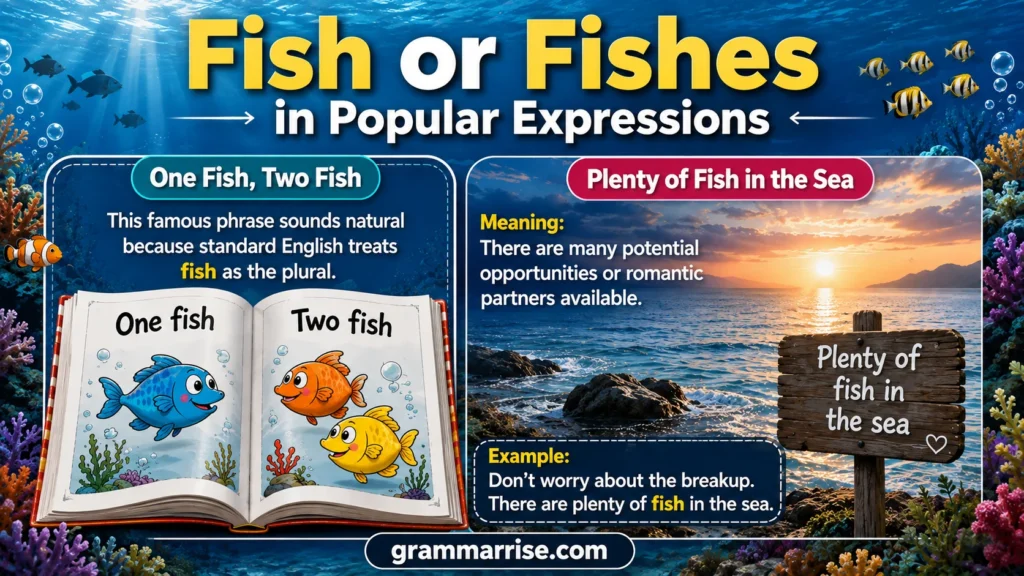
Fish or Fishes in Popular Expressions
Many English expressions use fish, not fishes.
One Fish, Two Fish
This famous phrase sounds natural because standard English treats fish as the plural.
Plenty of Fish in the Sea
Meaning:
There are many potential opportunities or romantic partners available.
Example:
Don’t worry about the breakup. There are plenty of fish in the sea.
Fish Out of Water
Meaning:
Someone feels uncomfortable or out of place.
Example:
He felt like a fish out of water during the conference.
Big Fish in a Small Pond
Meaning:
An important person within a small group.
Example:
She was a big fish in a small pond before joining the national company.
Like Shooting Fish in a Barrel
Meaning:
Something is extremely easy.
Example:
Winning that game was like shooting fish in a barrel.
Common Mistakes People Make
Many learners make predictable mistakes when using these words.
Mistake: Using Fishes for Every Plural
Incorrect:
I saw ten fishes.
Correct:
I saw ten fish.
Mistake: Assuming Fishes Is Wrong
Incorrect assumption:
Fishes isn’t a real word.
Reality:
Fishes is a legitimate English word with a specific meaning.
Mistake: Using Fishes in Casual Speech
Most native speakers rarely use fishes during everyday conversation.
Sentence:
We bought three fishes at the store.
Grammatically possible but unnatural.
Most people would say:
We bought three fish at the store.
Quick Correction Table
| Incorrect | Correct |
| Five fishes swam by. | Five fish swam by. |
| I caught three fishes. | I caught three fish. |
| Scientists studied fishes species. | Scientists studied fishes. |
| The reef contains many fish species. | The reef contains many fishes. |
Real-World Case Study: Aquarium vs. Marine Biology
Here’s a practical example.
Aquarium Owner
A hobbyist says:
I have ten fish in my aquarium.
Correct.
The focus is quantity.
Marine Biologist
A researcher says:
The aquarium houses fishes from Asia, Africa, and South America.
Also correct.
The focus is species diversity.
Key Takeaway
The difference isn’t grammar alone.
It’s about what information matters most in the sentence.
Fish vs. Fishes Quiz
Test your understanding.
Question 1
We caught twenty _____ during our trip.
A. Fish
B. Fishes
Answer: Fish
Question 2
The coral reef contains many tropical _____.
A. Fish
B. Fishes
Answer: Fishes
Question 3
I ate grilled _____ for dinner.
A. Fish
B. Fishes
Answer: Fish
Question 4
Researchers studied native freshwater _____.
A. Fishes
B. Fish
Answer: Fishes
Question 5
The pond contains hundreds of _____.
A. Fish
B. Fishes
Answer: Fish
Fish vs. Fishes Cheat Sheet
Save this quick reference.
| If You Mean… | Use |
| One animal | Fish |
| Multiple animals | Fish |
| Fish as food | Fish |
| Everyday conversation | Fish |
| Fishing trips | Fish |
| Different species | Fishes |
| Scientific studies | Fishes |
| Biodiversity discussions | Fishes |
Memory Trick
Think of it this way:
Count fish. Classify fishes.
If you’re counting individual animals, use fish.
If you’re grouping species, use fishes.
That’s the easiest rule to remember.
My Personal Experience as an English Specialist
As an English specialist, I’ve often seen learners get confused about “fish” and “fishes.” In my experience, the easiest way to understand the difference is to focus on context. Fish is normally used for one fish and also for multiple fish. For example, “I saw one fish” and “I saw five fish” are both correct.
I’ve also explained that fishes isn’t wrong. It’s mainly used when talking about different species or types of fish, especially in scientific or academic writing. For example, “The reef contains many fishes” can emphasize species diversity.
My simple rule is: count fish, classify fishes. In everyday English, fish is usually the natural choice. When discussing different species, fishes may be more suitable. Once learners understand this context-based difference, the confusion usually disappears.
FAQs
1. Is “fish” or “fishes” the correct plural?
Fish is the usual plural when you’re talking about more than one fish. Fishes is also correct when you’re referring to different species or types of fish.
2. Can “fish” be both singular and plural?
Yes. You can say “one fish” for a single animal and “five fish” for several animals. The plural form usually stays the same as the singular.
3. When should I use “fishes”?
Use fishes when you want to emphasize different species, groups, or types of fish. This form is especially common in scientific and biological writing.
4. Is “fishes” grammatically wrong?
No. Fishes is grammatically correct, but it has a more specific use. In everyday English, fish is normally the more natural plural.
5. What is the easiest way to remember fish vs. fishes?
Think about whether you mean several individual fish or several kinds of fish. For individual animals, use fish; for different species or kinds, fishes can be appropriate.
6. Which form should I use in everyday writing?
In most everyday situations, choose fish. For example, “We saw many fish in the lake” sounds natural. Use fishes when the distinction between species or types matters.
Conclusion
Understanding the difference between fish and fishes becomes much easier when you pay attention to the context. Fish is normally used for one fish or several fish, while fishes is commonly used when talking about different species or types of fish. This small difference can make your writing clearer and more accurate, especially when you’re working on school assignments, articles, reports, or professional documents.
If you’re ever unsure which form to choose, don’t overthink it. In everyday English, fish is usually the safest and most natural option. When your sentence focuses on separate species, fishes may be the better choice. Once you understand this simple rule and see how both words work in real sentences, the confusion quickly disappears, and you can use fish or fishes with confidence.

Hussain Abid is an English language writer with over 10 years of experience in grammar, spelling, vocabulary, and writing. He specializes in creating clear, well-researched content that helps readers improve their English with confidence. At GrammarRise, Hussain writes practical guides, grammar explanations, and word comparison articles based on trusted language sources and real-world usage. His mission is to make English learning simple, accurate, and accessible for everyone