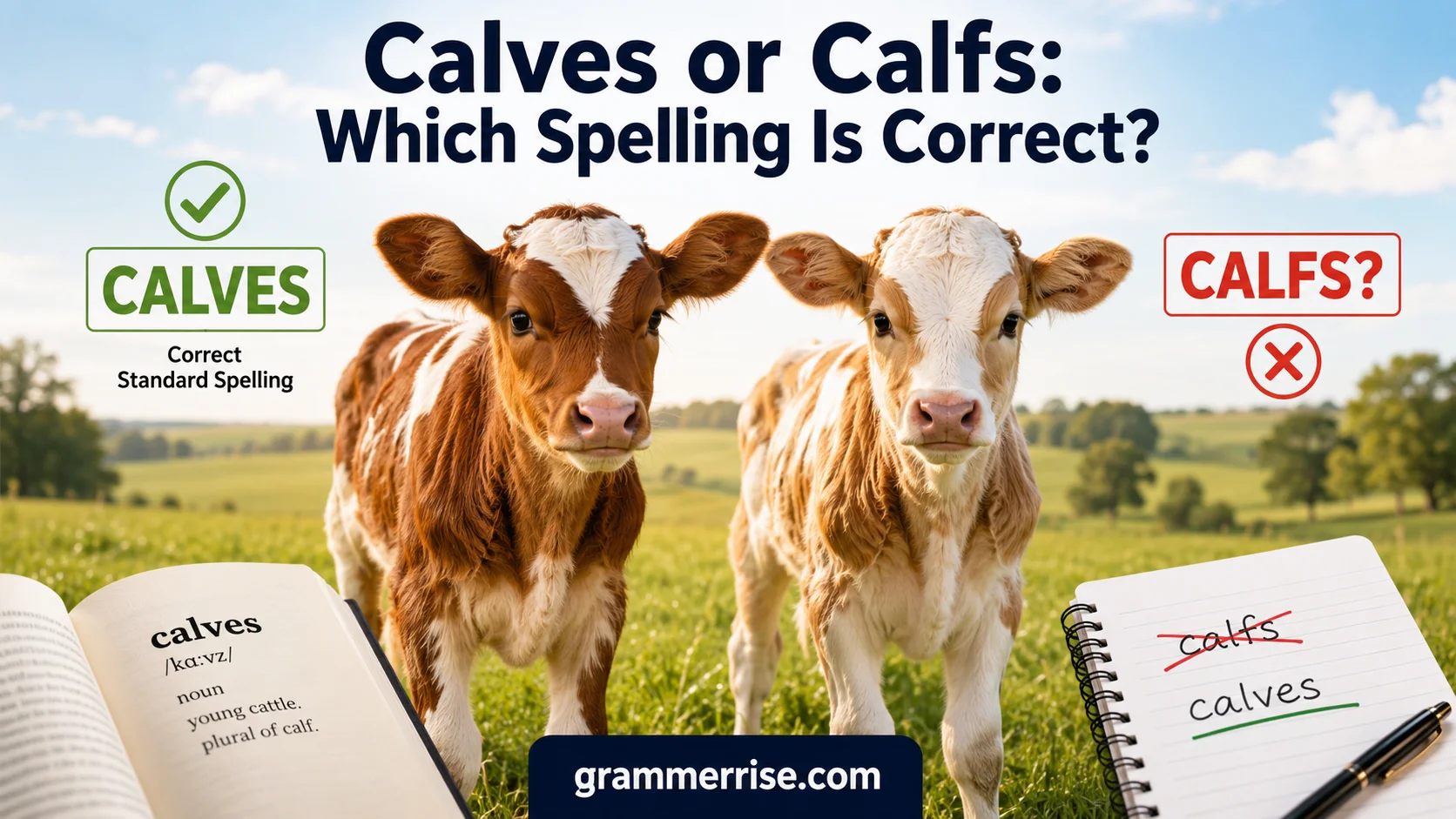
Calves or Calfs is a common spelling question for English speakers, especially students, writers, and English learners.
The correct spelling is calves, the standard plural of calf, while calfs is incorrect in standard English. The calf can mean a young cow, one of several mammals, or the muscles at the back of the lower human leg.
Real-life examples make the rule easier to remember. A farmer may have raised several young calves that stayed near their mothers, while someone who was running may have injured both calves in the lower leg. These examples show how the same plural works in animals and anatomy. Many students, writers, and other English speakers have searched for English spelling questions because using the wrong spelling can make writing seem unprofessional to readers.
This keyword often appears in searches about essays, social media posts, and articles. A helpful guide should offer a quick answer, explain the origin of the word, and provide clear spelling rules. British and American English both use calves as the accepted form, so your audience doesn’t change the correct plural. Remembering these irregular plural rules is more reliable than assuming every word takes -s, and it helps prevent common mistakes when using nouns, regular plurals, and common mistakes correctly.
Quick Answer
If you only need the answer for ordinary writing, remember this:
| Word | Correct use | Example |
| calf | One young animal or one lower leg | The calf is sleeping. |
| calves | More than one young animal or lower leg | The calves are sleeping. |
| calfs | Specialized use referring to calf hide or calfskin | The term can appear in leather-related contexts. |
| calve | A verb meaning to give birth to a calf or produce offspring | The cow will calve soon. |
For most writers, calves is the correct plural.
For example:
- Correct: The farmer has six calves.
- Correct: My calves hurt after the hike.
- Incorrect in ordinary usage: The farmer has six calfs.
- Incorrect in ordinary usage: My calfs hurt after the hike.
There is one wrinkle worth knowing. Merriam-Webster records calfs as a plural for the hide of a domestic calf, especially calfskin. It separately gives calves as the plural for the young animal and for the fleshy part of the leg.
That means the blanket statement “calfs is never a word” goes too far. The better explanation is that calves is the standard plural for the meanings most people intend when they ask about calves or calfs.
What Does Calf Mean?
The word calf has several meanings. Two are especially common in modern English.
First, it can describe a young cow or the young of certain other large mammals. Cambridge Dictionary specifically includes young cows and young animals such as elephants and whales.
Second, calf refers to the thick or fleshy part at the back of the human lower leg, below the knee.
These meanings look completely different on the surface, yet they share the same plural:
calf → calves
Calf as a Young Animal
When someone says “a calf,” they usually mean a young cow.
For example:
- The calf followed its mother across the pasture.
- A newborn calf rested beside the fence.
- The farmer checked the calf before sunrise.
- The cow stayed close to her calf.
The term isn’t limited to cattle, though. English also uses calf for the young of various large mammals, including elephants and whales.
So these sentences are also correct:
- The elephant protected her calf.
- The whale traveled beside her calf.
- The herd included several young calves.
Once there is more than one, the spelling changes to calves.
Calf as a Part of the Leg
The second major meaning has nothing to do with farming.
Your calf is the fleshy area at the back of your lower leg, below the knee. Cambridge Dictionary defines it as the thick curved part at the back of the human leg between the knee and foot.
For example:
- My right calf feels tight.
- She injured her calf during training.
- He stretched his calf before running.
- Both calves were sore after the climb.
Again, the plural is calves, not calfs.
Merriam-Webster likewise lists calves as the plural for this anatomical meaning.
Why Is the Plural of Calf “Calves”?
Here’s where English spelling gets a little quirky.
Many nouns become plural simply by adding -s:
- book → books
- chair → chairs
- dog → dogs
- table → tables
But calf belongs to a group of nouns that form plurals with an -ves ending.
The basic pattern looks like this:
calf → calves
The spelling changes from f to v, then adds -es.
Several familiar English words follow a similar pattern:
| Singular | Plural |
| calf | calves |
| leaf | leaves |
| wolf | wolves |
| half | halves |
| knife | knives |
| life | lives |
| wife | wives |
| shelf | shelves |
Grammarly identifies calf → calves as one of the common irregular plural patterns involving -f or -fe nouns. It also points out that English has exceptions, such as roof → roofs.
That last point matters.
You shouldn’t assume that every English noun ending in f must change to ves.
For instance:
- roof → roofs
- chief → chiefs
- belief → beliefs
- proof → proofs
English doesn’t offer a neat mathematical formula here. Historical spelling and pronunciation patterns helped shape these forms over time.
Is “Calfs” Ever Correct?
Yes, but only in a much narrower sense.
This is the detail that separates a careful explanation from the oversimplified advice that “calfs is always wrong.”
Merriam-Webster gives calfs as a plural associated with the hide of a domestic calf, especially calfskin.
So there are two different grammatical situations:
Young animals:
one calf → two calves
Leg muscles:
one calf → two calves
Calf hide or calfskin:
calfs can occur as a specialized plural form
For everyday writing, however, you will almost always need calves.
If you’re writing about cattle, wildlife, anatomy, fitness, sports, or injuries, choose calves.
Why This Distinction Matters
Consider these sentences:
The rancher raised twenty calves.
This clearly refers to young animals.
The runners stretched their calves.
This clearly refers to leg muscles.
Now consider a leather-related context:
The traditional term referred to calfs used as a material.
Here, the specialized dictionary sense can become relevant.
The important point is context. Calves isn’t merely a more popular spelling of calfs. The two forms can serve different meanings in dictionary usage.
Calf vs. Calves: Singular and Plural
The easiest way to understand the relationship is to treat calf as singular and calves as plural.
| Number | Animal | Leg |
| Singular | one calf | one calf |
| Plural | two calves | two calves |
Look at the difference in sentence structure:
Singular:
The calf is standing near the barn.
Plural:
The calves are standing near the barn.
Now switch meanings:
Singular:
My calf is sore.
Plural:
My calves are sore.
Notice another important change: is becomes are when the subject becomes plural.
That’s a small grammatical detail, but it helps prevent awkward sentences.
Calves in Animal-Related Writing
The plural calves appears frequently in farming, wildlife, veterinary, and zoological writing.
For cattle, a calf is a young member of the species. In wildlife writing, the same word can describe young animals from several large mammals.
Examples include:
- cattle calves
- elephant calves
- whale calves
- bison calves
- giraffe calves
- moose calves
Dictionary.com also notes that calf can refer to the young of various mammals beyond domestic cattle.
Example Sentences About Animals
Here are several natural examples:
- The dairy farmer separated the calves from the older cattle.
- Several calves rested together beneath the shade.
- The elephant herd moved slowly while protecting its calves.
- Researchers observed whale calves swimming near adult whales.
- The newborn calves stayed close to their mothers.
In each example, calves clearly means more than one young animal.
Calves in Fitness and Sports
The word calves also appears constantly in fitness writing.
The calf contains muscles that contribute to movements involving the ankle and foot. The prominent muscles include the gastrocnemius and soleus, which work together during movements such as pushing off the ground and raising the heel.
That’s why athletes, runners, cyclists, dancers, and gym-goers often talk about their calves.
For example:
- Strong calves can contribute to powerful movements.
- The runner felt tightness in both calves.
- She added calf raises to her workout.
- The athlete rested after developing a calf strain.
Merriam-Webster defines the anatomical calf as the fleshy back part of the leg below the knee.
Read more: Fishes or Fish? Which One Is Correct?
Calf Muscle vs. Calves
This is another place where number matters.
Calf muscle is singular:
The calf muscle helps stabilize the lower leg.
Calf muscles is plural:
The calf muscles were sore after training.
You can also simply say calves:
My calves are sore.
All three forms can work. The best choice depends on what you want to emphasize.
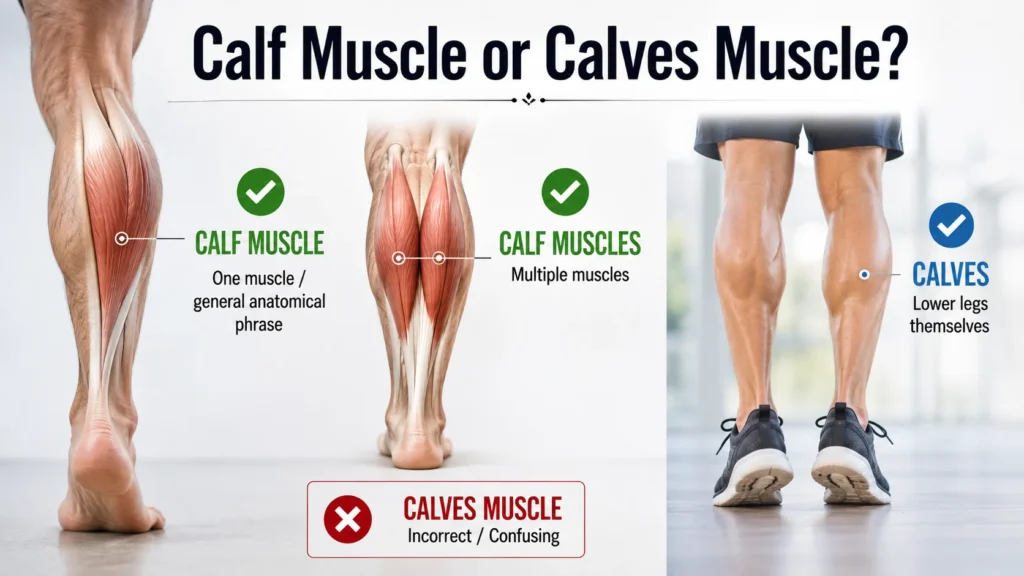
Calf Muscle or Calves Muscle?
This mistake often appears because writers see calves and assume it should modify muscle.
Usually, that’s not how the phrase works.
Use:
- calf muscle for one muscle or the general anatomical phrase
- calf muscles for multiple muscles
- calves when referring to the lower legs themselves
Avoid:
- calves muscle
Compare these examples:
| Awkward or incorrect | Better |
| My calves muscle hurts. | My calf muscle hurts. |
| My calves muscle is tight. | My calf muscles are tight. |
| I trained my calves muscles. | I trained my calf muscles. |
| My calfs hurt. | My calves hurt. |
The phrase calf muscle works much like other anatomical compounds. The first noun acts as a modifier, so it stays singular.
You say:
- calf muscle
- shoulder muscle
- thigh muscle
- arm muscle
You don’t normally change the first word simply because the overall sentence refers to both sides of the body.
Calves vs. Calve: Don’t Confuse Them
The spelling calves can cause another problem because it looks similar to calve.
They’re different words.
Calves can be:
- The plural of calf.
- The third-person singular present form of the verb calve.
Calve is a verb meaning to give birth to a calf. It can also describe an ice mass breaking away and becoming detached. Merriam-Webster records both meanings.
Consider these examples:
The farmer has five calves.
Here, calves is a plural noun.
The cow calves every spring.
Here, calves is a verb.
That second sentence may look strange at first, but grammar gives it away.
A Useful Comparison
| Word | Part of speech | Meaning | Example |
| calf | noun | One young animal or one leg | The calf is nearby. |
| calves | noun | More than one calf | The calves are nearby. |
| calve | verb | Give birth to a calf | The cow may calve soon. |
| calves | verb | Gives birth | The cow calves in spring. |
So calves can actually have two grammatical roles.
Context tells you which one you’re seeing.
How to Pronounce Calves
Spelling isn’t the only confusing part.
In American English, calf is commonly pronounced approximately like “kaf.” The plural calves is pronounced approximately like “kavz.” Cambridge gives the American pronunciations as /kæf/ for calf and /kævz/ for calves. British pronunciation differs in the vowel but retains the plural ending with a v sound.
The important point is that the plural doesn’t sound like calfs with an ordinary f-s sequence.
Think of the transition like this:
calf → calves
f → v
That pronunciation change matches the spelling change.
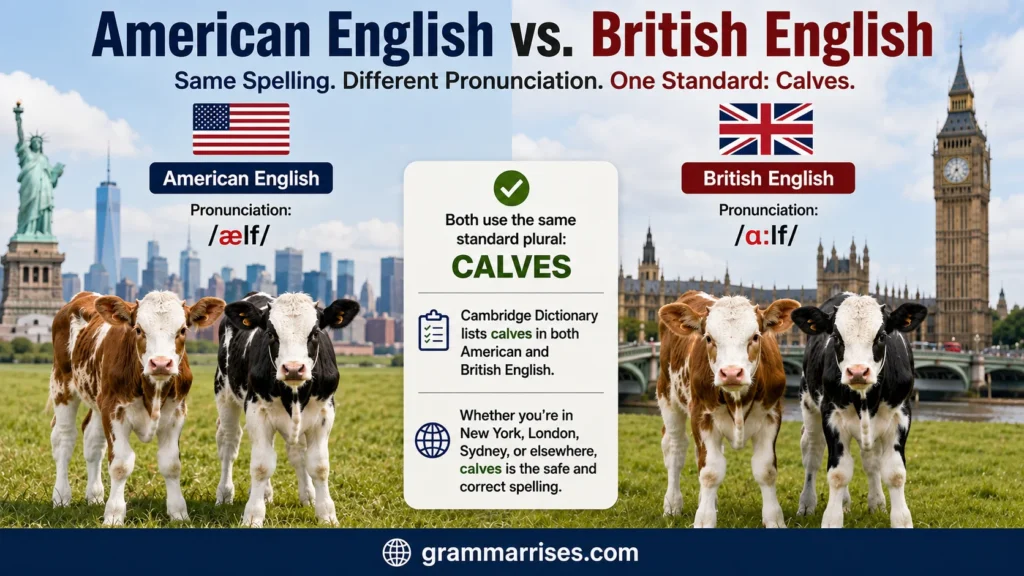
American English vs. British English
You won’t find a major American-versus-British spelling battle here.
Both American and British English use calves as the standard plural of calf for the animal and anatomical meanings. Cambridge lists calves in both varieties.
The main difference is pronunciation.
American English commonly pronounces calf with the vowel /æ/, while British English commonly uses /ɑː/. The plural follows the corresponding pronunciation pattern.
So whether you’re writing for readers in New York, London, Sydney, or elsewhere, calves is the safe standard spelling for ordinary plural usage.
Common Mistakes With Calves and Calfs
A few errors appear repeatedly because English plural rules aren’t always predictable.
Writing “calfs” for multiple animals
Incorrect:
The farmer bought ten calfs.
Correct:
The farmer bought ten calves.
Writing “calfs” for both legs
Incorrect:
His calfs were sore after the race.
Correct:
His calves were sore after the race.
Using “calf” after a plural number
Incorrect:
She saw three calf in the field.
Correct:
She saw three calves in the field.
The number three tells you that the noun must be plural.
Confusing “calves” and “calve”
Incorrect:
The farmer said the cow had two calve.
Correct:
The farmer said the cow had two calves.
But:
The cow may calve tomorrow.
Here calve is the verb.
Using “calves muscle”
Incorrect:
His calves muscle was injured.
Better:
His calf muscle was injured.
Or, if talking about both sides:
His calf muscles were injured.
These small changes make a sentence sound much more polished.
A Simple Trick to Remember Calves
If spelling rules make your head spin, don’t try to memorize every exception in English.
Just memorize this pair:
CALF → CALVES
Then connect it with a few familiar words:
- half → halves
- leaf → leaves
- wolf → wolves
- knife → knives
- life → lives
The pattern isn’t universal. English has plenty of exceptions.
For example:
- roof → roofs
- chief → chiefs
- proof → proofs
So the safest strategy isn’t “every f becomes ves.”
Instead, remember individual common forms.
Calf has one standard everyday plural: calves.
That tiny memory hook can save you from a surprisingly common spelling error.
Why English Has Irregular Plurals Like Calves
English developed from several Germanic and later linguistic influences. As a result, some modern plural forms preserve older spelling or sound patterns rather than following today’s simplest rules.
Merriam-Webster traces calf back to Old English forms such as cealf and identifies the animal sense as dating to before the 12th century. The anatomical sense has a different history and entered English through Middle English from a Norse source.
That history helps explain why the word doesn’t behave like a freshly coined noun.
English spelling is essentially a historical scrapbook. Some words preserve older patterns even when newer words follow simpler rules.
The result is a language where:
leaf → leaves
but:
roof → roofs
and:
calf → calves
There isn’t always a tidy modern rule behind each form.
Calves in Real-World Usage
The word appears across many fields, which makes learning its correct form especially useful.
Farming
Farmers commonly discuss:
- newborn calves
- dairy calves
- beef calves
- calf health
- calf nutrition
- calf growth
- calf care
When these terms become plural, calves remains the standard form.
Example:
The farmer monitored the calves throughout the first weeks of life.
Wildlife
Wildlife writers frequently use calves for young whales, elephants, and other large mammals.
Example:
The mother elephant kept her calves within the center of the herd.
Sports
Athletes often discuss:
- calf injuries
- calf strains
- calf muscles
- tight calves
- sore calves
- calf strength
Example:
The runner stopped training after developing pain in both calves.
Medicine and Anatomy
Medical writing also uses calf and calves.
Merriam-Webster’s medical definition identifies the calf as the fleshy back part of the leg below the knee and gives calves as its plural.
Example:
The patient reported discomfort in both calves.
That makes calves the correct choice even in technical contexts.
A Practical Calves vs. Calfs Correction Table
When editing your writing, this quick table can help:
| If you wrote | Use instead | Why |
| two calfs | two calves | Standard plural of calf |
| several calfs | several calves | Multiple animals |
| my calfs hurt | my calves hurt | Multiple leg muscles |
| three calf | three calves | Plural noun follows plural number |
| calf muscles | calf muscles | Correct compound noun |
| calves muscle | calf muscles | Correct noun modifier and plural |
| the cow will calves | the cow will calve | Verb follows “will” |
| the cow calves yearly | correct | Third-person singular verb |
The pattern becomes much easier once you separate noun forms from verb forms.
What About “Calves” as a Verb?
Here’s a useful grammatical twist: calves isn’t always a plural noun.
It can also be the third-person singular form of calve.
For example:
The cow calves every year.
Here, calves means the cow gives birth.
Merriam-Webster defines calve as a verb meaning “to give birth to a calf” and also uses it for the breaking away of an ice mass.
The second meaning appears in sentences such as:
The glacier calves large icebergs into the ocean.
So the word calves can describe either:
- multiple young animals or leg muscles, or
- an action performed by a third-person singular subject.
Context does the heavy lifting.
Interesting Facts About the Word Calf
The word calf has a surprisingly rich history and range of meanings.
The word is very old
Merriam-Webster records the animal sense of calf as dating to before the 12th century.
Calf has more than one origin story
The animal-related noun traces back through Middle English to Old English. The anatomical sense has a separate Middle English history connected to Old Norse.
Calves can refer to young animals beyond cows
English uses calf for the young of several large mammals, including elephants and whales.
Calves can refer to both legs
When someone says “my calves,” the phrase often means the lower-leg muscles on both sides.
Calves has two grammatical identities
It can be the plural noun calves, or it can be the third-person singular present form of calve.
That’s a lot of grammatical mileage for one short word.
A Short Case Study: Editing a Fitness Sentence
Imagine a fitness article contains this sentence:
“After running ten miles, Sarah said her calfs were extremely sore.”
The meaning is obvious, but the spelling is wrong for ordinary anatomical usage.
A polished version would read:
“After running ten miles, Sarah said her calves were extremely sore.”
Why?
Because Sarah has more than one calf. The plural of the anatomical noun calf is calves.
Now imagine the sentence changes:
“Sarah strained her calf during the final mile.”
That’s singular because only one calf is being discussed.
The difference isn’t complicated:
one calf → two calves
A good editor simply checks whether the noun refers to one or more than one.
Another Case Study: A Farming Sentence
Consider this sentence:
“The farmer separated the newborn calfs from the older cattle.”
The intended meaning is clear, but calfs isn’t the standard plural for young animals.
The corrected sentence is:
“The farmer separated the newborn calves from the older cattle.”
The word calves appears in agricultural and scientific contexts because it is the accepted plural form of calf. Cambridge’s dictionary examples include repeated references to calves in farming and animal research contexts.
This is why spelling accuracy matters even when readers can understand the intended meaning. A sentence can be understandable and still be grammatically or orthographically weak.
My Personal Experience at an English Specialist
In my experience as an English specialist, I’ve often seen people confused about calves or calfs. The correct plural of calf is calves, whether you’re talking about young animals or the muscles at the back of the legs. I used to understand why learners chose calfs, since many English nouns simply take -s. However, examples like leaf → leaves and wolf → wolves helped make the pattern easier to remember. Now, whenever I explain this word, I simply use the rule: one calf, two calves.
FAQs
1. Is “calves” or “calfs” correct?
Calves is the correct plural form of calf. Calfs is not considered standard English.
2. Why does calf become calves?
Calf is an irregular noun. Instead of simply adding -s, the f changes to ves, giving us calves.
3. Can “calves” refer to people?
Yes. Calves can describe the muscles at the back of the lower legs. For example, “My calves hurt after running.”
4. Does “calves” only mean young cows?
No. Calves can refer to young cows and the young of some other large mammals. It can also describe human leg muscles.
5. Do British and American English use “calves”?
Yes. Both British English and American English use calves as the standard plural of calf.
6. How can I remember the correct spelling?
Think of similar words such as wolf → wolves and leaf → leaves. Like these words, calf → calves, not calfs.
Conclusion
The difference between calves and calfs may seem small, but choosing the right form matters in clear English. Calves is the correct plural of calf, whether you mean young cows or the muscles behind your lower legs. Unlike regular nouns that simply add -s, calf follows the irregular f → ves pattern. So, when you’re writing, remember calf → calves, not calfs. This simple rule can help you avoid spelling mistakes and make your English sound more natural and professional.

Hussain Abid is an English language writer with over 10 years of experience in grammar, spelling, vocabulary, and writing. He specializes in creating clear, well-researched content that helps readers improve their English with confidence. At GrammarRise, Hussain writes practical guides, grammar explanations, and word comparison articles based on trusted language sources and real-world usage. His mission is to make English learning simple, accurate, and accessible for everyone