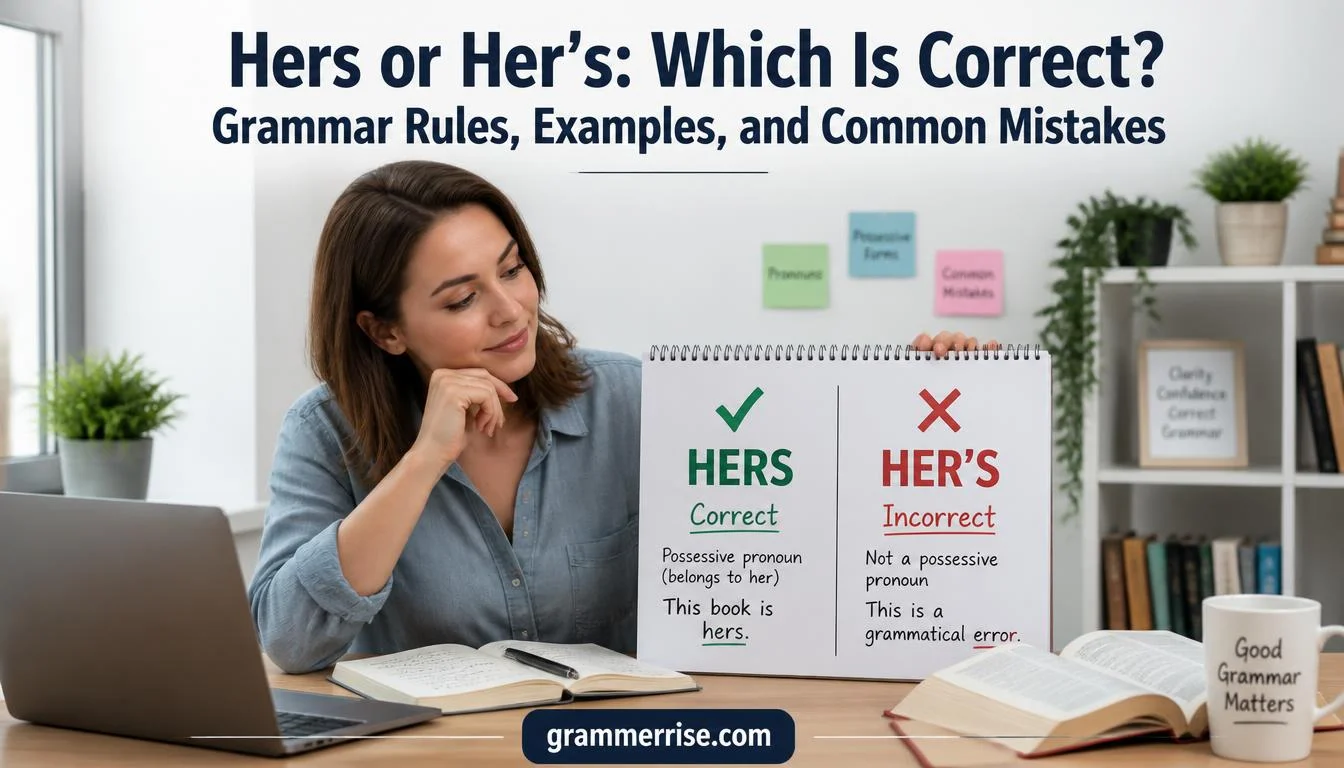
For English learners and writers, Hers or Her’s is a common spelling question; hers is correct, while her’s is grammatically incorrect and should be avoided.
The correct spelling is hers, a possessive pronoun formed from the personal pronoun her. It shows possession and indicates that something belongs to or is associated with a female or feminine entity. For example, “The blue jacket is hers” and “That notebook is hers” clearly demonstrate correct usage. The incorrect form her’s often appears because writers mistakenly apply the apostrophe rule used with some nouns. However, possessive pronouns follow a different pattern and do not need an apostrophe. Understanding this distinction helps English learners and writers use hers correctly and confidently in emails, essays, social media posts, articles, and everyday writing.
The history of hers also helps explain its unusual possessive formulation. The modern form developed from Middle English and Old English, where forms such as hire and hir gradually evolved into her and modern possessive pronouns. The word has a Germanic origin, and its spelling changed over time into the form we use today. Hers means “of her,” but it does not require an apostrophe to express possession. Although homographs can have the same spelling with different meanings or sounds, that concept does not justify writing her’s. Sentences such as “This seat is hers,” “The decision was hers,” and “That responsibility is hers” illustrate the correct form and reinforce why her’s is a misspelled and grammatically incorrect possessive pronoun.
Quick Answer
Hers is correct, while her’s is incorrect in standard English. Use hers when you want to show that something belongs to or is connected with a woman or girl.
For example:
- This book is hers. ✅
- That car is hers. ✅
- The blue jacket is her’s. ❌
The confusion happens because apostrophes often show possession, as in Sarah’s book or the dog’s bowl. However, hers is already a possessive pronoun, so it doesn’t need an apostrophe.
A simple way to remember it is to compare her and hers. Use her before a noun: “This is her phone.” Use hers when the noun is understood: “This phone is hers.”
So, whenever you’re deciding between hers or her’s, choose hers. It’s the standard and grammatically correct form.
Hers or Her’s: Which Is Correct?
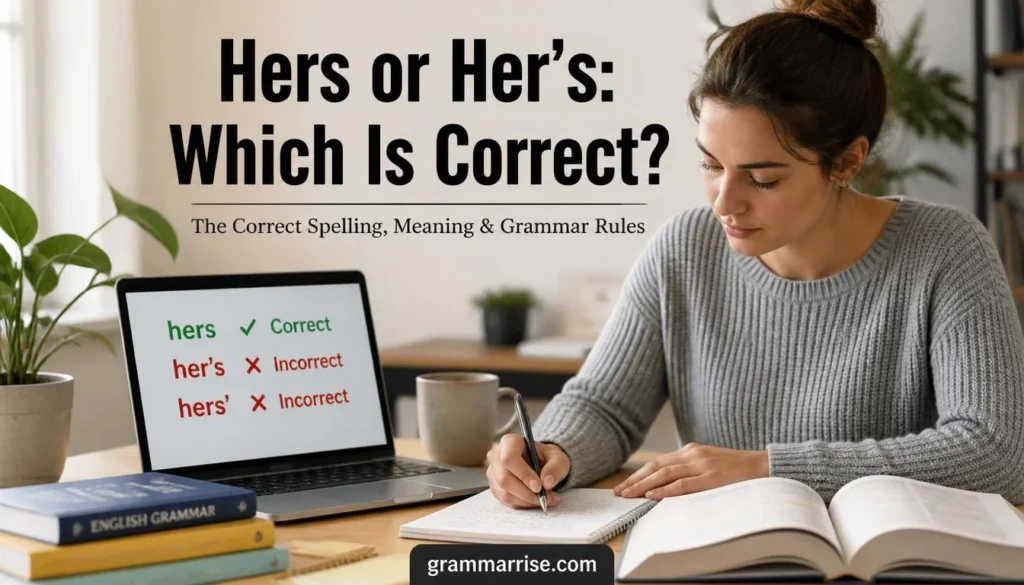
The correct answer is hers.
| Form | Correct? | Use |
| hers | ✅ Yes | Possessive pronoun |
| her’s | ❌ No | Incorrect standard spelling |
| hers’ | ❌ No | Incorrect spelling |
For example:
- That jacket is hers. ✅
- The red bicycle is hers. ✅
- This seat is hers. ✅
- That jacket is her’s. ❌
- The red bicycle is her’s. ❌
The key point is simple: hers already functions as a possessive pronoun, so it doesn’t need an apostrophe. Standard grammar references specifically list hers among possessive pronouns that don’t take apostrophes.
Why “Her’s” Looks Correct at First
The mistake makes sense if you’ve learned that apostrophes often indicate possession.
Consider these examples:
- Maria’s phone
- James’s jacket
- the dog’s bowl
- the teacher’s desk
In each case, the apostrophe helps mark possession or a close relationship.
However, hers isn’t a noun with an apostrophe added to it. It’s a possessive pronoun with its own established form.
Think of the difference like this:
Sarah’s book → The possessive form belongs to the noun Sarah.
The book is hers → Hers replaces Sarah’s book.
That’s the distinction that clears up the whole issue.
What Does “Hers” Mean?
Hers means “belonging to her” or “connected with her.”
It normally refers to something associated with a woman, girl, or female animal already mentioned or understood from context. Cambridge Dictionary defines hers as a pronoun referring to something belonging to or connected with the person mentioned.
For example:
- That notebook is hers.
- The blue car is hers.
- The larger office is hers.
- That opinion is hers.
- The final choice was hers.
Notice something important in each sentence: hers doesn’t directly come before the noun it describes.
You don’t normally say:
❌ hers notebook
Instead, you say:
✅ her notebook
But you can say:
✅ The notebook is hers.
This difference between her and hers is one of the most useful grammar points to remember.
Her vs. Hers: What’s the Difference?
Although her and hers both relate to possession, they don’t perform exactly the same grammatical job.
Her works as a possessive determiner when it appears before a noun. Hers works as a possessive pronoun when it stands in place of a noun phrase.
Compare these sentences:
- Her phone is on the table.
- The phone is hers.
The first sentence uses her before phone. The second uses hers independently.
Here’s the pattern:
| Word | Function | Example |
| her | Possessive determiner | Her coat is warm. |
| her | Object pronoun | I called her yesterday. |
| hers | Possessive pronoun | The coat is hers. |
| her’s | Incorrect possessive spelling | The coat is her’s. ❌ |
This distinction matters because her has more than one grammatical role.
Her as a Possessive Determiner
When her comes directly before a noun, it identifies the person associated with that noun.
Examples include:
- her house
- her sister
- her computer
- her decision
- her idea
- her favorite book
You could say:
Her laptop is new.
Here, her tells you whose laptop it is.
You cannot replace her with hers in that structure:
❌ Hers laptop is new.
Instead:
✅ Her laptop is new.
Hers as a Possessive Pronoun
Hers stands independently and refers back to something already understood.
For example:
My desk is near the window, but hers is near the door.
The word hers replaces the longer phrase her desk. This helps avoid unnecessary repetition. Possessive pronouns commonly serve this purpose.
You could write:
My desk is near the window, but her desk is near the door.
That’s grammatically fine. However, hers makes the sentence shorter and smoother.
Why Doesn’t “Hers” Need an Apostrophe?
This is where English grammar can feel slightly backward.
Apostrophes can show possession with nouns:
- Emma’s notebook
- the child’s toy
- the dog’s leash
But possessive pronouns follow a different pattern.
Common possessive pronouns include:
- mine
- yours
- his
- hers
- ours
- theirs
These forms don’t use apostrophes. Both Cambridge Dictionary and the British Council explicitly note this rule.
A useful comparison makes the pattern easier to remember:
| Person | Possessive determiner | Possessive pronoun |
| I | my | mine |
| You | your | yours |
| He | his | his |
| She | her | hers |
| We | our | ours |
| They | their | theirs |
Notice the pattern.
You don’t write:
- ❌ mine’s
- ❌ your’s
- ❌ her’s
- ❌ our’s
- ❌ their’s
You write:
- ✅ mine
- ✅ yours
- ✅ hers
- ✅ ours
- ✅ theirs
That makes hers part of a larger grammatical pattern rather than an isolated exception.
Hers or Her’s Examples in Everyday English
The easiest way to master the difference is to see it in realistic sentences.
Correct Examples With “Hers”
- That umbrella is hers.
- The black purse is hers.
- This room is hers.
- The blue bicycle belongs to her, so it’s hers.
- My answer differs from hers.
- Her presentation was stronger than mine, but hers was more detailed.
- The final decision was hers.
- That seat by the window is hers.
- The smaller apartment is hers.
- I thought the red notebook was hers.
In every example, hers stands on its own.
Incorrect Examples With “Her’s”
These sentences contain the common apostrophe error:
- ❌ That umbrella is her’s.
- ❌ The black purse is her’s.
- ❌ This room is her’s.
- ❌ The final decision was her’s.
- ❌ I thought the notebook was her’s.
Correct them by removing the apostrophe:
- ✅ That umbrella is hers.
- ✅ The black purse is hers.
- ✅ This room is hers.
- ✅ The final decision was hers.
- ✅ I thought the notebook was hers.
It’s a tiny change on the page, but it reflects an important grammatical distinction.

Hers vs. Her’s in Comparisons
Hers appears frequently in comparisons because it can replace an entire noun phrase.
For example:
My car is newer than hers.
Here, hers means her car.
You could technically write:
My car is newer than her car.
That sentence is correct, but repeating car isn’t necessary.
Consider a few more examples:
- My score was higher than hers.
- Your office is larger than hers.
- His presentation was shorter than hers.
- Their garden is bigger than hers.
- My handwriting looks different from hers.
This use becomes especially valuable in polished writing because it keeps sentences concise without losing meaning.
A Quick Replacement Test
When you’re unsure whether hers fits, mentally replace it with her + noun.
For example:
My phone is newer than hers.
Ask:
Does hers mean her phone?
Yes.
Therefore, hers works.
Another example:
That jacket is hers.
Ask:
Does hers mean her jacket?
Yes.
Again, hers is correct.
This simple test can help you make the right choice without memorizing a long grammar rule.
The Apostrophe Trap: Possession Does Not Always Mean Apostrophe
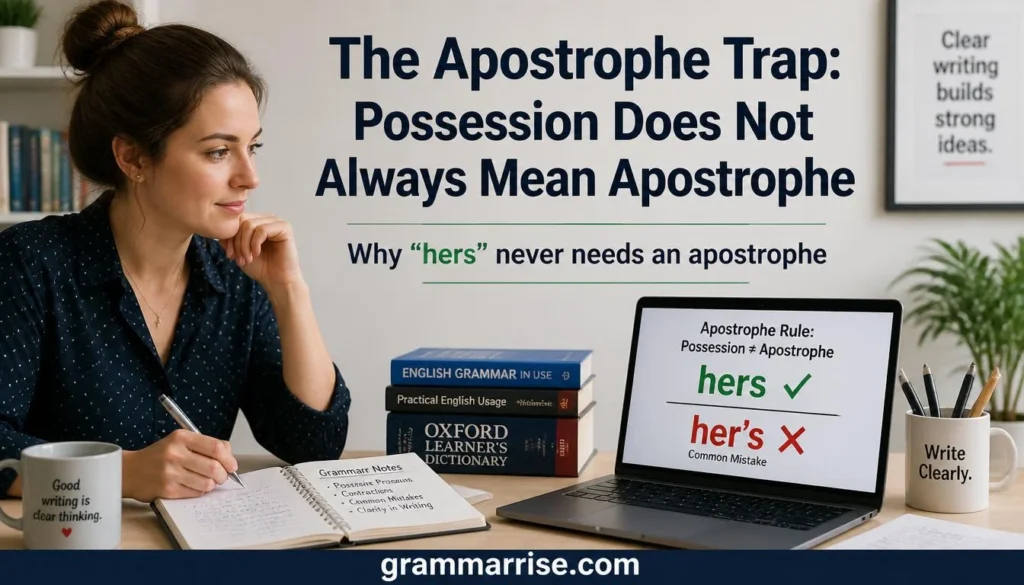
One of the most persistent myths in English grammar is that every possessive form needs an apostrophe.
That’s not true.
Apostrophes have several important functions. They can show possession with certain nouns, and they can indicate missing letters in contractions.
For example:
Possessive noun:
Maria’s laptop is expensive.
Contraction:
She’s working today.
Here, she’s can mean she is or she has, depending on context.
But hers doesn’t fall into either category.
It’s already a complete possessive pronoun.
So:
The laptop is hers. ✅
Not:
The laptop is her’s. ❌
The apostrophe would be unnecessary.
Hers vs. Hers’: Is “Hers’” Correct?
No.
Some writers who learn that her’s is incorrect then make a second mistake by moving the apostrophe to the end:
❌ hers’
That doesn’t work either.
The correct form remains:
✅ hers
There is no apostrophe before the s and no apostrophe after it.
Compare the Three Forms
| Form | Status | Example |
| hers | ✅ Correct | The blue coat is hers. |
| her’s | ❌ Incorrect | The blue coat is her’s. |
| hers’ | ❌ Incorrect | The blue coat is hers’. |
The safest rule is straightforward:
When “hers” means belonging to her, spell it H-E-R-S.
Nothing more needs to be added.
Common Mistakes With Hers
Even after learning the basic rule, several related mistakes can sneak into everyday writing.
Writing “Her’s” Instead of “Hers”
This is the most common error.
Incorrect:
That computer is her’s.
Correct:
That computer is hers.
The apostrophe doesn’t belong in the word.
Writing “Hers’” Instead of “Hers”
Moving the apostrophe doesn’t fix the spelling.
Incorrect:
The blue car is hers’.
Correct:
The blue car is hers.
Using “Hers” Before a Noun
Because hers expresses possession, some writers assume they can put it directly before a noun.
They can’t in standard English.
Incorrect:
Hers car is parked outside.
Correct:
Her car is parked outside.
But:
The car is hers.
The noun position determines which form you need.
Using “Her” When “Hers” Is Needed
The opposite mistake also occurs.
Incorrect:
The red jacket is her.
Correct:
The red jacket is hers.
Why?
Because her cannot normally stand alone as a possessive determiner. It needs a noun after it when it expresses possession.
Compare:
her jacket
the jacket is hers
That’s the basic structural difference.
A Useful Case Study: Choosing Between Her and Hers
Imagine two coworkers are comparing laptops.
One says:
My laptop is silver.
The other replies:
Her laptop is black.
Here, her comes before laptop, so it functions as a possessive determiner.
Now imagine the conversation continues:
My laptop is silver, but hers is black.
This time, hers replaces her laptop.
The meaning stays clear without repeating the noun.
| Meaning | Correct sentence |
| The laptop belongs to her and the noun follows | Her laptop is black. |
| The noun has already been mentioned | Hers is black. |
| The laptop belongs to her | The laptop is hers. |
| Incorrect apostrophe form | The laptop is her’s. ❌ |
This small conversation captures the central rule better than a complicated definition ever could.
Hers, Mine, Yours, His, Ours, and Theirs
Learning hers becomes much easier when you see it alongside the other possessive pronouns.
| Possessive determiner | Possessive pronoun | Example |
| my | mine | This book is mine. |
| your | yours | This seat is yours. |
| his | his | The jacket is his. |
| her | hers | The jacket is hers. |
| our | ours | The house is ours. |
| their | theirs | The decision is theirs. |
The pattern is useful because the possessive pronoun often stands where a full noun phrase would otherwise appear.
For example:
This is my phone.
This phone is mine.
Then:
That is her phone.
That phone is hers.
The same structure works across the system.
The British Council lists hers, mine, yours, his, ours, and theirs as possessive pronouns and specifically warns that these forms don’t take apostrophes.
“A Friend of Hers” Is Correct
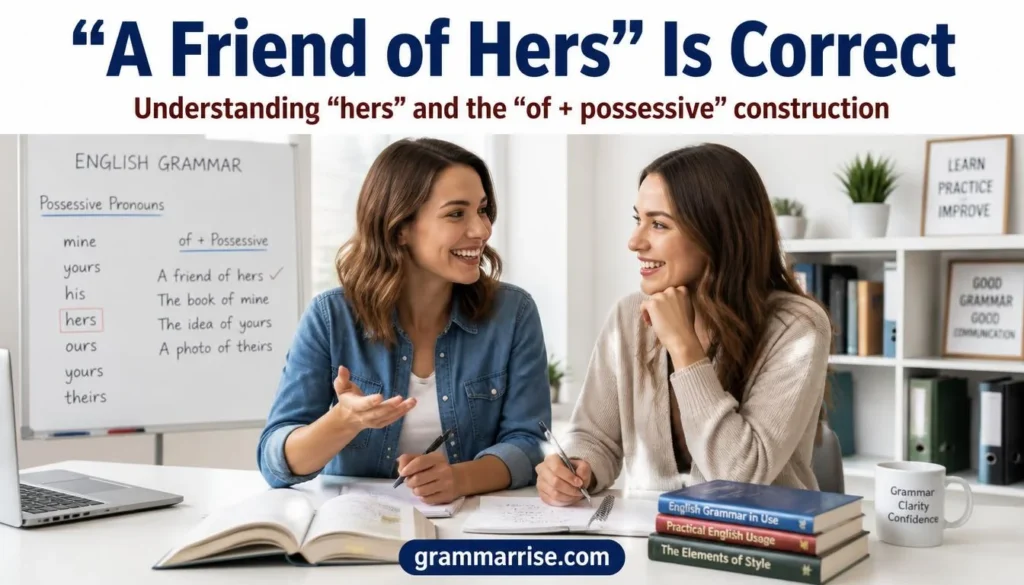
There’s another useful construction that sometimes confuses learners:
She is a friend of hers.
This sentence is completely correct.
Here, hers appears after of and refers to a person or relationship associated with her.
For example:
- He’s a colleague of hers.
- She’s an old friend of hers.
- That’s a cousin of hers.
- They met a neighbor of hers.
This construction can sound more natural than simply repeating a possessive phrase.
Compare:
She is one of her friends.
with:
She is a friend of hers.
Both express a similar idea, although the structures differ.
Standard grammar references recognize this of + possessive construction.
“Hers” Can Refer to More Than Physical Objects
Possession doesn’t always involve something you can hold.
Hers can refer to belongings, ideas, responsibilities, characteristics, choices, or other things associated with a person.
Consider these examples:
- The final decision was hers.
- That opinion is hers alone.
- The responsibility is hers.
- The choice was hers.
- The larger share was hers.
- That style of writing is distinctly hers.
In these sentences, hers doesn’t simply mean a physical object owned by a woman.
It can point to something belonging to, associated with, or attributable to her. Cambridge Dictionary gives examples involving characteristics, jobs, houses, relationships, and other associations.
That broader meaning makes hers more versatile than a simple “ownership word.”
Read more: Families or Family’s: Grammar Rules and Examples
Hers vs. Her’s: A Simple Memory Trick
If apostrophes keep getting in the way, use this shortcut:
Possessive pronouns don’t need apostrophes.
Remember the group:
mine, yours, his, hers, ours, theirs
None needs an apostrophe.
You can also remember the phrase:
“Hers belongs without an apostrophe.”
Another useful trick is to compare hers with his.
You wouldn’t normally write:
❌ his’s
You simply write:
✅ his
The same principle applies to hers.
It doesn’t need an extra punctuation mark to prove that it expresses possession.
Hers vs. Her’s: Quick Grammar Test
Try these sentences before checking the answers.
Choose the Correct Form
- The red backpack is ___.
- ___ backpack is on the chair.
- My answer was different from ___.
- That notebook is ___, not mine.
- I spoke with a friend of ___.
- ___ favorite color is blue.
- The final choice was ___.
- The black shoes are ___.
Answers
- hers
- Her
- hers
- hers
- hers
- Her
- hers
- hers
The trick isn’t simply memorizing hers.
Instead, look at what comes next.
If a noun follows immediately, her may be the correct possessive determiner:
her backpack
If the noun doesn’t follow because the possessive expression stands independently, use hers:
The backpack is hers.
My Personal Experience as an English Specialist
As an English specialist, I’ve often seen learners confuse hers with her’s. I understand why because apostrophes commonly show possession, such as in Sarah’s book. However, hers is a possessive pronoun and never needs an apostrophe.
I usually explain it with a simple comparison: “This is her book” becomes “This book is hers.” Once learners understand that hers replaces her book, the difference becomes much easier to remember.
From my experience, the best rule is simple: use her before a noun and hers when the noun is understood. For example, “Her jacket is blue” and “The jacket is hers.” This small distinction can make English writing much clearer and more accurate.
FAQs
1. Is hers or her’s correct?
Hers is the correct spelling. Her’s is incorrect because possessive pronouns like hers don’t take an apostrophe.
2. Why doesn’t hers need an apostrophe?
The word hers is already a possessive pronoun. Unlike possessive nouns, it doesn’t need an apostrophe to show ownership.
3. Can I use hers without a noun after it?
Yes. Hers can stand alone when the noun is already understood. For example, “My phone is black, but hers is white.”
4. What is the difference between her and hers?
Her can work as a possessive determiner before a noun, as in “her book.” Hers stands alone, as in “The book is hers.”
5. Is her’s ever grammatically correct?
No. In standard English, her’s is considered an incorrect spelling. Use hers when expressing possession.
6. How can I remember the correct spelling of hers?
A simple trick is to remember that possessive pronouns such as hers, yours, ours, and theirs generally don’t use apostrophes.
Conclusion
Choosing hers instead of her’s is a small detail, but it makes a big difference in clear and polished English. Hers is the only correct form when you want to show that something belongs to her. The apostrophe in her’s is unnecessary and makes the word grammatically incorrect. Once you remember that hers is a possessive pronoun, the rule becomes much easier to follow. Whether you’re writing an email, completing an essay, or simply chatting online, using hers will keep your sentences accurate, natural, and professional.



[…] Read more: Hers or Her’s: Which Is Correct Examples? […]