
Many English learners, students, writers, and non-native speakers feel confused about Sent or Send because these words are closely connected, but they have different tenses and grammatical purposes.
In writing and speaking, Send is the base form and present form, while Sent is the past tense and past participle used for completed actions. This distinction becomes easier through grammar, verb forms, tense usage, grammar rules, and sentence structure. Using examples from emails, text messages, formal reports, essays, and professional writing can improve clarity and accuracy.
The main confusion often comes from spelling and changes between the forms. Learners may accidentally write sended, an incorrect form, but the grammar rule is simple. Send refers to present actions, while Sent refers to completed actions. With consistent learning, practice, application, and repeated practice, learners can recognize useful patterns, improve vocabulary, strengthen writing skills, and eliminate common mistakes. This also supports better communication, confidence, professionalism, and overall correctness.
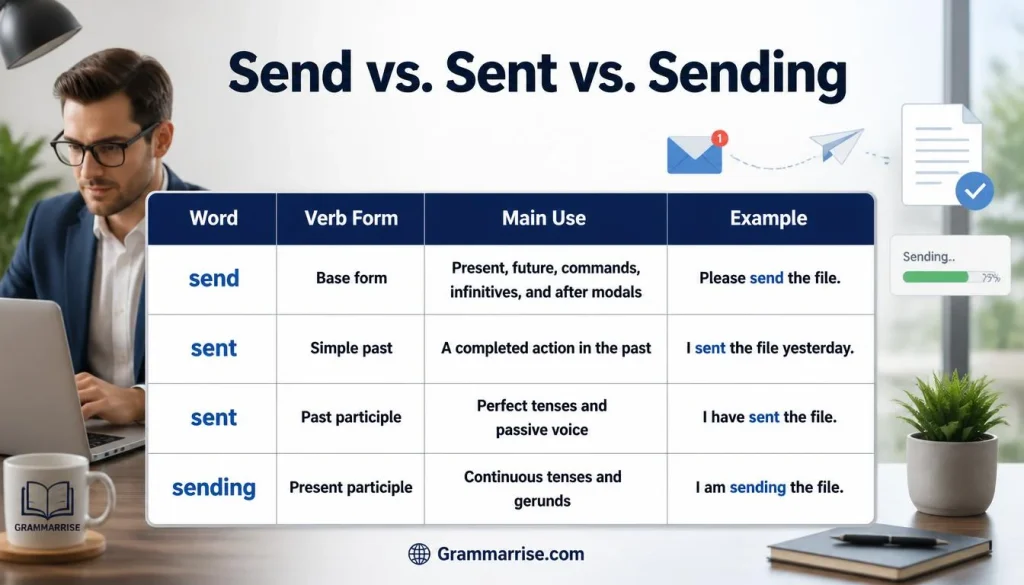
Quick Answer
The simplest way to understand sent or send is to look at the grammatical structure.
| Word | Verb form | Main use | Example |
| send | Base form | Present, future, commands, infinitives, and after modals | Please send the file. |
| sent | Simple past | A completed action in the past | I sent the file yesterday. |
| sent | Past participle | Perfect tenses and passive voice | I have sent the file. |
| sending | Present participle | Continuous tenses and gerunds | I am sending the file. |
Here’s the most useful shortcut:
Use “send” after words such as did, will, can, should, must, and to.
Use “sent” for a completed past action and after have, has, or had.
Compare these examples:
- I send reports every Friday.
- I sent the report yesterday.
- I will send the report tomorrow.
- Did you send the report?
- I have sent the report.
- The report was sent yesterday.
Once you recognize the structure, choosing between send and sent becomes much more automatic.
What Does “Send” Mean?
Send means to cause something or someone to go from one place, person, or situation to another.
The verb has several everyday uses. You can send an email, message, package, invitation, payment, document, person, or piece of information.
For example:
- Please send me the address.
- I send my manager a weekly report.
- We need to send the package today.
- She will send the documents tomorrow.
- Can you send me the details?
The word also has broader meanings.
You can send someone to school, send a signal, or even send prices higher.
For example:
The company plans to send more employees to the training program.
Here, send doesn’t involve mailing anything. It means arranging for people to go somewhere.
Another example is:
The announcement could send the stock price higher.
In this sentence, send means “cause something to move in a particular direction.”
Common Uses of “Send”
You’ll frequently see send in these expressions:
- send an email
- send a message
- send a text
- send a package
- send a letter
- send a document
- send an invitation
- send information
- send a payment
- send someone somewhere
- send a signal
- send a reminder
The base form also appears after auxiliary and modal verbs.
For example:
- Did you send it?
- Will you send it?
- Can you send it?
- Should I send it?
- I need to send it.
That grammatical pattern is one of the most important things to remember.
What Does “Sent” Mean?
Sent is the simple past form and past participle of send.
Unlike regular verbs such as walk → walked, English doesn’t form the past of send by simply adding -ed.
You don’t say:
- ❌ I sended the email.
You say:
- ✅ I sent the email.
The word sent has two major grammatical functions.
It can describe a completed action in the past:
I sent the application yesterday.
It can also function as a past participle:
I have sent the application.
The spelling stays exactly the same in both cases. The surrounding words tell you how sent functions.
“Sent” as the Simple Past
Use sent when describing a completed action that happened in the past.
Examples include:
- I sent the email yesterday.
- She sent me a message last night.
- We sent the package last Friday.
- He sent the report two hours ago.
- They sent an invitation last month.
Past-time expressions often make this use especially obvious.
Common examples include:
- yesterday
- last night
- last week
- last month
- two days ago
- three hours ago
- earlier
- previously
- this morning, when the action is already finished
For example:
Maria sent the contract yesterday.
The action happened and finished in the past. Therefore, sent is correct.
“Sent” as the Past Participle
The same word appears as the past participle.
The past participle usually appears with auxiliary verbs such as have, has, and had in perfect constructions.
Examples:
- I have sent the email.
- She has sent the documents.
- They had sent the package before noon.
- We have sent the confirmation.
- He had sent the information earlier.
The key difference is structural.
Compare:
I sent the email yesterday.
Here, sent is the simple past.
I have sent the email.
Here, sent is the past participle.
The spelling doesn’t change. The auxiliary verb changes the grammatical role.

Send vs. Sent: Understanding the Verb Forms
English verbs often have several forms, and send is an irregular verb.
Here is the complete basic pattern:
| Verb form | Form of “send” | Example |
| Base form | send | I want to send it. |
| Present simple | send / sends | They send emails. / She sends emails. |
| Simple past | sent | She sent an email. |
| Past participle | sent | She has sent an email. |
| Present participle | sending | She is sending an email. |
The most important fact is that send has the same form for its simple past and past participle: sent.
That’s why learners sometimes find this verb confusing.
With a regular verb, you might see:
work → worked → worked
With send, you see:
send → sent → sent
The verb doesn’t follow the regular -ed pattern.
Is “Sended” Correct?
No. Sended is not the standard past form of send.
The correct forms are:
- send
- sends
- sent
- sending
So:
- ❌ I sended the message.
- ✅ I sent the message.
And:
- ❌ She has sended the documents.
- ✅ She has sent the documents.
This is worth remembering because English has many regular verbs that take -ed, but send belongs to the irregular group.
When to Use “Send”
Understanding when to use send is easier when you focus on the structure rather than memorizing isolated examples.
Use “Send” for Present Actions
Use send in the present simple with I, you, we, and they.
Examples:
- I send emails every morning.
- You send useful updates.
- We send invoices every month.
- They send reports on Fridays.
With he, she, or it, the form becomes sends:
- She sends emails every morning.
- He sends the report every Friday.
- The system sends an automatic notification.
So don’t confuse send with sends.
The choice depends on the subject.
Use “Send” for Future Actions
After will, use the base form send.
Correct:
I will send the document tomorrow.
Incorrect:
I will sent the document tomorrow.
The rule is straightforward:
will + base verb
Therefore:
- will send
- will write
- will call
- will receive
- will finish
Examples:
- She will send the invoice later.
- We will send the confirmation tomorrow.
- They will send the package next week.
Use “Send” After Modal Verbs
Modal verbs take the base form of the main verb.
Common modal verbs include:
- can
- could
- may
- might
- must
- shall
- should
- would
Therefore:
- Can you send it?
- You should send the application.
- We must send the documents.
- She might send another message.
- They could send someone tomorrow.
Don’t write:
❌ You should sent the report.
Write:
✅ You should send the report.
The modal already creates the grammatical structure. The main verb stays in its base form.
Use “Send” After “To”
When to introduces an infinitive, use the base form.
Examples:
- I need to send an email.
- She wants to send the package.
- We plan to send the documents.
- He forgot to send the attachment.
- They agreed to send a replacement.
So:
❌ I need to sent the report.
becomes:
✅ I need to send the report.
Use “Send” for Commands and Requests
Commands use the base form.
Examples:
- Send me the details.
- Send the report before noon.
- Please send the attachment.
- Send the application today.
You don’t need a subject in a normal imperative sentence because the implied subject is you.
“Please send the file” essentially means:
Please, you send the file.
The base form remains send.
When to Use “Sent”
Use sent when the sentence requires either the simple past or past participle.
Use “Sent” for Completed Past Actions
When an action happened and finished in the past, use sent.
Examples:
- I sent the email yesterday.
- She sent the invoice last night.
- We sent the package on Monday.
- He sent the application two days ago.
Consider this example:
Daniel sent the proposal before the meeting.
The proposal was sent before a past event. The action occurred in the past, so sent works naturally.
Use “Sent” With Have, Has, and Had
This is one of the most important rules in the entire sent or send discussion.
Use:
have + sent
has + sent
had + sent
Examples:
- I have sent the email.
- You have sent the documents.
- She has sent the invoice.
- He has sent the confirmation.
- We had sent the package already.
- They had sent the information before the call.
Don’t use the base form after these perfect-tense auxiliaries.
Incorrect:
❌ I have send the email.
Correct:
✅ I have sent the email.
Incorrect:
❌ She has send the invoice.
Correct:
✅ She has sent the invoice.
The reason is grammatical, not stylistic. Have, has, and had form perfect constructions with a past participle. For send, that participle is sent.
“Did You Send” or “Did You Sent”?
This is one of the most common mistakes involving send and sent.
The correct question is:
Did you send the email?
Not:
❌ Did you sent the email?
Why?
Because did already marks the sentence as past tense. The main verb therefore returns to its base form.
The pattern is:
did + base verb
So:
- Did you send it?
- Did she call you?
- Did they finish the project?
- Did he write the report?
Not:
- ❌ Did you sent it?
- ❌ Did she called you?
- ❌ Did they finished the project?
Think of did as carrying the past-tense responsibility.
More Examples
- Did you send the message?
- When did she send the package?
- Why did they send the wrong document?
- Did he send the invitation?
- Where did you send the application?
A useful memory rule is:
Did + send, never did + sent.
“Have Sent” or “Have Send”?
The opposite mistake happens with perfect tenses.
The correct form is:
I have sent the email.
Not:
❌ I have send the email.
The reason is simple: have requires a past participle in the present perfect.
Since the past participle of send is sent, the correct structure is:
have/has + sent
Examples:
- I have sent the report.
- She has sent the invoice.
- We have sent the application.
- He has sent the documents.
- They have sent a confirmation.
For the past perfect, use:
had + sent
Example:
They had sent the documents before the deadline.
The word sent remains unchanged.
“Will Send” or “Will Sent”?
The correct phrase is:
will send
Not:
❌ will sent
Future constructions with will use the base form of the verb.
Examples:
- I will send the email.
- She will send the report.
- We will send the package.
- They will send the confirmation.
- He will send the information later.
This rule applies beyond send.
You say:
- will go, not will went
- will write, not will wrote
- will take, not will took
- will send, not will sent
So whenever will appears before the verb, choose send.
“Was Sent” or “Was Send”?
The correct construction is:
The package was sent yesterday.
Not:
❌ The package was send yesterday.
Why does sent work here?
Because passive constructions use a form of be followed by a past participle.
For send, the past participle is sent.
Examples:
- The email was sent this morning.
- The documents were sent yesterday.
- The package is sent by courier.
- The invitations have been sent.
- The information was sent to the wrong department.
The subject doesn’t perform the action in these sentences. Instead, the subject receives the action.
Compare:
Sarah sent the email.
Sarah performs the action.
The email was sent by Sarah.
The email receives the action.
Both sentences use sent, but they use it in different grammatical structures.
Send or Sent in Different Tenses
A tense chart can make the pattern much easier to see.
| Tense or structure | Correct form | Example |
| Present simple | send/sends | I send emails daily. |
| Simple past | sent | I sent an email yesterday. |
| Future | will send | I will send it tomorrow. |
| Present perfect | have/has sent | I have sent it already. |
| Past perfect | had sent | I had sent it before lunch. |
| Modal | can/should send | I can send it today. |
| Infinitive | to send | I need to send it. |
| Passive | was/were sent | The files were sent yesterday. |
| Present continuous | am/is/are sending | I am sending it now. |
This table reveals an important pattern.
Send appears whenever the grammar calls for the base form.
Sent appears as the simple past or past participle.
Sending appears when the sentence needs the present participle.
Send or Sent in Questions
Questions can expose mistakes quickly because auxiliary verbs often determine the correct verb form.
Present Simple Questions
Use send after do and does.
Examples:
- Do you send reports every week?
- Do they send invoices electronically?
- Does she send the confirmation?
- Does he send messages every morning?
Remember:
do/does + base verb
Therefore, do send and does send are correct.
Past Simple Questions
Use send after did.
Examples:
- Did you send the report?
- Did she send the application?
- When did they send the package?
- Why did he send the wrong file?
Again:
did + send
Never:
did + sent
Present Perfect Questions
Use sent after have or has.
Examples:
- Have you sent the email?
- Has she sent the documents?
- Have they sent the confirmation?
- Has he sent the invoice?
This gives you a useful contrast:
Did you send the email?
Have you sent the email?
Both questions can ask about an email, but the grammatical structures differ.
Send or Sent in Negative Sentences
Negative sentences follow the same auxiliary-verb rules.
Present Simple
Use don’t or doesn’t + send.
Examples:
- I don’t send personal emails from work.
- They don’t send paper invoices.
- She doesn’t send reports on weekends.
- He doesn’t send messages after business hours.
Simple Past
Use didn’t + send.
Examples:
- I didn’t send the attachment.
- She didn’t send the invoice.
- They didn’t send the package.
- He didn’t send the correct document.
Notice that didn’t requires send, even though the sentence refers to the past.
Incorrect:
❌ I didn’t sent the email.
Correct:
✅ I didn’t send the email.
Present Perfect
Use haven’t/hasn’t + sent.
Examples:
- I haven’t sent the message yet.
- She hasn’t sent the invoice.
- They haven’t sent the documents.
- He hasn’t sent the confirmation.
The contrast is easy to remember:
didn’t + send
haven’t/hasn’t + sent
Common Mistakes With Send and Sent
Small grammar errors can change an otherwise polished sentence into something that immediately sounds unnatural.
| Incorrect | Correct | Reason |
| I send it yesterday. | I sent it yesterday. | Simple past requires sent. |
| I have send it. | I have sent it. | Have requires the past participle. |
| Did you sent it? | Did you send it? | Did takes the base verb. |
| I will sent it. | I will send it. | Will takes the base verb. |
| Please sent it. | Please send it. | Commands use the base form. |
| It was send yesterday. | It was sent yesterday. | Passive voice requires the past participle. |
| I sended it. | I sent it. | Sended isn’t the standard form. |
| She has send a message. | She has sent a message. | Perfect tense requires the past participle. |
A Practical Correction Method
When you’re unsure, don’t stare at the two words in isolation.
Instead, examine the word immediately before the verb.
Ask:
Is there “did”?
Use send.
Is there “will”?
Use send.
Is there “can,” “should,” “must,” or another modal?
Use send.
Is there “to” introducing an infinitive?
Use send.
Is there “have,” “has,” or “had”?
Use sent.
Is the action simply completed in the past?
Use sent.
This approach is faster than trying to memorize dozens of separate examples.

Send vs. Sent in Real-Life Examples
Grammar becomes much easier when you see it in situations you actually encounter.
Emails
Consider these three sentences:
Please send me the report.
This is a request.
I sent the report yesterday.
This describes a completed past action.
I have sent the report already.
This uses the present perfect.
The same basic action appears in all three sentences. The grammar changes because the speaker’s focus changes.
Text Messages
You might say:
I’ll send you the address.
That’s a future action.
Later, you might say:
I sent you the address.
That’s a completed action.
If you’re checking whether someone received it, you might ask:
Did you send the address?
Or:
Have you sent the address?
The verb form follows the grammatical structure each time.
Work and Business
Business writing frequently uses both forms.
For example:
We send invoices at the end of each month.
This describes a regular process.
We sent the invoice yesterday.
This describes one completed action.
We have sent the invoice to the client.
This emphasizes the completed action and its present relevance.
The invoice was sent automatically.
This uses passive voice.
These distinctions matter because professional communication often depends on precise timing.
Packages and Deliveries
Imagine ordering a product online.
Before dispatch:
The company will send your package tomorrow.
After dispatch:
The company sent your package yesterday.
After receiving confirmation:
The company has sent your package.
In a tracking notification:
Your package has been sent.
The vocabulary remains familiar, but the grammar changes with the situation.
A Case Study: One Email, Four Different Structures
Imagine that Alex needs to email a report to a manager.
At 9:00 a.m., Alex hasn’t done it yet:
Alex needs to send the report.
At 10:00 a.m., Alex decides to do it:
Alex will send the report.
At 10:30 a.m., the action is complete:
Alex sent the report.
At 10:35 a.m., Alex confirms completion:
Alex has sent the report.
Later, the manager asks:
Did Alex send the report?
Every sentence refers to the same basic action. Yet send and sent alternate because English grammar expresses different relationships between the action and the surrounding time or auxiliary verb.
That’s the real secret behind sent vs. send.

Send vs. Sent vs. Sending
A third form, sending, sometimes adds another layer of confusion.
Here is the difference:
| Form | Function | Example |
| send | Base verb | I need to send this. |
| sent | Past / past participle | I sent this yesterday. |
| sending | Present participle | I am sending this now. |
Use sending when an action is in progress:
- I am sending the email now.
- She is sending the documents.
- They are sending the package today.
It can also function as a gerund:
Sending a follow-up email can help clarify the situation.
Here, sending acts more like a noun.
The three forms should therefore remain distinct:
send → sent → sending
Is “Sent” Always About the Past?
Not necessarily.
This is an important point for advanced learners.
When sent functions as a past participle, the sentence doesn’t necessarily describe a simple past event.
Consider:
I have sent the email.
The sending happened before now, but the present perfect connects the completed action to the present situation.
Compare:
I sent the email yesterday.
The simple past places the action at a finished time in the past.
So the statement “sent means past” is useful for beginners, but it isn’t the complete grammatical explanation.
A better rule is:
Sent is the simple past form and past participle of send.
That explanation covers both uses.
Is “Send” Always About the Present?
No.
Send is the base form, and the base form appears in several structures that refer to the future or hypothetical situations.
For example:
I will send the file tomorrow.
The action hasn’t happened yet.
Likewise:
I might send another message.
This describes a possible future action.
And:
I want to send the application today.
The infinitive to send can also refer to a future intention.
Therefore, thinking “send = present” can lead to mistakes.
It’s more accurate to think:
Send = base form
The base form can appear in present-tense structures, future constructions, infinitives, commands, and modal constructions.
A Simple Trick to Remember Send vs. Sent
If grammar terminology feels like alphabet soup, use this shortcut.
Think About the Helper Word
If you see:
- did → send
- will → send
- can → send
- could → send
- should → send
- must → send
- to → send
- have → sent
- has → sent
- had → sent
Examples:
Did you send it?
I will send it.
You should send it.
I need to send it.
I have sent it.
She has sent it.
They had sent it.
This tiny pattern solves a surprising number of common errors.
Read more: Hers or Her’s: Which Is Correct Examples?
Think About Time When No Helper Appears
If you’re simply describing a completed action in the past, use sent:
I sent the message yesterday.
If you’re describing a regular present action, use send or sends:
I send messages every morning.
She sends messages every morning.
The subject determines whether you need send or sends in the present simple.
Practice: Choose Send or Sent
Test yourself with these sentences.
- I ___ the report yesterday.
- Please ___ me the document.
- Did you ___ the invitation?
- She has ___ the payment confirmation.
- We will ___ the package tomorrow.
- They ___ the report last night.
- Can you ___ me the link?
- He had ___ the message before the meeting.
- The files were ___ this morning.
- I need to ___ another reminder.
- She doesn’t ___ reports on weekends.
- I haven’t ___ the email yet.
- Did they ___ the correct attachment?
- We ___ the application two days ago.
- He should ___ the documents today.
Answer Key
- sent
- send
- send
- sent
- send
- sent
- send
- sent
- sent
- send
- send
- sent
- send
- sent
- send
The pattern becomes much clearer once you identify the auxiliary verb.
My Personal Experience as an English Specialist
As an English specialist, I’ve often seen learners confuse send and sent, especially in emails and everyday writing. One common mistake I noticed was writing “Did you sent the email?” I explained that did already shows the past tense, so the correct form is “Did you send the email?”
I’ve also helped learners understand that sent is used for completed past actions, such as “I sent the report yesterday,” while send is used after words like will, can, should, did, and to. Once students started focusing on the sentence structure instead of memorizing individual examples, they became much more confident. This experience showed me that simple grammar patterns can make English clearer, more accurate, and easier to use.
FAQs
1. Is “send” or “sent” correct?
Both send and sent are correct, but they’re used in different situations. Send is the present or base form, while sent is the past form.
2. What is the past tense of “send”?
The past tense of send is sent. For example: “I sent the email yesterday.”
3. Can I say “sended”?
No. Sended is not the standard English form. The correct past tense is sent.
4. When should I use “send” in a sentence?
Use send when talking about an action in the present, a regular action, or something that will happen. For example: “Please send me the document.”
5. When should I use “sent”?
Use sent when the action has already happened. For example: “She sent the message this morning.”
6. How can I remember the difference between “send” and “sent”?
Think of send as the basic or present form and sent as the completed-action form. Reading and practicing real sentences can make the difference easier to remember.
Conclusion
Understanding Sent or Send becomes much easier once you focus on the time of the action. Use send for the present or base form, and use sent when the action has already happened. Remember that sended is not the correct past form.
The best way to master this difference is through regular practice. Pay attention to how these words appear in emails, messages, conversations, and everyday writing. With a little practice, choosing between send and sent will become natural, helping you write with greater clarity, accuracy, and confidence.

Hussain Abid is an English language writer with over 10 years of experience in grammar, spelling, vocabulary, and writing. He specializes in creating clear, well-researched content that helps readers improve their English with confidence. At GrammarRise, Hussain writes practical guides, grammar explanations, and word comparison articles based on trusted language sources and real-world usage. His mission is to make English learning simple, accurate, and accessible for everyone



[…] Read more: Sent or Send: Meaning, Grammar and Examples […]