The term Skillset or Skill Set often creates confusion among writers because choosing the right form matters in professional writing and resumes. Many people see skillset, skill-set, and skill set online in job descriptions, business documents, and articles, which creates confusion about spelling and correct usage. The difference is linked to compound word evolution, style conventions, and how English compound words change over time.
A skill set is a collection of skills a person possesses, including knowledge, expertise, competencies, and practical skills that help individuals perform tasks and grow in their career. In formal English, it works as a noun phrase, while skillset as a single word is often a stylistic choice and a modern neologism used in HR, business, and marketing materials.
This comprehensive guide helps people understand the skillset vs skill set debate through grammar rules, word evolution, and style guide preferences across different contexts. Whether you are a student, job applicant, or professional, knowing your personal skill set or job skill set improves clarity in job applications, business communication, corporate communications, emails, news articles, social media, and academic papers.Many users search this keyword to learn skillset meaning, understand the origins of these forms, avoid common mistakes, prevent stylistic inconsistencies, and follow professional writing recommendations.
Quick Answer
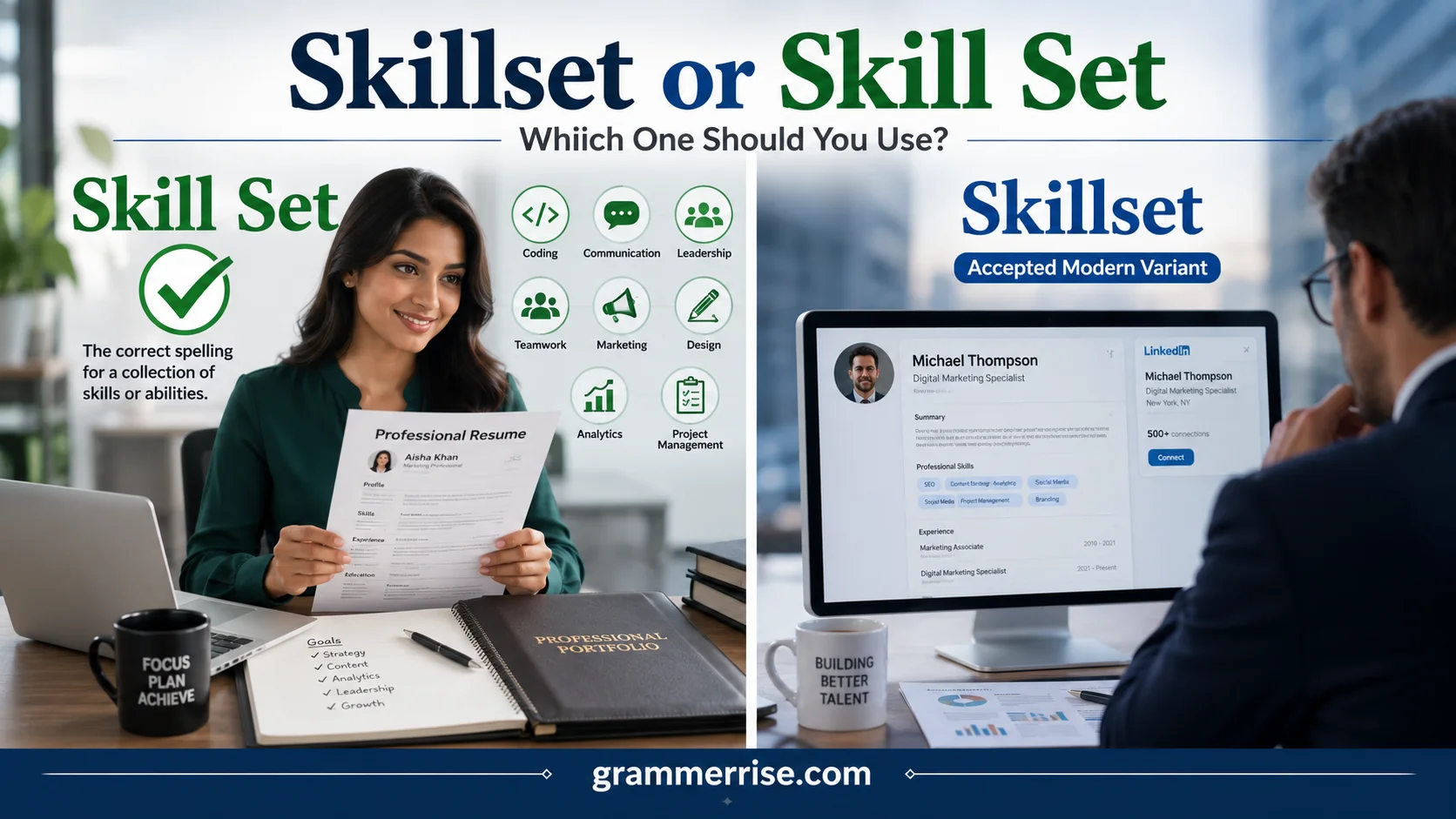
If you’re deciding between skill set and skillset, here’s the simple answer: both are correct, but skill set (two words) is the standard and more widely accepted spelling. You’ll see it in most dictionaries, style guides, resumes, academic writing, and professional documents.
Skillset (one word) has become increasingly common in modern business English, especially on LinkedIn, job postings, HR platforms, and company websites. It carries the same meaning, but it’s considered a newer spelling variant.
Skillset or Skill Set: Which One Is Correct?
The answer depends on the context, but one version remains the safer choice.
Skill set is the standard spelling and is preferred in formal writing, resumes, academic documents, business communication, and most dictionaries.
Skillset is an accepted modern variant that appears frequently in recruitment software, company websites, online job listings, and HR content.
Both refer to exactly the same idea—a collection of skills that someone possesses.
The difference lies in spelling rather than meaning.
| Term | Correct | Best Used In |
| Skill set | ✅ Standard | Resumes, business writing, academic papers, professional communication |
| Skillset | ✅ Accepted variant | Job advertisements, HR platforms, marketing content, LinkedIn profiles |
If you’re unsure which version to choose, use skill set. It remains the safest option because it aligns with traditional English usage and professional writing standards.
For example:
- She has an impressive skill set in digital marketing.
- Employers value a diverse skill set.
- Building the right skill set takes time and practice.
Modern examples using the one-word form include:
- The company is looking for a candidate with a strong skillset.
- Her leadership skillset helped the organization grow.
- This certification expands your technical skillset.
Although both versions communicate the same meaning, consistency matters. If you choose one spelling, use it throughout the entire document.
What Does Skill Set Mean?
A skill set is the combination of abilities, knowledge, experience, and competencies that enable someone to perform specific tasks effectively.
Instead of referring to a single ability, the term describes a complete collection of related skills.
For example, a graphic designer’s skill set may include:
- Adobe Photoshop
- Adobe Illustrator
- Typography
- Branding
- Color theory
- User interface design
- Creativity
- Communication
Together, these abilities form the person’s overall skill set.
Likewise, a software developer’s skill set extends beyond programming languages.
It often includes:
- Python
- JavaScript
- SQL
- Problem-solving
- Version control
- Database management
- Team collaboration
- Debugging
- System design
Employers evaluate candidates based on their complete skill set rather than one isolated skill because successful employees usually combine technical expertise with interpersonal abilities.
What Is Included in a Skill Set?
A strong skill set generally combines several categories of abilities.
Technical Skills
Technical skills involve specialized knowledge learned through education, training, or practical experience.
Examples include:
- Programming
- Data analysis
- Graphic design
- Accounting
- Video editing
- Machine operation
- Cybersecurity
- Web development
These skills are measurable and often appear on resumes.
Soft Skills
Soft skills describe how you interact with people and manage your work.
Common examples include:
- Communication
- Leadership
- Teamwork
- Adaptability
- Critical thinking
- Time management
- Emotional intelligence
- Conflict resolution
Employers consistently rank these among the most valuable workplace skills because they influence collaboration and productivity.
Transferable Skills
Transferable skills remain useful across many industries.
Examples include:
- Project management
- Public speaking
- Research
- Customer service
- Organization
- Writing
- Negotiation
- Problem-solving
Someone changing careers can often rely on transferable skills to qualify for new roles.
Industry-Specific Skills
Some abilities apply only to particular professions.
Examples include:
| Industry | Examples of Skills |
| Healthcare | Patient care, medical coding, diagnosis support |
| Finance | Financial analysis, budgeting, forecasting |
| Marketing | PPC advertising, content strategy |
| Engineering | CAD software, structural analysis, prototyping |
| Education | Lesson planning, curriculum development, assessment |
Every profession develops its own unique skill set over time.
Is “Skillset” One Word?
This question appears frequently because modern business writing has changed significantly over the past decade.
Historically, English treated skill set as two separate words.
Many respected dictionaries still present it that way.
However, language naturally evolves.
Over time, frequently paired words often merge into single compound words.
Examples include:
| Older Form | Modern Form |
| Web site | Website |
| Data base | Database |
| Online shopping | Online-shopping (early usage) → online shopping |
| Healthcare | Health care (older style) |
| E-mail (older style) |
The same trend explains the rise of skillset.
As recruiters, HR professionals, and technology companies repeatedly used the phrase, many writers began treating it as a single compound noun.
Today, you’ll find skillset on:
- Corporate career pages
- Recruitment software
- Applicant tracking systems
- HR blogs
- LinkedIn profiles
- Technology company websites
- Professional networking articles
Despite this growing popularity, skill set remains the preferred form in most professional writing standards.
If you’re writing for school, preparing an official report, or submitting a resume, skill set remains the strongest choice.
Skill Set vs. Skillset: What’s the Difference?
Surprisingly, there is no difference in meaning.
Both forms describe the same concept.
The distinction exists only in spelling and stylistic preference.
| Feature | Skill Set | Skillset |
| Meaning | Collection of skills | Collection of skills |
| Grammar | Open compound noun | Closed compound noun |
| Traditional usage | Yes | No |
| Modern HR usage | Yes | Yes |
| Formal writing | Preferred | Less common |
| Job advertisements | Common | Common |
| Academic writing | Preferred | Rare |
Because there is no difference in definition, your audience should guide your choice.
If you’re writing:
- A resume
- A research paper
- A university assignment
- A formal proposal
- A professional report
Choose skill set.
If you’re creating:
- A LinkedIn headline
- Marketing copy
- HR software content
- A startup website
- A recruitment advertisement
You’ll frequently encounter skillset.
Regardless of your choice, maintain consistency throughout the document.
Switching between skill set and skillset within the same article makes the writing appear inconsistent.
Why “Skill Set” Is More Widely Accepted
Although skillset continues gaining popularity, skill set remains the preferred spelling for several important reasons.
Dictionaries Favor “Skill Set”
Most major English dictionaries list skill set as the primary entry.
This reflects traditional English compound noun conventions, where two closely related words remain separate.
As a result, editors, teachers, and professional writers generally recommend the two-word form.
Professional Writing Standards
Business communication values consistency and clarity.
Using the established spelling helps avoid unnecessary questions from employers, recruiters, and clients.
A resume with polished language creates a stronger first impression than one containing inconsistent terminology.
Academic Preference
Universities and educational institutions generally encourage students to use standard dictionary spellings.
Since skill set remains the recognized form in many reference works, it fits naturally in essays, reports, and academic publications.
Resume Best Practices
Recruiters review hundreds of resumes every week.
Although most understand both spellings, skill set continues to appear more frequently in professional resume writing guides.
Using the traditional spelling demonstrates careful editing and attention to detail.
Origin and History of Skill Set
The phrase skill set emerged during the twentieth century as businesses sought better ways to describe a person’s overall capabilities rather than individual talents.
Before that, employers usually referred to a person’s qualifications, abilities, or experience.
As workplaces became more specialized, organizations needed a broader term that described multiple competencies working together.
The expression skill set gained widespread recognition through human resources, recruitment, education, and workforce development. During the rise of digital hiring platforms in the late 1990s and early 2000s, recruiters increasingly used the phrase to match candidates with specific job requirements.
In recent years, the closed compound skillset has appeared more often in online job boards, applicant tracking systems, company career pages, and technology-focused industries. This shift reflects a broader pattern in English where commonly paired words gradually evolve into single-word compounds.
Even with this modern trend, skill set remains the more widely accepted spelling in formal and professional writing. Understanding that history helps explain why both forms exist today while also showing why the two-word version continues to be the preferred choice in many contexts.
How to Use Skill Set Correctly
Using skill set correctly isn’t difficult once you understand its role in a sentence. In almost every case, it functions as a compound noun that describes a person’s complete collection of abilities rather than a single skill.
Think of it this way. Knowing how to use Microsoft Excel is a skill. Knowing Excel, data analysis, budgeting, communication, and project management together forms a skill set.
Here are some correct examples:
- She has an impressive skill set in digital marketing.
- His technical skill set helped him secure the position.
- Employers look for candidates with a diverse skill set.
- This certification strengthens your professional skill set.
- Developing a strong skill set takes continuous learning.
Notice that skill set almost always follows an adjective describing its quality.
For example:
- Strong skill set
- Broad skill set
- Technical skill set
- Professional skill set
- Leadership skill set
- Specialized skill set
- Diverse skill set
- Relevant skill set
These combinations sound natural because native English speakers use them regularly.
Singular and Plural Forms
The singular form refers to one collection of skills.
Examples:
- Her skill set includes leadership and communication.
- This role requires a technical skill set.
The plural form refers to multiple collections of skills belonging to different people or professions.
Examples:
- Different jobs require different skill sets.
- Modern organizations value diverse skill sets.
- Employees bring unique skill sets to every project.
The plural simply adds s to set.
Read more: Roll Call or Role Call: Meaning and Common Mistakes
Skill Set as Different Parts of Speech
Although skill set appears in many kinds of writing, its grammatical role remains straightforward.
Skill Set as a Compound Noun
In nearly every sentence, skill set functions as a compound noun.
A compound noun combines two words that work together to create one idea.
Examples include:
- Coffee shop
- High school
- Living room
- Business plan
- Skill set
Each expression represents one complete concept rather than two unrelated words.
Examples:
- Her skill set matches the job description.
- Building a valuable skill set requires practice.
- Every employee contributes a unique skill set.
Skillset as a Closed Compound Noun
When written as one word, skillset functions exactly the same way.
Examples:
- His skillset includes cloud computing and cybersecurity.
- The internship expanded her professional skillset.
- Companies value candidates with a diverse skillset.
The grammar doesn’t change. Only the spelling does.
Examples of Skill Set in Everyday English
Understanding grammar is helpful, but seeing real-world examples makes the concept easier to remember.
Student Examples
Students develop new skill sets throughout their education.
Examples:
- College helped her build a strong research skill set.
- His science projects improved his analytical skill set.
- Every semester adds new abilities to your academic skill set.
- Internships strengthen a student’s professional skill set.
- Learning another language expands your communication skill set.
Resume Examples
Recruiters often search resumes for complete skill sets rather than individual skills.
Examples:
- My skill set includes project management, budgeting, and leadership.
- This position matches my technical skill set.
- My customer service skill set has grown through five years of experience.
- I continuously improve my professional skill set through certifications.
- My skill set aligns with the company’s requirements.
Workplace Examples
Employees use the phrase regularly during meetings and performance reviews.
Examples:
- Your leadership skill set has improved significantly.
- The team combines several complementary skill sets.
- We need someone with a broader technical skill set.
- His communication skill set makes him an effective manager.
- Every department contributes a unique skill set.
Business Examples
Organizations often discuss workforce development using this phrase.
Examples:
- The company invested in employee training to strengthen everyone’s skill set.
- Our consultants possess an international business skill set.
- The project required a multidisciplinary skill set.
- Strong problem-solving remains part of our core skill set.
- The organization values adaptable skill sets.
Interview Examples
Hiring managers frequently ask questions related to skill sets.
Examples:
- Tell us about your strongest skill set.
- Which technical skill set makes you the best candidate?
- How has your leadership skill set evolved?
- Which skill set would you like to improve next?
- How does your current skill set support this role?
Common Collocations With Skill Set
Certain word combinations appear naturally with skill set because native speakers use them frequently.
Learning these collocations makes your writing smoother and more professional.
| Collocation | Example |
| Strong skill set | She has a strong skill set in finance. |
| Broad skill set | Employers appreciate a broad skill set. |
| Technical skill set | The role requires a technical skill set. |
| Professional skill set | Training expands your professional skill set. |
| Leadership skill set | Managers need a solid leadership skill set. |
| Unique skill set | Every employee brings a unique skill set. |
| Specialized skill set | The company seeks candidates with a specialized skill set. |
| Core skill set | Communication remains part of every manager’s core skill set. |
| Relevant skill set | Your relevant skill set matches the position. |
| Transferable skill set | Customer service develops a transferable skill set. |
| Essential skill set | Problem-solving is an essential skill set for engineers. |
| Valuable skill set | Coding is a valuable skill set in today’s job market. |
| Expand your skill set | Online courses help expand your skill set. |
| Develop a skill set | Practice helps develop a strong skill set. |
These expressions frequently appear in:
- Job descriptions
- Performance evaluations
- Resume summaries
- LinkedIn profiles
- Career advice articles
- Professional development guides
Using these natural combinations helps your writing sound more fluent and polished.
Skill Set vs. Skills
Many people confuse skills with skill set, but they describe different concepts.
A skill is one specific ability.
A skill set is the complete collection of related skills someone possesses.
| Skill | Skill Set |
| One ability | Multiple abilities working together |
| Individual competency | Complete professional profile |
| Narrow focus | Broader capability |
| Example: Excel | Example: Excel, budgeting, analysis, communication |
Consider this example.
A project manager may have these individual skills:
- Scheduling
- Leadership
- Budgeting
- Communication
- Risk management
- Conflict resolution
Together, these abilities form the project manager’s skill set.
Here’s another example.
A web developer may possess:
- HTML
- CSS
- JavaScript
- React
- Git
- Responsive design
Each item is a separate skill.
Collectively, they make up the developer’s technical skill set.
Skill Set vs. Competency
Although people often use skill set and competency interchangeably, they don’t mean exactly the same thing. Understanding the difference helps you communicate more precisely in professional settings.
A skill set refers to the collection of skills a person possesses.
A competency goes one step further. It combines skills, knowledge, experience, behaviors, and judgment to perform a task successfully.
Think of it this way.
A software developer may know several programming languages. Those languages are part of the developer’s skill set.
However, delivering a secure application on time while collaborating with a team demonstrates competency.
The difference becomes clearer in the comparison below.
| Skill Set | Competency |
| Collection of abilities | Ability to perform successfully |
| Focuses on skills | Includes skills, knowledge, behavior, and experience |
| Easy to list on a resume | Usually demonstrated through performance |
| Can be learned through training | Develops through practice and application |
| Describes what you know | Describes what you can accomplish |
Examples
Skill Set
- Programming
- Graphic design
- Data analysis
- Public speaking
Competency
- Leading cross-functional teams
- Managing complex projects
- Solving customer problems efficiently
- Making strategic business decisions
Most employers evaluate both. They want candidates with a strong skill set who can also demonstrate real-world competency.
Skill Set vs. Expertise
Another term closely related to skill set is expertise.
Although both describe professional ability, they represent different stages of experience.
A skill set includes every ability a person has, regardless of proficiency.
Expertise refers to advanced knowledge gained through years of study, practice, and experience.
For example, someone may have a digital marketing skill set that includes:
- Email marketing
- Social media
- Google Ads
- Content writing
After years of successful campaigns and measurable results, that person develops expertise in digital marketing.
The comparison below highlights the distinction.
| Skill Set | Expertise |
| Collection of skills | High-level mastery |
| Can belong to beginners | Usually belongs to experienced professionals |
| Broad | Deep |
| Often learned through education | Developed through extensive practice |
| Continues to grow | Reflects advanced proficiency |
Which Term Should You Use?
Use skill set when discussing the abilities someone possesses.
Use expertise when emphasizing exceptional knowledge or mastery.
Examples:
- She has a strong technical skill set.
- He has extensive expertise in cybersecurity.
- The position requires a broad skill set.
- Her expertise helped solve a difficult engineering problem.
Choosing the correct word improves both clarity and professionalism.
Synonyms of Skill Set
English offers several alternatives to skill set, although each emphasizes a slightly different aspect of a person’s abilities.
The best synonym depends on your audience and purpose.
| Synonym | Best Used For | Example |
| Competencies | Professional evaluations | Leadership competencies are essential for managers. |
| Capabilities | Business communication | The company expanded its technical capabilities. |
| Qualifications | Hiring and recruitment | She has the qualifications for the position. |
| Abilities | Everyday English | His abilities impressed the interview panel. |
| Expertise | Advanced knowledge | Her expertise lies in artificial intelligence. |
| Proficiencies | Technical documents | Language proficiencies strengthen a resume. |
| Strengths | Performance reviews | Communication remains one of her greatest strengths. |
| Talents | General conversation | His creative talents earned industry recognition. |
Choosing the Right Synonym
Each alternative has its own purpose.
✅ Competencies are used when discussing measurable workplace performance.
✅ Qualifications refer to education, certifications, and experience.
✅ When highlighting what someone does particularly well, focus on their strengths.
✅ Expertise describes mastery in a specialized field.ghlighting what someone does particularly well.
While these words are similar, skill set remains the broadest and most flexible choice because it describes an individual’s complete collection of professional abilities.
Related Terms
Several workplace terms closely relate to skill set. Understan
.ding how they differ helps you build stronger resumes and communicate more effectively.
Hard Skills
Hard skills are teachable and measurable abilities.
Examples include:
- Coding
- Accounting
- Video editing
- Data analysis
- Graphic design
- Foreign languages
These skills often require formal training or hands-on experience.
Soft Skills
Soft skills describe how you interact with people and handle workplace situations.
Examples include:
- Communication
- Leadership
- Adaptability
- Teamwork
- Time management
- Emotional intelligence
- Creativity
Many hiring managers consider soft skills just as valuable as technical knowledge.
Transferable Skills
Transferable skills remain useful across multiple careers and industries.
Examples include:
- Problem-solving
- Organization
- Customer service
- Writing
- Research
- Public speaking
- Negotiation
These skills make career transitions much easier.
Core Competencies
Core competencies represent the primary abilities required for a particular profession or organization.
Examples include:
- Strategic planning
- Risk management
- Financial analysis
- Customer relationship management
Companies often define these competencies in job descriptions.
Qualifications
Qualifications include education, certifications, licenses, experience, and technical skills.
Examples:
- Bachelor’s degree
- CPA license
- AWS certification
- Five years of management experience
Qualifications often determine whether someone meets the minimum requirements for a role.
Experience
Experience refers to practical knowledge gained through performing real work.
For example:
- Managing a sales team
- Building software applications
- Teaching mathematics
- Conducting medical research
Experience strengthens a person’s overall skill set because it transforms knowledge into practical ability.
Knowledge
Knowledge refers to what someone understands through education or learning.
Examples include:
- Business law
- Economics
- Human anatomy
- Marketing principles
Knowledge supports skills, but it doesn’t replace practical application.
Aptitudes
An aptitude is a natural ability to learn or perform certain tasks.
Examples include:
- Musical aptitude
- Mechanical aptitude
- Mathematical aptitude
- Artistic aptitude
People often develop these natural talents into professional skills through education and practice.
Common Mistakes to Avoid
Even experienced professionals occasionally misuse skill set or skillset. Avoiding these common mistakes will make your writing more polished and credible.
Using Both Spellings in the Same Document
One of the most common mistakes is switching between skill set and skillset.
For example:
❌ She has an excellent skill set. Her technical skillset includes programming and networking.
Choose one spelling and use it consistently.
Writing “Skillset” in Formal Academic Papers
Although skillset has become common online, many universities and professional editors still prefer skill set.
For essays, research papers, formal reports, and resumes, the two-word version remains the safest choice.
Confusing Skills With Skill Set
Remember the difference.
A skill is one ability.
A skill set is the complete collection of abilities.
Correct example:
- My skill set includes communication, leadership, and budgeting.
Incorrect example:
- My skill includes communication, leadership, and budgeting.
Overloading a Resume With Generic Skills
Many applicants list vague terms such as:
- Hardworking
- Motivated
- Dedicated
- Team player
Instead, describe specific, measurable skills.
For example:
- Project management
- SQL
- Adobe Photoshop
- Financial modeling
Specific skills make your overall skill set far more convincing.
Case Study: How a Strong Skill Set Helped a Candidate Land a Better Job
Emily worked as a customer service representative for three years. When she decided to apply for a project coordinator position, she realized her resume focused only on her previous job title rather than the complete skill set she had developed.
Instead of listing generic responsibilities, she highlighted skills such as customer communication, conflict resolution, scheduling, data entry, Microsoft Excel, CRM software, and team collaboration. She also completed an online project management certification to strengthen her qualifications.
During interviews, Emily explained how these abilities worked together rather than discussing each skill separately. Hiring managers saw that her skill set aligned with the new role, even though she had never held the exact job title before.
Within a few weeks, she received multiple interview invitations and accepted a position with a higher salary and greater career growth.
This example illustrates an important lesson. Employers rarely hire based on one isolated skill. They look for a well-rounded skill set that demonstrates both technical knowledge and the ability to apply it effectively in real-world situations.
FAQs
1. Is it correct to write skillset or skill set?
The most widely accepted spelling in formal English is skill set (two words). It is a noun phrase that describes a person’s collection of abilities, knowledge, and expertise. While skillset is becoming more common in business, HR, and marketing content, many professional style guides still prefer the traditional two-word form.
2. What does skill set mean?
A skill set refers to the combination of abilities, experience, knowledge, and competencies that someone has developed. It can include technical skills, communication abilities, problem-solving skills, leadership qualities, and other strengths needed for personal or professional growth.
3. Is skillset one word or two words?
The standard form is skill set as two words. However, skillset appears frequently in modern workplace communication, especially in HR materials and online content. It is considered an evolving compound word, but formal writing usually favors skill set.
4. Why do people confuse skillset and skill set?
People often get confused because English compound words change over time. Some terms begin as two separate words, later become hyphenated, and eventually develop into single words. The different usage of skill set, skill-set, and skillset reflects this natural language evolution.
5. Should I use skill set in a resume?
Yes, using skill set in a resume is generally recommended because it looks professional and follows traditional grammar conventions. For example, you can write “strong communication skill set” or “technical skill set” when describing your abilities to employers.
6. Can skillset and skill set have different meanings?
No, both forms usually express the same meaning. They describe a group of skills that a person possesses. The main difference is not meaning but spelling preference, style choice, and the level of formality required for the writing context.
Conclusion
Understanding the difference between skillset or skill set helps you make better choices in professional and formal writing. While both forms are commonly seen in online content, resumes, and workplace communication, skill set remains the safest and most widely accepted option in standard English. It clearly describes a person’s collection of abilities, experience, and expertise without creating confusion.
Language continues to evolve, and terms like skillset may become more accepted over time, especially in industries such as HR, marketing, and business. However, when writing job applications, academic papers, or professional documents, choosing the traditional form shows attention to detail and strong communication skills. By understanding the usage, context, and style preferences behind these terms, you can confidently select the right spelling for every situation.