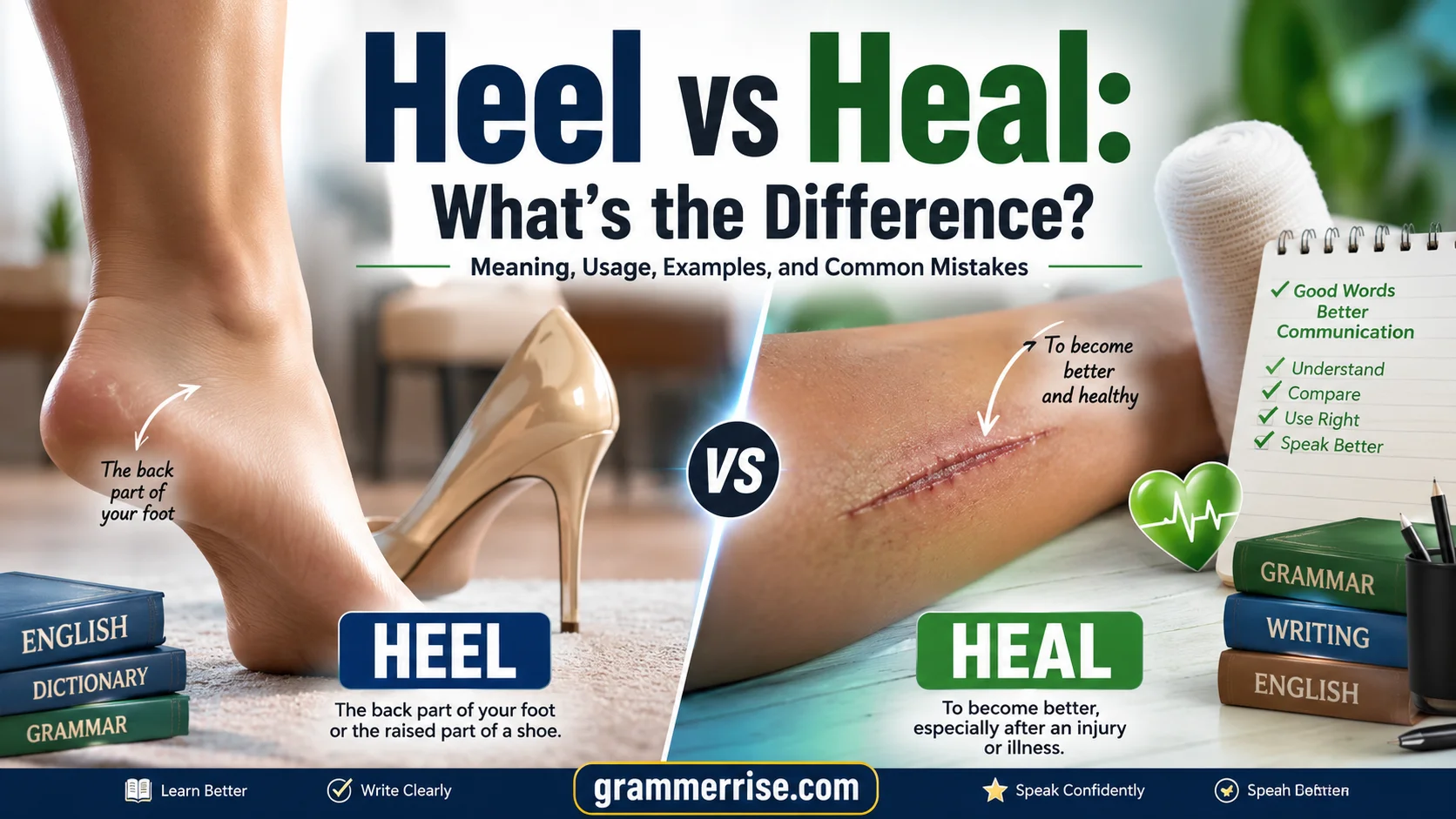
Heel vs Heal differences in English show how similar words sound alike but have different meanings, needing clear spelling, pronunciation, and usage. English often contains pairs of words that can confuse almost everyone because they appear similar. Heal and heel are a perfect example of homophones that are pronounced alike but spelled differently. Their only similarity is their sound, while their word meaning changes completely.
In everyday English, learners may pause while exploring these commonly confused words because heal means getting better and recovering, while heel refers to the back part of the foot or the bottom of a shoe. Understanding their definitions, examples, and different meanings improves language learning, communication, writing, and speaking with clarity.
Knowing these different concepts helps you use confidently the right word in every sentence. Heal is an action that restores health, fixes injuries, and supports overcoming wounds, troubles, and emotional struggles through recovery, health, emotional improvement, and physical improvement. Heel can indicate the rear part of the foot, a shoe area, or a change in stance and may also appear metaphorically in various contexts. This guide helps writers, students, and professionals avoid incorrect usage, misuse, wrong interpretation, and major misspellings in academic writing, professional writing, and published work.
Quick Answer
Heel refers to the back part of your foot, a shoe part, or a dog-training command.
Heal means to recover, repair, or become healthy again.
Example:
- My heel hurts after walking all day.
- My injury will heal soon.
Remember: Heel = Foot. Heal = Recovery.
Heel vs Heal at a Glance
Before diving deeper, here’s a quick overview.
| Word | Part of Speech | Meaning | Example |
| Heel | Noun, Verb | Back part of the foot, part of a shoe, or to follow closely | My heel hurts after running. |
| Heal | Verb | To recover, repair, or become healthy | The wound will heal in a few days. |
Quick Rule
- Heel = Foot or Shoe
- Heal = Recovery or Health
If you’re talking about a body part, footwear, or a dog-training command, use heel.
If you’re talking about recovery, repair, health, or emotional restoration, use heal.
What Does Heel Mean?
The word heel most commonly refers to the back part of the human foot. However, English uses the word in several different ways.
Heel as Part of the Foot
Anatomically, the heel is the rounded structure at the back of the foot. It contains the calcaneus bone, which is the largest bone in the foot.
Examples:
- My heel started hurting after the marathon.
- She developed a blister on her heel.
- The doctor examined the patient’s heel.
Athletes often experience heel pain because the heel absorbs a large amount of impact during walking, running, and jumping.
Heel as Part of a Shoe
In footwear, the heel is the raised back section of a shoe.
Examples:
- Her shoe heel snapped during the wedding.
- High heels remain popular in fashion.
- The heel of my boot wore down over time.
Different types of shoe heels include:
| Heel Type | Description |
| Stiletto Heel | Thin, high heel |
| Block Heel | Wide, sturdy heel |
| Kitten Heel | Short decorative heel |
| Wedge Heel | Solid heel extending under the foot |
| Cuban Heel | Moderately high heel with straight back |
Heel in Dog Training
Dog owners hear this term frequently.
The command heel tells a dog to walk closely beside its handler, usually on the left side.
Examples:
- The trainer taught the puppy to heel.
- The dog learned to heel without a leash.
- Competitive obedience events often require dogs to heel precisely.
Heel as a Verb
Less commonly, heel can function as a verb.
Examples:
- The hunting dogs heeled their master through the forest.
- The assistant heeled closely behind the manager.
This usage appears more often in older writing and literature.
What Does Heal Mean?
The word heal means to restore health, repair damage, or recover from injury, illness, trauma, or emotional pain.
Unlike heel, heal almost always functions as a verb.
Physical Healing
Physical healing occurs when the body repairs itself after injury.
Examples:
- The cut healed completely.
- Broken bones eventually heal.
- The skin will heal naturally over time.
The human body possesses remarkable healing abilities. Small cuts often heal within days, while fractures may require several weeks or months.
Emotional Healing
Healing isn’t always physical.
People also heal emotionally after difficult experiences.
Examples:
- It took years to heal after the loss.
- Therapy helped him heal emotionally.
- Support from friends can help people heal.
Emotional healing involves processing experiences, developing resilience, and gradually regaining emotional balance.
Healing Relationships
Relationships can heal too.
Examples:
- Honest communication helped heal the conflict.
- Time helped heal old disagreements.
- The family worked together to heal past wounds.
Community Healing
Communities often heal after disasters, conflicts, or crises.
Examples:
- The town worked together to heal after the flood.
- Community programs helped heal divisions.
- Volunteers played a role in helping the neighborhood heal.
Heel vs Heal: Side-by-Side Comparison
Understanding the distinction becomes easier when you compare the two directly.
| Feature | Heel | Heal |
| Meaning | Foot, shoe part, dog command | Recover, repair, restore |
| Part of Speech | Noun, Verb | Verb |
| Associated With | Movement, footwear | Recovery, health |
| Common Context | Feet, shoes, pets | Injuries, emotions |
| Example | My heel hurts. | My wound will heal. |
Simple Example
Correct: My heel hurts after hiking.
Correct: My blister will heal soon.
Notice how the first sentence refers to a body part while the second refers to recovery.
Why Do People Confuse Heel and Heal?
This confusion isn’t surprising.
They Are Perfect Homophones
Both words share the same pronunciation:
/hiːl/
Since they sound identical, listeners rely entirely on context to understand which word is intended.
Their Spellings Are Similar
Only one letter differs:
- Heel
- Heal
When typing quickly, many people accidentally choose the wrong spelling.
Autocorrect Doesn’t Always Help
Spell-check tools often miss the mistake because both words are legitimate English words.
For example:
❌ My injury will heel soon.
The sentence is grammatically correct even though the word choice is wrong. Spell-check may not flag it.
Context Determines Meaning
Context is your best clue.
If the sentence discusses:
- Feet
- Shoes
- Walking
- Dog training
Use heel.
If the sentence discusses:
- Recovery
- Health
- Repair
- Emotional growth
Use heal.
Read more: Occasion or Ocassion: Which Spelling Is Correct and Meaning?
Heel vs Heal Pronunciation
One reason these words cause confusion is that pronunciation offers no help.
| Word | IPA Pronunciation |
| Heel | /hiːl/ |
| Heal | /hiːl/ |
Both words sound exactly like the word “heel.”
Why English Has So Many Homophones
English developed from multiple language influences including:
- Germanic languages
- Latin
- French
- Norse languages
Over centuries, pronunciation changed while spellings remained different. This created many homophone pairs such as:
- Hear and Here
- Sale and Sail
- Peace and Piece
- Heel and Heal
Easy Memory Tricks for Heel vs Heal
Memory tricks can make the difference stick permanently.
Connect Heal With Health
Notice the beginning of both words:
- Heal
- Health
- Healthy
- Healing
They all share the same root.
If the topic relates to health, use heal.
Connect Heel With Footwear
Think of a shoe.
Shoes have heels.
Feet have heels.
Simple.
The Fastest Trick
Remember this sentence:
Your heel can hurt, but it can also heal.
The first word refers to a body part.
The second refers to recovery.
Common Heel Examples in Everyday English
Here are practical examples.
Foot Examples
- My heel hurts after standing all day.
- A sharp rock cut my heel.
- She rubbed lotion on her cracked heel.
- The athlete injured his heel.
- The doctor checked the swollen heel.
Footwear Examples
- The heel of her shoe broke.
- These boots have a thick heel.
- The heel wore down after years of use.
- The shoe heel needs repair.
- High heels changed fashion forever.
Dog Training Examples
- The dog learned to heel quickly.
- The puppy refused to heel.
- Professional trainers teach dogs to heel.
- The police dog heeled perfectly.
- He practiced the heel command daily.
Common Heal Examples in Everyday English
Medical Examples
- The cut will heal naturally.
- Most bruises heal within weeks.
- The wound healed without complications.
- Bones heal slowly.
- Proper rest helps injuries heal.
Emotional Examples
- Time helped heal the pain.
- She continued to heal emotionally.
- Counseling helped him heal.
- People heal at different speeds.
- Healing often requires patience.
Relationship Examples
- Trust helped heal the friendship.
- Honest conversations heal misunderstandings.
- Families can heal after conflicts.
- Forgiveness may help heal old wounds.
- Mutual respect helps relationships heal.
Heel vs Heal in Popular Expressions
English contains many famous expressions using these words.
Expressions With Heel
Achilles’ Heel
Meaning: A weakness in an otherwise strong person or system.
Example:
- Cybersecurity became the company’s Achilles’ heel.
Head Over Heels
Meaning: Deeply in love.
Example:
- He fell head over heels for her.
Dig In Your Heels
Meaning: Refuse to change your position.
Example:
- She dug in her heels during negotiations.
Cool Your Heels
Meaning: Wait patiently.
Example:
- We cooled our heels in the lobby.
At Someone’s Heels
Meaning: Following closely.
Example:
- Reporters stayed at the politician’s heels.
Expressions With Heal
Time Heals All Wounds
Meaning: Emotional pain often becomes easier with time.
Heal Old Wounds
Meaning: Resolve long-standing emotional pain.
Healing Process
Meaning: The journey toward recovery.
Healing Journey
Meaning: Personal growth and recovery after hardship.
Real-World Case Study: The Cost of a Small Spelling Error
Imagine a medical clinic publishing this sentence on its website:
“Our treatment helps injuries heel faster.”
Patients may question the clinic’s professionalism because the wrong word appears in an important health-related statement.
Now compare:
“Our treatment helps injuries heal faster.”
The message instantly becomes clear and credible.
This example highlights why choosing the correct word matters in professional communication.
Frequently Confused Sentences
The following table shows common mistakes.
| Incorrect | Correct | Why |
| My injury will heel soon. | My injury will heal soon. | Recovery requires heal. |
| My shoe heal broke. | My shoe heel broke. | Shoes have heels. |
| The doctor helped heel the wound. | The doctor helped heal the wound. | Doctors help wounds heal. |
| My heel hurts today. | Correct | Refers to the foot. |
| The puppy learned to heal. | The puppy learned to heel. | Dog command uses heel. |
Heel vs Heal in Professional Writing
Medical Writing
Healthcare professionals use heal constantly.
Examples:
- Healing wounds
- Healing tissues
- Healing fractures
- Healing processes
Using heel instead of heal can undermine credibility.
Sports and Fitness Writing
Sports articles often use both words.
Example:
- The runner injured her heel.
- Doctors expect the injury to heal fully.
This makes sports writing one of the most common places where confusion occurs.
Veterinary and Dog Training Content
Dog training guides frequently use heel.
Examples:
- Teach your dog to heel.
- Reward proper heel positioning.
- Practice the heel command daily.
Business Communication
Professional writers should always proofread homophones carefully.
A single mistake can affect:
- Marketing materials
- Reports
- Websites
- Educational content
Heel vs Heal Quiz
Test your understanding.
Multiple Choice
Which sentence is correct?
- My ankle will heel soon.
- My ankle will heal soon.
Answer: 2
Which word refers to a shoe part?
- Heel
- Heal
Answer: 1
Fill in the Blank
- The dog learned to ______.
- The wound will ______ soon.
- Her shoe ______ broke.
- Time can ______ emotional pain.
Answers:
- heel
- heal
- heel
- heal
Other Commonly Confused Homophones
Hear vs Here
| Word | Meaning |
| Hear | To listen |
| Here | This place |
Brake vs Break
| Word | Meaning |
| Brake | Stop a vehicle |
| Break | Separate into pieces |
Sale vs Sail
| Word | Meaning |
| Sale | Discount or transaction |
| Sail | Travel by boat |
Hole vs Whole
| Word | Meaning |
| Hole | Opening |
| Whole | Complete |
Allowed vs Aloud
| Word | Meaning |
| Allowed | Permitted |
| Aloud | Spoken out loud |
Expert Tips for Never Mixing Up Heel and Heal Again
Visualize the Meaning
When you see the word:
- Imagine a foot for heel
- Imagine recovery for heal
Check the Context
Ask yourself:
- Is this about feet, shoes, or dogs?
- Is this about recovery or health?
The answer usually becomes obvious.
Proofread Slowly
Many spelling mistakes happen because writers read what they intended to write rather than what actually appears on the page.
Slow down during proofreading.
Use Reading Aloud Techniques
Read sentences aloud and focus on meaning.
Since pronunciation won’t help, context becomes easier to notice.
FAQs
1. What is the main difference between heel and heal?
The main difference is their meaning and usage. Heel usually refers to the back part of your foot or the bottom part of a shoe. Heal is a verb that means to recover, repair, or become healthy after an injury, illness, or emotional pain.
2. Are heel and heal pronounced the same?
Yes, heel and heal are homophones, which means they have the same pronunciation but different spellings and meanings. Their similar sound is what makes many English learners confuse them.
3. How can I remember when to use heel or heal?
A simple trick is to connect heal with health because both words relate to recovery and getting better. Remember heel with your feet or shoes, as the heel is a physical body part or shoe section.
4. Can heal be used for emotional problems?
Yes, heal can describe emotional recovery as well as physical recovery. For example, someone may heal from sadness, stress, loss, or painful experiences over time.
5. Why do people often confuse heel and heal?
People confuse these words because they sound exactly the same but have different meanings. Since pronunciation does not help separate them, writers must focus on spelling and context to choose the correct word.
6. Is using heel instead of heal considered a spelling mistake?
Yes, using heel when you mean heal, or using heal when referring to a foot or shoe part, is an incorrect usage. These mistakes can change the meaning of a sentence and create confusion for readers.
Conclusion
Understanding the difference between heel vs heal becomes much easier once you connect each word with its meaning. Heel relates to the back part of the foot, a shoe, or certain expressions, while heal focuses on recovery, restoration, and becoming healthy again. Although they sound the same, their spelling and purpose are completely different.
By paying attention to context, sentence structure, and word usage, you can avoid common mistakes and communicate more clearly. Whether you are writing an email, completing academic work, or improving your everyday English, knowing when to use heel and heal will make your writing more accurate and confident.

Hussain Abid is an English language writer with over 10 years of experience in grammar, spelling, vocabulary, and writing. He specializes in creating clear, well-researched content that helps readers improve their English with confidence. At GrammarRise, Hussain writes practical guides, grammar explanations, and word comparison articles based on trusted language sources and real-world usage. His mission is to make English learning simple, accurate, and accessible for everyone