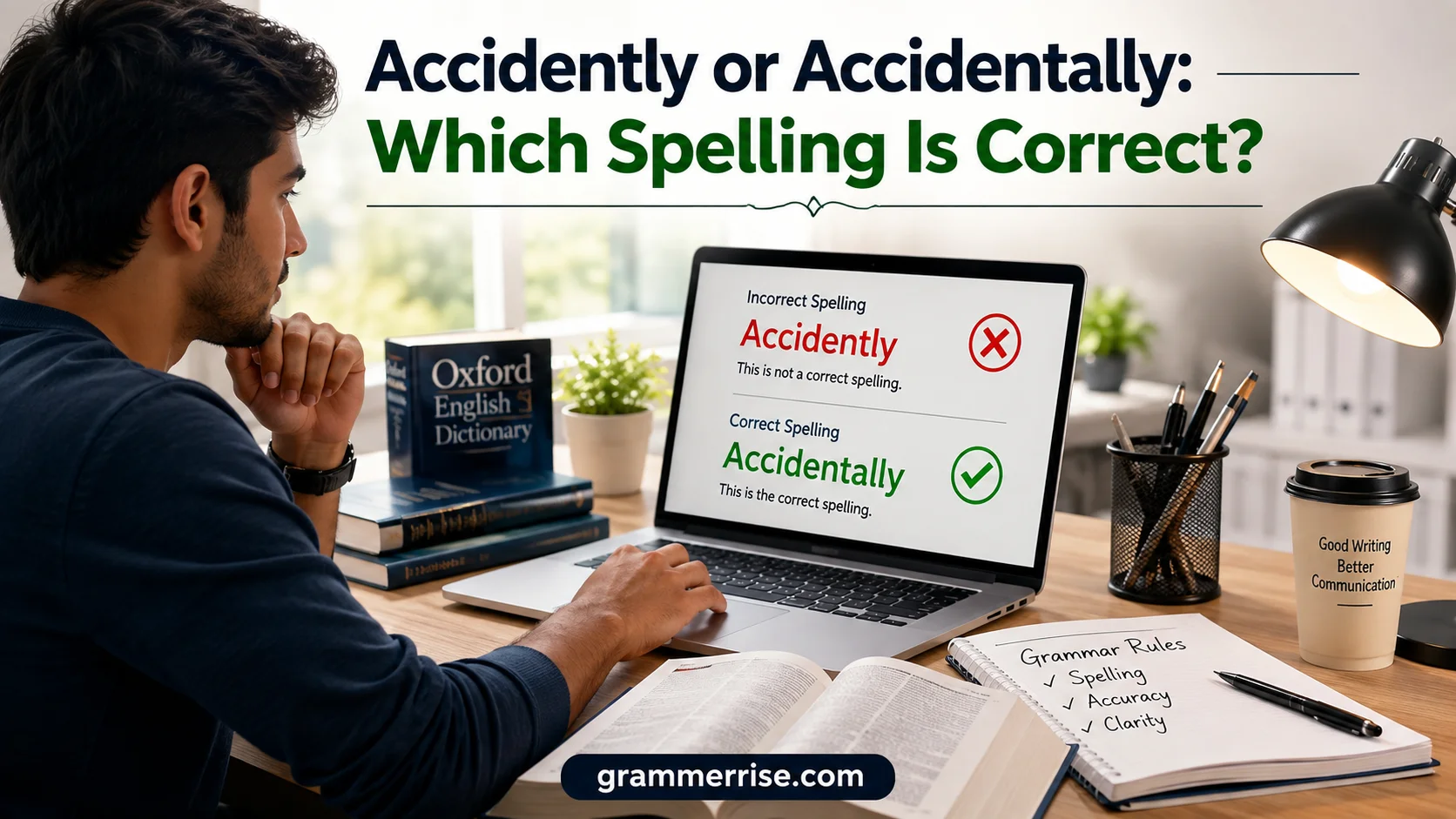
Have you ever wondered about Accidently or Accidentally and which spelling is correct in everyday English writing with clear usage and meaning.
Many people have stared at a screen and wondered how to type the right word because this common spelling problem affects many people who search for the right answer every single day. These similar words look almost the same and sound similar, but the extra a in the middle creates a clear difference. The correct spelling is Accidentally, which is the standard form and correct word in the English language. It means doing something by chance or unintentionally, like when someone spilled coffee on a shirt in the morning. This guide helps clear up the confusion once and for all by showing the difference between the two spellings and explaining why Accidently is an incorrect spelling, misspelling, and wrong form that is not recognized by most dictionaries.
The article breaks down the usage, meaning, dictionary definition, origin, and history of these two adverbs while explaining the proper spelling, proper usage, and correct expression used in formal writing, informal writing, emails, essays, social media posts, online posts, workplace communication, and academic writing. Many English learners and native speakers become confused because English spelling rules are not always simple, and words change form when creating an adverb form.
Quick Answer
The correct spelling is accidentally.
Accidently is a common misspelling and should not be used in formal or professional writing.
| Spelling | Correct or Incorrect | Meaning |
| Accidentally | ✅ Correct | Something happens unintentionally or by mistake |
| Accidently | ❌ Incorrect | A common spelling mistake with no standard meaning |
Correct example:
“I accidentally sent the email to the wrong person.”
Incorrect example:
“I accidently sent the email to the wrong person.”
The difference may seem small, but that extra “al” matters. English word formation often depends on small letter patterns, and removing one part can create an incorrect spelling.
What Does Accidentally Mean?
Accidentally is an adverb that explains how an action happens. It tells the reader that something was not planned, expected, or intentional.
The word comes from the noun accident, which refers to an unexpected event.
For example:
- “The glass broke accidentally.”
This sentence means the person did not plan to break the glass. It happened unintentionally.
Another example:
- “She accidentally called her old number.”
The person did not mean to make that call. It happened because of a mistake.
Simple Meaning of Accidentally
You can understand accidentally as:
- By mistake
- Without intending to
- Unintentionally
- Without planning
- Unexpectedly
Examples in Everyday Life
- You press the wrong button on your computer.
- You send a message to the wrong person.
- You spill water while carrying a glass.
- You forget to save a file before closing an application.
All of these situations can be described using accidentally.
Why Is Accidentally the Correct Spelling?
The reason accidentally is correct comes from how English builds words.
The word develops in three stages:
| Word Part | Result | Function |
| Accident | Accident | Noun meaning an unexpected event |
| Accident + al | Accidental | Adjective describing something caused by chance |
| Accidental + ly | Accidentally | Adverb describing an action |
The complete structure is:
Accident + al + ly = Accidentally
The important part is that the letters “al” remain before “ly.”
Many spelling mistakes happen because people think the word follows a pattern like:
Quick → Quickly
or
Slow → Slowly
However, accidentally comes from accidental, not directly from accident.
The correct transformation is:
Accident → Accidental → Accidentally
Not:
Accident → Accidently
Why Do People Spell Accidently Incorrectly?
The mistake is common because English pronunciation can hide certain sounds.
When people say “accidentally” quickly, the middle syllable may sound weak. The word is often pronounced naturally without emphasizing every letter.
This creates a gap between pronunciation and spelling.
Pronunciation Confusion
People often write words based on how they sound.
For example:
- February is often pronounced without clearly hearing the first “r.”
- Probably is sometimes shortened in speech.
- Accidentally often loses attention on the “al” sound.
However, spelling requires remembering the complete word structure.
Similar Word Patterns
Another reason is that many English adverbs simply add -ly.
Examples:
- Careful → Carefully
- Beautiful → Beautifully
- Quick → Quickly
Because of this pattern, writers may assume:
- Accident → Accidently
But English does not work that way here.
The word already becomes an adjective first:
- Accident → Accidental
- Accidental → Accidentally
Fast Digital Communication
Typing quickly can also create spelling errors.
People often write messages on phones, social media platforms, or chats without checking every word. A small mistake can become a habit if someone repeatedly sees the incorrect version.
Accidently vs Accidentally: The Main Difference
The biggest difference is simple:
Accidentally is correct. Accidently is not.
| Feature | Accidentally | Accidently |
| Standard English spelling | Yes | No |
| Used in professional writing | Yes | No |
| Meaning | By mistake | No accepted meaning |
| Word formation | Accident + al + ly | Incorrect shortening |
Understanding the difference helps you avoid mistakes in:
- School assignments
- Business emails
- Blog posts
- Reports
- Applications
- Professional communication
Sentence Examples Using Accidentally
Seeing the word in real situations makes it easier to remember.
Everyday Examples
- “I accidentally left my keys inside the house.”
- “She accidentally spilled juice on the table.”
- “He accidentally broke the handle while moving the box.”
- “I accidentally wore my shirt backward.”
Workplace Examples
- “The employee accidentally attached the wrong file to the email.”
- “The manager accidentally shared an unfinished report.”
- “She accidentally deleted a draft presentation.”
Technology Examples
Technology creates many accidental actions.
Examples:
- “I accidentally closed the browser before saving my work.”
- “He accidentally removed the photo from his phone.”
- “She accidentally clicked the wrong button.”
Funny Examples
Small accidents can create memorable moments.
- “I accidentally waved back at someone who wasn’t waving at me.”
- “He accidentally wore mismatched socks to an important meeting.”
- “She accidentally called her teacher ‘mom’ during class.”
Accidentally vs Accidental: Understanding the Difference
Many people confuse accidental and accidentally because they come from the same word family.
The difference is their grammatical role.
| Word | Type | Purpose | Example |
| Accident | Noun | Names an event | “The accident caused traffic problems.” |
| Accidental | Adjective | Describes something | “It was an accidental mistake.” |
| Accidentally | Adverb | Describes an action | “He accidentally deleted the file.” |
Compare These Sentences
Accidental:
“The damage was accidental.”
This describes the damage.
Accidentally:
“She accidentally damaged the car.”
This describes how the action happened.
A simple way to remember:
- Accidental describes a thing.
- Accidentally describes an action.
Common Mistakes With Accidentally
Removing the “al”
Incorrect:
“I accidently forgot my password.”
Correct:
“I accidentally forgot my password.”
The missing al creates the spelling error.
Confusing Adjectives and Adverbs
Incorrect:
“He accidental pressed the button.”
Correct:
“He accidentally pressed the button.”
Because “pressed” is an action, you need the adverb form.
Using Accidentally When Something Was Planned
Accidentally should only describe unintentional actions.
Incorrect:
“I accidentally planned the event.”
Planning is intentional, so accidentally does not fit.
Better:
“I accidentally deleted the event details.”
Read more: Supercede or Supersede: The Complete Guide to Examples
How to Remember the Correct Spelling of Accidentally
Spelling becomes easier when you create a memory shortcut.
Remember the Formula
Think:
Accident + AL + LY
The middle AL is the part people forget.
Use the Related Word Trick
Remember this sentence:
“An accidental event happens accidentally.”
Both words contain the same middle letters.
Break the Word Into Parts
Instead of seeing one long word, divide it:
Ac-ci-den-tal-ly
Small sections are easier for your brain to recognize.
Create a Visual Reminder
Imagine the word like this:
ACCIDENT + AL + LY
The middle section stands out and becomes harder to forget.
Is Accidently Ever Correct?
No. In modern standard English, accidently is considered a spelling mistake.
You may find it online because many people make this error. Search engines often show common mistakes because users type them frequently.
However, that does not make the spelling correct.
Avoid using accidently in:
- Academic writing
- Professional documents
- Resumes
- Articles
- Formal emails
Always choose:
Accidentally
How Grammar Tools Identify Accidently
Most modern writing tools recognize accidently as an error.
Programs such as spell checkers usually suggest:
- Accidentally
These tools are useful, but understanding the spelling rule is better than depending only on corrections.
When you know the word pattern, you can write confidently even without technology.
Real-Life Case Study: Why Small Spelling Errors Matter
Imagine someone applying for a professional writing position. Their application includes this sentence:
“I accidently deleted the company report.”
The reader may understand the meaning, but the spelling mistake can affect their impression of attention to detail.
Now compare:
“I accidentally deleted the company report.”
The second version looks polished and professional.
A single missing letter combination can influence how readers view your writing skills.
Synonyms for Accidentally
Sometimes using another word can make your writing more interesting.
| Synonym | Example |
| Unintentionally | “He unintentionally offended his friend.” |
| By mistake | “I opened the wrong file by mistake.” |
| Unknowingly | “She unknowingly shared outdated information.” |
| Unexpectedly | “The plan changed unexpectedly.” |
| Inadvertently | “The information was inadvertently revealed.” |
However, accidentally remains one of the most common and natural choices in everyday English.
FAQs
1. Is “Accidently” a correct spelling?
No, “Accidently” is not considered the correct spelling in standard English. The accepted spelling is “Accidentally.” The incorrect version usually happens because people forget the extra “a” before the “lly” ending.
2. What does “Accidentally” mean?
Accidentally means doing something by chance, unintentionally, or without planning it. For example, if you drop your phone while walking, you may have dropped it accidentally because it was not your intention.
3. Why do people write “Accidently” instead of “Accidentally”?
People often write “Accidently” because both words look and sound very similar. The spelling mistake happens during quick typing, online writing, emails, or casual conversations where people may not notice the missing letter.
4. Is “Accidentally” used the same way in British and American English?
Yes, “Accidentally” is the correct spelling in both British English and American English. Unlike some words that have different regional spellings, this word remains the same in both forms of English.
5. How can I remember the correct spelling of Accidentally?
A simple trick is to remember that accidentally comes from the word accidental. When you add “ly” to make it an adverb, the spelling keeps the extra “a” before the ending: accidental + ly = accidentally.
6. Can “Accidently” be used in formal writing?
No, you should avoid using “Accidently” in formal writing such as essays, reports, emails, and professional documents. Always use “Accidentally” to maintain correct spelling, clear communication, and professional writing standards.
Conclusion
Choosing the correct spelling between Accidently or Accidentally becomes much easier once you understand the simple rule behind the word. While Accidently may appear in typing, online posts, or casual writing, it is still considered an incorrect spelling. The correct and accepted form is Accidentally, which clearly expresses an action done by chance or without intention.
Improving your spelling skills takes practice, attention, and a better understanding of common English patterns. By remembering the extra “a” in Accidentally, you can avoid this common mistake in emails, essays, professional writing, and everyday communication. Using the right spelling not only improves your writing accuracy but also helps you communicate with confidence and clarity.