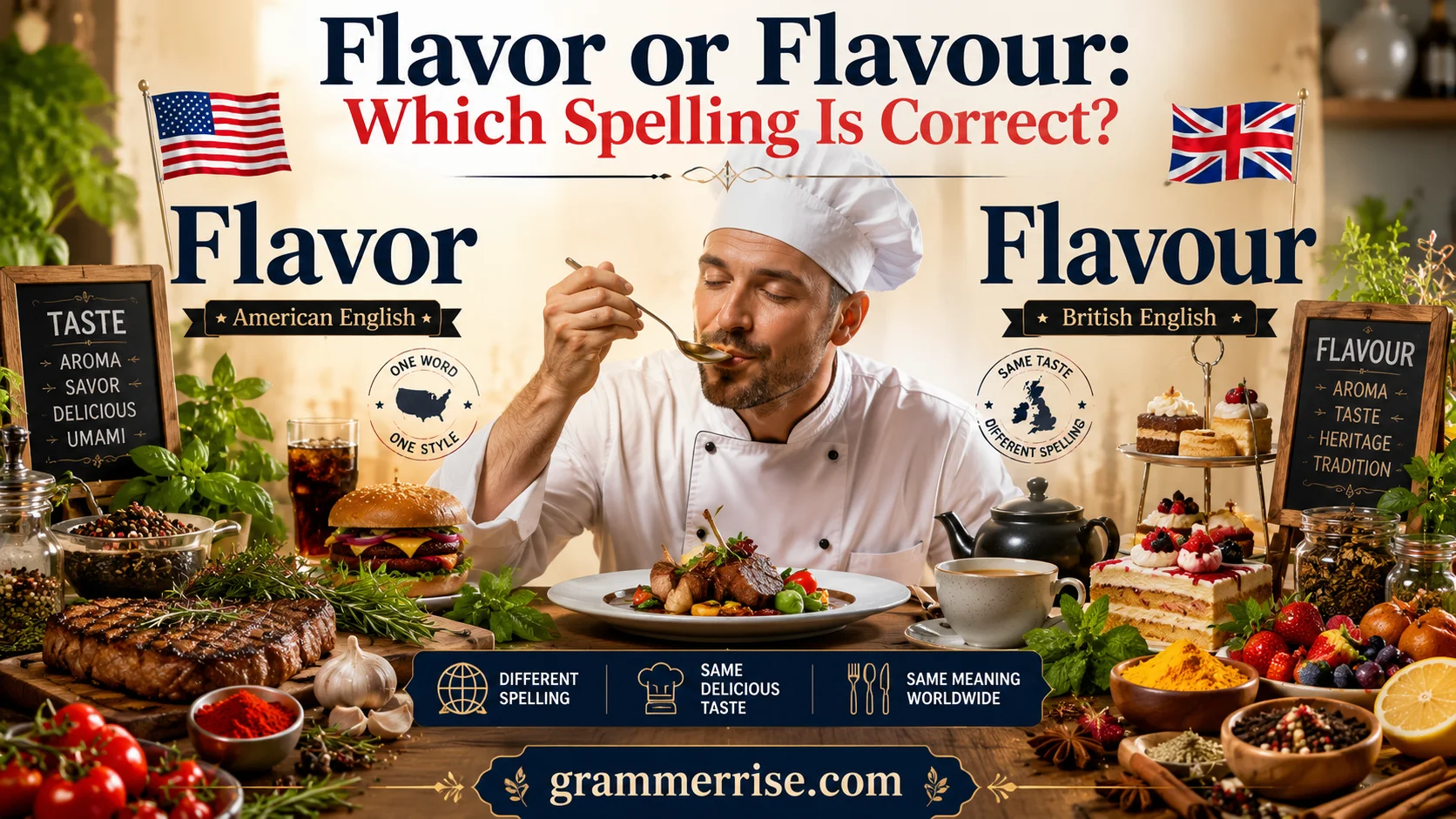
Flavor or Flavour explains why people search this topic because both words look different but sound the same in English.
Both forms mean the same thing and are exactly the same in meaning, with the main difference being spelling. Flavor is the American spelling, while flavour is the British spelling. These spellings have evolved through history, creating regional distinctions between American English and British English. The correct answer depends on the version of English, type of English, and the audience, including readers from the United States, United Kingdom, Canada, Australia, and other countries. Both describe the taste of food, a figurative experience, or a distinct quality.
From my experience with digital content and content creation, selecting the right spelling helps writers, bloggers, food writers, and English learners maintain quality, credibility, and regional awareness. Using the wrong form in emails, blogs, product descriptions, academic writing, social media posts, books, recipes, online articles, and ads may appear inconsistent, careless, or unprofessional.
This guide covers correct usage, grammar rules, global usage patterns, common mistakes, real world examples, related spelling pairs, exercises, answers, practical advice, clear rules, clear examples, tables, and a quick answer to help readers understand, choose confidently, avoid errors, match audience expectations, improve writing quality, and know when to use flavour or when to use flavor.
Quick Answer
If you’re in a hurry, this table covers the essentials.
| Feature | Flavor | Flavour |
| Meaning | Taste or distinctive quality | Taste or distinctive quality |
| Correct Spelling | Yes | Yes |
| Region | United States | UK, Canada, Australia, New Zealand |
| Pronunciation | Same | Same |
| Part of Speech | Noun and Verb | Noun and Verb |
| Dictionary Recognition | Yes | Yes |
Key Takeaway
Flavor is the preferred spelling in American English.
Flavour is the preferred spelling in British English and most Commonwealth countries.
Neither spelling is wrong. The best choice depends on your audience.
Is It Flavor or Flavour?
Many spelling debates involve one correct word and one mistake. This isn’t one of them.
Both spellings appear in respected dictionaries, academic publications, cookbooks, food packaging, and professional writing.
The Short Answer
Use flavor if you’re writing for:
- American readers
- US businesses
- US publications
- American schools
Use flavour if you’re writing for:
- British readers
- Canadian readers
- Australian readers
- New Zealand readers
- International audiences following British English
Why the Difference Exists
The distinction traces back to historical spelling reforms.
American English simplified many words by removing the letter “u” from words ending in -our.
As a result:
| American English | British English |
| Flavor | Flavour |
| Color | Colour |
| Honor | Honour |
| Labor | Labour |
| Neighbor | Neighbour |
The meaning never changed. Only the spelling evolved.
What Does Flavor Mean?
The word flavor describes the taste, smell, and overall sensory impression of food or drink.
However, its meaning extends beyond food.
Flavor Definition
According to major dictionaries, flavor refers to:
The distinctive taste or characteristic quality of something.
When people discuss flavor, they often mean a combination of:
- Taste
- Aroma
- Texture perception
- Mouthfeel
- Aftertaste
Flavor as a Noun
In everyday language, flavor usually functions as a noun.
Examples:
- The soup has a rich flavor.
- Garlic adds flavor to pasta dishes.
- The coffee has a smooth flavor profile.
Flavor as a Verb
The word can also function as a verb.
Examples:
- Chefs flavor sauces with fresh herbs.
- The company flavors its beverages naturally.
- Cinnamon can flavor baked goods beautifully.
Flavor Beyond Food
People often use flavor figuratively.
Examples:
- The festival added local flavor to the city.
- The movie has a nostalgic flavor.
- Her writing carries a unique flavor.
In these examples, flavor means character, atmosphere, or distinctive qualities rather than taste.
What Does Flavour Mean?
Flavour means exactly the same thing as flavor.
The only difference is regional spelling.
Flavour Definition
In British English, flavour refers to:
- Taste
- Aroma
- Characteristic qualities
- Distinctive attributes
Nothing changes except the presence of the extra “u.”
Flavour in Everyday British English
You’ll commonly see flavour used in:
- British recipes
- Food packaging
- Restaurant menus
- Educational materials
- Newspapers
- Scientific publications
Examples of Flavour in Sentences
- The curry has a bold flavour.
- Lemon adds flavour to the cake.
- The town retains its historic flavour.
- The novel has a distinctly Victorian flavour.
Notice how the meaning remains identical to American usage.
Flavor vs Flavour: Side-by-Side Comparison
Let’s compare them directly.
| Feature | Flavor | Flavour |
| Meaning | Same | Same |
| Pronunciation | Same | Same |
| Grammar | Same | Same |
| Usage | American English | British English |
| Accepted by Dictionaries | Yes | Yes |
| Used in Food Industry | Yes | Yes |
The Main Difference
The only real difference is spelling.
That’s it.
The meaning remains unchanged, with no difference in grammar or pronunciation.
What Stays the Same
Both words:
- Describe taste
- Describe character
- Function as nouns
- Function as verbs
- Appear in dictionaries
- Work in formal writing
The History of Flavor and Flavour
Language history often explains modern spelling differences.
The story of flavor and flavour stretches back hundreds of years.
Origins in Old French
The word traces its roots to Old French.
Early forms included words similar to:
- Fleur
- Flaur
- Flaveur
These words referred to smell, scent, and taste.
Arrival in Middle English
After the Norman Conquest, many French words entered English.
Flavor gradually evolved into various spellings before becoming standardized.
Spelling wasn’t consistent during the Middle Ages. Writers often spelled words differently from one document to another.
The Influence of Noah Webster
A major turning point arrived in the early nineteenth century.
American lexicographer Noah Webster believed English spelling should become simpler and more logical.
His dictionaries promoted spellings such as:
- Color instead of colour
- Honor instead of honour
- Flavor instead of flavour
These simplified forms became standard in American English.
Why Britain Kept the U
British English retained traditional spellings.
As a result, words ending in -our continued appearing with the extra letter.
Today, these differences remain one of the easiest ways to distinguish American and British writing.
Why American and British English Use Different Spellings
English isn’t a single uniform language.
Instead, it developed differently across countries.
The Pattern Behind Flavor and Flavour
The flavor/flavour distinction belongs to a larger spelling pattern.
Here are common examples.
| American | British |
| Flavor | Flavour |
| Color | Colour |
| Honor | Honour |
| Humor | Humour |
| Labor | Labour |
| Neighbor | Neighbour |
| Favor | Favour |
Why These Differences Survived
Several factors contributed:
- National identity
- Educational systems
- Publishing standards
- Dictionary influence
- Government usage
Once schools adopted specific spellings, those forms became deeply rooted.
Read more: Accidently or Accidentally: Which Is Correct Examples?
Flavor vs Flavour in Food and Cooking
Food is where the word appears most frequently.
Why Flavor Matters
People don’t eat food solely for nutrition.
They eat for enjoyment.
Flavor transforms simple ingredients into memorable meals.
The Five Basic Tastes
Scientists generally recognize five primary tastes.
| Taste | Example |
| Sweet | Honey |
| Sour | Lemon |
| Salty | Sea Salt |
| Bitter | Dark Chocolate |
| Umami | Mushrooms |
Together, these create complex flavor experiences.
Understanding Flavor Profiles
Professional chefs often discuss flavor profiles.
A flavor profile describes how tastes interact.
Examples include:
- Sweet and spicy
- Salty and smoky
- Tangy and fresh
- Rich and savory
The best dishes balance multiple flavor elements.
Real-World Example
Consider barbecue sauce.
Its flavor profile often combines:
- Sweetness from sugar
- Acidity from vinegar
- Smokiness from spices
- Heat from peppers
That combination creates depth and complexity.
Flavor vs Flavour in Marketing and Branding
Food companies carefully choose words because spelling influences customer perception.
Product Packaging Differences
An American package might say:
Natural Strawberry Flavor
A British package might say:
Natural Strawberry Flavour
The product remains identical.
The packaging simply matches regional expectations.
Global Brands Adapt Their Language
Large companies often localize packaging.
For example:
| Market | Spelling |
| United States | Flavor |
| United Kingdom | Flavour |
| Australia | Flavour |
| Canada | Flavour |
Localization improves customer trust and familiarity.
Why This Matters
Consumers often notice unusual spellings.
Using the expected version helps brands feel more authentic.
Flavor vs Flavour in Academic and Professional Writing
Spelling consistency matters in professional environments.
School Assignments
Students should follow:
- Teacher instructions
- School guidelines
- Regional standards
Mixing flavor and flavour in the same paper can appear careless.
Business Communication
Companies generally follow one language standard.
American businesses usually use flavor.
British organizations typically use flavour.
Scientific Publications
Scientific journals often specify language requirements.
Some journals require:
- American English
- British English
Authors should follow the selected style throughout the manuscript.
Style Guide Recommendations
Popular style guides emphasize consistency.
Switching between spellings weakens professionalism.
Flavor vs Flavour in Content Writing
Writers often ask which spelling performs better in search results.
The answer depends on your target audience.
Search Behavior Differs by Region
American users usually search:
- flavor definition
- flavor profile
- flavor enhancer
British users often search:
- flavour definition
- flavour profile
- flavour enhancer
Regional habits influence keyword volume.
Choosing the Right Keyword
Ask yourself:
Who is reading this content?
The answer determines which spelling you should prioritize.
Can You Use Both?
Yes, but do so carefully.
A common approach looks like this:
Flavor, spelled flavour in British English, refers to the distinctive taste and character of food.
This method captures both search variations naturally.
Best Practice
Choose one primary spelling.
Mention the alternative when relevant.
Maintain consistency afterward.
Common Mistakes People Make
Even experienced writers occasionally make errors.
Mixing Both Spellings
This mistake appears frequently.
Example:
❌ The flavor of the soup had a wonderful flavour.
Choose one spelling and stay consistent.
Assuming One Is Wrong
Many people mistakenly believe flavour is incorrect.
Others think flavor is incorrect.
Neither assumption is accurate.
Ignoring the Audience
Audience expectations matter.
American readers expect flavor.
British readers expect flavour.
Confusing Meaning Differences
Some people think the spellings describe different concepts.
They don’t.
The meaning remains exactly the same.
Flavor and Flavour Examples in Sentences
Flavor Examples
- The chef created a rich flavor using fresh herbs.
- Vanilla flavor remains one of America’s favorites.
- This seasoning adds flavor without extra salt.
- The sauce delivers bold flavor in every bite.
Flavour Examples
- The dish has a distinctive Mediterranean flavour.
- Fresh basil improves the flavour significantly.
- The tea offers a delicate floral flavour.
- The recipe develops flavour during slow cooking.
Business Examples
- The company launched a new mango flavor beverage.
- The manufacturer introduced a tropical flavour line.
Academic Examples
- Researchers evaluated flavor perception among participants.
- Scientists analyzed flavour compounds in fermented foods.
When Should You Use Flavor?
Choose flavor when writing for American audiences.
Ideal Situations
- US websites
- American blogs
- US newspapers
- American businesses
- US educational materials
Example
If your audience lives in Texas, New York, or California, flavor will usually feel more natural.
When Should You Use Flavour?
Choose flavour when writing for audiences outside the United States that follow British English conventions.
Ideal Situations
- UK websites
- Canadian publications
- Australian businesses
- New Zealand audiences
- British academic institutions
Example
If you’re publishing a recipe for readers in London or Sydney, flavour will generally be the better choice.
Related American and British English Spelling Differences
Flavor and flavour aren’t unique.
English contains many regional variations.
| American English | British English |
| Flavor | Flavour |
| Color | Colour |
| Favor | Favour |
| Honor | Honour |
| Labor | Labour |
| Humor | Humour |
| Neighbor | Neighbour |
Why Consistency Matters
Imagine a restaurant menu that switches between:
- Flavor
- Flavour
- Color
- Colour
Readers quickly notice the inconsistency.
Consistent spelling creates trust and professionalism.
FAQs
1. Is flavor or flavour the correct spelling?
Both flavor and flavour are correct spellings. The choice depends on the type of English you are using. Flavor is preferred in American English, while flavour is commonly used in British English and other regions that follow British spelling rules.
2. Do flavor and flavour have different meanings?
No, both words have exactly the same meaning. They describe the taste of food, drinks, or a unique quality of an experience. The only difference is the spelling style used in different English-speaking regions.
3. Why does American English use flavor instead of flavour?
American English often simplified certain spellings over time, removing letters that were common in British forms. This is why words like flavor, color, and honor use the shorter -or ending in American English.
4. Which spelling should I use for SEO content: flavor or flavour?
The best choice depends on your target audience. If your readers are mainly from the United States, use flavor. If your audience is from the UK, Canada, Australia, or regions using British English, flavour may be more suitable.
5. Is using the wrong spelling of flavor or flavour a grammar mistake?
No, it is not a grammar mistake. It is a regional spelling difference. However, mixing both versions in the same article, website, or professional document can make your writing appear inconsistent.
6. How can I remember when to use flavor and flavour?
A simple way to remember is to connect flavor with American English and flavour with British English. Always check your audience and maintain the same spelling style throughout your writing.
Conclusion
The choice between Flavor or Flavour is not about finding a wrong or right word because both spellings are correct. The real difference comes from regional English preferences. Flavor belongs to American English, while flavour is commonly used in British English and countries influenced by British spelling. Understanding this small spelling difference helps you create clearer, more professional, and audience-friendly content.
Whether you are writing a blog, recipe, product description, academic document, or social media post, consistency matters. Once you know your audience and their preferred version of English, choosing between flavor and flavour becomes simple. By following proper spelling rules and maintaining a consistent writing style, you can communicate confidently and avoid unnecessary confusion.