The term Aluminum or Aluminium often creates spelling confusion because this metal has two accepted spellings.
Both words describe the same chemical element and material, but different countries and regions follow unique spelling traditions. American English uses aluminum, while British English, the United Kingdom, Australia, Canada, and New Zealand prefer aluminium. This spelling difference comes from historical background, word history, and language variations.
The correct spelling, meaning, and usage depend on your audience and purpose. Writers, students, and professionals should understand these regional differences before creating academic, technical content. Both versions are accepted worldwide, and choosing the right form improves writing quality and confidence.
Many websites, books, and scientific articles show these variations. Using grammar rules, avoiding common mistakes, and learning through practical examples helps English learners select the best spelling for every situation.
Quick Answer
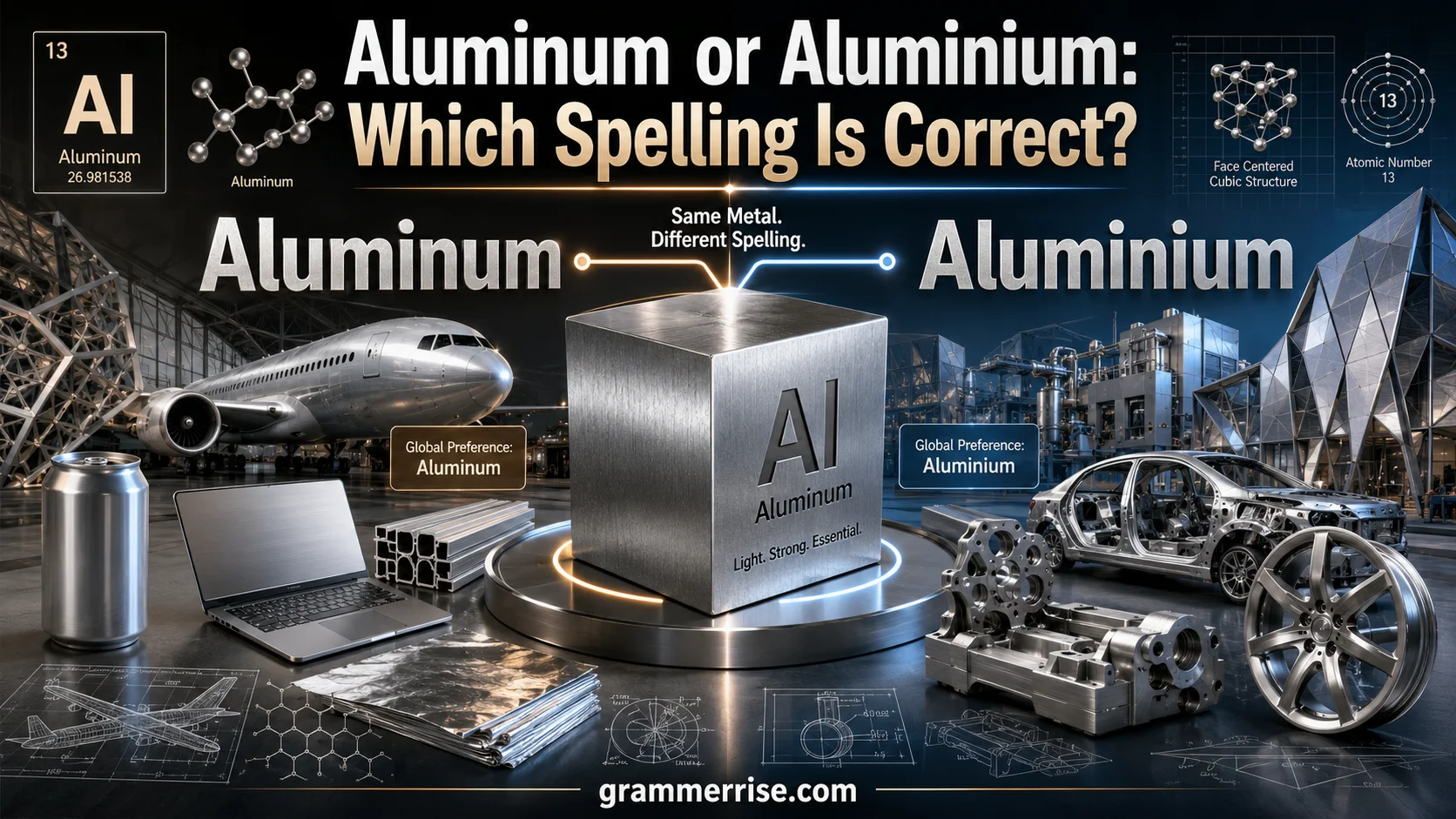
Aluminum and aluminium are both correct spellings of the same chemical element (symbol Al, atomic number 13). The difference comes down to regional language preferences. Aluminum is the standard spelling in the United States and Canada, while aluminium is used in the United Kingdom, Australia, New Zealand, and many other English-speaking countries. Neither spelling is more correct than the other. If you’re writing for a specific audience, use the version that matches their regional English. The metal, its properties, and its uses remain exactly the same regardless of which spelling you choose.
Aluminum vs Aluminium at a Glance
Before diving deeper, here’s a quick comparison.
| Feature | Aluminum | Aluminium |
| Meaning | Same metal | Same metal |
| Chemical Symbol | Al | Al |
| Atomic Number | 13 | 13 |
| Preferred Region | United States, Canada | United Kingdom, Australia, New Zealand, Ireland |
| Scientific Validity | Accepted | Accepted |
| Pronunciation | uh-LOO-muh-num | al-yoo-MIN-ee-um |
| Usage in US Publications | Standard | Rare |
| Usage in UK Publications | Less Common | Standard |
Quick Fact
No matter which spelling you use, you are referring to the exact same element on the periodic table.
Is It Aluminum or Aluminium?
The answer depends on where your audience lives.
In the United States and Canada, aluminum is the standard spelling. In the United Kingdom and most other English-speaking countries, aluminium is preferred.
Neither version is incorrect. Both are recognized by dictionaries, scientific organizations, and language authorities.
Why This Creates Confusion
Most spelling differences involve words like:
- Color vs Colour
- Favorite vs Favourite
- Center vs Centre
However, aluminum and aluminium are unusual because they don’t simply differ by one letter. They have different endings and different pronunciations.
That makes the distinction more noticeable and often more confusing.
What Is Aluminum (or Aluminium)?
Aluminum is a lightweight metallic element found naturally in Earth’s crust.
It is the third most abundant element on Earth and the most abundant metal.
Basic Facts About Aluminum
| Property | Value |
| Chemical Symbol | Al |
| Atomic Number | 13 |
| Atomic Weight | 26.98 |
| Category | Post-transition metal |
| Color | Silvery-white |
| Density | 2.70 g/cm³ |
| Melting Point | 660.3°C |
| Boiling Point | 2,470°C |
Why Aluminum Is Important
Modern life would look very different without aluminum.
You can find it in:
- Airplanes
- Cars
- Smartphones
- Beverage cans
- Window frames
- Solar panels
- Electrical wiring
- Kitchen foil
- Construction materials
Because it combines strength with low weight, aluminum has become one of the most useful industrial metals ever discovered.
Key Properties
Lightweight
Aluminum weighs about one-third as much as steel.
Corrosion Resistant
A protective oxide layer forms naturally on its surface.
Highly Recyclable
Aluminum can be recycled repeatedly without losing quality.
Excellent Conductor
It conducts electricity and heat efficiently.
Durable
Despite being lightweight, it remains remarkably strong.
The Fascinating History Behind Aluminum and Aluminium
The story behind these spellings begins more than 200 years ago.
Unlike many language debates, this one has roots in science rather than simple regional preference.
The Discovery of the Element
During the early 1800s, scientists knew aluminum compounds existed but had not yet isolated the pure metal.
British chemist Sir Humphry Davy played a major role in researching the element.
Although he never successfully isolated pure aluminum, he proposed names for the newly identified substance.
The First Name: Alumium
Davy initially suggested the name alumium.
The name came from alum, a compound that had been known and used since ancient times.
However, scientists felt the name sounded incomplete.
The Shift to Aluminum
Davy later changed the name to aluminum.
Many early scientific publications adopted this version.
At the time, aluminum appeared to be the preferred term.
How Aluminium Appeared
Soon afterward, scientists proposed aluminium.
Why?
Because many element names already ended in -ium, including:
- Sodium
- Potassium
- Calcium
- Magnesium
The spelling “aluminium” fit the naming pattern better.
As a result, it gained popularity throughout Europe.
The Great Split
By the late 19th century, language usage had diverged.
The United States continued using aluminum.
Britain and much of the rest of the world adopted aluminium.
That division remains largely unchanged today.
Why Americans Say Aluminum While Brits Say Aluminium
The difference isn’t random.
Historical dictionaries and educational systems reinforced different standards.
American Preference
American English adopted aluminum largely due to the influence of dictionaries and industrial publications.
As aluminum production expanded in the United States, manufacturers standardized the shorter spelling.
Eventually, it became the accepted American norm.
British Preference
British English favored aluminium because it matched the naming structure used for other metallic elements.
Scientific institutions and educational systems reinforced that choice.
Over time, aluminium became the dominant spelling throughout Britain and many Commonwealth countries.
Countries That Prefer Aluminium
The following countries generally use aluminium:
- United Kingdom
- Australia
- New Zealand
- Ireland
- India
- South Africa
Countries That Prefer Aluminum
The following countries generally use aluminum:
- United States
- Canada
Read more: Weird or Wierd: Rules, Examples and Memory Tricks
What Does IUPAC Say About Aluminum and Aluminium?
Many people assume science has chosen one correct spelling.
The reality is more nuanced.
Understanding IUPAC
The International Union of Pure and Applied Chemistry (IUPAC) establishes global naming standards for chemical elements.
Its recommendations carry significant weight in scientific communities.
Historical Position
IUPAC originally preferred aluminium as the international standard.
This choice aligned with naming conventions used for other elements.
Current Acceptance
Today, both aluminium and aluminum are accepted in scientific communication.
This practical approach recognizes widespread regional usage.
What Scientists Actually Do
Most scientists simply follow regional conventions.
For example:
| Region | Typical Usage |
| United States | Aluminum |
| United Kingdom | Aluminium |
| Australia | Aluminium |
| Canada | Aluminum |
Consistency matters more than choosing one spelling over the other.
Aluminum vs Aluminium Pronunciation
The spelling difference also changes pronunciation.
American Pronunciation
Aluminum
Pronounced as:
uh-LOO-muh-num
This version contains four syllables.
British Pronunciation
Aluminium
Pronounced as:
al-yoo-MIN-ee-um
This version contains five syllables.
Why the Pronunciations Differ
The extra “i” creates an additional syllable.
As a result, British pronunciation sounds longer and more rhythmic.
Which Pronunciation Is Correct?
Both.
The correct pronunciation depends on the spelling being used and the audience hearing it.
Aluminum vs Aluminium: Side-by-Side Differences
Here’s a direct comparison.
| Category | Aluminum | Aluminium |
| Spelling Length | Shorter | Longer |
| Pronunciation | Four syllables | Five syllables |
| Region | North America | Most other English-speaking countries |
| Meaning | Same | Same |
| Symbol | Al | Al |
| Atomic Number | 13 | 13 |
What Doesn’t Change
No matter which spelling appears:
- It remains element 13.
- The chemical symbol remains Al.
- The properties remain identical.
- The industrial uses remain identical.
Only the word changes.
Aluminum vs Aluminium in Everyday Writing
Choosing the right spelling depends on context.
Business Writing
If your audience is American, use aluminum.
If your audience is British, Australian, or international, aluminium may be more appropriate.
Academic Writing
Always follow your institution’s style guide.
Universities often require consistency throughout a paper.
Technical Documentation
Engineering firms typically use the standard spelling adopted in their country.
Website Content
Audience location matters.
A U.S.-focused website should generally use aluminum.
A UK-focused website should generally use aluminium.
International Marketing
Some multinational companies create separate versions for different markets.
This improves clarity and user experience.
Examples of Aluminum Used Correctly
Everyday Examples
- The soda can is made from aluminum.
- Aluminum siding protects the house from weather damage.
- The aircraft uses lightweight aluminum components.
Industrial Examples
- Aluminum alloys improve fuel efficiency in vehicles.
- Engineers selected aluminum because of its strength-to-weight ratio.
Scientific Examples
- Aluminum oxide forms naturally on exposed surfaces.
- Aluminum plays an important role in modern manufacturing.
Examples of Aluminium Used Correctly
Everyday Examples
- The kitchen foil is made from aluminium.
- Aluminium frames provide excellent durability.
- The building uses recycled aluminium panels.
Industrial Examples
- Aluminium alloys are common in aerospace engineering.
- Manufacturers prefer aluminium because it resists corrosion.
Scientific Examples
- Aluminium compounds occur naturally in minerals.
- Aluminium extraction requires significant electrical energy.
Common Mistakes People Make
Thinking They Are Different Metals
This is the most common misunderstanding.
Aluminum and aluminium are exactly the same element.
Mixing Spellings
Switching between aluminum and aluminium in the same article can confuse readers.
Choose one version and stay consistent.
Using the Wrong Regional Version
A UK audience may expect aluminium.
An American audience expects aluminum.
Assuming One Is Wrong
Many people incorrectly believe one spelling is a mistake.
In reality, both are accepted.
Should You Use Aluminum or Aluminium?
The smartest approach is simple.
When to Use “Aluminum” vs “Aluminium”
- Your audience is in the United States.
- You’re writing for American publications.
- You’re following American English conventions.
Use Aluminium If
- Your audience is in the United Kingdom.
- You’re writing for Australia or New Zealand.
- You’re using British English standards.
Use One Consistently
Consistency creates professionalism.
Mixing spellings often appears careless.
Practical Rule
Ask yourself one question:
Who will read this content?
The answer usually determines the correct spelling.
Related Spelling Differences in English
The aluminum versus aluminium debate isn’t unique.
English contains many regional variations.
Color vs Colour
American English removes the “u.”
British English keeps it.
Favor vs Favour
Another common spelling difference.
Center vs Centre
Americans use center.
Brits use centre.
Sulfur vs Sulphur
Scientific naming conventions have influenced this spelling as well.
What These Examples Teach
Language evolves over time.
Regional preferences develop naturally.
Neither version is automatically superior.
Interesting Facts About Aluminum
Aluminum Was Once More Valuable Than Gold
In the 19th century, producing pure aluminum was extremely expensive.
Rare aluminum objects became status symbols among wealthy elites.
Napoleon III Loved Aluminum
French Emperor Napoleon III reportedly reserved aluminum utensils for honored guests while others used gold cutlery.
Recycling Saves Massive Energy
Recycling aluminum uses roughly 95% less energy than producing new aluminum from raw ore.
Modern Aviation Depends on Aluminum
Without aluminum alloys, modern air travel would be dramatically less efficient.
Beverage Cans Have a Remarkable Life Cycle
A recycled aluminum can can return to store shelves as a new can in as little as a few months.
FAQs
1. Is aluminum and aluminium the same thing?
Yes, aluminum and aluminium refer to the same chemical element and lightweight metal. The difference is only in the spelling. American English usually uses “aluminum,” while British English and many other countries use “aluminium.”
2. Which spelling is correct: aluminum or aluminium?
Both spellings are correct. The choice depends on the type of English you are using. If you are writing for an American audience, “aluminum” is preferred. For British, Australian, or international audiences, “aluminium” is often the better choice.
3. Why do aluminum and aluminium have different spellings?
The two spellings developed because of historical and regional language differences. American English simplified some words over time, while British English kept the “-ium” ending used in many scientific terms.
4. Do aluminum and aluminium have different pronunciations?
Yes, there are slight pronunciation differences. Americans usually pronounce “aluminum” with fewer syllables, while British speakers pronounce “aluminium” with an extra “i” sound. However, both refer to the same metal.
5. Which spelling should I use in academic or professional writing?
You should choose the spelling based on your target audience. For American schools, businesses, and websites, use “aluminum.” For international, British, or scientific contexts, “aluminium” may be more suitable.
6. Can I use aluminum and aluminium interchangeably?
Yes, you can use both forms when the meaning is clear. However, keeping one spelling consistent throughout your article, report, or document makes your writing look more professional and polished.
Conclusion
The difference between aluminum or aluminium is not about meaning but about regional spelling preferences. Both words describe the same metal, the same chemical element, and the same material used in industries around the world. The main difference comes from American English and British English spelling traditions.
When writing, the best choice depends on your audience, location, and purpose. Whether you choose aluminum for an American audience or aluminium for British and international readers, both forms are correct. Understanding these spelling variations helps you write with more confidence, avoid confusion, and maintain a professional writing style. Once you know the history and usage rules behind both versions, choosing the right spelling becomes simple.

Hussain Abid is an English language writer with over 10 years of experience in grammar, spelling, vocabulary, and writing. He specializes in creating clear, well-researched content that helps readers improve their English with confidence. At GrammarRise, Hussain writes practical guides, grammar explanations, and word comparison articles based on trusted language sources and real-world usage. His mission is to make English learning simple, accurate, and accessible for everyone