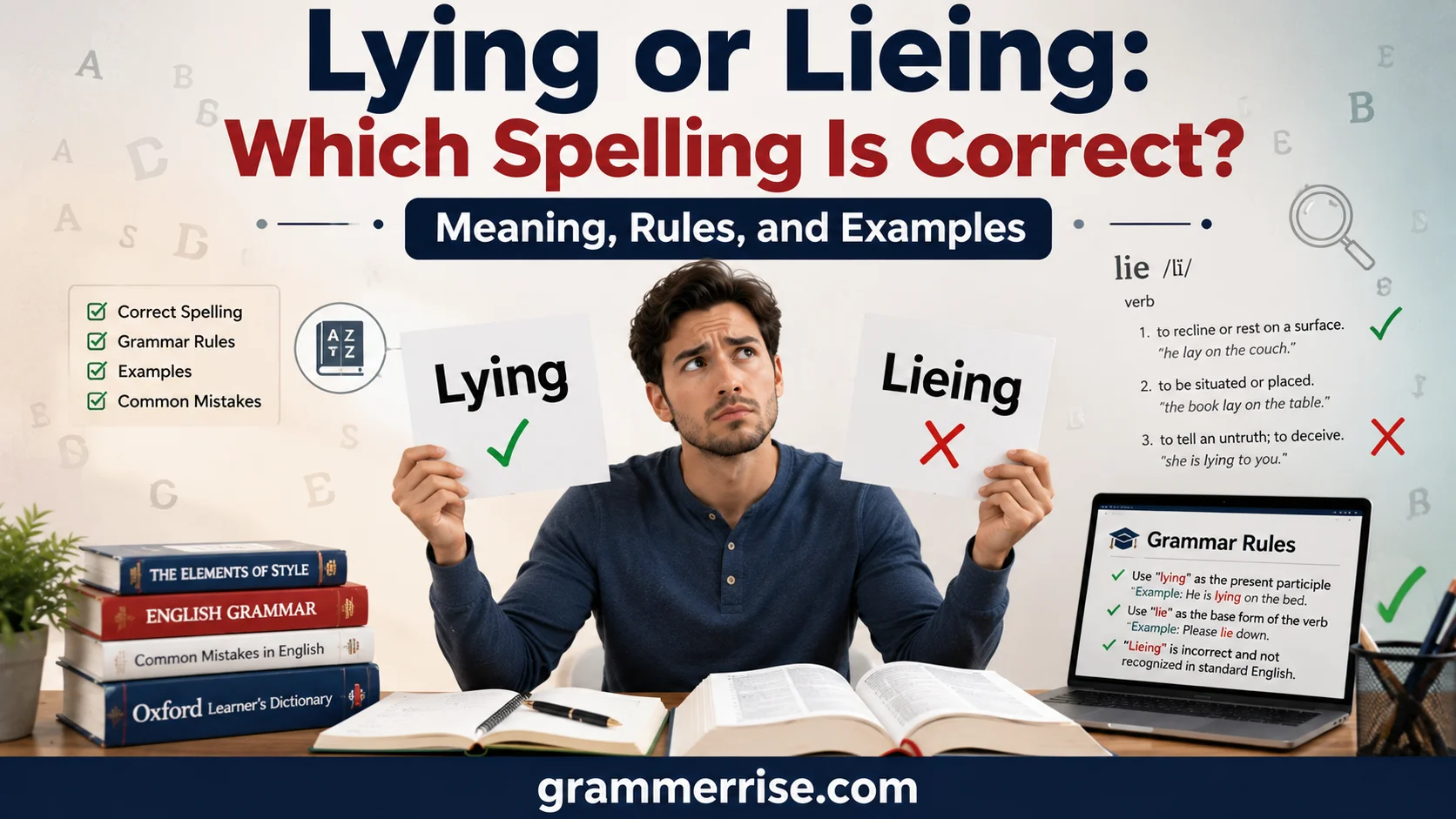
Many learners ask, “Lying or Lieing” when they search for the correct spelling because both forms look possible in English writing and daily communication.
I have noticed this spelling confusion among native speakers and learners while creating a professional email, academic essay, blog post, or social media caption. The correct spelling is lying, while lieing is an incorrect form in standard English. The reason comes from English spelling rules and grammar rules. When the verb lie changes into its present participle form by adding -ing, the ie changes to y, and the word becomes lying. This word change follows common language rules and explains why lie + ing does not create lieing.
The English language contains many spelling rules that are not always obvious, which is why many people have wondered about this commonly searched spelling question. This guide explains the difference through real examples such as tie becoming tying and die becoming dying. Learning these verb forms, word formation, and suffix changes improves writing skills, accuracy, and professional credibility. Whether you write an exam answer, an online writing piece, or a daily message, choosing the correct phrase helps you avoid a common spelling mistake, improve writing quality, and use the word with confidence through correct usage.
Quick Answer
Lying is the correct spelling. Lieing is incorrect.
When adding -ing to words ending in -ie, the “ie” changes to “y”:
- Lie → Lying ✅
- Tie → Tying ✅
- Die → Dying ✅
So, use “lying” in your writing.
Lying or Lieing: Which Spelling Is Correct?
The correct spelling is lying.
Lieing is incorrect and should not be used in standard English writing.
The confusion happens because many people think the verb lie should simply add -ing like other verbs:
- Walk → Walking ✅
- Talk → Talking ✅
- Play → Playing ✅
- Lie → Lieing ❌
However, English has a special spelling rule for verbs ending in -ie.
When a verb ends with -ie, the letters ie change to y before adding -ing.
The pattern looks like this:
| Base Verb | Incorrect Form | Correct Form |
| Lie | Lieing | Lying |
| Tie | Tieing | Tying |
| Die | Dieing | Dying |
This spelling change keeps the word easier to read and follows traditional English spelling patterns.
So, whenever you are unsure, remember:
Lie + ing = Lying
Not:
Lie + ing = Lieing
Why Is Lying Spelled Without an Extra “E”?
The reason behind lying spelling comes from a simple English grammar rule.
Words that end in -ie usually change before adding the suffix -ing. Instead of keeping the original letters, English replaces ie with y.
For example:
- Lie becomes lying.
- Tie becomes tying.
- Die becomes dying.
This rule prevents unusual letter combinations and keeps pronunciation clear.
Imagine reading the word “lieing.” The extra “e” makes the spelling look awkward because English readers naturally expect the ie combination to change.
The same pattern appears in other words:
| Word | Correct Form |
| Vie | Vying |
| Untie | Untying |
| Tie | Tying |
| Die | Dying |
Although English has many exceptions, this particular spelling rule is reliable.
What Does Lying Mean?
The word lying has two main meanings. The meaning depends entirely on the context.
A sentence like:
“She is lying to her friend.”
means she is not telling the truth.
A sentence like:
“The cat is lying on the sofa.”
means the cat is resting in a flat position.
The spelling stays the same, but the meaning changes.
Understanding the context helps you recognize which meaning the writer intends.
Lying Meaning: Telling Something False
The first meaning of lying relates to dishonesty.
When someone lies, they say something that they know is false. They may hide the truth, create a false story, or provide incorrect information intentionally.
Examples:
- “He was lying about his age.”
- “She admitted that she was lying during the interview.”
- “The child wasn’t lying when he explained what happened.”
Lying can happen in small everyday situations or serious situations.
For example:
A child might say:
“I didn’t eat the cookies.”
when they actually did.
That is a small lie.
However, someone giving false information in court or during an investigation involves a much more serious form of dishonesty.
Lying Meaning: Resting in a Flat Position
The second meaning of lying comes from the verb lie, which means to rest or remain in a horizontal position.
Examples:
- “The dog is lying under the table.”
- “My phone is lying next to my notebook.”
- “The baby is lying peacefully in the crib.”
In these sentences, nobody is being dishonest. The word simply describes a position.
This meaning often creates confusion because many people mix up lying with laying.
Lying vs Laying: What Is the Difference?
One of the biggest grammar challenges in English is understanding the difference between lying and laying.
The easiest way to remember the difference:
- Lying means something or someone rests by itself.
- Laying means someone puts something somewhere.
Here is a simple comparison:
| Word | Meaning | Example |
| Lying | Resting in a position | The dog is lying on the floor. |
| Laying | Putting something down | She is laying the book on the desk. |
The key difference is whether an object receives an action.
Lying
The subject is simply resting.
Example:
“The keys are lying on the counter.”
The keys are not doing anything. They are just there.
Laying
Someone actively places something.
Example:
“He is laying the keys on the counter.”
The person is performing an action.
Lie and Lay Verb Forms Explained
The confusion becomes easier when you look at the complete verb forms.
Lie Meaning: To Rest
| Verb Form | Word |
| Present | Lie |
| Past | Lay |
| Past Participle | Lain |
| Present Participle | Lying |
Examples:
- “I lie down after lunch.”
- “Yesterday, I lay on the couch.”
- “I have lain here for an hour.”
- “I am lying on the bed.”
Lie Meaning: To Tell Something False
| Verb Form | Word |
| Present | Lie |
| Past | Lied |
| Past Participle | Lied |
| Present Participle | Lying |
Examples:
- “I never lie to my friends.”
- “He lied about the situation.”
- “She has lied before.”
- “They are lying right now.”
The tricky part is that both meanings use lying in the present participle form.
Read more: Label or Lable: Meaning, Examples and Common Mistakes
Common Reasons People Write “Lieing”
Many people write lieing because they apply a normal spelling pattern to an unusual word.
Here are the most common reasons:
Adding “-ing” Directly
Most verbs follow this pattern:
- Work → Working
- Help → Helping
- Learn → Learning
Because of this, writers naturally assume:
- Lie → Lieing
However, lie is different.
The correct transformation is:
Lie → Lying
Confusing Similar Words
English contains several words that look and sound similar:
- Lie
- Lay
- Lying
- Laying
Because these words are closely related, writers often mix them up.
Relying on Pronunciation
The words lieing and lying might seem similar when spoken, but spelling rules decide the correct written form.
English spelling does not always follow sound alone.
Correct and Incorrect Examples of Lying and Lieing
Seeing examples makes the difference easier to remember.
Incorrect:
❌ “She is lieing about the accident.”
Correct:
✅ “She is lying about the accident.”
Incorrect:
❌ “The cat is lieing on the blanket.”
Correct:
✅ “The cat is lying on the blanket.”
Incorrect:
❌ “I was lieing down when you called.”
Correct:
✅ “I was lying down when you called.”
Lying Word Forms: Complete Grammar Guide
Here is a quick reference chart:
| Word | Meaning | Example |
| Lie | Rest or recline | I need to lie down. |
| Lay | Past tense of lie (rest) | I lay on the beach yesterday. |
| Lain | Past participle of lie | She has lain there all morning. |
| Lying | Resting or telling false information | He is lying on the couch. |
| Lied | Past tense of lie (not telling truth) | He lied about his homework. |
| Laying | Putting something somewhere | She is laying the plates on the table. |
This table shows why these words confuse many learners.
How to Remember the Correct Spelling of Lying
Remembering lying spelling becomes easy with a few simple tricks.
Remember the “IE Changes to Y” Rule
Whenever you see a verb ending in -ie, change it to -y before adding -ing.
Examples:
- Lie → Lying
- Tie → Tying
- Die → Dying
Use a Simple Memory Sentence
Try remembering:
“When I lie, I start by changing IE to Y before I add ING.”
This small reminder prevents the common spelling mistake.
Think About Common Words
Most people already know:
- Cry → Crying
- Try → Trying
The same idea appears with lie:
- Lie → Lying
Is Lieing Ever Correct?
No. In modern standard English, lieing is not considered a correct spelling.
You may occasionally see it online, especially in:
- Social media posts
- Informal messages
- Comments
- Unedited content
However, it is still a spelling mistake.
For professional writing, school assignments, articles, emails, and published content, always use:
✅ Lying
Avoid:
❌ Lieing
Lying in Different Contexts
The meaning of lying changes depending on how it appears in a sentence.
Personal Conversations
Example:
“Are you lying to me?”
Here, lying means giving false information.
Physical Position
Example:
“The jacket is lying on the chair.”
Here, lying means resting somewhere.
Figurative Expressions
English also uses lying in creative ways.
Examples:
- “The answer is lying beneath the surface.”
- “A hidden opportunity is lying ahead.”
In these cases, lying means something exists or remains in a certain place.
Quick Comparison: Lie, Lay, Lying, and Laying
| Term | Definition | Example |
| Lie | To rest | I want to lie down. |
| Lay | To place something | Please lay the phone there. |
| Lying | Resting or being dishonest | She is lying on the bed. |
| Laying | Putting something somewhere | He is laying the documents down. |
A useful shortcut:
If there is an object receiving the action, use laying.
Example:
“I am laying the book on the table.”
The book receives the action.
If there is no object, use lying.
Example:
“I am lying on the sofa.”
No object receives an action.
FAQs
1. Is “lieing” a correct spelling in English?
No, “lieing” is not a correct spelling in standard English. The correct form is “lying.” When the verb lie changes into its -ing form, the “ie” changes to “y,” creating the word lying.
2. Why do people confuse lying and lieing?
People often confuse these words because English spelling rules can feel unpredictable. Many assume that adding -ing directly to lie should create lieing, but English has specific spelling changes for some verbs.
3. What is the difference between lie and lying?
The word lie is the base verb, while lying is its present participle form. Lying can mean resting or reclining, and it can also refer to saying something that is not true.
4. Is lying the same in British and American English?
Yes, lying is the correct spelling in both British English and American English. There is no regional spelling difference between these two forms.
5. How can I remember the correct spelling of lying?
A simple trick is to remember examples like tie → tying and die → dying. Similar to these words, lie → lying because the “ie” changes to “y” before adding -ing.
6. Can using “lieing” affect my writing quality?
Yes, using lieing instead of lying can make your writing appear less professional. Correct spelling helps improve clarity, credibility, and accuracy in emails, essays, articles, and online content.
Conclusion
Understanding the difference between lying or lieing becomes simple once you know the spelling rule behind it. The correct word is always lying, while lieing is an incorrect spelling that should be avoided in professional and everyday writing. English may have many confusing patterns, but learning small changes like lie + ing = lying can help you write with more confidence. Whether you are creating an essay, sending an email, or writing online content, using the right spelling improves your communication and makes your writing look more polished.