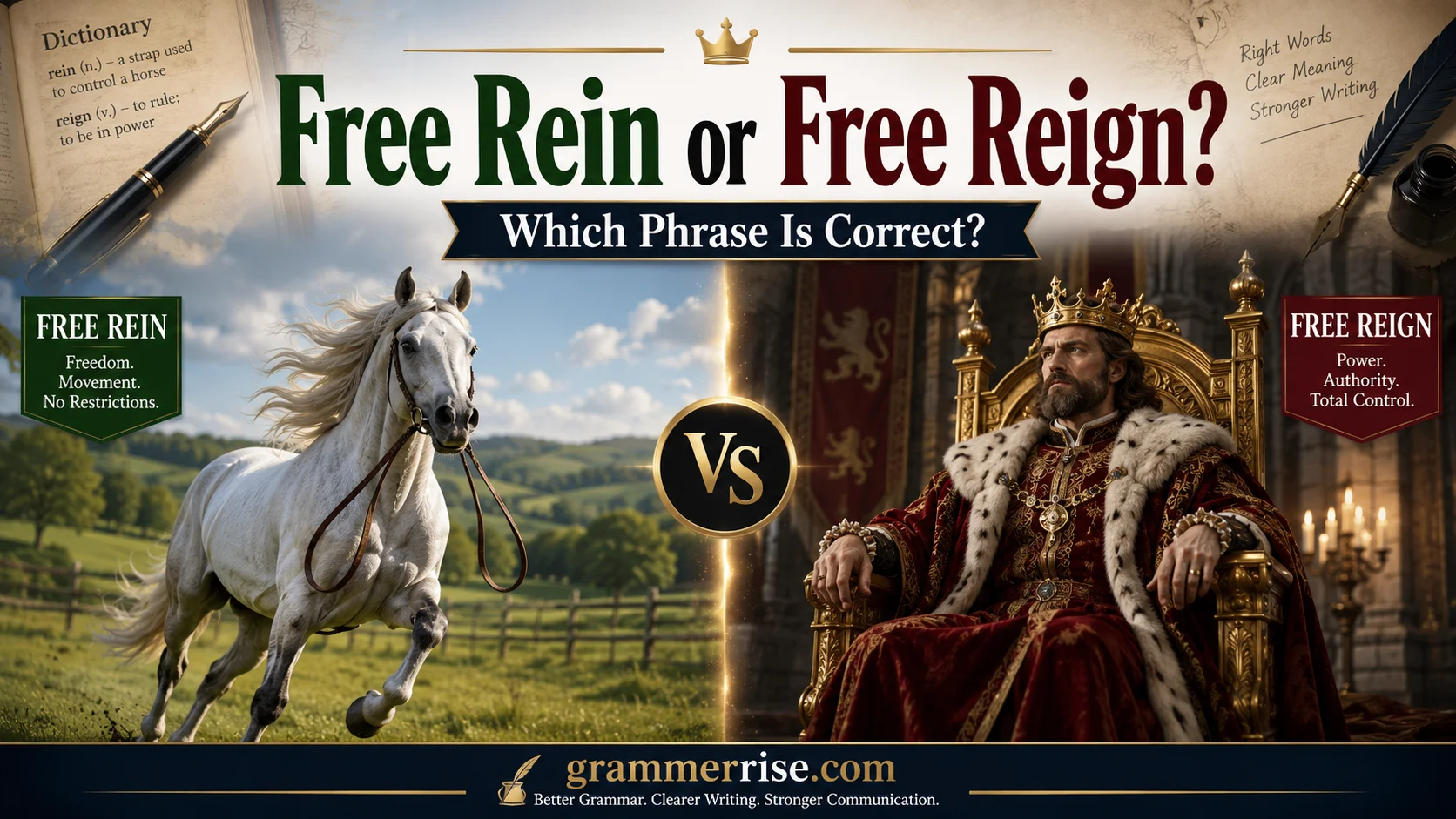
Free Rein or Free Reign is a common English phrase confusion where free rein is correct, and many writers learn its meaning through context and usage.
Free rein is the correct form of this commonly misused phrase in the English language. According to Merriam Webster, this expression comes from horseback riding, where holding the reins loosely can allow an animal to enjoy greater freedom and movement. Many seasoned writers still confuse these tricky words because they have a similar sound when spoken, but their meanings, origins, and usage are different. The history, origin, and historical usage of this phrase show how free reign appeared around the 1890s, leading to people swapping the two terms for over a hundred years. This reflects how language evolves as a living language and breathing entity.
The semantic difference depends on context and meaning. Free rein describes the freedom to act without interference, while free reign connects with authority, control, and a monarch’s rule. Although some people accept both phrases because of language evolution and phrase evolution, traditional grammar rules, spelling, and correct usage still support the accurate expression. Understanding this difference, word choice, and phrase distinction improves writing accuracy, professional writing, and reader trust.
Free Rein or Free Reign: The Quick Answer
The correct phrase is free rein.
It means giving someone complete freedom to act, make decisions, or pursue ideas without unnecessary restrictions.
Correct Example
The company gave its marketing team free rein to develop a new campaign.
Incorrect Example
The company gave its marketing team free reign to develop a new campaign.
Although free reign appears frequently online, dictionaries, editors, teachers, and professional writers overwhelmingly prefer free rein.
Quick Comparison
| Phrase | Correct? | Meaning |
| Free Rein | Yes | Complete freedom to act |
| Free Reign | No | Common misspelling |
Whenever you’re writing professionally, academically, or even casually, free rein is the version you should choose.
What Does Free Rein Mean?
The phrase free rein means allowing someone to operate with minimal supervision or restrictions.
When someone receives free rein, they have room to make decisions independently.
Think of it as handing someone the keys and saying:
“I trust your judgment. Go ahead.”
Common Meanings of Free Rein
- Freedom to make choices
- Independence in decision-making
- Creative liberty
- Lack of excessive control
- Authority to pursue ideas
The phrase often appears in workplaces, schools, creative industries, and family situations.
Examples in Everyday Life
A manager might give employees free rein to solve problems their own way.
A teacher might give students free rein to choose research topics.
Parents might give children free rein to explore a museum.
An author may have free rein when creating fictional worlds.
In every example, the core idea remains the same:
Freedom without constant interference.
How People Use Free Rein Today
Modern English uses the phrase in many different contexts.
In Business
Companies often encourage innovation by giving employees free rein.
For example:
The startup gave its designers free rein to experiment with bold concepts.
Businesses that provide more autonomy often see higher employee satisfaction and stronger creativity.
In Education
Teachers use free rein to encourage critical thinking.
Instead of assigning identical projects, they may allow students to choose topics that interest them.
This approach increases engagement and promotes independent learning.
In Parenting
Parents sometimes provide children with free rein within safe boundaries.
For instance:
During the nature trip, the children had free rein to explore the trails.
This freedom helps build confidence and decision-making skills.
In Creative Industries
Artists, writers, filmmakers, musicians, and designers frequently thrive when given free rein.
Creative work often benefits from fewer restrictions and greater flexibility.
Examples of Free Rein in Sentences
Here are several examples that show proper usage.
Workplace Examples
- The CEO gave department heads free rein to improve operations.
- Our manager allows us free rein when planning projects.
- The team received free rein to redesign the company website.
Education Examples
- Students had free rein to select their presentation topics.
- The professor gave researchers free rein to pursue new theories.
- The class enjoyed free rein during the science fair.
Creative Examples
- The director had free rein over the film’s visual style.
- The novelist enjoyed free rein when developing characters.
- Designers were given free rein to create innovative concepts.
Family Examples
- Parents gave their children free rein in the art room.
- During vacation, the kids had free rein to choose activities.
Notice how every example involves freedom, flexibility, and trust.
The Origin of Free Rein
Understanding the origin makes the phrase much easier to remember.
The expression comes directly from horseback riding.
What Are Reins?
Reins are long straps attached to a horse’s bridle.
Riders hold the reins to guide and control the horse.
By tightening or pulling the reins, the rider influences the horse’s movement and direction.
What Happens When a Horse Has Free Rein?
When a rider loosens the reins, the horse gains more freedom.
The animal can move more naturally without constant direction.
This situation is known as giving a horse free rein.
Literal Meaning
Imagine riding a horse across an open field.
Instead of controlling every movement, you loosen your grip and allow the horse to choose its pace and direction.
That is free rein in its original sense.
From Horses to Everyday Language
Over time, English speakers began applying the idea metaphorically.
Instead of horses, people started talking about employees, students, artists, and leaders receiving free rein.
The meaning shifted from physical freedom to personal freedom.
Yet the original image remains remarkably clear.
A loose rein equals greater freedom.
A tight rein equals greater control.
That simple relationship explains the entire phrase.
Why People Mistakenly Write Free Reign
If free rein is correct, why do millions of people still write free reign?
Several factors contribute to the confusion.
The Words Sound Identical
Rein and reign are homophones.
Homophones are words that sound alike but have different meanings and spellings.
Examples include:
- Their, There, They’re
- Peak, Peek, Pique
- Flour, Flower
- Rein, Reign
Because people usually hear the phrase before writing it, many never realize there’s a spelling distinction.
Reign Feels Logical
The word reign means ruling authority.
For example:
The queen’s reign lasted forty years.
Because the phrase refers to freedom and power, writers often assume reign fits naturally.
They think:
If someone has complete freedom, they must have free reign.
While this interpretation seems logical, it doesn’t match the phrase’s historical origin.
Read more: Other Than or Other Then: Correct Usage and Examples
The Influence of Online Content
Spelling errors spread rapidly online.
When readers repeatedly encounter incorrect forms, those errors begin to look familiar.
Familiarity often creates a false sense of correctness.
That’s one reason free reign continues to appear despite being widely recognized as incorrect in edited English.
Rein vs Reign: Understanding the Difference
Learning the difference between these two words eliminates confusion permanently.
| Word | Meaning | Example |
| Rein | A strap used to guide a horse | Pull the reins gently |
| Reign | The period of rule by a monarch | The king’s reign lasted decades |
Rein Defined
Rein relates to control and guidance.
Common expressions include:
- Free rein
- Rein in spending
- Tight rein
- Hand over the reins
Reign Defined
Reign relates to ruling, governing, or dominating.
Examples include:
- Reign supreme
- The reign of Queen Victoria
- Terror reigns
- The emperor’s reign
Simple Rule
If horses are involved, use rein.
If kings, queens, rulers, or dominance are involved, use reign.
That rule solves most situations instantly.
Free Rein vs Free Reign: Side-by-Side Comparison
| Feature | Free Rein | Free Reign |
| Accepted English | Yes | No |
| Historical origin | Horse riding | Misinterpretation |
| Used by editors | Yes | Rarely |
| Suitable for formal writing | Yes | No |
| Dictionary preference | Yes | No |
This comparison makes the distinction clear.
Professional writers should always use free rein.
Common Situations Where Free Rein Is Used
The phrase appears in many areas of daily life.
Leadership and Management
Strong leaders don’t micromanage every decision.
Instead, they often give trusted employees free rein.
Benefits include:
- Increased innovation
- Faster decision-making
- Better morale
- Greater accountability
Marketing and Advertising
Creative teams perform best when ideas can flow freely.
Many successful campaigns emerged because designers had free rein to experiment.
Education
Students develop confidence when allowed some independence.
Teachers who provide free rein often encourage stronger problem-solving skills.
Technology
Software developers frequently receive free rein when testing new solutions.
This flexibility helps drive innovation.
Entrepreneurship
Founders often succeed because they have free rein to pursue bold ideas without excessive bureaucracy.
Case Study: Free Rein in Action
Google’s Innovation Culture
One famous example involves Google’s approach to creativity.
For years, employees were encouraged to spend part of their workweek exploring independent projects.
This freedom led to innovations that eventually became major products.
The lesson is simple:
When talented people receive free rein, remarkable ideas often emerge.
Of course, freedom works best when combined with responsibility and accountability.
Related Expressions You Should Know
Several common English expressions also use the word rein.
Understanding them strengthens your grasp of the language.
Rein In
Meaning:
To control, limit, or restrain something.
Examples:
- The company must rein in expenses.
- Parents should rein in dangerous behavior.
- Governments often try to rein in inflation.
Tight Rein
Meaning:
Strict supervision or control.
Examples:
- The coach kept a tight rein on the team.
- Management maintained a tight rein on spending.
Hand Over the Reins
Meaning:
Transfer leadership or control.
Examples:
- The founder handed over the reins to a new CEO.
- The retiring principal passed the reins to her successor.
Reign Supreme
This expression correctly uses reign.
Meaning:
To dominate or hold the highest position.
Example:
Quality continues to reign supreme in the luxury market.
Easy Memory Tricks to Remember the Correct Phrase
Want to avoid this mistake forever?
These tricks work remarkably well.
Think of a Horse
Picture a rider loosening the reins.
Loose reins create freedom.
That’s free rein.
Connect It to Rein In
You probably already know the phrase rein in.
Both expressions use the same word.
- Rein in = more control
- Free rein = less control
Either way, the word remains rein.
Visual Association
Imagine this sequence:
Horse → Reins → Freedom → Free Rein
The image takes only a second to recall.
The One-Sentence Trick
Remember:
The horse has free rein.
Since horses use reins, not reigns, the correct spelling becomes obvious.
Is Free Reign Ever Acceptable?
This question sparks debate among language enthusiasts.
What Dictionaries Say
Major dictionaries consistently identify free rein as the standard form.
Some acknowledge that free reign appears frequently.
However, frequency doesn’t automatically make something correct.
What Editors Prefer
Professional editors overwhelmingly choose free rein.
You’ll find it in:
- Newspapers
- Books
- Academic journals
- Business publications
- Professional websites
What About Informal Writing?
Even in casual writing, free rein remains the better choice.
Using the accepted form helps maintain clarity and credibility.
Professional Recommendation
If accuracy matters, always choose free rein.
It’s the safer and more widely accepted option.
Common Grammar Mistakes Similar to Free Rein vs Free Reign
English contains many confusing word pairs.
Here are some of the most common.
Bear With Me vs Bare With Me
Correct:
Bear with me.
Meaning:
Be patient.
Principle vs Principal
- Principle = rule or belief
- Principal = head of a school or primary
Compliment vs Complement
- Compliment = praise
- Complement = something that completes another thing
Peak vs Peek vs Pique
- Peak = highest point
- Peek = quick look
- Pique = stimulate interest
Toe the Line vs Tow the Line
Correct:
Toe the line.
Meaning:
Follow rules or expectations.
Like free rein, many of these mistakes occur because words sound similar.
Frequently Asked Questions About Free Rein or Free Reign
1. Is it free rein or free reign?
The correct phrase is free rein. It means giving someone complete freedom to act, make decisions, or do something without restrictions. Free reign is a common mistake because both phrases sound the same, but it usually refers to the idea of a ruler’s authority or control.
2. What does free rein mean?
Free rein means allowing someone the freedom to do something without interference or strict control. The phrase comes from horseback riding, where a rider loosens the reins and allows the horse more freedom to move naturally.
3. Why do people confuse free rein and free reign?
People often confuse these phrases because they are homophones, meaning they sound identical when spoken. The word reign is connected with kings, queens, and rulers, so many people mistakenly assume “free reign” means unlimited freedom.
4. Can free reign ever be considered correct?
Although free reign is widely recognized as a mistake in most writing situations, it has appeared in use over time because of its connection with authority and ruling power. However, when you mean freedom or independence, free rein is the accepted choice.
5. How can I remember the difference between free rein and free reign?
A simple way to remember is to connect rein with a horse’s reins. When you give a horse free rein, you loosen the reins and allow movement. On the other hand, reign relates to a monarch’s rule and power.
6. What is an example sentence using free rein?
Example: “The manager gave the creative team free rein to design the new project.”
Here, free rein means the team received complete freedom to make decisions without unnecessary restrictions.
Conclusion
Understanding the difference between free rein or free reign helps you write with more confidence and accuracy. While these phrases sound identical, their meanings come from completely different ideas. Free rein is the correct expression when you mean freedom, independence, or the ability to act without limits. It connects to the image of a horse moving freely when its reins are loosened.
Although free reign continues to appear because of language changes and common mistakes, knowing the proper usage allows you to avoid confusion in professional writing, academic work, and everyday communication. By paying attention to context, meaning, and word choice, you can use these expressions correctly and make your writing clearer, stronger, and more effective.

Hussain Abid is an English language writer with over 10 years of experience in grammar, spelling, vocabulary, and writing. He specializes in creating clear, well-researched content that helps readers improve their English with confidence. At GrammarRise, Hussain writes practical guides, grammar explanations, and word comparison articles based on trusted language sources and real-world usage. His mission is to make English learning simple, accurate, and accessible for everyone