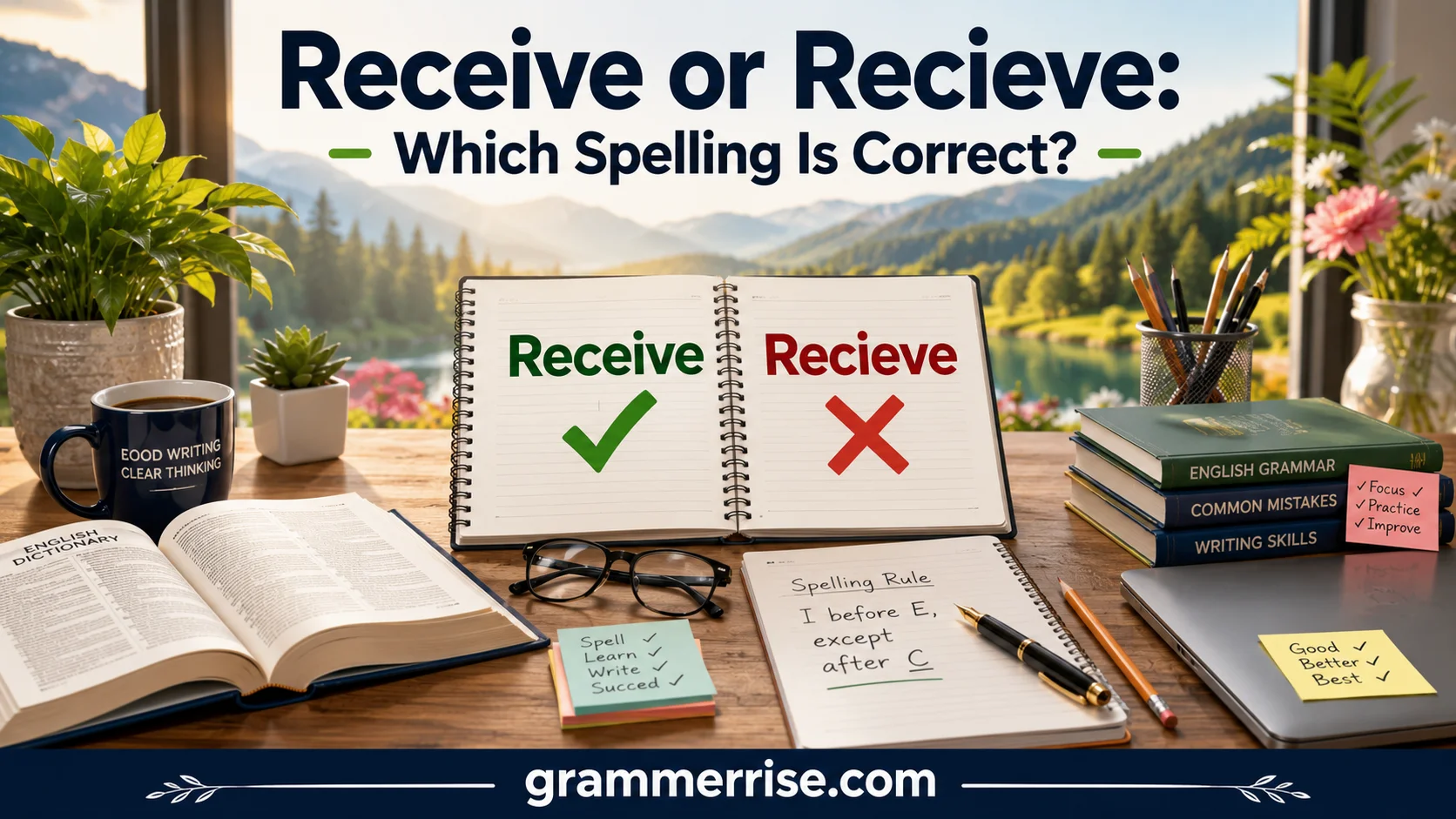
Many native speakers, students, professionals, and English learners often search for Receive or Recieve because the spelling looks similar and creates confusion. People may accidentally reverse the letters e and i while writing during fast typing. The ie and ei patterns in English words can feel unusual, but the correct word is receive, while recieve is an incorrect spelling. This spelling mistake can affect emails, essays, and professional documents.
The spelling rule becomes easier to remember with practice, repetition, and grammar rules. Using proofreading, editing, and reliable dictionary meaning helps writers improve writing accuracy and avoid common spelling errors. A clear understanding of word meaning, proper word choice, and correct usage supports better communication.
In business communication, academic writing, and digital communication, applying standard usage improves clarity and credibility. Following practical examples and quick rules helps people write the word confidently. Receive should always be used because recieve is considered wrong.
Quick Answer
| Word | Correct? | Meaning |
| Receive | ✅ Yes | To get, obtain, accept, or be given something |
| Recieve | ❌ No | Incorrect spelling |
Correct Examples
- I received your email this morning.
- She will receive an award for her achievements.
- We received the package yesterday.
- Customers usually receive a confirmation message after payment.
Incorrect Examples
- ❌ I recieved your email.
- ❌ She will recieve an award.
- ❌ We recieved the package.
Whenever you see recieve, remember that it is simply a spelling mistake.
Is It Receive or Recieve?
The correct spelling is receive.
The spelling recieve is incorrect and is considered a misspelling in standard English.
What Does Receive Mean?
The word receive is a verb that means to get, obtain, accept, or take possession of something that is given, sent, or delivered.
Dictionary Meaning
Receive means:
- To get something
- To be given something
- To accept something
- To take delivery of something
- To experience or undergo something
Everyday Examples
You can receive:
- Emails
- Gifts
- Packages
- Payments
- Messages
- Awards
- Information
- Medical treatment
- Instructions
Example Sentences
- I received a birthday gift from my friend.
- The company received thousands of applications.
- Students received their exam results online.
- The patient received immediate medical care.
- We received excellent customer service.
Notice that the word appears in both casual and professional communication. It is one of the most frequently used verbs in modern English.
Why Do People Spell Receive as Recieve?
The mistake usually happens because English spelling often feels counterintuitive.
Several factors contribute to the confusion.
The “I Before E” Problem
Many people learn the famous spelling rule:
“I before E except after C.”
However, they often forget the second part.
Since the word sounds like “re-seev,” many writers instinctively place the i before the e, creating recieve.
Pronunciation Can Be Misleading
English spelling doesn’t always match pronunciation perfectly.
Consider these words:
| Word | Pronunciation |
| Receive | re-SEEV |
| Believe | be-LEEV |
| Achieve | uh-CHEEV |
Because words like believe and achieve use “ie,” people sometimes assume receive follows the same pattern.
Typing Too Quickly
Modern communication encourages speed.
When writing emails, text messages, or reports, people often type rapidly and accidentally reverse the letters.
Reliance on Spell Check
Many writers depend heavily on autocorrect tools.
As a result, they may never fully learn the correct spelling and continue making the same mistake whenever spell check isn’t available.
The “I Before E Except After C” Rule Explained
One of the most famous spelling rules in English helps explain why receive is spelled correctly.
The Rule
I before E except after C.
This means:
- Use ie in most situations.
- Use ei when the letters come after c.
Examples Following the Rule
| Word | Pattern |
| Believe | ie |
| Achieve | ie |
| Chief | ie |
| Friend | ie |
| Receive | ei after c |
| Deceive | ei after c |
| Conceive | ei after c |
| Perceive | ei after c |
Because receive comes after the letter c, it follows the ei pattern.
Why the Rule Isn’t Perfect
English contains many exceptions.
For example:
| Word | Exception |
| Weird | Rule broken |
| Foreign | Rule broken |
| Height | Rule broken |
| Seize | Rule broken |
| Their | Rule broken |
These exceptions exist because English borrowed vocabulary from numerous languages including Latin, French, German, and Greek.
Even so, the rule works well for receive and many related words.
Receive vs Recieve: Side-by-Side Comparison
Sometimes a direct comparison makes things easier to remember.
| Feature | Receive | Recieve |
| Correct spelling | ✅ Yes | ❌ No |
| Found in dictionaries | ✅ Yes | ❌ No |
| Accepted in academic writing | ✅ Yes | ❌ No |
| Accepted in business writing | ✅ Yes | ❌ No |
| Accepted in professional communication | ✅ Yes | ❌ No |
| Used by native speakers | ✅ Yes | ❌ No |
The verdict is simple:
Receive is correct. Recieve is always wrong.
How to Remember the Correct Spelling of Receive
Learning a memory trick can save you years of confusion.
Remember the Letter C
The word contains:
C + EI
Think:
“After C comes EI.”
This directly follows the spelling rule.
Connect It to Related Words
Many related words use the same pattern.
- Receive
- Deceive
- Conceive
- Perceive
If you remember one, the others become easier too.
Visual Memory Trick
Break the word into parts:
Re + ceive
Notice how the letters ei sit immediately after the letter c.
Create a Mental Phrase
Try this sentence:
“The C receives the EI.”
It sounds unusual, which makes it memorable.
Practice Through Repetition
Write the word ten times:
- Receive
- Receive
- Receive
Simple repetition helps train muscle memory and improves spelling accuracy.
Common Words Similar to Receive
Many English words share the same spelling pattern.
Words Using EI After C
| Word | Meaning |
| Receive | Get something |
| Conceive | Form an idea |
| Perceive | Understand or notice |
| Deceive | Mislead |
| Ceiling | Upper interior surface |
Words Often Confused With Receive
| Word | Meaning |
| Believe | Accept as true |
| Achieve | Successfully accomplish |
| Relieve | Reduce pain or stress |
| Retrieve | Get back |
| Grieve | Feel sorrow |
Understanding these spelling families can improve your overall spelling skills.
Receive in Grammar and Sentence Structure
Since receive is a verb, it changes form depending on tense.
Verb Forms
| Tense Form | Example |
| Base Form | Receive |
| Present Simple | Receives |
| Past Tense | Received |
| Past Participle | Received |
| Present Participle | Receiving |
Present Tense Examples
- She receives emails daily.
- He receives many compliments.
Past Tense Examples
- I received the package yesterday.
- They received approval last week.
Future Tense Examples
- You will receive a confirmation email.
- Customers will receive updates shortly.
Continuous Form Examples
- We are receiving applications now.
- The office is receiving complaints.
These forms appear frequently in business, education, healthcare, and everyday communication.
Real-World Examples of Receive
The word appears almost everywhere.
Business Communication
Companies use receive constantly.
Examples:
- Receive invoices
- Receive payments
- Receive applications
- Receive customer feedback
Education
Schools regularly use the word.
Examples:
- Receive grades
- Receive certificates
- Receive scholarships
- Receive feedback
Healthcare
Medical professionals often use receive.
Examples:
- Receive treatment
- Receive medication
- Receive care
- Receive test results
Everyday Life
Most people use receive daily.
Examples:
- Receive a package
- Receive a text message
- Receive a phone call
- Receive an invitation
The word is remarkably versatile and appears across nearly every field.
Common Phrases and Expressions With Receive
Certain combinations occur frequently in English.
Popular Phrases
- Receive an email
- Receive a package
- Receive a gift
- Receive payment
- Receive recognition
- Receive support
- Receive treatment
- Receive instructions
- Receive approval
- Receive compensation
Examples in Sentences
- Employees receive annual bonuses.
- Patients receive professional care.
- Winners receive trophies.
- Customers receive discounts.
Learning these phrases improves both writing and speaking fluency.
Most Common Mistakes Related to Receive
Even when people know the spelling, other mistakes still occur.
Writing Recieve
This remains the most common error.
Incorrect:
❌ I recieved your letter.
Correct:
✅ I received your letter.
Using the Wrong Verb Form
Incorrect:
❌ I have receive your package.
Correct:
✅ I have received your package.
Mixing Receive and Accept
These words are related but different.
Receiving means getting something.
Accepting means agreeing to take it.
Forgetting the Past Tense
Incorrect:
❌ Yesterday I receive the report.
Correct:
✅ Yesterday I received the report.
Small grammar errors can affect professionalism and clarity.
Read more: Realy or Really: What is Common Mistakes?
Receive vs Accept: What’s the Difference?
Many learners confuse these two verbs.
Receive
Means getting something.
Example:
- I received a gift.
Accept
Means agreeing to take it.
Example:
- I accepted the gift.
Comparison Table
| Receive | Accept |
| Means getting something | Means agreeing to take something |
| May happen automatically | Usually involves choice |
| Focuses on obtaining | Focuses on approval |
Example Scenario
Imagine someone hands you flowers.
You receive them when they are given to you.
You accept them when you willingly agree to keep them.
That subtle difference matters in formal writing.
Receive in Digital Communication
Technology has made the word even more common.
Email Communication
Examples:
- Receive email notifications
- Receive newsletters
- Receive verification links
Mobile Messaging
Examples:
- Receive text messages
- Receive chat requests
- Receive alerts
Online Banking
Examples:
- Receive transfers
- Receive payments
- Receive refunds
E-Commerce
Examples:
- Receive order confirmations
- Receive shipping updates
- Receive tracking information
Digital communication has dramatically increased the frequency of this word in everyday life.
Origin and History of the Word Receive
Understanding a word’s history often makes its spelling easier to remember.
Latin Origins
Receive ultimately comes from the Latin word:
recipere
Meaning:
To take back, take in, or accept.
Old French Influence
The word later passed into Old French as:
receivre
Eventually it entered Middle English before becoming the modern word receive.
Why the Spelling Looks Unusual
English inherited spelling patterns from multiple languages.
As a result, some words preserve historical letter arrangements even when pronunciation changes.
Receive is one example of this linguistic history.
A Real-World Case Study: The Cost of a Simple Spelling Error
Imagine a job applicant submitting a resume.
Everything looks professional until the hiring manager notices:
“I recieved several awards during my career.”
The spelling mistake immediately creates doubt.
Even though the applicant may be highly qualified, attention to detail becomes questionable.
What Hiring Managers Often Notice
- Grammar errors
- Spelling mistakes
- Formatting issues
- Inconsistent language
A single typo rarely destroys an opportunity.
However, repeated spelling mistakes can affect credibility.
That’s why mastering commonly misspelled words like receive is worthwhile.
Quick Quiz: Can You Spot the Correct Spelling?
Choose the correct option.
Question 1
I _____ your message yesterday.
A. recieved
B. received
Answer: B
Question 2
Customers will _____ updates by email.
A. receive
B. recieve
Answer: A
Question 3
The school _____ hundreds of applications.
A. received
B. recieved
Answer: A
Question 4
She hopes to _____ an award.
A. recieve
B. receive
Answer: B
If you answered all four correctly, you’ve mastered the spelling.
Fun Facts About the Word Receive
Interesting Facts
- Receive is among the most frequently misspelled English words.
- The mistake “recieve” appears millions of times online despite being incorrect.
- The word traces its roots back more than 1,500 years.
- Receive follows one of the most famous spelling rules in English.
- Business emails often contain this word multiple times per day.
Quote Worth Remembering
“Good spelling is a sign of clear thinking and careful communication.”
While not every typo matters, consistent accuracy strengthens credibility.
FAQs
1. Is receive or recieve the correct spelling?
The correct spelling is receive. The word recieve is a common spelling mistake and is not accepted in standard English. The confusion usually happens because people mix up the position of the letters i and e.
2. Why do people spell receive as recieve?
Many people write recieve because the ie and ei combinations in English can be confusing. While typing quickly, writers may accidentally reverse the letters and create an incorrect spelling.
3. What is the easy way to remember the spelling of receive?
A helpful memory trick is the rule “i before e except after c.” Since receive has the letter c before ei, the correct form is receive, not recieve.
4. Can recieve be used in emails or formal writing?
No, recieve should not be used in emails, essays, business documents, or professional writing. Using the incorrect spelling can make your content appear less polished and may affect credibility.
5. Does receive have the same meaning in American and British English?
Yes, receive has the same meaning in both American English and British English. The spelling remains the same, so writers in both forms of English should use receive.
6. How can I avoid making the receive spelling mistake?
You can avoid this mistake by practicing correct spelling, proofreading your work, using grammar tools, and checking a reliable dictionary when you are unsure. Regular practice helps build stronger writing habits.
Conclusion
Understanding the difference between receive or recieve helps you avoid one of the most common English spelling mistakes. Although both forms may look similar, only receive is the correct spelling used in professional, academic, and everyday communication. The confusion mainly comes from the tricky ie and ei letter patterns, but learning the spelling rule and practicing regularly can make the correct form easier to remember.
Whether you are writing emails, essays, business documents, or online content, using the right spelling improves your clarity, credibility, and overall writing quality. A small spelling detail can make a big difference in how your message is understood. By proofreading your work and building strong language habits, you can confidently use receive correctly every time.