The keyword Vaccum or Vacuum creates spelling confusion because writers compare both forms before choosing the correct spelling in English today.
The vacuum and vacuum cleaner have a subtle difference, which is why many people become confused about their meanings. These words share something common, creating confusion in the first place. This explains why the word vacuum can work as a word itself and also become a part of the word phrase “vacuum cleaner.” This guide helps clarify and explain clearly the difference, commonality, and similar terminology through simple language, definition, usage, and context.
A vacuum cleaner is a household appliance, object, or device used for cleaning, while a vacuum can describe a concept or physical space that is entirely devoid of matter. The machine uses suction power and a cleaning tool to remove dirt and debris from carpets, floors, and surfaces.
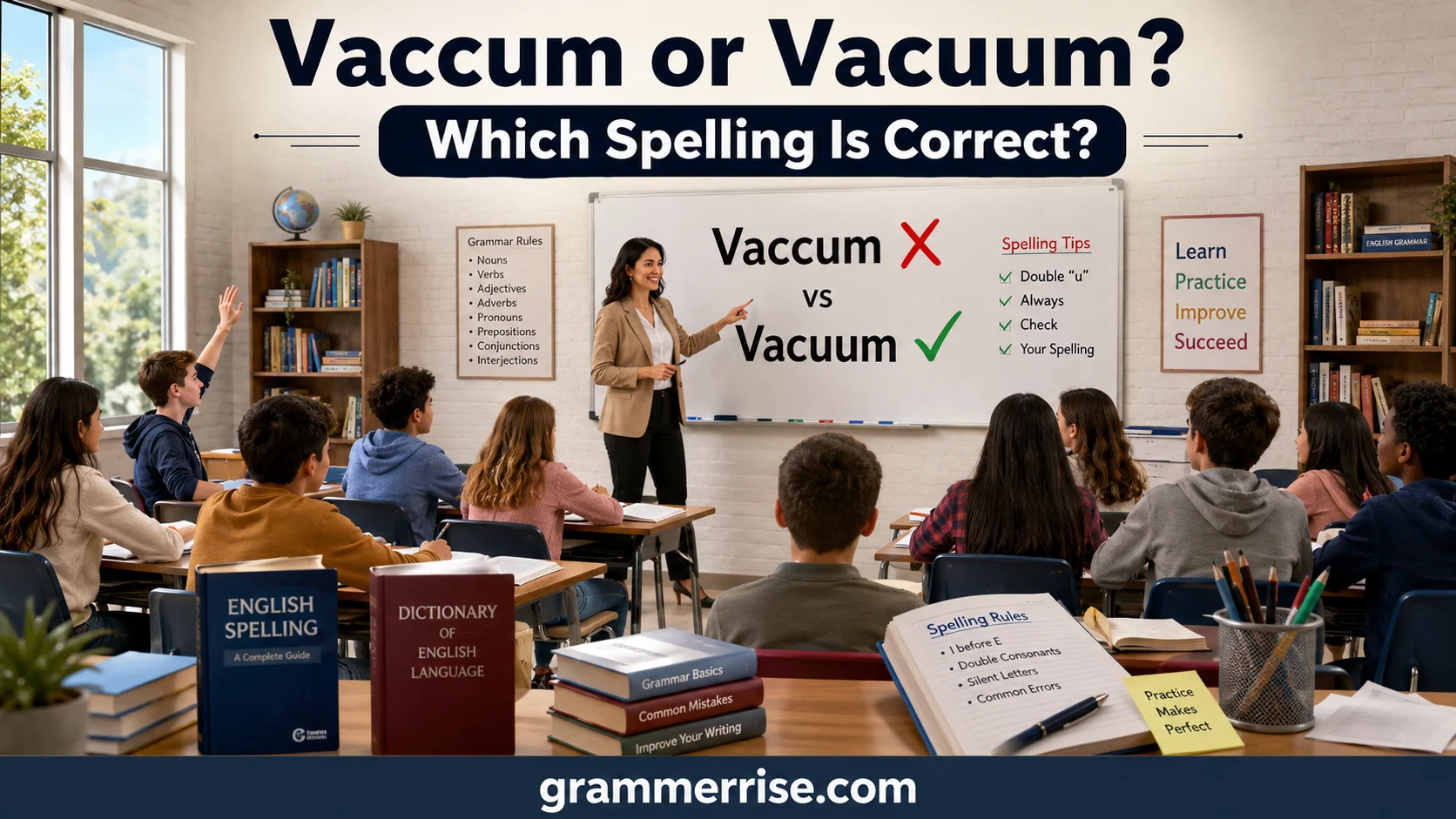
The main keyword is Vacuum, not Vaccum. The correct spelling is vacuum, while Vaccum is an incorrect spelling and a common misspelling caused by an unusual sequence of letters and English pronunciation. Many writers drop a letter, forget the double u, or replace the second u with c because the sound feels different when spoken.
Quick Answer
If you’re looking for the short answer, here it is:
| Word | Correct? |
| Vacuum | ✅ Yes |
| Vaccum | ❌ No |
The only correct spelling is vacuum.
Correct Examples
- I bought a new vacuum cleaner.
- Please vacuum the living room.
- Scientists created a vacuum chamber for testing.
Incorrect Examples
- I bought a new vaccum cleaner. ❌
- Please vaccum the carpet. ❌
- The vaccum chamber was sealed. ❌
Whenever you see vaccum, treat it as a spelling mistake. Standard dictionaries recognize only vacuum.
Why Do People Spell Vacuum as Vaccum?
Spelling mistakes usually happen for a reason. The confusion between vaccum and vacuum comes from several factors.
The Double-U Pattern Is Rare
One reason people misspell vacuum is that English rarely uses two consecutive “u” letters.
Most people are accustomed to seeing words like:
- Success
- Address
- Committee
- Occasion
These words contain double consonants. Because of this pattern, many writers instinctively expect another “c” instead of another “u.”
The brain often tries to force unfamiliar words into familiar spelling structures.
Pronunciation Creates Confusion
The pronunciation of vacuum doesn’t clearly reveal its spelling.
When spoken quickly, many people hear:
“vak-yoom”
The sound doesn’t strongly emphasize the second “u.” As a result, writers frequently omit it.
This happens with many English words where pronunciation doesn’t perfectly match spelling.
Fast Typing Leads to Errors
Typing quickly can also cause mistakes.
Many people accidentally write:
- Vacum
- Vaccum
- Vacume
- Vaccuum
The fingers often skip letters or duplicate the wrong character.
English Learners Face Additional Challenges
For people learning English as a second language, vacuum presents an unusual challenge.
Most languages don’t commonly use double vowels in the same way English does. As a result, the spelling can feel unnatural.
What Does Vacuum Mean?
Understanding a word’s meaning often makes its spelling easier to remember.
The word vacuum has multiple meanings.
Vacuum as a Noun
The most common use refers to a cleaning machine.
Household Appliance
A vacuum cleaner removes dirt and dust using suction.
Examples:
- The vacuum is stored in the closet.
- My vacuum cleaner needs a new filter.
- This vacuum works well on carpets.
Many people encounter the word for the first time in this context.
Empty Space
In science, vacuum refers to a space containing very little matter.
Examples:
- Outer space is nearly a vacuum.
- Scientists conducted experiments inside a vacuum chamber.
- Sound travels poorly through a vacuum.
This scientific definition existed before vacuum cleaners were invented.
Vacuum as a Verb
Vacuum can also function as a verb.
In this case, it means cleaning with a vacuum cleaner.
Examples:
- I vacuum the living room every Saturday.
- She vacuumed the entire house yesterday.
- We need to vacuum before guests arrive.
This dual role makes vacuum both a noun and a verb.
The Fascinating Origin of the Word Vacuum
Many spelling mysteries become easier once you explore a word’s history.
The word vacuum comes from the Latin word vacuus.
Meaning of Vacuus
The Latin term meant:
- Empty
- Unoccupied
- Void
- Free from contents
Ancient Romans used the word to describe spaces lacking substance.
Over time, English borrowed the term while preserving much of its original spelling.
Why the Double U Stayed
Unlike many borrowed words that changed dramatically, vacuum retained its unusual structure.
The double “u” traces directly back to its Latin roots.
That means the spelling isn’t random.
It’s actually a historical remnant that survived centuries of language evolution.
Historical Timeline
| Period | Development |
| Ancient Rome | Vacuus used in Latin |
| Middle Ages | Latin scholars continue usage |
| 1500s–1600s | Word enters English |
| Modern Era | Vacuum becomes scientific term |
| 1900s | Vacuum cleaner popularizes word |
The spelling remained remarkably stable throughout this journey.
Easy Tricks to Remember the Correct Spelling of Vacuum
Many people struggle with spelling until they find a memory trick that works.
Here are some of the most effective methods.
Remember: One C, Two U’s, One M
Break the word into parts:
VAC + UUM
This creates:
VACUUM
Think:
- One C
- Two U’s
- One M
Visual Memory Trick
Imagine the two U’s forming an empty container.
A vacuum creates empty space.
Those two U’s can represent that emptiness.
Phrase Method
Repeat:
“A vacuum has room for two U’s.”
This simple phrase helps many students remember the spelling instantly.
Spelling Pattern Formula
| Letter | Count |
| V | 1 |
| A | 1 |
| C | 1 |
| U | 2 |
| M | 1 |
Many spelling experts recommend memorizing the pattern instead of trying to sound it out.
Common Misspellings of Vacuum
Several spelling errors appear regularly online.
Most Frequent Mistakes
| Misspelling | Correct? |
| Vaccum | ❌ |
| Vacum | ❌ |
| Vaccuum | ❌ |
| Vacume | ❌ |
| Vaccume | ❌ |
| Vacuum | ✅ |
Why These Errors Happen
Vaccum
Writers double the C instead of the U.
Vacum
One U is accidentally omitted.
Vaccuum
Both the C and U are doubled.
Vacume
An unnecessary E gets added.
Vaccume
Several spelling mistakes occur simultaneously.
Only vacuum is accepted in standard English.
Vacuum in Everyday Sentences
Seeing words in context improves retention.
Home Cleaning Examples
- The vacuum cleaner stopped working.
- We bought a cordless vacuum last week.
- Please vacuum under the sofa.
- This vacuum removes pet hair easily.
Science Examples
- Scientists tested the material in a vacuum chamber.
- Light can travel through a vacuum.
- Space is often described as a near vacuum.
Business Examples
The word can also appear metaphorically.
- The company faced a leadership vacuum.
- The departure created a power vacuum.
- The organization quickly filled the management vacuum.
These figurative uses are common in journalism and business writing.
Read more: Useing or Using: Which Spelling Is Correct?
Vacuum Idioms and Popular Expressions
The word vacuum appears in several well-known expressions.
Power Vacuum
A power vacuum occurs when leadership suddenly disappears.
Example:
After the CEO resigned, a power vacuum emerged within the company.
Leadership Vacuum
This phrase describes a lack of strong leadership.
Example:
The team struggled because of a leadership vacuum.
Fill the Vacuum
This expression means stepping into an empty role.
Example:
A new manager quickly filled the vacuum left by her predecessor.
Vacuum-Sealed
Often used for packaging.
Example:
The coffee remained fresh because it was vacuum-sealed.
These expressions extend the meaning of vacuum beyond cleaning and science.
Vacuum vs Similar Misspellings
Many people search for variations of the same word.
Vacuum vs Vacum
| Word | Correct? |
| Vacuum | ✅ |
| Vacum | ❌ |
Vacum is missing one U.
Vacuum vs Vaccuum
| Word | Correct? |
| Vacuum | ✅ |
| Vaccuum | ❌ |
Vaccuum incorrectly doubles the C.
Vacuum vs Vacume
| Word | Correct? |
| Vacuum | ✅ |
| Vacume | ❌ |
Vacume incorrectly adds an E.
Vacuum vs Vaccume
| Word | Correct? |
| Vacuum | ✅ |
| Vaccume | ❌ |
Vaccume contains multiple spelling errors.
Whenever in doubt, remember:
One C. Two U’s. One M.
Is Vacuum Spelled Differently in American and British English?
Many English words differ between American and British spelling.
Examples include:
| American | British |
| Color | Colour |
| Favor | Favour |
| Center | Centre |
However, vacuum is not one of them.
American English
Vacuum ✅
British English
Vacuum ✅
The spelling remains identical on both sides of the Atlantic.
That means you never need to switch spellings based on audience location.
Case Study: Why So Many People Search “Vaccum”
Search engines process thousands of spelling-related searches daily.
One common pattern appears repeatedly.
People often:
- Hear the word.
- Guess the spelling.
- Type “vaccum.”
- Receive corrections.
- Learn the proper form.
This behavior shows how pronunciation influences spelling assumptions.
Language researchers call this a phonetic spelling error because people spell the word based on what they hear rather than its historical spelling.
Interesting Fact
Studies of common English spelling mistakes consistently place vacuum among the words people frequently misspell because of its uncommon double-vowel structure.
The Science Meaning of Vacuum Explained
Many people associate vacuum only with cleaning.
However, the scientific meaning is equally important.
What Is a Vacuum in Physics?
A vacuum is a region containing little or no matter.
Scientists use vacuum environments to conduct precise experiments.
Types of Vacuum
| Type | Description |
| Partial Vacuum | Reduced air pressure |
| High Vacuum | Very little matter present |
| Ultra-High Vacuum | Extremely low particle density |
Why Scientists Use Vacuums
Researchers use them to:
- Study particles
- Test electronics
- Manufacture semiconductors
- Simulate space conditions
Without vacuum technology, many modern innovations would not exist.
Vacuum Cleaner History
The word vacuum became far more familiar after the invention of vacuum cleaners.
Early Cleaning Methods
Before vacuum cleaners, people relied on:
- Brooms
- Carpet beaters
- Brushes
- Manual dust removal
Cleaning required much more effort.
Rise of Vacuum Technology
By the early twentieth century, vacuum cleaners transformed household cleaning.
Modern vacuums now include:
- Robot vacuums
- Cordless vacuums
- Wet-dry vacuums
- HEPA-filter vacuums
This widespread use made vacuum one of the most recognizable English words.
Common Grammar Lessons From Vacuum
The word vacuum teaches several valuable spelling principles.
English Doesn’t Always Follow Expectations
Writers often expect familiar patterns.
Vacuum reminds us that language contains exceptions.
Word Origins Matter
Many unusual spellings come from historical roots.
Understanding etymology often clarifies confusing words.
Memorization Beats Guessing
For unusual spellings, memorization remains the most reliable strategy.
Similar Words Frequently Misspelled
| Correct Word | Common Error |
| Vacuum | Vaccum |
| Separate | Seperate |
| Definitely | Definately |
| Occasion | Ocassion |
| Beginning | Begining |
These words often appear on lists of commonly misspelled English terms.
FAQs
1. Is “vaccum” a correct spelling?
No, vaccum is not the correct spelling. The correct spelling is vacuum. The incorrect form happens because many people accidentally remove the second u or replace it with another letter while writing.
2. Why do people confuse vacuum and vaccum?
People often confuse vacuum and vaccum because the pronunciation does not clearly highlight the double u. When spoken aloud, the word sounds simple, causing writers to make spelling mistakes.
3. What does the word vacuum mean?
The word vacuum has two main meanings. In science, it refers to a space that is completely empty or devoid of matter. In everyday language, it also refers to a cleaning device that removes dirt and debris.
4. Is a vacuum the same as a vacuum cleaner?
Not exactly. A vacuum describes an empty space without matter, while a vacuum cleaner is a household appliance that uses suction power to clean floors, carpets, and surfaces.
5. How can I remember the correct spelling of vacuum?
A simple trick is to remember that vacuum contains two u letters together. Think of the word as “vac + uum” to avoid dropping a letter when writing.
6. Do British and American English spell vacuum differently?
No, both British English and American English use the same spelling: vacuum. The spelling does not change based on the region, although pronunciation may slightly vary.
Conclusion
Choosing between vaccum or vacuum is easier once you understand the correct spelling and meaning behind the word. The right form is always vacuum, while vaccum is a common spelling mistake caused by confusion with pronunciation and letter patterns. Whether you are writing about science, household appliances, or cleaning tools, using the correct version helps your writing look professional and accurate.
Remember that vacuum can describe an empty space without matter, while a vacuum cleaner is a device designed to remove dirt and debris. A small spelling check can prevent mistakes in essays, emails, blogs, and professional documents. Once you learn the double u pattern, you’ll confidently use vacuum every time.

Hussain Abid is an English language writer with over 10 years of experience in grammar, spelling, vocabulary, and writing. He specializes in creating clear, well-researched content that helps readers improve their English with confidence. At GrammarRise, Hussain writes practical guides, grammar explanations, and word comparison articles based on trusted language sources and real-world usage. His mission is to make English learning simple, accurate, and accessible for everyone