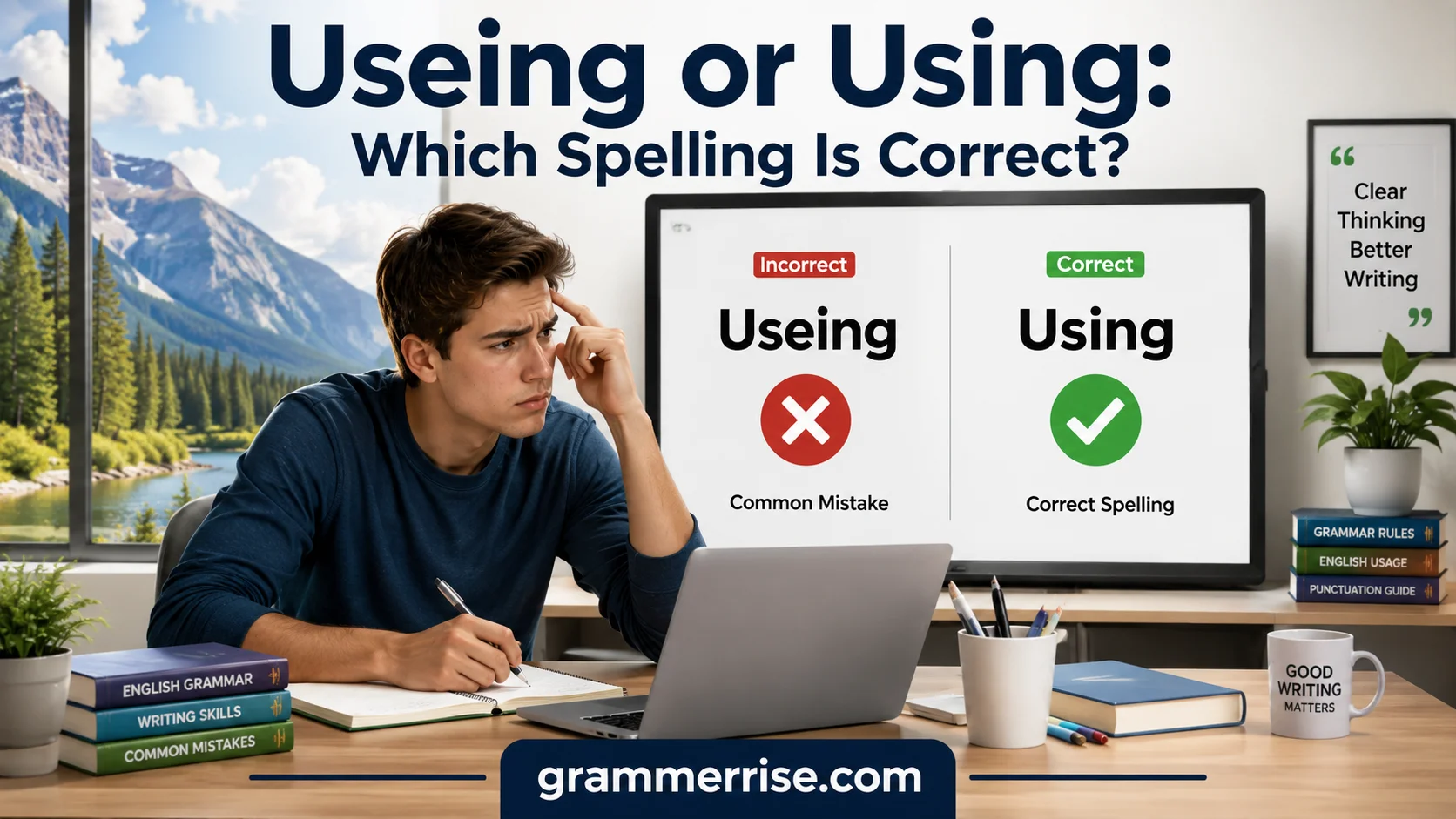
The Useing or Using debate confuses many writers, but learning the correct spelling rule helps English learners avoid mistakes in everyday writing.
Many English learners, students, bloggers, and native speakers have wondered about the correct spelling of using and useing while writing. This spelling confusion happens when adding endings to words because the base word use changes when adding -ing creates a new form. English grammar follows a different rule, where the correct form is using and useing becomes an incorrect spelling in standard English. This common mistake appears in everyday writing, texts, emails, and assignments, especially when people typed quickly, paused, and faced spelling doubts because both forms look possible.
This guide explains the difference between using vs useing through practical examples, real-life examples, and simple techniques that help you remember the correct usage every time. The English spelling rules, language rules, and verb endings improve writing skills, vocabulary, and English usage. The clear answer is simple: using is the only correct form. This article solves the problem by explaining British rules, American rules, and examples from written English.
Quick Answer
If you’re looking for a quick answer, here it is:
| Word | Correct? |
| Using | ✅ Yes |
| Useing | ❌ No |
The correct spelling is using.
The incorrect spelling is useing.
Correct Examples
- I am using a new laptop.
- She is using the latest software.
- We are using a better strategy this year.
- They are using online resources for research.
Incorrect Examples
- I am useing a new laptop.
- She is useing the latest software.
- We are useing a better strategy.
- They are useing online resources.
Every major dictionary recognizes using as the standard spelling. The word useing does not appear as an accepted English word.
Why Is Using Correct?
To understand why using is correct, you need to understand how English forms present participles.
The word using comes from the base verb use.
When English verbs end with a silent e, that e is usually dropped before adding -ing.
Understanding the Root Word “Use”
The word use can function as both a noun and a verb.
As a verb, it means:
To employ something for a purpose.
Examples:
- Use a pencil.
- Use your skills.
- Use the software correctly.
- Use available resources wisely.
As a noun, it refers to the purpose or function of something.
Examples:
- The tool has many uses.
- This machine has limited use.
When we want to show an ongoing action, we add -ing.
That’s where using comes from.
The Grammar Rule Behind Using
English follows a common spelling pattern.
When a verb ends in a silent e, the final e is usually removed before adding -ing.
For example:
| Base Verb | Remove E | Add ING | Result |
| Use | Us | ing | Using |
| Make | Mak | ing | Making |
| Write | Writ | ing | Writing |
| Drive | Driv | ing | Driving |
| Smile | Smil | ing | Smiling |
| Share | Shar | ing | Sharing |
This rule explains why useing is incorrect.
The silent e must disappear before -ing is added.
Step-by-Step Formation
Let’s break it down.
Step 1: Start with the verb use
Step 2: Remove the silent e
Use → Us
Step 3: Add -ing
Us + ing = Using
That’s the entire process.
Simple rules often solve what appears to be a complicated spelling problem.
Why Do People Write “Useing”?
Even though using is correct, many people still type useing.
There are several reasons why this happens.
Pronunciation Creates Confusion
The word use contains a long vowel sound.
Because of the way it sounds, some writers assume the e should remain when adding -ing.
They think:
Use + ing = Useing
It looks logical at first glance.
However, English spelling rules don’t work that way.
Overgeneralizing Other English Words
English contains words where letters remain during word formation.
Because writers see those patterns elsewhere, they sometimes apply them incorrectly to use.
This is especially common among English learners.
Typing Errors
Fast typing often leads to spelling mistakes.
Someone may know the correct spelling but accidentally write useing during:
- Emails
- Text messages
- Essays
- Social media posts
- Business reports
Spellcheck usually catches the mistake immediately.
Influence of Early Learning
Many children learn pronunciation before spelling.
As a result, they often spell words according to how they sound rather than according to spelling rules.
This habit can continue into adulthood if the mistake isn’t corrected.
Examples of Using in Sentences
Seeing words in context helps reinforce correct spelling.
Everyday Conversation Examples
- I’m using my phone right now.
- She’s using a recipe from her grandmother.
- They’re using public transportation today.
- We’re using less electricity this month.
Academic Writing Examples
- Students are using online databases for research.
- Scientists are using advanced technology to collect data.
- Researchers are using machine learning models.
- Universities are using digital learning platforms.
Business Communication Examples
- Our team is using a new project management system.
- The company is using artificial intelligence tools.
- Employees are using cloud storage services.
- Managers are using performance metrics to evaluate results.
Technology Examples
- Developers are using Python for automation.
- Businesses are using data analytics to improve decisions.
- Consumers are using mobile payment systems.
- Designers are using AI-powered software.
Common Verbs That Follow the Same Rule
The spelling rule behind using appears throughout English.
Many verbs drop the final silent e before adding -ing.
| Verb | Correct Form |
| Use | Using |
| Make | Making |
| Write | Writing |
| Drive | Driving |
| Smile | Smiling |
| Arrive | Arriving |
| Hope | Hoping |
| Share | Sharing |
| Create | Creating |
| Improve | Improving |
Notice a pattern?
The silent e disappears almost every time.
Once you understand this rule, dozens of spelling decisions become easier.
Exceptions to the Silent E Rule
English loves exceptions.
While most verbs drop the silent e, some keep it.
Cases Where the E Stays
Certain words retain the e to preserve pronunciation.
Examples include:
| Word | ING Form |
| Dye | Dyeing |
| Singe | Singeing |
| Hoe | Hoeing |
These exceptions exist because removing the e would create confusion.
Consider this example:
- Dyeing = coloring fabric
- Dying = approaching death
Without the e, the meanings become completely different.
Why English Has Exceptions
English developed from several languages including:
- Old English
- Latin
- French
- Germanic languages
- Norse languages
Because of this mixed heritage, some spelling rules contain exceptions.
Fortunately, using is not one of those exceptions.
The standard rule applies perfectly.
Using Meaning and Definition
The word using serves as the present participle and gerund form of use.
Dictionary Definition
Using means:
Employing, utilizing, applying, or making use of something.
Examples of Meaning
- Using a tool
- Using a computer
- Using experience
- Using information
- Using resources
In every case, the word describes applying something for a purpose.
Read more: Weird or Wierd: Which Spelling Is Correct?
Common Contexts for Using
The word appears across countless situations.
Technology
- Using software
- Using smartphones
- Using cloud computing
Education
- Using textbooks
- Using research materials
- Using learning platforms
Business
- Using analytics
- Using customer feedback
- Using automation tools
Daily Life
- Using kitchen appliances
- Using transportation
- Using communication apps
Because the word appears so frequently, spelling it correctly matters.
Frequently Confused Spellings Similar to Useing
The confusion surrounding useing is not unique.
Many English words create similar challenges.
Ageing or Aging
American English generally prefers:
✅ Aging
British English often uses:
✅ Ageing
Both forms can be correct depending on regional usage.
Hoeing or Hoing
Correct:
✅ Hoeing
Incorrect:
❌ Hoing
The extra e remains to preserve pronunciation.
Dyeing or Dying
This is one of English’s most famous spelling distinctions.
| Word | Meaning |
| Dyeing | Coloring material |
| Dying | Approaching death |
One small letter changes everything.
Cueing or Cuing
Both forms appear in modern English.
However, cueing remains more common in many style guides.
These examples show why spelling rules matter.
Small differences often create major changes in meaning.
Memory Trick to Remember the Correct Spelling
A simple memory trick can prevent future mistakes.
The Formula
Use
− e
+ ing
=
Using
Whenever you’re unsure, remember this formula.
Easy Mnemonic
Think of it this way:
The silent “e” steps aside to make room for “-ing.”
That visual image helps many students remember the rule instantly.
Another Helpful Trick
Compare these words:
- Use → Using
- Make → Making
- Write → Writing
If you already know those spellings, using follows the same pattern.
Common Mistakes to Avoid
Even experienced writers occasionally make spelling mistakes.
Here are the most common errors involving using.
Keeping the Silent E
Incorrect:
❌ Useing
Correct:
✅ Using
Relying Entirely on Autocorrect
Autocorrect helps.
However, it isn’t perfect.
Proofreading remains important.
Mixing Sound and Spelling
Many spelling errors occur because writers spell words exactly as they hear them.
English often requires learning spelling patterns rather than relying on pronunciation.
Ignoring Grammar Rules
Understanding why a word is spelled correctly makes mistakes less likely.
Memorization helps.
Understanding helps even more.
Real-World Case Study: How a Small Spelling Error Affects Credibility
Imagine two job applicants.
Applicant A
I am useing advanced data analysis tools.
Applicant B
I am using advanced data analysis tools.
Both applicants possess identical skills.
However, the second sentence immediately appears more professional.
Research consistently shows that spelling errors can influence perceptions of:
- Credibility
- Professionalism
- Attention to detail
- Competence
One extra letter may seem insignificant.
In professional communication, though, details matter.
Quick Comparison Table: Useing vs Using
| Feature | Useing | Using |
| Correct spelling | ❌ | ✅ |
| Dictionary approved | ❌ | ✅ |
| Used in schools | ❌ | ✅ |
| Used in business writing | ❌ | ✅ |
| Grammatically correct | ❌ | ✅ |
| Accepted worldwide | ❌ | ✅ |
The verdict couldn’t be clearer.
Using wins every time.
Fun Facts About the Word “Using”
Here are a few interesting language facts.
Fact #1
Using ranks among the most frequently written English verbs because it appears in technology, education, business, and everyday communication.
Fact #2
The verb use originated from the Latin word usus, meaning practice, employment, or habit.
Fact #3
Modern English adopted the word through Old French before it became the spelling we recognize today.
Fact #4
Search engines receive thousands of monthly searches related to spelling confusion between useing and using.
Fact #5
Most spelling errors involving using happen because writers follow pronunciation instead of grammar rules.
Expert Writing Tips for Avoiding Similar Mistakes
Want to avoid spelling errors beyond just using?
Try these strategies.
Learn Patterns Instead of Individual Words
Patterns reduce memorization.
When you learn:
- Use → Using
- Make → Making
- Write → Writing
You learn dozens of words at once.
Read More Often
Frequent reading exposes you to correct spellings naturally.
The more you see words used correctly, the easier they become to remember.
Proofread Slowly
Fast proofreading misses mistakes.
Read one sentence at a time.
You’ll catch more errors.
FAQs
1. Is “useing” or “using” the correct spelling?
The correct spelling is using. The word useing is incorrect in standard English. When you add -ing to the verb use, the final e is removed, creating the correct form using.
2. Why do people confuse using with useing?
Many people confuse using and useing because English spelling rules can sometimes feel unpredictable. Since the base word is use, writers may think adding -ing directly creates useing. However, English follows a specific spelling rule where the final e is dropped before adding -ing.
3. How can I remember the correct spelling of using?
A simple technique is to remember that most verbs ending with a silent e drop that letter before adding -ing. For example, use becomes using, make becomes making, and write becomes writing. This rule can help you avoid similar spelling mistakes.
4. Is useing ever acceptable in English writing?
No, useing is not considered a correct spelling in modern English. You should always write using in emails, assignments, professional documents, social media posts, and other forms of written communication.
5. Does the rule for using apply to British and American English?
Yes, both British English and American English follow the same spelling rule for this word. Whether you are writing for a UK audience or a US audience, using is the correct form, and useing should be avoided.
6. What is the easiest way to explain the difference between using and useing?
The easiest explanation is that using is the present participle form of use, while useing is a spelling mistake. The final e is removed before adding -ing, which makes using the only correct choice.
Conclusion
The difference between using or useing may seem small, but understanding this spelling rule can improve your everyday writing and communication skills. The correct form is always using because English removes the final e from use before adding -ing. Once you remember this simple pattern, you can avoid this common mistake in emails, assignments, social media posts, and professional writing.
Spelling mistakes are a natural part of learning any language, but knowing the rules makes improvement easier. Whether you are a student, blogger, or professional writer, choosing the correct spelling helps your content look more accurate and polished. Keep practicing, follow English spelling rules, and you’ll never need to question using or useing again.

Hussain Abid is an English language writer with over 10 years of experience in grammar, spelling, vocabulary, and writing. He specializes in creating clear, well-researched content that helps readers improve their English with confidence. At GrammarRise, Hussain writes practical guides, grammar explanations, and word comparison articles based on trusted language sources and real-world usage. His mission is to make English learning simple, accurate, and accessible for everyone