Understanding Addition vs Edition helps writers avoid mistakes by learning how added elements differ from versions, releases, and content. I still remember a confusing mistake in my writing when I described a new addition of a book as an edition. A colleague corrected me because I had mixed up these terms, and that experience showed the importance of understanding the subtle differences in English. Addition refers to something added to an existing thing, while edition refers to a version, printing, release, or publication of a product.
By learning the meanings, grammar, and usage patterns, writers can avoid mistakes and clearly understand how to correctly use these terms in everyday, professional, and academic contexts. This guide covers definitions, examples, sentence structures, and phrase choices that improve communication, writing skills, accuracy, and proper usage. A book edition, latest edition, additional element, or added feature can change the original, revised, or published material, helping readers build knowledge, make a comparison, and understand the distinction between vocabulary, English grammar, and English usage.
The context makes the difference easier to remember because these words can be confusing. Many writers mistake them because they are homophones with similar sounds, appearing alike while being spelled differently. I studied Charles’s history book collection for years to find the perfect way to describe this difference because words can delight or mystify readers. A clear example provides clarity, tips, and guidance for using addition and edition correctly. In mathematical contexts and practical contexts, addition means the sum of two or more quantities, parts, or members joined to form new structures, groups, and features. The inclusion of existing items and new items appears in classroom lessons and complex calculations, where added numbers and sets are explained clearly.
Quick Answer
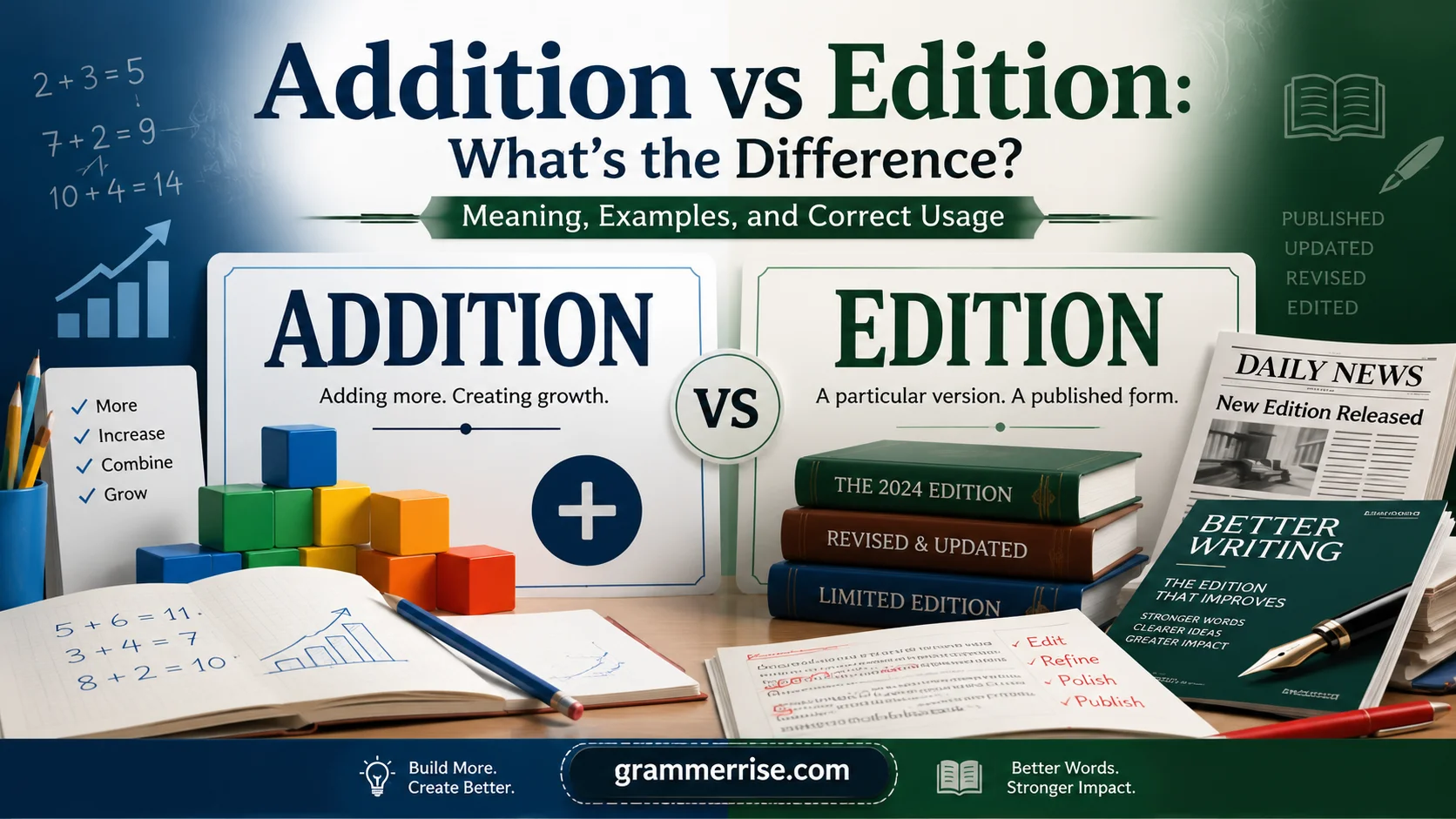
Addition means something extra is added to an existing thing, while edition means a specific version, release, or published form of something. For example, a new chapter is an addition, but a revised book version is a new edition.
Addition vs Edition at a Glance
Before diving deeper, here’s a quick overview.
| Word | Meaning | Common Contexts |
| Addition | Something added or the act of adding | Math, construction, business, writing |
| Edition | A specific published version of something | Books, newspapers, magazines, software |
Quick Memory Trick
Think about the root words:
- Addition comes from add
- Edition is related to edit and publishing
If something is being added, use addition.
If you’re talking about a version of a publication, use edition.
What Does Addition Mean?
The word addition refers to the process of adding something or something that has already been added.
In simple terms, whenever something increases, expands, grows, or gets attached to something else, the word addition may be appropriate.
Definition of Addition
According to standard English dictionaries, addition means:
The action of adding something to something else.
It can also refer to:
- An increase
- An enhancement
- An extra item
- A mathematical operation
Origin of the Word Addition
The word comes from the Latin word additio, meaning “a joining or adding to.”
For centuries, English speakers have used addition to describe growth, increase, and accumulation.
Addition in Mathematics
Most people first encounter the word addition in school.
Addition is one of the four basic arithmetic operations.
For example:
| Equation | Result |
| 2 + 2 | 4 |
| 15 + 10 | 25 |
| 125 + 375 | 500 |
Example sentence:
Learning addition helps children understand how numbers combine to create larger values.
Addition as Something Extra
Beyond mathematics, addition can also describe something extra that is included or added to an existing thing.
It can describe anything new that becomes part of an existing thing.
Examples:
- A new bedroom added to a house
- A new employee joining a company
- Extra content added to a report
- New features added to software
Example sentences:
- The new garage is a valuable addition to the property.
- Sarah’s hiring was a great addition to the marketing team.
- The report includes an addition explaining recent changes.
Addition in Construction
Construction professionals frequently use this term.
Examples include:
- Room additions
- Home additions
- Building expansions
Case Study:
A family living in a three-bedroom house decides they need more space. Instead of moving, they build another bedroom and bathroom onto the structure.
This new section is called a home addition.
Addition in Business
Businesses constantly grow through additions.
Common examples:
- New employees
- Product features
- Services
- Departments
For example:
A company launches live chat support.
The live chat feature becomes a valuable addition to customer service.
Examples of Addition in Sentences
Here are several examples:
- The library received a valuable addition of rare historical documents.
- The chef’s new dessert is a welcome addition to the menu.
- The school announced the addition of three science laboratories.
- The software update includes an addition that improves security.
- The new stadium is a significant addition to the city.
What Does Edition Mean?
Unlike addition, edition refers to a specific version of a published work.
Whenever books, newspapers, magazines, journals, software products, or digital publications are released in different forms or updates, the word edition becomes relevant.
Definition of Edition
An edition is:
A particular form or version of a published text, product, or work.
The content may be identical or revised depending on the publication.
Origin of the Word Edition
Edition comes from the Latin word editio, which means “publication.”
This origin helps explain why the word remains closely connected to publishing today.
Book Editions
Books commonly appear in multiple editions.
Examples include:
- First Edition
- Second Edition
- Revised Edition
- Updated Edition
- Collector’s Edition
Example:
A textbook published in 2020 may receive a revised edition in 2025 to include new research and updated information.
Newspaper Editions
Newspapers often publish different editions throughout the day.
Examples:
- Morning Edition
- Evening Edition
- Weekend Edition
- Special Edition
Example sentence:
The breaking news appeared in the evening edition of the newspaper.
Magazine Editions
Magazines frequently release:
- Monthly editions
- Anniversary editions
- Holiday editions
- Special editions
Collectors often seek limited-edition magazine releases because of their rarity.
Software Editions
Technology companies use editions to distinguish product versions.
Examples:
| Software | Editions |
| Microsoft Windows | Home, Pro, Enterprise |
| SQL Server | Express, Standard, Enterprise |
| Adobe Products | Student, Professional Editions |
Each edition contains different features.
Examples of Edition in Sentences
- I purchased the latest edition of the law textbook.
- The first edition of the novel is worth thousands of dollars.
- The newspaper released a special edition after the election.
- The software’s enterprise edition includes advanced security tools.
- She owns a collector’s edition of the comic book.
Addition vs Edition: The Key Differences
Although the words appear similar, their meanings are entirely different.
Side-by-Side Comparison
| Feature | Addition | Edition |
| Meaning | Something added | A specific version |
| Related To | Growth and increase | Publishing and releases |
| Common Use | Construction, business, math | Books, media, software |
| Root Word | Add | Edit |
| Example | Room addition | Third edition |
The Simple Rule
Ask yourself:
Is something being added?
Use addition.
Is it a version of a publication or product?
Use edition.
Example Comparison
Incorrect:
- I bought the newest addition of the textbook.
Correct:
- I bought the newest edition of the textbook.
Incorrect:
- The company announced a new edition to the staff.
Correct:
- The company announced a new addition to the staff.
Why People Confuse Addition and Edition
Several factors contribute to this common mistake.
Similar Spelling
The words differ by only one letter.
Compare:
- Addition
- Edition
At a quick glance, they appear nearly identical.
Read more: Axle vs Axel: What’s the Difference and Which One Is Correct?
Similar Pronunciation
When spoken rapidly, some speakers pronounce the words similarly.
This can cause confusion during writing.
Context Overlap
Sometimes a new edition contains additions.
For example:
A revised textbook edition often includes additions such as:
- New chapters
- Updated statistics
- Additional examples
This overlap causes many writers to accidentally swap the words.
When to Use Addition
Use addition whenever you’re discussing something that has been added.
Common Situations
- Mathematical calculations
- Home expansions
- Team growth
- New product features
- Supplemental information
Correct Examples
- The office welcomed a new addition to the accounting department.
- The restaurant’s vegan menu is a popular addition.
- The architect designed a large home addition.
- The software update includes an important addition for privacy protection.
Common Errors
Wrong:
- The fifth addition of the textbook was released this year.
Correct:
- The fifth edition of the textbook was released this year.
When to Use Edition
Use edition whenever discussing a published version.
Common Situations
- Books
- Newspapers
- Journals
- Magazines
- Software packages
Correct Examples
- The second edition includes updated research.
- The collector’s edition sold out immediately.
- Students must purchase the latest edition of the textbook.
- The enterprise edition contains advanced reporting tools.
Common Errors
Wrong:
- The company announced a new edition to its workforce.
Correct:
- The company announced a new addition to its workforce.
Addition and Edition in Publishing
Publishing creates one of the biggest sources of confusion.
People often hear:
“This edition includes several additions.”
That sentence is actually correct because both words serve different purposes.
Understanding the Difference
Imagine a publisher updates a textbook.
The publisher:
- Adds new chapters
- Adds fresh examples
- Adds updated statistics
These are additions.
After publishing the updated book, the publisher releases a new edition.
Real Example
| Action | Correct Word |
| Added two new chapters | Addition |
| Released updated textbook version | Edition |
| Included new case studies | Addition |
| Published revised version | Edition |
The additions help create the new edition.
Addition vs Edition in Academic Writing
Students frequently mix these words.
Common Student Mistakes
Incorrect:
- My professor requires the latest addition of the chemistry textbook.
Correct:
- My professor requires the latest edition of the chemistry textbook.
Incorrect:
- The university announced a new edition to the engineering faculty.
Correct:
- The university announced a new addition to the engineering faculty.
Why Accuracy Matters
Academic writing values precision.
Using the wrong word may confuse readers or create an impression of weak proofreading.
Real-Life Examples of Addition and Edition
In Books
- First edition of a novel
- Revised edition of a textbook
Construction
- Home addition
- Office addition
Business
- Addition of a new manager
- Addition of new services
Technology
- Security feature addition
- Professional software edition
Education
- New teacher addition
- Updated textbook edition
Commonly Confused Word Pairs Related to Addition vs Edition
Addition vs Addendum
| Word | Meaning |
| Addition | Something added |
| Addendum | Supplementary material added to a document |
Edition vs Revision
| Word | Meaning |
| Edition | Published version |
| Revision | Process of updating content |
A revision often leads to a new edition.
Edition vs Version
Many people use these interchangeably.
However:
- Edition usually refers to published works.
- Version can refer to almost any variation of a product.
Addition vs Inclusion
An inclusion is something contained within a group.
An addition is something newly introduced.
Grammar Tips to Avoid the Mistake
Here are simple strategies.
Ask Yourself These Questions
- Is something being added?
- Is something increasing?
- Is something expanding?
If yes, choose addition.
Now ask:
- Is this a book version?
- Is this a publication release?
- Is this a software package variation?
If yes, choose edition.
Easy Decision Chart
Something added?
│
Yes
│
Addition
│
No
▼
Published version?
│
Yes
│
Edition
Another Helpful Trick
Remember:
ADDition = ADD something
EDition = EDITED version
That tiny memory shortcut prevents most mistakes.
Addition vs Edition Quiz
Test your understanding.
Fill in the Blanks
- The publisher released the third _____ of the novel.
- The new swimming pool is a valuable _____ to the property.
- The software’s premium _____ includes extra tools.
- The company announced the _____ of five new employees.
- I purchased the latest _____ of the textbook.
- The kitchen _____ increased the home’s value.
- The newspaper published a special _____ after the event.
- The museum’s new exhibit is an exciting _____.
- The revised _____ contains updated statistics.
- The team welcomed another _____ this season.
Answers
| Question | Answer |
| 1 | Edition |
| 2 | Addition |
| 3 | Edition |
| 4 | Addition |
| 5 | Edition |
| 6 | Addition |
| 7 | Edition |
| 8 | Addition |
| 9 | Edition |
| 10 | Addition |
FAQs
1. What is the main difference between addition and edition?
The main difference is that addition means something extra is added to an existing thing, while edition refers to a specific version, release, or publication. For example, adding a new chapter to a book is an addition, but a newly released version of that book is a new edition.
2. Can addition and edition be used when talking about books?
Yes, both words can appear in book-related discussions, but they have different meanings. A book edition refers to a particular published version, such as the first edition or revised edition. An addition refers to extra content added to the book, such as a new section, chapter, or feature.
3. Why do people confuse addition and edition?
People often confuse these words because they sound similar and look closely related. They are also commonly used in similar contexts involving books, products, and changes. Understanding their meanings and usage patterns makes it easier to choose the correct word.
4. How can I remember when to use addition?
Think of addition as something being added. It connects with the idea of increasing, joining, or including something new. In mathematics, addition means combining numbers, while in everyday use it means an extra element, feature, or item added to something existing.
5. How is edition used outside of books?
Although edition is commonly associated with books, it is also used for magazines, newspapers, software, digital products, broadcasts, and other media. For example, a software update may introduce a new edition with improved features, changes, or updated content.
6. What is an easy way to avoid mistakes between addition and edition?
A simple trick is to focus on the meaning. If you are talking about something extra being included, use addition. If you are talking about a version, release, or published form of something, use edition. Checking the context of the sentence will usually reveal the correct choice.
Conclusion
Understanding the difference between addition vs edition becomes much easier once you focus on their meanings and context. While both words may sound similar, they represent completely different ideas. Addition is about including something extra, increasing a quantity, or adding a new element to an existing thing. Edition, however, describes a particular version, release, or published form of something, such as a book, magazine, software product, or digital content.
Using these words correctly improves your writing accuracy, communication, and confidence in everyday, professional, and academic situations. Whether you are describing a new feature, a revised book, or a mathematical operation, choosing the right term helps readers understand your message clearly. By remembering that an addition is something added and an edition is a version, you can easily avoid common mistakes and use both words with greater precision.

Hussain Abid is an English language writer with over 10 years of experience in grammar, spelling, vocabulary, and writing. He specializes in creating clear, well-researched content that helps readers improve their English with confidence. At GrammarRise, Hussain writes practical guides, grammar explanations, and word comparison articles based on trusted language sources and real-world usage. His mission is to make English learning simple, accurate, and accessible for everyone