Label or Lable creates confusion for many English users because the correct spelling, label, is often mixed with the wrong form lable in writing.
Many people search for lable or label every month because they are unsure which form is correct. Even experienced writers, bloggers, students, and professionals sometimes get confused because both words look similar, and English pronunciation can make the incorrect version seem acceptable. However, label is the correct spelling in standard English, while lable is an incorrect form caused by typing errors, fast typing, and common spelling habits. These spelling mistakes happen because English contains many tricky spellings, and repeated use of a wrong form can create spelling confusion between pronunciation, spelling patterns, and written forms.
A label means a small piece of paper, fabric, or plastic that is attached to an object to provide information. You can see labels on clothing, food, and packaging that display product contents, origin, and instructions. This complete guide helps you learn the difference, meanings, and usage of the word label through real-life examples, grammar tips, and memory tricks. Whether you create a school assignment, product description, business email, social media post, or digital content, using the correct form improves English accuracy, writing accuracy, and clear communication.
Quick Answer
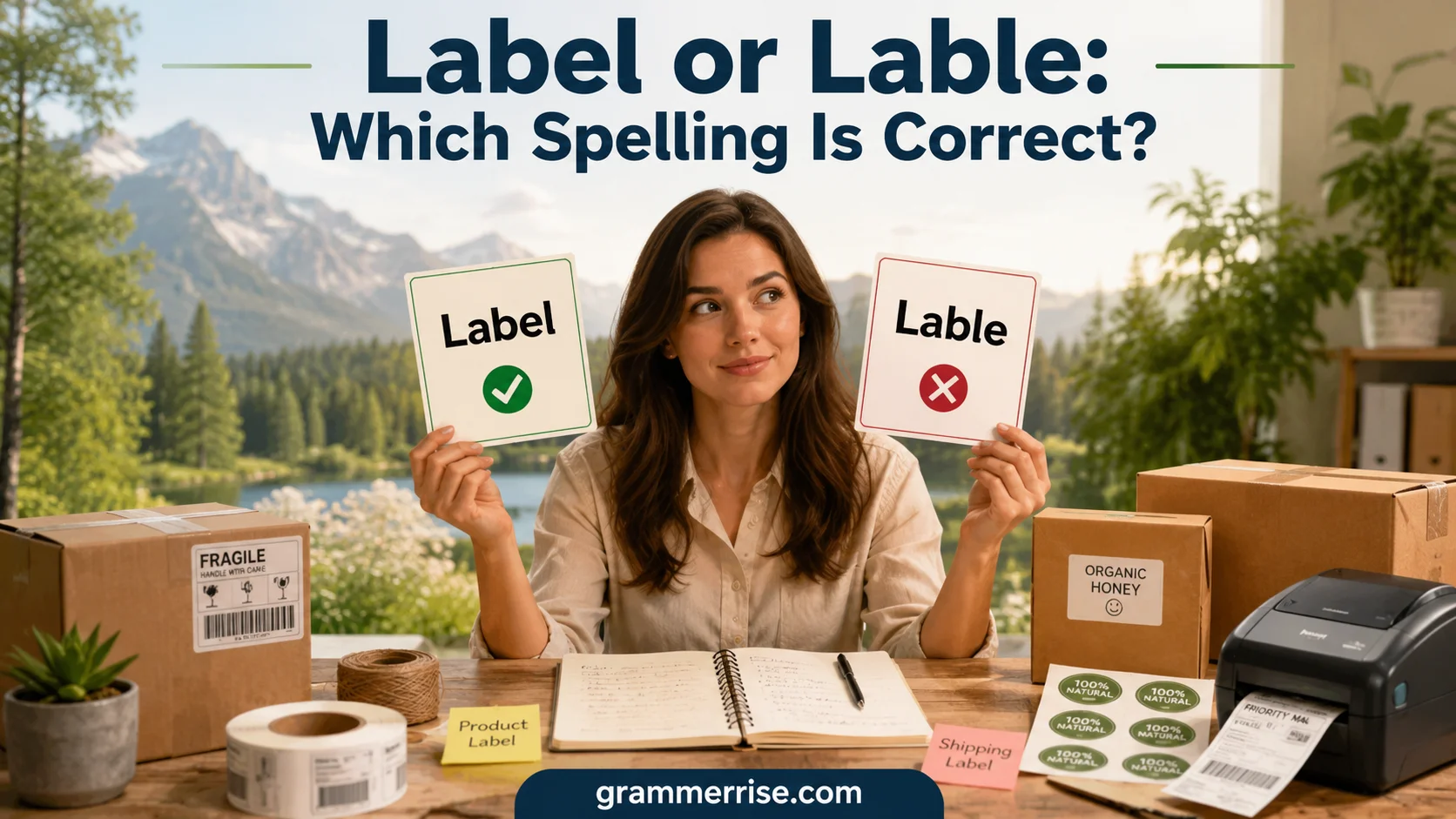
Label is the correct spelling, while Lable is an incorrect spelling mistake. The word label refers to a tag, name, description, or category used to identify something. For example, a product label shows important details like ingredients, price, or instructions. Always use label in your writing because lable is not recognized as a standard English word.
Label or Lable: Which Spelling Is Correct?
The correct spelling is label.
Lable is incorrect and does not appear as a standard English word in modern dictionaries.
Many people accidentally write lable because the pronunciation of “label” can make the second vowel sound less noticeable. When people type quickly, they often rearrange letters or skip the second “e” sound.
Here is the correct comparison:
| Word | Correct or Incorrect | Meaning |
| Label | ✅ Correct | A tag, name, description, or category |
| Lable | ❌ Incorrect | Common spelling mistake |
Correct Examples
- Please read the label before using the medicine.
- The company added a new label to its products.
- Scientists label samples carefully during experiments.
Incorrect Examples
- Please check the lable on the bottle. ❌
- The box has a shipping lable. ❌
The correct version in both sentences is label.
What Does Label Mean?
The word label has multiple meanings depending on how you use it. It can work as both a noun and a verb.
In simple terms, a label is something that gives information, identifies something, or places something into a category.
For example, a sticker on a package showing the product name is a label. A description used to classify someone or something can also be called a label.
According to standard English usage, label means a piece of information attached to an object or a name used to identify or describe something.
Label as a Noun
As a noun, label refers to a physical or mental identifier.
Examples:
- A clothing tag showing size and brand is a label.
- A jar has a label that lists ingredients.
- A person may receive a social label based on assumptions.
Label as a Verb
As a verb, label means to attach information, name something, or describe something.
Examples:
- Workers label boxes before shipping them.
- Scientists label test tubes to avoid mistakes.
- People sometimes unfairly label others.
Why Do People Misspell Label as Lable?
The mistake lable happens frequently because English spelling does not always perfectly match pronunciation.
Many words contain silent or reduced sounds that confuse writers. The word label is one of them.
Read more: Separate or Seperate: Meaning, Examples and Common Mistakes
Common Reasons People Write Lable
Letter Order Confusion
When typing quickly, people sometimes place letters in the wrong order.
For example:
- Label → Correct
- Lable → Incorrect
The brain recognizes the general shape of the word, so a small letter swap can happen easily.
Pronunciation Confusion
The second syllable in label sounds softer than the first.
The pronunciation is:
Label → LAY-buhl
Because the final “el” sound is not strongly emphasized, some writers forget the second “e.”
Typing Habits
Digital communication has increased spelling mistakes because people often type quickly on phones. Autocorrect may fix some mistakes, but it does not always recognize unusual errors.
Learning English as a Second Language
English learners often struggle with words where pronunciation and spelling do not perfectly match.
Examples:
- Label
- Vegetable
- Comfortable
- Different
These words require memorization because sound alone does not always reveal spelling.
Label Meaning as a Noun
The noun label has several practical meanings in everyday life.
Product Labels
Product labels provide important information about items.
A food label may include:
- Ingredients
- Nutrition facts
- Expiration date
- Manufacturer details
- Usage instructions
For example, when you buy cereal, the box label tells you what is inside and how much nutritional value it provides.
Clothing Labels
Clothing labels help customers understand:
- Brand name
- Fabric type
- Size
- Washing instructions
- Country of manufacture
A shirt without a label can make it difficult to know how to properly care for the fabric.
Warning Labels
Warning labels protect consumers by highlighting possible risks.
Examples:
- “Keep away from children.”
- “Do not consume.”
- “Flammable material.”
These small labels can prevent accidents and encourage safe usage.
Shipping Labels
Shipping companies use labels to move packages efficiently.
A shipping label usually contains:
- Sender information
- Receiver information
- Tracking number
- Barcode
- Delivery instructions
Without accurate labels, packages can easily be delayed or delivered incorrectly.
Label Meaning as a Verb
When you use label as a verb, it describes the action of adding information or classification.
Labeling Products
Businesses label products to help customers identify and understand what they are buying.
Example:
A coffee company labels each package with the roast type, origin, and expiration date.
Labeling Files and Documents
Organizations use labels to organize digital information.
Examples:
- Labeling computer folders
- Labeling emails
- Labeling research documents
Proper labeling saves time because people can find information faster.
Labeling People
The word label can also describe assigning a category to a person.
For example:
- “He was labeled a leader because of his teamwork skills.”
However, labeling people can sometimes create unfair assumptions.
A person is more complex than a single description. A label may describe one quality, but it does not represent the entire individual.
Label vs Lable: Side-by-Side Comparison
| Feature | Label | Lable |
| Correct spelling | ✅ Yes | ❌ No |
| Dictionary word | ✅ Yes | ❌ No |
| Used professionally | ✅ Yes | ❌ No |
| Used in academic writing | ✅ Yes | ❌ No |
| Common mistake | Sometimes | Very common |
The difference is simple: label is a real English word, while lable is only a spelling error.
Label in British English vs American English
A common question is whether British and American English spell this word differently.
The answer is no.
Both versions use:
Label
However, some related forms change.
| Meaning | American English | British English |
| Present form | Label | Label |
| Past tense | Labeled | Labelled |
| Present participle | Labeling | Labelling |
Examples:
American English:
- The company labeled the product clearly.
British English:
- The company labelled the product clearly.
Both forms are correct depending on the variety of English.
Common Forms of the Word Label
The word label changes depending on grammar usage.
Label
Base form:
- Please label the folders.
Labels
Plural noun or third-person verb:
- The bottles have different labels.
- She labels every package carefully.
Labeled
American English past tense:
- The boxes were labeled yesterday.
Labelled
British English past tense:
- The boxes were labelled yesterday.
Labeling
American English:
- Labeling files improves organization.
Labelling
British English:
- Labelling products requires accuracy.
Label Used in Everyday Life
Labels are part of almost every area of modern life.
You interact with labels daily without thinking about them.
Shopping
Stores use labels for:
- Prices
- Sizes
- Brands
- Product details
Education
Teachers use labels to organize:
- Student materials
- Classroom supplies
- Learning categories
Healthcare
Medical professionals use labels to identify:
- Medicine containers
- Patient information
- Laboratory samples
Business
Companies depend on labels for:
- Inventory management
- Branding
- Customer communication
Technology
Digital platforms use labels to organize:
- Emails
- Photos
- Files
- Online content
Label in Technology and Digital Communication
The meaning of label has expanded because of technology.
Today, labels are not only physical stickers. They also exist digitally.
Data Labeling in Artificial Intelligence
Artificial intelligence systems use labeled data to learn patterns.
For example:
A computer vision system may use thousands of labeled images to recognize objects.
A photo labeled “cat” helps an AI model understand what a cat looks like.
Email Labels
Email services use labels to organize messages.
Instead of placing every message into one folder, users can apply multiple labels.
Examples:
- Work
- Personal
- Important
- Travel
Programming Labels
Developers use labels in different programming environments to organize information or identify sections.
The Psychology of Labels
Labels do more than organize objects. They also influence how people think.
A product label helps customers understand what they are buying. However, labels applied to people can have deeper effects.
For example:
Calling someone “lazy” creates a negative impression, even if that person only struggled in one situation.
A better approach is to describe actions rather than define people.
Instead of:
“She is careless.”
Try:
“She made a mistake in this situation.”
Words shape perception.
Common Phrases With Label
The word label appears in many common expressions.
Product Label
Meaning: Information attached to a product.
Example:
- Always check the product label before purchasing.
Warning Label
Meaning: A notice about possible danger.
Example:
- The warning label explains how to safely use the chemical.
Record Label
Meaning: A company that produces and promotes music.
Example:
- The singer signed with a major record label.
Private Label
Meaning: Products created for a retailer and sold under its brand.
Example:
- Many supermarkets offer private label products.
Nutrition Label
Meaning: Food information showing calories and nutrients.
Example:
- The nutrition label shows the amount of sugar per serving.
How to Remember the Correct Spelling of Label
Remembering label becomes easier with simple tricks.
Memory Trick
Think:
“A label has an extra E before L.”
Label:
L A B E L
Not:
L A B L E
Visual Method
Write the word several times:
- Label
- Label
- Label
Repeated exposure helps your brain recognize the correct pattern.
Proofreading Tip
When checking your writing, look for unusual words. If “lable” appears, replace it immediately with “label.”
Words Commonly Confused With Label
Label vs Tag
A label usually provides information.
A tag often refers to a physical attachment.
Example:
- Shirt label = size and washing details
- Price tag = cost information
Label vs Sticker
A sticker is something attached with adhesive.
A label may be printed directly or attached.
Label vs Brand
A brand represents identity.
A label provides information.
Example:
- Nike is a brand.
- A shoe size sticker is a label.
Quick Quiz: Label or Lable?
Choose the correct spelling:
1. The bottle has a nutrition _____.
Answer: label
2. Workers must _____ every package.
Answer: label
3. The shipping _____ contains the tracking number.
Answer: label
The correct choice is always label.
FAQs
1. Is “lable” a correct spelling in English?
No, lable is not a correct spelling in standard English. The correct spelling is label. The incorrect form usually happens because of typing mistakes, spelling habits, or confusion caused by pronunciation.
2. Why do people confuse label and lable?
People often confuse label and lable because both spellings look very similar. English pronunciation does not always match spelling patterns, so some writers accidentally add an extra “e” sound while writing the word.
3. What does the word label mean?
A label is a tag, sticker, or piece of material attached to something to provide information. Labels are commonly found on products, clothing, food packages, and documents to show details like names, contents, instructions, or origins.
4. How can I remember the correct spelling of label?
A simple memory trick is to remember that label has only one “l” after the first syllable and does not contain the extra “e” found in lable. Practicing the correct spelling in daily writing can help avoid mistakes.
5. Is label used differently in British and American English?
The spelling label is the same in both British English and American English. However, some related words may have small spelling differences between the two varieties, but label remains unchanged.
6. How can using the correct spelling of label improve my writing?
Using the correct spelling of label makes your writing clearer and more professional. Whether you are creating emails, assignments, product descriptions, or online content, accurate spelling improves communication and builds trust with readers.
Conclusion
Understanding the difference between label or lable helps you avoid a common English spelling mistake. While lable may look correct because of pronunciation or repeated online usage, it is not accepted in standard English. The correct word is label, and it is used for tags, names, descriptions, and information attached to products or objects.
Improving your spelling accuracy requires attention to small details, regular practice, and learning common word patterns. Whether you are a student, writer, blogger, or professional, using the correct spelling of label makes your communication clearer and more reliable. By remembering the simple rule that label is the only accepted form, you can write confidently and avoid this confusion in the future.