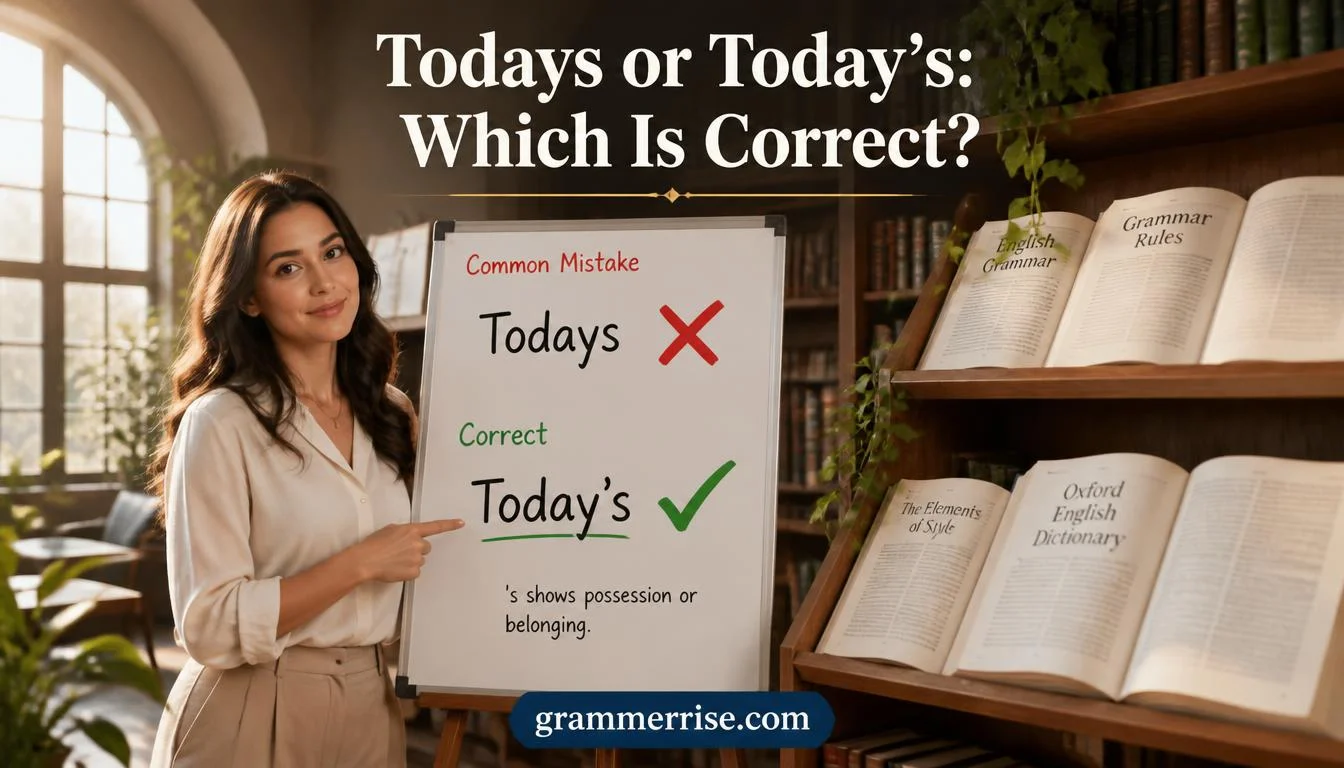
Todays or Today’s can confuse English learners, but today’s is correct for possession or “of today,” while today names the current day in English.
The main difference between today, today’s, and todays comes from their grammatical function. Today is the standard word for the current day, while today’s uses an apostrophe to express possession or the meaning “of today.” In standard English, todays without an apostrophe is generally considered an incorrect spelling when you intend the possessive form.
This distinction becomes especially important in professional writing, academic work, emails, social media posts, and everyday communication. When you mean something connected with the current day, such as “today’s meeting” or “today’s news,” the apostrophe is necessary. When you simply refer to the current day, use today, as in “I’ll finish it today.” Understanding this simple rule can improve grammatical accuracy, spelling, punctuation, and overall writing clarity.
The confusion often comes from the similar appearance of these forms rather than from complicated grammar rules. Today’s can function as a possessive form, while today works as a normal adverb or noun depending on the sentence. By checking the intended meaning and sentence structure, you can quickly choose the correct word and avoid common spelling mistakes.

Quick Answer
Today’s is the correct form in almost all everyday writing because it shows possession or serves as a contraction of “today is.” For example, today’s weather, today’s meeting, and today’s date are all correct. On the other hand, todays without an apostrophe is usually considered a mistake in standard English. While it can occasionally appear as a rare plural noun in creative or literary writing, most writers will never need to use it. A simple way to remember the rule is this: if something belongs to the current day or relates to the current day, use today’s. If you can replace it with “of today” and the sentence still makes sense, the apostrophe belongs there.
What Does “Today” Mean?
Before comparing todays vs today’s, it helps to understand the base word: today.
The word today refers to the current day. Depending on the sentence, it can function as either a noun or an adverb.
Today as a Noun
When used as a noun, today refers to the present day.
Examples:
- Today is beautiful.
- Today feels different from yesterday.
- Today has been productive.
Today as an Adverb
When used as an adverb, today describes when something happens.
Examples:
- I am leaving today.
- She arrives today.
- We will finish the project today.
Understanding this foundation makes it easier to see why today’s requires an apostrophe.
Today’s vs. Todays: The Key Difference
The main difference comes down to possession and grammar.
| Word | Correct? | Meaning |
| Today | ✅ | The current day |
| Today’s | ✅ | Belonging to today or today is |
| Todays | ❌ Usually incorrect | Rare plural use in literature |
Most of the time, when people write todays, they actually mean today’s.
Quick Rule
If something belongs to, relates to, or happens on the current day, use today’s.
Examples:
- Today’s weather
- Today’s schedule
- Today’s lesson
- Today’s headlines
- Today’s meeting
In each example, something is connected to the current day.
Why “Today’s” Is Correct
The apostrophe in today’s shows possession.
Think of it this way:
- Today + ’s = Today’s
- Meaning: belonging to today
Examples
| Phrase | Meaning |
| Today’s weather | Weather of today |
| Today’s news | News of today |
| Today’s agenda | Agenda for today |
| Today’s lesson | Lesson for today |
A useful trick is to replace today’s with of today.
If the sentence still makes sense, today’s is probably correct.
Example
Today’s weather is sunny.
Becomes:
The weather of today is sunny.
The meaning remains clear, which confirms that today’s is correct.
Can “Today’s” Mean “Today Is”?
Yes. This is a rule many people overlook.
Besides showing possession, today’s can also function as a contraction of today is.
Examples
- Today’s going to be a busy day.
- Today’s the deadline.
- Today’s not as cold as yesterday.
- Today’s the perfect opportunity.
In these examples, the apostrophe replaces the missing letters in is.
Expanded Versions
| Contraction | Full Form |
| Today’s going to rain. | Today is going to rain. |
| Today’s the day. | Today is the day. |
| Today’s not easy. | Today is not easy. |
Context helps readers determine whether today’s shows possession or acts as a contraction.
Is “Todays” Ever Correct?
Surprisingly, yes—but only in very rare situations.
Most grammar guides focus only on everyday writing. However, there are occasional literary uses of todays as a plural noun.
Literary Example
A writer might compare different periods of life:
Our yesterdays shaped our todays.
Here, todays refers to multiple present moments or different versions of the present.
Why Most Writers Should Avoid It
Although technically possible, this usage rarely appears in business writing, academic writing, journalism, or everyday communication.
For practical purposes:
- Use today when referring to the current day.
- Use today’s when showing possession or meaning “today is.”
- Avoid todays unless writing creative literature.
Today’s Date or Todays Date?
This is one of the most common grammar questions.
Correct
✅ Today’s date
Incorrect
❌ Todays date
The date belongs to the current day, so possession is involved.
Examples
- Please write today’s date at the top of the page.
- Today’s date appears on the invoice.
- Verify today’s date before submitting the application.
A missing apostrophe instantly stands out to many readers.
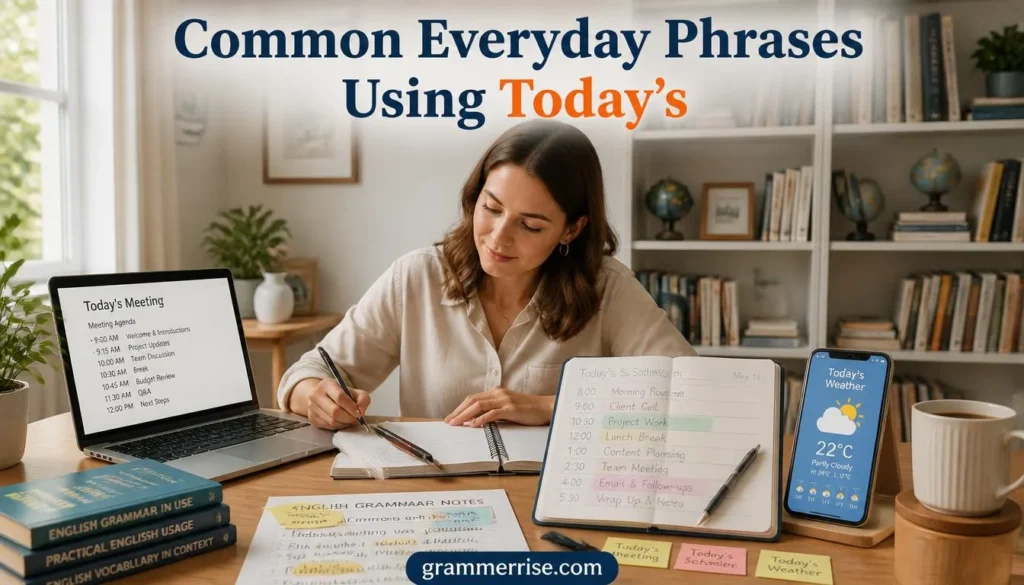
Common Everyday Phrases Using Today’s
Certain expressions appear constantly in daily communication.
Today’s Meeting
Business professionals use this phrase every day.
Examples:
- Today’s meeting starts at 10 a.m.
- The agenda for today’s meeting has changed.
- Everyone should prepare for today’s meeting.
Today’s Schedule
This phrase appears in schools, workplaces, and events.
Examples:
- Today’s schedule is packed.
- Please review today’s schedule.
- Today’s schedule includes three workshops.
Today’s Weather
Weather forecasts frequently use this expression.
Examples:
- Today’s weather looks perfect.
- Check today’s weather before traveling.
- Today’s weather may affect outdoor events.
Today’s News
News organizations often use this phrase.
Examples:
- Today’s news focuses on the economy.
- Here are today’s top stories.
- Today’s news cycle is particularly busy.
Today’s Assignment
Common in educational settings.
Examples:
- Complete today’s assignment before class ends.
- Today’s assignment covers grammar fundamentals.
- Review today’s assignment carefully.
Common Mistakes People Make With Today’s
Even experienced writers occasionally make mistakes with apostrophes.
Forgetting the Apostrophe
This is the most frequent error.
❌ Todays lesson
✅ Today’s lesson
Using the Wrong Apostrophe Placement
Some writers incorrectly add the apostrophe after the s.
❌ Todays’
✅ Today’s
Confusing Today and Today’s
Many people accidentally swap these forms.
| Incorrect | Correct |
| Today weather is warm. | Today’s weather is warm. |
| Today meeting starts early. | Today’s meeting starts early. |
| What is todays date? | What is today’s date? |
Relying on Autocorrect
While modern software catches many mistakes, it doesn’t always identify every grammatical error.
A quick manual review helps prevent embarrassing mistakes.
Today vs. Today’s
Although the words look similar, they perform different jobs.
Today
Use today when referring directly to the current day.
Examples:
- I am traveling today.
- We finish the project today.
- She arrives today.
Today’s
Use today’s when showing possession or replacing “today is.”
Examples:
- Today’s presentation was excellent.
- Today’s weather feels pleasant.
- Today’s the day we launch the website.
Comparison Table
| Sentence | Correct Form |
| I will leave today. | Today |
| Today’s lesson was interesting. | Today’s |
| Today’s going to be exciting. | Today’s |
| We finish the report today. | Today |

Examples of Today’s in Sentences
Seeing examples in context helps the rule stick.
Workplace Examples
- Today’s presentation exceeded expectations.
- Today’s conference call begins at noon.
- Today’s report contains important updates.
- Today’s budget meeting requires preparation.
School Examples
- Today’s homework focuses on grammar.
- Today’s lesson covers punctuation.
- Today’s quiz is open-book.
- Today’s classroom discussion was engaging.
Business Examples
- Today’s sales figures show strong growth.
- Today’s market conditions remain stable.
- Today’s customer feedback was positive.
- Today’s performance metrics look promising.
Everyday Examples
- Today’s dinner smells amazing.
- Today’s workout felt challenging.
- Today’s traffic was surprisingly light.
- Today’s sunset looked beautiful.
Incorrect vs. Correct Examples
Many grammar mistakes become obvious when viewed side by side.
| Incorrect | Correct |
| Todays weather is sunny. | Today’s weather is sunny. |
| Todays schedule changed. | Today’s schedule changed. |
| What is todays date? | What is today’s date? |
| Todays headlines are interesting. | Today’s headlines are interesting. |
| Todays meeting starts now. | Today’s meeting starts now. |
Memory Trick: Never Confuse Them Again
Here is a simple technique that works almost every time.
The “Of Today” Test
Replace today’s with of today.
If the sentence still makes sense, use today’s.
Examples
| Original Sentence | Test |
| Today’s news matters. | News of today matters. |
| Today’s lesson was useful. | Lesson of today was useful. |
| Today’s weather is warm. | Weather of today is warm. |
Because the replacement works, the apostrophe is needed.
Another Easy Trick
Ask yourself:
Does something belong to today?
If the answer is yes, use today’s.

Related Grammar Rules You Should Know
Learning similar patterns helps reinforce the rule.
Yesterday vs. Yesterday’s
Examples:
- Yesterday was busy.
- Yesterday’s meeting lasted two hours.
Tomorrow vs. Tomorrow’s
Examples:
- Tomorrow will be exciting.
- Tomorrow’s event is sold out.
Week vs. Week’s
Examples:
- The week passed quickly.
- This week’s schedule is full.
Month vs. Month’s
Examples:
- The month ended strongly.
- This month’s revenue increased.
Year vs. Year’s
Examples:
- The year moved quickly.
- This year’s results exceeded expectations.
Comparison Table
| Base Word | Possessive Form |
| Today | Today’s |
| Yesterday | Yesterday’s |
| Tomorrow | Tomorrow’s |
| Week | Week’s |
| Month | Month’s |
| Year | Year’s |
Notice the consistent pattern. Add ’s when showing possession.
Real-World Case Study: A Small Apostrophe, A Big Impression
Imagine two job applicants sending emails to a hiring manager.
Applicant One
Please find attached todays report.
Applicant Two
Please find attached today’s report.
The second version appears more polished and professional.
While a missing apostrophe may seem minor, grammar mistakes can affect credibility. Employers, teachers, editors, and clients often notice these details.
Strong writing creates trust.
Read more: Lets or Let’s: Which Is Correct Meaning?
Why Apostrophes Matter in Professional Writing
Apostrophes may be small, yet they carry significant meaning.
Benefits of Correct Apostrophe Usage
- Improves clarity
- Strengthens professionalism
- Prevents misunderstandings
- Enhances readability
- Builds credibility
Poor punctuation can distract readers from your message.
Good punctuation lets your ideas shine.
Quick Grammar Cheat Sheet
| Situation | Correct Form |
| The current day | Today |
| Something belongs to today | Today’s |
| Today is | Today’s |
| Plural literary use | Todays (rare) |
| Today’s date | ✅ |
| Today’s weather | ✅ |
| Todays weather | ❌ |
| Todays date | ❌ |
My Personal Experience as an English Specialist
As an English specialist, I’ve often seen learners confuse “Todays” and “Today’s.” Many people leave out the apostrophe because both forms sound the same when spoken. I usually explain that “today” means the current day, while “today’s” means something related to today, such as “today’s lesson” or “today’s weather.”
I’ve found that the easiest trick is to replace “today’s” with “of today.” If the sentence still makes sense, the apostrophe is needed. This simple method has helped many learners avoid the common mistake of writing “todays” in emails, assignments, and professional documents.
FAQs
1. Is “todays” a correct word in English?
No, todays is generally incorrect in standard English when you mean “of today.” The correct possessive form is today’s, with an apostrophe.
2. When should I use “today’s”?
Use today’s when something belongs to, relates to, or happens as part of today. For example, “I read today’s newspaper” means the newspaper published for today.
3. Is “today’s” always possessive?
Not always. Today’s can also be a contraction of today is or today has. For example, “Today’s a busy day” means “Today is a busy day.”
4. What is the difference between “today” and “today’s”?
Today refers to the current day, while today’s usually means “of today” or shows possession. For example, “I’m working today” differs from “I’m checking today’s schedule.”
5. Can “todays” ever be used without an apostrophe?
In ordinary standard English, todays is not normally used as the plural or possessive form of today. If you mean something belonging to today, write today’s.
6. Which is correct: “Todays news” or “Today’s news”?
Today’s news is correct because the apostrophe shows that the news is associated with today. Todays news is a common spelling mistake.
Conclusion
Choosing between Todays, Today’s, and Today is easier once you focus on meaning rather than appearance. Today refers to the current day, while today’s shows possession or means “of today.” Todays is generally not the correct standard English form. Although the apostrophe looks like a small detail, using it correctly can make your writing clearer, more polished, and grammatically accurate. When you’re unsure, simply ask yourself: Am I talking about the day itself, or something belonging to or connected with today? That quick check will usually lead you to the right choice.

Hussain Abid is an English language writer with over 10 years of experience in grammar, spelling, vocabulary, and writing. He specializes in creating clear, well-researched content that helps readers improve their English with confidence. At GrammarRise, Hussain writes practical guides, grammar explanations, and word comparison articles based on trusted language sources and real-world usage. His mission is to make English learning simple, accurate, and accessible for everyone