Lets or Let’s can confuse experienced writers, students, and professionals because both forms sound the same when spoken, but they have different purposes in English.
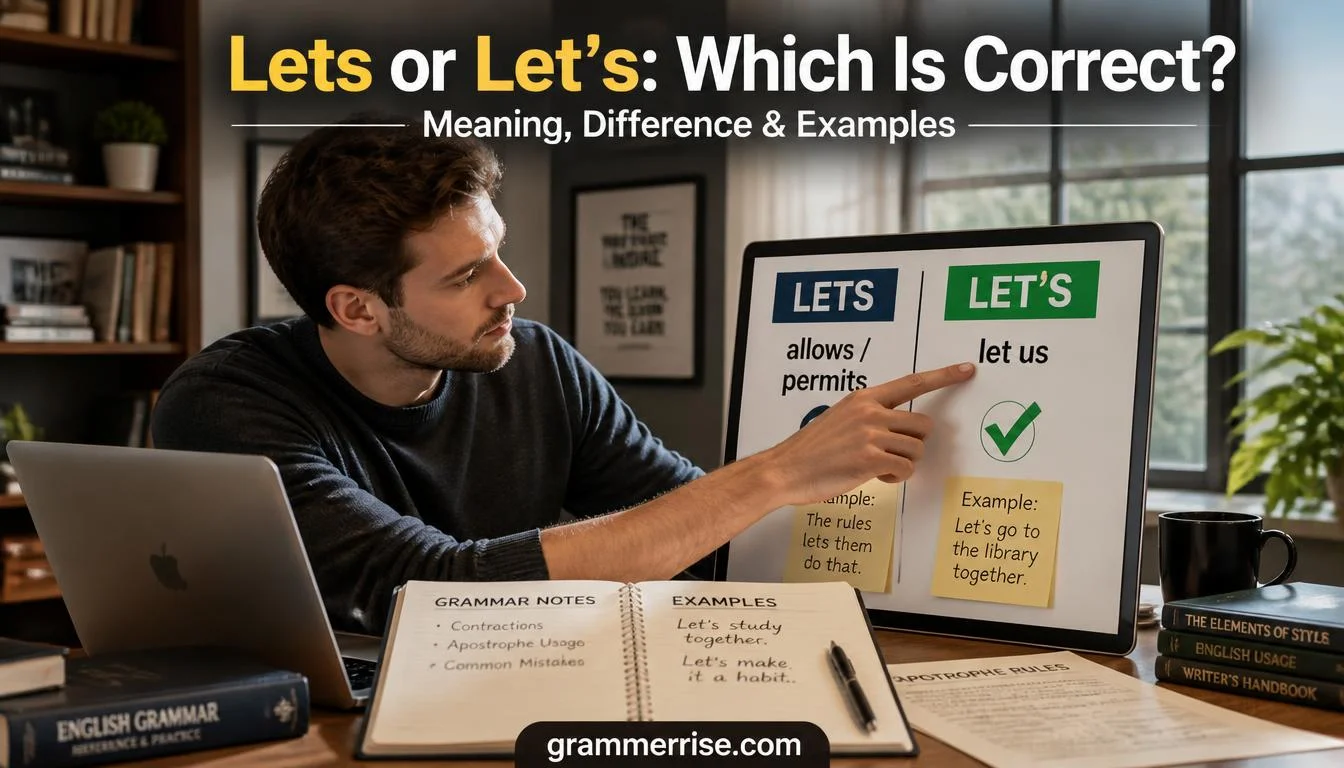
Lets is the third-person, singular, present tense form of the verb let. Its meaning is “allows” or “permits.” For example, He lets his dog run in the park is correct. Let’s is a contraction of let us, and its apostrophe changes the meaning. It introduces suggestions, invitations, or commands. Understanding this difference helps explain the origin, uses, and differences between these forms in British English and American English. In professional writing, this simple distinction can prevent confusion and improve clarity.
When you search for lets or let’s, Lets or Let’s, or Which Is Correct, the main question is how to use each form correctly in a sentence. The example He let’s his dog run in the park is wrong because he needs lets. However, Let’s go and Let’s review this are correct because they express suggestions or invitations. These real-life examples help many English learners and native speakers avoid common mistakes and common errors in emails, essays, social media posts, and formal writing.
Quick Answer
Let’s is correct when you mean “let us.”
Lets is correct when you mean “allows” or “permits.”
Examples:
- Let’s go for a walk. → Let us go for a walk.
- She lets me use her car. → She allows me to use her car.
Easy trick: If you can replace the word with “let us,” use let’s. If it means “allows,” use lets.
Lets or Let’s: What’s the Difference?
The simplest way to understand lets vs. let’s is to look at their meanings and grammatical roles.
| Word | Meaning | Grammatical role | Example |
| let’s | let us | Contraction | Let’s watch a movie. |
| lets | allows or permits | Verb | My mother lets me choose. |
So, when should you use each one?
Use let’s when you mean “let us.”
Let’s finish the project today.
You can expand it:
Let us finish the project today.
Use lets when a singular subject allows, permits, or enables something.
The teacher lets students ask questions.
Here, replacing lets with let us doesn’t make sense.
That distinction solves most lets or let’s questions in seconds.
What Does “Let’s” Mean?
Let’s is a contraction formed from “let us.” The apostrophe shows that letters have been omitted.
The basic transformation is:
let us → let’s
In modern English, let’s most often introduces a suggestion involving the speaker and at least one other person.
For example:
- Let’s have lunch.
- Let’s take a break.
- Let’s try again.
- Let’s call them tomorrow.
- Let’s look at the evidence.
- Let’s go home.
In each sentence, the speaker proposes an action.
Let’s Usually Means “We Should”
In everyday conversation, let’s often carries the practical meaning “we should.”
For example:
Let’s order pizza.
This generally means:
We should order pizza.
Likewise:
Let’s leave before traffic gets worse.
means:
We should leave before traffic gets worse.
The exact shade of meaning depends on context. Sometimes let’s sounds like a friendly invitation. At other times, it sounds like a firm suggestion or encouragement.

Let’s Can Introduce an Invitation
You can also use let’s when inviting someone to participate in an activity.
Consider:
Let’s grab coffee after work.
The speaker isn’t simply stating a fact. They’re proposing something for both people to do.
Another example:
Let’s meet at the library tomorrow.
Again, the speaker includes themselves in the proposed action.
Let’s Can Express Encouragement
The word can also encourage people to take action.
For example:
Let’s keep going!
We can give it another try.
Together, we can finish strong.
These sentences often appear in conversations, sports, classrooms, workplaces, and motivational situations.
Let’s Not
The negative form is let’s not, meaning “let us not.”
Examples include:
- Let’s not rush.
- Let’s not argue about it.
- Let’s not forget the deadline.
- Let’s not make the same mistake twice.
Notice that the apostrophe remains because let’s still represents let us.
What Does “Lets” Mean?
Lets is a real English word. It doesn’t need an apostrophe when it functions as the third-person singular present form of let.
The verb let has several related meanings. One of the most common is to allow or permit.
For example:
My father lets me use his car.
Here, lets means allows.
You can rewrite the sentence:
My father allows me to use his car.
That replacement makes the meaning obvious.
Examples of “Lets” Meaning “Allows”
Here are several natural examples:
- The teacher lets students work together.
- My sister lets me borrow her books.
- The coach lets the players rest.
- This window lets in plenty of sunlight.
- The app lets users change their settings.
- The dog lets the puppy sleep beside it.
- The manager lets employees leave early on Fridays.
In every example, lets functions as a verb.
The subject is singular:
- The teacher lets
- My sister lets
- The coach lets
- This window lets
- The app lets
That’s why the verb takes the -s ending.
Why “Lets” Has No Apostrophe
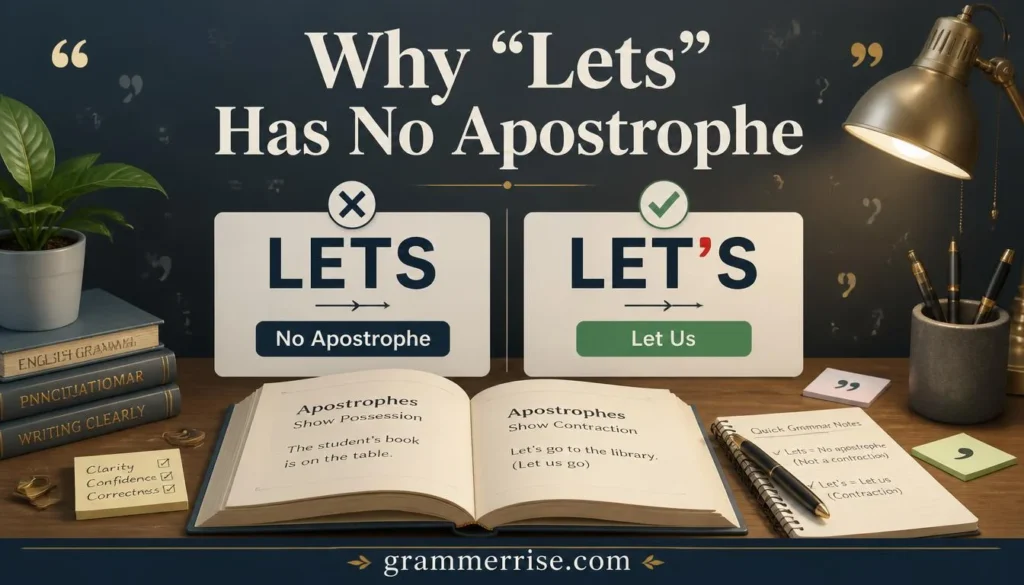
A common mistake is assuming that every word ending in -s needs an apostrophe somewhere.
That’s not how English works.
Apostrophes serve specific grammatical purposes. In let’s, the apostrophe indicates a contraction.
In lets, the s is simply part of the verb form.
Compare:
She lets me choose.
with:
Let’s choose.
The first sentence contains the verb lets.
The second contains the contraction let’s.
Adding an apostrophe to lets in the first sentence would change the word incorrectly.
Let’s vs. Lets: The Easy “Let Us” Test
There’s a remarkably simple trick for remembering the difference.
Replace “Let’s” With “Let Us”
When you’re unsure, replace the word with “let us.”
If the sentence still makes sense, let’s is probably the correct choice.
For example:
Let’s go outside.
Replace it:
Let us go outside.
The sentence works.
Therefore:
Let’s go outside.
is correct.
Try another:
Let’s start the meeting.
Becomes:
Let us start the meeting.
Again, it works.
So let’s is correct.
When the “Let Us” Test Doesn’t Work
Now consider:
She lets me use her laptop.
Try replacing lets with let us:
She let us me use her laptop.
That doesn’t work.
The intended meaning is allows, not let us.
Therefore, lets is correct.
This little test is useful because it focuses on meaning rather than spelling.
Let’s Go or Lets Go: Which Is Correct?
Few examples create more confusion than “let’s go” and “lets go.”
Both combinations can appear in grammatically correct sentences. Their meanings differ.
“Let’s Go” Means “Let Us Go”
When you’re encouraging someone to leave or suggesting that you leave together, use let’s go.
Let’s go home.
This means:
Let us go home.
Other examples include:
- Let’s go to the beach.
- Let’s go before it gets dark.
- Let’s go get some food.
- Let’s go see what happened.
- Let’s go for a walk.
The apostrophe matters because let’s is a contraction.
“Lets Go” Can Also Be Correct
Now consider:
The athlete lets go of the rope.
Here, lets means allows or forms part of the expression “lets go of.”
The subject is the athlete.
The sentence isn’t a suggestion to the reader. It describes what the athlete does.
Compare the meanings:
| Sentence | Meaning |
| Let’s go home. | Let us go home. |
| She lets go of the rope. | She releases the rope. |
| Let’s go for a walk. | We should go for a walk. |
| The child lets go of the balloon. | The child releases the balloon. |
Context tells you which spelling belongs there.
Let’s vs. Lets in Everyday Sentences
Seeing the two forms side by side makes the distinction much clearer.
Examples With “Let’s”
Use let’s when you mean let us:
- Let’s eat dinner.
- Let’s check the results.
- Let’s discuss the problem.
- Let’s take the next train.
- Let’s call her later.
- Let’s find another solution.
- Let’s finish this before lunch.
- Let’s keep the conversation private.
- Let’s not worry about that yet.
- Let’s give everyone another chance.
Each sentence proposes an action.
Examples With “Lets”
Use lets when a singular subject allows something:
- My brother lets me borrow his car.
- The teacher lets us leave early.
- This software lets you edit photos.
- The door lets fresh air into the room.
- Her parents let her travel alone.
- The coach lets the players choose their positions.
- The new system lets customers track orders.
- The manager lets employees work remotely.
- This design lets water drain quickly.
- The dog lets the child touch its paw.
One detail deserves attention: let itself doesn’t take -s after certain subjects, but lets appears with a third-person singular subject.
Let, Lets, and Let’s: How Are They Related?
These three forms look similar, but grammar separates them.
| Form | Function | Example |
| let | Base verb | I let him decide. |
| lets | Third-person singular present | She lets him decide. |
| let’s | Contraction of “let us” | Let’s decide together. |
This distinction becomes easier when you look at the subject.
I Let
I let my dog sleep inside.
She Lets
She lets her dog sleep inside.
Let’s
Let’s take the dog outside.
The first two use let as a verb. The third uses let’s as a contraction.
Is “Lets” Ever Correct?
Absolutely.
Lets is not a misspelling of let’s. It’s a standard English word with its own grammatical function.
For example:
The teacher lets students ask questions.
Here, lets means allows.
Another example:
The website lets users create free accounts.
Again, lets means allows.
You can replace it with allows:
The website allows users to create free accounts.
The meaning stays intact.
“Lets” Can Describe Things, Not Just People
The subject doesn’t have to be a person.
For example:
This window lets in natural light.
Here, a window can’t make a conscious decision. Yet lets still means that it allows something to pass through.
Other examples include:
- The filter lets clean water through.
- The fabric lets air circulate.
- The opening lets sunlight enter.
- The design lets heat escape.
- The system lets users customize their profiles.
This broader use helps explain why lets appears frequently in technical and explanatory writing.
Can “Lets” Mean “Rents”?
Yes, although this meaning is more closely associated with British English.
In British usage, let can mean to rent out property.
For example:
The owner lets the apartment to students.
Here, lets doesn’t mean “allows.” It means the owner rents the property to someone.
The distinction matters because American readers may be more familiar with let as meaning “allow.”
For most everyday lets or let’s questions, however, the important distinction remains:
lets = allows
let’s = let us
Common Mistakes With Let’s and Lets
Because pronunciation doesn’t reveal the difference, writers often make predictable mistakes.
Mistake: “Lets Go” for a Suggestion
Incorrect:
Lets go to the restaurant.
Correct:
Let’s go to the restaurant.
Why?
Because the intended meaning is:
Let us go to the restaurant.
The apostrophe marks the contraction.
Mistake: “Let’s” After a Singular Subject
Incorrect:
She let’s me borrow her phone.
Correct:
She lets me borrow her phone.
The sentence means:
She allows me to borrow her phone.
You can’t replace lets with let us.
Mistake: Thinking Apostrophes Mark Plurals
Incorrect reasoning:
The word ends in “s,” so maybe it needs an apostrophe.
Apostrophes don’t normally create ordinary verb forms.
In:
He lets me decide.
the s belongs to the verb.
In:
Let’s decide.
the apostrophe signals the contraction.
Why Pronunciation Causes the Confusion
The problem becomes obvious when you say the words aloud.
Lets and let’s normally sound the same.
That means someone can hear:
“Let’s go.”
but can’t see whether the writer included the apostrophe.
Speech provides no visual clue.
Writing does.
This is similar to other commonly confused pairs:
- its / it’s
- your / you’re
- whose / who’s
- were / we’re
- they’re / their / there
The spelling carries information that pronunciation doesn’t always provide.
Let’s vs. Lets in Formal Writing
Both forms are standard English when used correctly.
Let’s isn’t grammatically wrong simply because it’s a contraction. It’s widely used in everyday writing, professional communication, instructions, articles, speeches, and other contexts.
For example:
Let’s examine the evidence.
That sentence can work perfectly well in professional writing.
However, some formal contexts may favor “let us” when the writer wants a more traditional or deliberate tone.
Compare:
Let’s consider the alternatives.
and:
Let us consider the alternatives.
Both can be grammatical. The second may sound more formal or rhetorical depending on context.
The choice often depends on tone rather than correctness.
When Should You Use “Let’s”?
Choose let’s when you’re proposing or encouraging a shared action.
Use it for:
- Suggestions
- Invitations
- Encouragement
- Joint decisions
- Group instructions
- Calls to action
Examples:
Let’s review the plan.
Tomorrow, we can meet and discuss the next steps.
If needed, we can try a different approach.
Together, we can work through the problem.
For now, let’s not jump to conclusions.
A useful clue is that let’s usually connects the speaker with another person or group.
When Should You Use “Lets”?
Choose lets when the subject allows, permits, enables, or releases something.
Examples:
The app lets you save your work.
Her father lets her drive.
The gate lets people enter.
The fabric lets air through.
The teacher lets students choose their partners.
In these sentences, lets describes what someone or something allows.
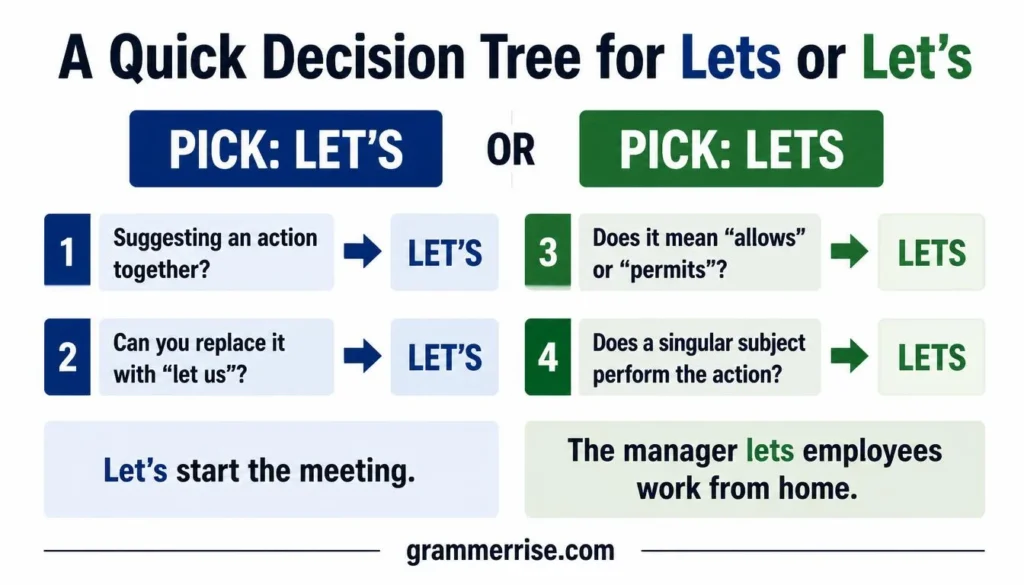
A Quick Decision Tree for Lets or Let’s
When you’re editing a sentence, ask these questions in order.
Are you suggesting that you and someone else do something?
→ Use let’s.
Can you replace the word with “let us”?
→ Use let’s.
Does the word mean “allows” or “permits”?
→ Use lets.
Does a singular subject perform the action?
→ lets may be the correct form.
For example:
Let’s start the meeting.
“Let us start the meeting” works.
Now:
The manager lets employees work from home.
“ The manager allows employees to work from home” works.
That contrast gives you a reliable shortcut.
Let’s or Lets: A Practical Case Study
Imagine an editor receives this sentence:
“My teacher lets us take a break, so lets go outside.”
At first glance, the sentence looks almost correct.
There are actually two different forms in it.
The first lets is correct:
My teacher lets us take a break.
Why?
Because the teacher allows the students to take a break.
The second form needs an apostrophe:
Let’s go outside.
Why?
Because the writer means:
Let us go outside.
The corrected sentence is:
My teacher lets us take a break, so let’s go outside.
This example shows why context matters more than pronunciation.
The two words sound alike, yet they perform completely different grammatical jobs.
Another Case Study: “Lets Go”
Consider this sentence:
The child lets go of the balloon, and it floats away.
Here, lets is correct.
The phrase “lets go of” means releases.
Now change the sentence:
Let’s go to the park before it gets dark.
Here, let’s is correct because it means let us go.
The wording looks almost identical, but the grammar changes.
| Phrase | Correct? | Meaning |
| Let’s go to the park. | Yes | We should go to the park. |
| She lets go of the rope. | Yes | She releases the rope. |
| Lets go to the park. | No, for that intended meaning | Missing apostrophe |
| She let’s go of the rope. | No | Incorrect apostrophe |
Why Apostrophes Matter in “Let’s”
The apostrophe in let’s represents omitted letters from let us.
That makes it part of the word’s grammatical structure.
Consider:
let us → let’s
The apostrophe tells readers that two words have been contracted into one.
Without it, lets becomes a different grammatical form.
This is why the difference between lets and let’s isn’t merely a spelling preference.
It changes the meaning.
“Let’s” Doesn’t Always Sound Like a Literal Permission Request
Historically, let can relate to permission or allowing. In modern expressions, however, let’s commonly works as a suggestion.
For example:
Let’s have another look.
Nobody is necessarily asking for permission.
The speaker is proposing an action.
Likewise:
Let’s get started.
This usually means:
We should get started.
Understanding this conversational function helps explain why let’s appears so often in everyday English.
Read more: Whose or Who’s? Meaning and Easy Ways to Remember
Examples You Can Use as a Reference
Correct Uses of “Let’s”
- Let’s begin.
- Let’s eat.
- Let’s go home.
- Let’s call them.
- Let’s discuss the issue.
- Let’s try again.
- Let’s check the facts.
- Let’s take a different route.
- Let’s meet after lunch.
- Let’s not waste time.
Correct Uses of “Lets”
- She lets me choose.
- He lets his dog sleep inside.
- The teacher lets students leave early.
- The app lets you change your password.
- The door lets fresh air inside.
- This material lets water pass through.
- The coach lets players rest.
- The system lets customers track their orders.
- The rule lets members vote.
- The window lets sunlight into the room.
Quick Facts About Let’s and Lets
Here are the key facts worth remembering:
- Let’s is a contraction of let us.
- Lets is the third-person singular present form of let.
- Lets commonly means allows or permits.
- Let’s commonly introduces a suggestion.
- The two forms usually sound identical.
- The apostrophe in let’s represents omitted letters.
- Let’s not is the standard negative form of the contraction.
- Lets doesn’t require an apostrophe when it functions as a verb.
- Let’s go and lets go can both be correct in different contexts.
- The “let us” test provides a quick way to distinguish them.
My Personal Experience as an English Specialist
As an English specialist, I’ve often seen writers confuse “lets” and “let’s.” Both sound the same, but they have different meanings. “Let’s” means “let us” and is used for suggestions or invitations, while “lets” means “allows” or “permits.”
For example, “Let’s go outside” means “Let us go outside.” However, “My teacher lets us leave early” means “My teacher allows us to leave early.”
One simple trick I recommend is the “let us” test. If you can replace the word with “let us,” use “let’s.” If it means “allows” or “permits,” use “lets.”
From my experience, this quick rule helps writers avoid one of the most common apostrophe mistakes in English.
FAQs
1. What is the difference between “lets” and “let’s”?
Lets means allows or permits, while let’s is short for let us. The apostrophe changes the meaning and grammatical role.
2. Is “lets” a correct English word?
Yes. Lets is the third-person singular present form of let. For example: “She lets her children play outside.”
3. When should I use “let’s”?
Use let’s when making a suggestion, invitation, or proposal. For example: “Let’s watch a movie tonight.”
4. Is “He let’s me go” correct?
No. The correct sentence is “He lets me go.” Here, lets means allows, so an apostrophe isn’t needed.
5. Why do “lets” and “let’s” sound the same?
They’re pronounced the same in standard English, but they have different meanings and grammatical functions. Context tells you which form is correct.
6. How can I quickly remember which one to use?
Try replacing let’s with let us. If the sentence still makes sense, use let’s. If you mean “allows” or “permits,” use lets.
Conclusion
The difference between lets and let’s may look small, but that tiny apostrophe can completely change a sentence. Remember the simple rule: lets means “allows” or “permits,” while let’s means “let us.” When you’re unsure, replace let’s with “let us.” If the sentence still makes sense, you’ve found the right form. With a little practice, choosing between lets and let’s becomes almost automatic. Whether you’re writing an email, essay, social media post, or everyday message, using the correct form keeps your English clear, polished, and professional.