The Weird or Wierd spelling confusion is a common issue that people search every day because both spellings look almost the same and create doubt among beginners and experts.
This post helps you learn the correct word with easy examples, a simple trick, and a way to remember it forever. The Meaning and Usage of weird explain that the word describes something unusual, strange, or extraordinary. This article clears the difference between wierd vs weird for learners and students who make this mistake because both words have the same sound.
The spellchecker detects the wrong spelling, but understanding English origin, pronunciation, letter order, and spelling accuracy improves learning. The famous I before E except after C rule feels confusing in this case because weird is an exception. Knowing this difference improves writing skills, professional writing, and written English. This guide provides a quick answer, clear explanation, and useful guidance to help you choose and use the correct spelling in academic writing and daily communication. Strong learning of grammar rules, vowel patterns, and spelling patterns helps you avoid common mistakes, build stronger language skills, and feel confident when you have typed or searched this keyword during fast typing in emails, social media posts, or exams.
Quick Answer
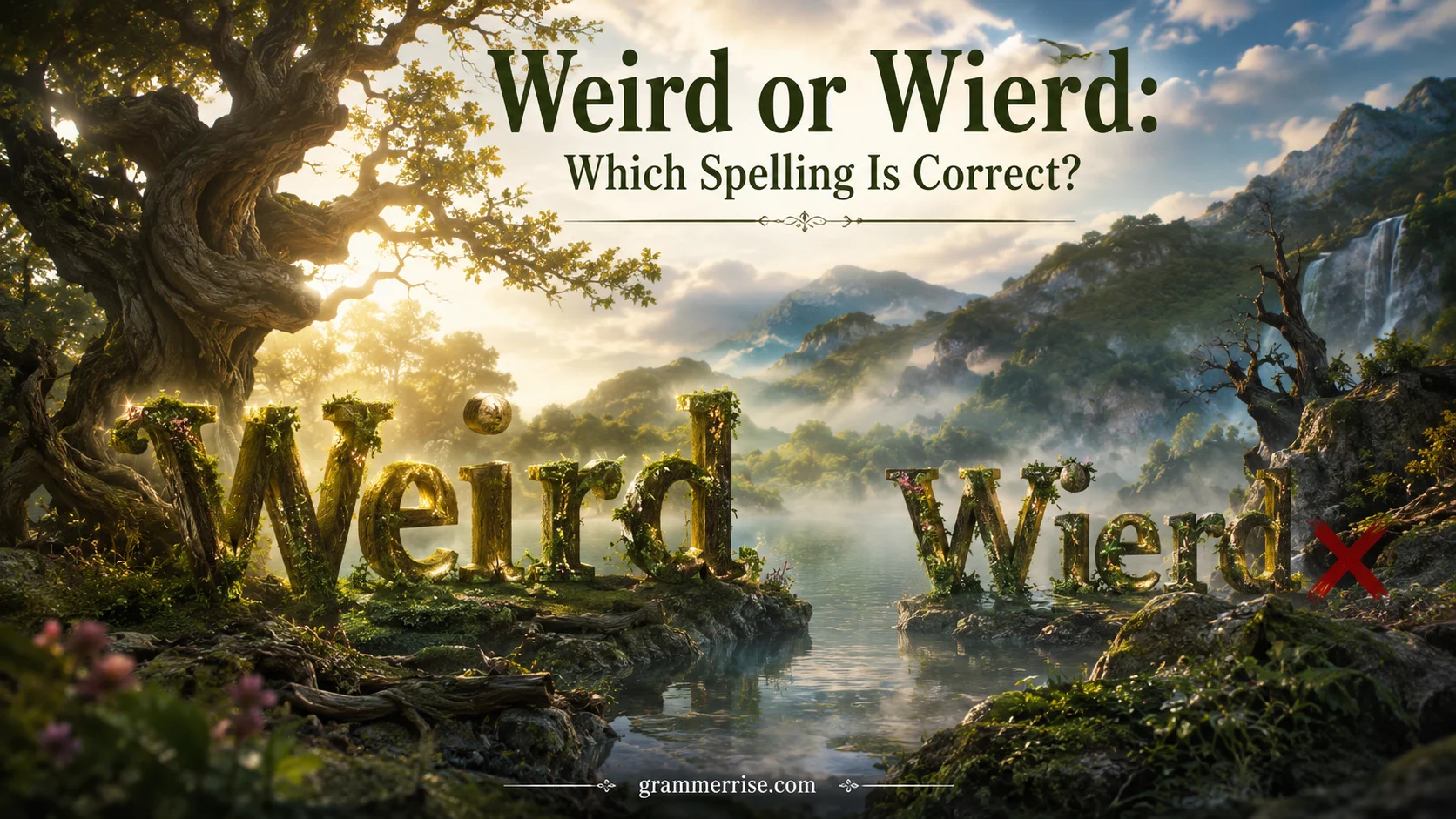
If you’re wondering whether to write weird or wierd, the correct spelling is weird. The spelling wierd is a common mistake and isn’t recognized as a correct English word. The confusion often comes from the old spelling rule “I before E except after C,” but weird is one of the many exceptions to that rule. The word weird means strange, unusual, unexpected, or difficult to explain. For example, you could say, “That was a weird noise,” or “We had a weird experience during our trip.” A simple way to remember the correct spelling is to focus on the first two letters: we in weird. Whenever you’re in doubt, remember that weird is always correct and wierd is always wrong.
Weird or Wierd: Which One Is Correct?
The correct spelling is weird.
✅ Weird
❌ Wierd
That’s the simple answer.
The word weird means strange, unusual, unexpected, or difficult to explain. The spelling wierd is considered a misspelling and should never be used in formal or informal writing.
Quick Reference Table
| Spelling | Correct? | Meaning |
| Weird | ✅ Yes | Strange, unusual, unexpected |
| Wierd | ❌ No | Misspelling of weird |
Examples
- That was a weird dream.
- I heard a weird noise last night.
- The weather has been weird lately.
- She gave me a weird look.
In every case, weird is the correct spelling.
What Does Weird Mean?
The word weird describes something that seems unusual, strange, odd, or difficult to understand.
Sometimes it refers to behavior. Other times it describes events, situations, feelings, sounds, or experiences.
Dictionary Meaning
Weird (adjective): Strange, unusual, unexpected, or mysterious.
Common Uses of Weird
People use the word when something:
- Doesn’t seem normal
- Feels unexpected
- Appears strange
- Is difficult to explain
- Creates confusion or surprise
Examples in Everyday Life
Imagine opening your front door and finding your shoes neatly arranged in a perfect circle. Most people would call that weird.
Suppose your phone suddenly starts playing music without anyone touching it. That would feel pretty weird too.
The word often appears in casual conversation because it quickly communicates that something doesn’t fit expectations.
Why Do People Spell Weird as Wierd?
The mistake isn’t random. There are several reasons why people write wierd.
The “I Before E” Rule Creates Confusion
Many people learn this rhyme as children:
“I before E except after C.”
The rule works for words like:
- Believe
- Piece
- Field
- Chief
Because of this pattern, writers often assume the letters should appear as ie.
However, English contains many exceptions.
Weird Is an Exception
The word weird follows the pattern ei, not ie.
That makes it one of the most commonly misspelled words in English.
Other Famous Exceptions
| Correct Word | Common Misspelling |
| Weird | Wierd |
| Their | Thier |
| Foreign | Foriegn |
| Seize | Sieze |
| Height | Hieght |
These words remind us that spelling rules help, but they don’t always work.
Pronunciation Doesn’t Help
Part of the problem comes from pronunciation.
When people hear the word, they may assume it follows the sound pattern found in words like:
- Friend
- Piece
- Believe
As a result, they instinctively type wierd instead of weird.
Fast Typing Mistakes
Sometimes the issue has nothing to do with spelling knowledge.
The letters “i” and “e” sit close together mentally because they’re often paired in English. During fast typing, many people accidentally reverse them.
The Fascinating History of the Word Weird
Most people use weird every day without realizing the word has a surprisingly rich history.
Its origins stretch back hundreds of years.
Old English Roots
The word comes from the Old English term wyrd.
Originally, it did not mean strange.
Instead, it referred to:
- Fate
- Destiny
- Future events
- Supernatural control over life
Ancient English speakers believed that fate guided human lives. The word wyrd represented that concept.
Connection to Shakespeare
The meaning began changing over time.
One major influence came from Shakespeare’s famous play Macbeth.
In the play, the “Weird Sisters” are mysterious witches who predict the future.
Because these characters seemed supernatural and mysterious, the word gradually became associated with strange and unusual things.
Evolution of Meaning
| Time Period | Meaning |
| Old English | Fate or destiny |
| Middle English | Supernatural force |
| Shakespearean Era | Mysterious beings |
| Modern English | Strange or unusual |
Language evolves constantly. Weird is a perfect example of how a word can travel from fate and prophecy to everyday conversations about odd experiences.
How to Remember the Correct Spelling of Weird
Many people want a simple trick they can use instantly.
Fortunately, several memory techniques work well.
Remember “We Are Weird”
Look at the first two letters.
WEird
The word begins with “we.”
Think:
“We are weird.”
Because “we” comes first, the letter e comes before i.
Visual Memory Trick
Picture the word split into parts:
WE + IRD
The opening “we” becomes easy to remember.
Create a Personal Association
You could imagine a strange group of people saying:
“We are weird.”
That phrase reinforces the correct spelling every time.
Repetition Helps
Writing the correct spelling several times strengthens memory.
For example:
- Weird
- Weird
- Weird
- Weird
After enough repetition, the correct version starts to look natural while wierd begins to look wrong.
Weird in Everyday English
The word appears everywhere.
People use it in conversations, movies, books, social media posts, and news articles.
Common Expressions
Weird Feeling
A strange sensation that doesn’t seem normal.
Example:
I had a weird feeling that something was about to happen.
Weird Dream
A dream that feels unusual or confusing.
Example:
Last night I had a weird dream about talking cats.
Weird Coincidence
An unexpected connection between events.
Example:
It’s a weird coincidence that we both chose the same restaurant.
Weird Situation
A confusing or unusual circumstance.
Example:
Walking into the wrong meeting created a weird situation.
Weird Behavior
Actions that seem unusual or unexpected.
Example:
His weird behavior made everyone curious.
Why People Like the Word
The word is versatile.
Instead of explaining every detail, you can simply say something was weird and most people immediately understand what you mean.
Common Mistakes People Make With Weird
Spelling isn’t the only issue.
Several other mistakes appear regularly.
Writing Wierd
This remains the biggest mistake by far.
Remember:
✅ Weird
❌ Wierd
Overusing the Word
Because weird is convenient, some writers use it too often.
For example:
The movie was weird. The ending was weird. The characters were weird.
Repeating the same word weakens writing.
Better Alternatives
Depending on the situation, you might choose:
- Strange
- Odd
- Peculiar
- Unusual
- Bizarre
- Eerie
- Surreal
These words add variety and precision.
Using Weird in Formal Reports
While the word isn’t incorrect, professional writing often benefits from more specific language.
Instead of:
The results were weird.
Try:
The results were unusual.
Or:
The results were unexpected.
Specific wording improves clarity.
Synonyms of Weird
Different situations call for different words.
Everyday Alternatives
| Word | Meaning |
| Strange | Not normal |
| Odd | Slightly unusual |
| Funny | Peculiar or unexpected |
| Peculiar | Distinctively unusual |
Formal Alternatives
| Word | Best Use |
| Unusual | Business writing |
| Atypical | Academic writing |
| Abnormal | Scientific contexts |
| Extraordinary | Exceptional situations |
Stronger Alternatives
| Word | Strength |
| Bizarre | Very strange |
| Surreal | Dream-like |
| Eerie | Mysterious or spooky |
| Outlandish | Extremely unusual |
Example Comparison
Consider these sentences:
- That’s a weird idea.
- That’s an unusual idea.
- That’s a bizarre idea.
- That’s an outlandish idea.
Each version creates a different impression even though the basic meaning remains similar.
Weird vs Other Commonly Misspelled Words
The confusion surrounding weird belongs to a larger group of spelling mistakes.
Weird vs Wierd
Correct: Weird
Incorrect: Wierd
Receive vs Recieve
Correct: Receive
Incorrect: Recieve
Friend vs Freind
Correct: Friend
Incorrect: Freind
Their vs Thier
Correct: Their
Incorrect: Thier
Believe vs Beleive
Correct: Believe
Incorrect: Beleive
Why These Mistakes Happen
Most involve the same challenge:
- Similar letter combinations
- Spelling-rule confusion
- Fast typing
- Habitual errors
Learning the correct pattern once can prevent years of mistakes.
Read more: Trys or Tries: The Complete Grammar Guide With Easy Rules
Is Weird Appropriate in Formal Writing?
Yes, but context matters.
Academic Writing
Academic papers often favor more precise language.
Instead of:
The data produced weird results.
A stronger version might be:
The data produced unexpected results.
Business Communication
Professional settings usually benefit from clear descriptions.
Instead of:
We noticed a weird trend.
Try:
We noticed an unusual trend.
Scientific Writing
Researchers often choose objective terminology.
Instead of:
A weird reaction occurred.
Try:
An atypical reaction occurred.
Formal Alternatives Table
| Casual Phrase | Formal Alternative |
| Weird result | Unexpected result |
| Weird pattern | Unusual pattern |
| Weird behavior | Atypical behavior |
| Weird response | Irregular response |
The goal isn’t to avoid weird entirely. The goal is choosing the most precise word for the audience.
Examples of Weird Used Correctly
Seeing real examples makes usage easier to understand.
Everyday Conversation
- That’s the weirdest story I’ve heard all week.
- Something weird happened on my way home.
- The dog made a weird sound.
- I received a weird text message.
Workplace Examples
- The software produced a weird error.
- We noticed a weird spike in traffic.
- A weird issue appeared after the update.
School Examples
- The experiment produced a weird outcome.
- The teacher shared a weird historical fact.
- I found a weird pattern in the data.
Creative Writing Examples
- A weird mist drifted through the forest.
- The house gave off a weird energy.
- The old clock made a weird ticking sound.
Social Media Examples
- Today has been weird.
- Anyone else having a weird week?
- That ending was weird but amazing.
Why Weird Is One of English’s Most Misunderstood Words
English contains thousands of words that break expected patterns.
Weird stands out because:
- It is extremely common.
- It violates a famous spelling rule.
- It appears in both speech and writing regularly.
- Its misspelling looks believable.
As a result, even experienced writers occasionally pause before typing it.
Interestingly, studies of online writing consistently show that wierd remains one of the most searched spelling corrections on the internet.
That demonstrates how widespread the confusion really is.
Quick Cheat Sheet
Correct Usage
| Question | Answer |
| Weird or Wierd? | Weird |
| Is Wierd a word? | No |
| Can weird be used formally? | Sometimes |
| Does weird mean strange? | Yes |
| Is weird an exception to “I before E”? | Yes |
Memory Formula
WE + IRD = WEIRD
Think:
“We are weird.”
That simple phrase helps many people remember the spelling instantly.
FAQs
1. Is weird or wierd the correct spelling?
Weird is the correct spelling in standard English. Wierd is a common spelling mistake and is considered incorrect. Even though both words look similar, only weird should be used in writing, exams, emails, and professional communication.
2. Why do people spell weird as wierd?
Many people write wierd because of the famous “I before E except after C” rule. Since the word contains “ei,” the brain often applies the rule incorrectly. However, weird is an exception, so remembering the correct letter order helps avoid this mistake.
3. What does the word weird mean?
The word weird describes something unusual, strange, unexpected, or different from what is normal. It can describe a situation, behavior, idea, appearance, or event that feels uncommon or surprising.
4. How can I remember the spelling of weird?
A simple memory trick is to remember that weird contains “we,” not “wie.” You can also think of the phrase “weird is weird because it breaks the rule.” Regular practice and checking the letter order can make the spelling easier to remember.
5. Is weird spelled differently in British and American English?
No. The spelling weird is the same in both British English and American English. The confusion is not related to regional differences; it is simply a common spelling mistake made by many English learners.
6. Can using wierd affect my writing quality?
Yes. Using wierd instead of weird can make your writing appear less accurate, especially in academic work, professional documents, and online content. Choosing the correct spelling improves clarity and shows stronger English skills.
Conclusion
The confusion between weird or wierd is a small spelling mistake that many people make, but fixing it can greatly improve your English accuracy. The correct spelling is always weird, while wierd is an incorrect form that comes from misunderstanding common spelling patterns. Although the word breaks the famous “I before E except after C” rule, remembering this exception makes it easier to write correctly.
Building strong spelling habits takes practice, attention, and a good understanding of word patterns. Whether you are writing an email, completing an exam, creating content, or improving daily communication, choosing weird shows confidence and better language skills. Once you remember the correct letter order, you will never have to hesitate between weird and wierd again.

Hussain Abid is an English language writer with over 10 years of experience in grammar, spelling, vocabulary, and writing. He specializes in creating clear, well-researched content that helps readers improve their English with confidence. At GrammarRise, Hussain writes practical guides, grammar explanations, and word comparison articles based on trusted language sources and real-world usage. His mission is to make English learning simple, accurate, and accessible for everyone