Drank or Drunk often causes confusion for English learners, students, writers, and native speakers.
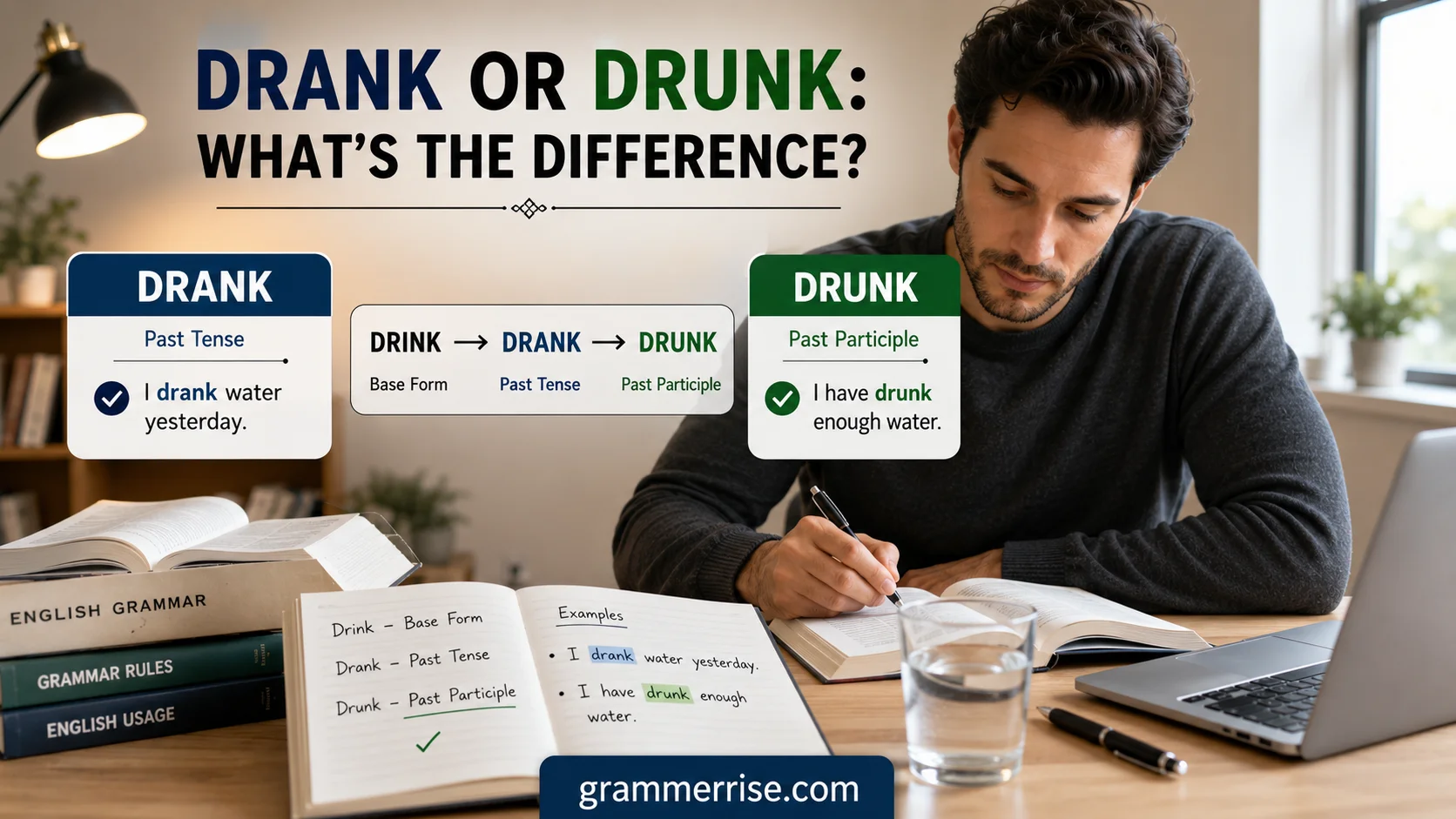
Both come from the verb drink, but their usage differs because of English verb tenses. Drank describes a past action and is the simple past tense, while drunk is the past participle and usually needs helping verbs. Understanding this difference helps you avoid common grammar mistakes and choose the correct verb form.
The grammar rules become easier with real-life examples and context. For example, “I drank water yesterday” is correct, while “I have drunk water today” uses the past participle correctly. The phrase “I have drank water” is grammatically incorrect. Learning these verb forms improves writing, speaking, English fluency, and communication, helping you use both forms correctly and confidently in everyday English.
Quick Answer
The simplest rule is this:
Drank is the simple past tense of drink.
Drunk is the past participle of drink.
Here’s the difference at a glance:
| Word | Verb Form | Main Use | Example |
| drink | Base form | Present tense, infinitives, commands, after modals | I drink water every day. |
| drank | Simple past | A completed action in the past | I drank water yesterday. |
| drunk | Past participle | Perfect tenses | I have drunk enough water. |
So, if you’re describing something that happened in the past, drank usually does the job:
I drank tea this morning.
However, if you use have, has, or had, you normally need drunk:
I have drunk two cups of tea.
There’s another important point. Drunk can also function as an adjective when it describes someone affected by alcohol:
He was drunk.
That sentence doesn’t use drunk as the past tense of drink. It’s an adjective describing his condition.
What Does “Drank” Mean?
Drank is the simple past form of drink. You use it when you describe an action that happened in the past.
Unlike drink, which can describe a regular or current action, drank places the action in the past.
Consider these examples:
- I drank coffee before work.
- She drank a glass of water.
- We drank tea after dinner.
- They drank juice at breakfast.
- He drank too much soda yesterday.
In each sentence, the drinking happened in the past.
When Should You Use “Drank”?
Use drank when you’re using the simple past tense and don’t need an auxiliary verb such as have or had.
Common time expressions often appear with this form:
- yesterday
- last night
- last week
- this morning
- two hours ago
- an hour ago
- when I was younger
- during the meeting
- before dinner
- after the game
For example:
Sarah drank coffee before her interview.
The sentence presents the drinking as a completed past event.
Here’s another example:
We drank lemonade at the picnic last Sunday.
The phrase last Sunday clearly places the event in the past, so drank fits naturally.
More Examples of “Drank”
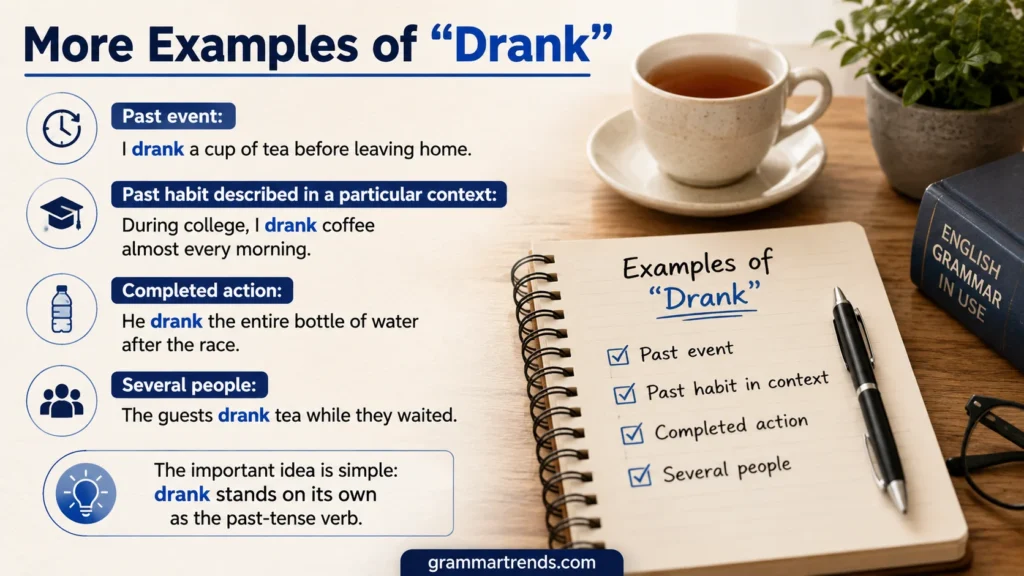
Past event:
I drank a cup of tea before leaving home.
Past habit described in a particular context:
During college, I drank coffee almost every morning.
Completed action:
He drank the entire bottle of water after the race.
Several people:
The guests drank tea while they waited.
The important idea is simple: drank stands on its own as the past-tense verb.
What Does “Drunk” Mean?
Drunk is the past participle of drink.
A past participle usually doesn’t work alone as the ordinary past tense. It typically appears with an auxiliary or helping verb in perfect constructions.
The most common combinations are:
- have drunk
- has drunk
- had drunk
- will have drunk
For example:
I have drunk enough water.
She has drunk three cups of coffee.
They had drunk everything before we arrived.
The word drunk tells us that the verb is functioning as a past participle rather than a simple past verb.
“Drunk” as a Verb
When drunk acts as the past participle of drink, it commonly follows have, has, or had.
Examples:
- I have drunk enough water.
- She has drunk her coffee.
- We have drunk all the juice.
- He had drunk the water before leaving.
- They had drunk everything before dinner.
The grammatical structure matters here.
have/has/had + drunk
That’s the pattern worth remembering.
“Drunk” as an Adjective
There’s a second meaning that causes another layer of confusion.
Drunk can also be an adjective meaning affected by alcohol.
For example:
He was drunk after the party.
She looked drunk when she arrived.
The driver appeared drunk.
In these sentences, drunk doesn’t mean that someone performed the action of drinking. Instead, it describes a person’s condition.
Compare these two sentences:
He had drunk too much.
He was drunk.
In the first sentence, drunk is a past participle. In the second, drunk is an adjective.
The spelling is identical, but the grammatical function is different.
Drink, Drank, Drunk: The Complete Verb Pattern
The irregular verb pattern is:
drink → drank → drunk
These three forms aren’t interchangeable.
| Form | Function | Example |
| drink | Base form | I drink water. |
| drank | Simple past | I drank water. |
| drunk | Past participle | I have drunk water. |
English has many irregular verbs that change internally rather than simply adding -ed.
For comparison:
- go → went → gone
- sing → sang → sung
- begin → began → begun
- swim → swam → swum
- drink → drank → drunk
That’s why drank and drunk don’t follow the same pattern as a regular verb such as walked.
Why Isn’t “Drunk” the Simple Past?
This is where many learners get tripped up.
The fact that drunk refers to something completed doesn’t automatically make it the simple past tense. Verb forms depend on grammatical structure, not merely on whether an action happened before now.
For example:
I drank the water yesterday.
Here, drank is the simple past.
But:
I have drunk the water.
Here, drunk is a past participle used with have.
Think of the auxiliary verb as a grammatical signal. When have, has, or had creates a perfect construction, the past participle follows.
“I Drank” or “I Drunk”: Which Is Correct?
The standard form is:
I drank.
Not:
I drunk.
For example:
Correct:
I drank coffee yesterday.
Incorrect:
I drunk coffee yesterday.
Why? Because the sentence uses the simple past tense. The simple past form of drink is drank.
The same pattern works with other subjects:
- She drank tea.
- He drank water.
- We drank lemonade.
- They drank coffee.
- You drank too much soda.
One useful test is to remove the time expression. If the sentence still describes a straightforward completed past action, drank may be the form you need.
I drank the juice.
That’s complete and grammatical.
“I Have Drank” or “I Have Drunk”: Which Is Correct?
In standard English, the correct form is:
I have drunk.
Not:
I have drank.
The reason is straightforward:
have + past participle
The past participle of drink is drunk.
So:
I have drunk enough water.
Not:
I have drank enough water.
The same rule applies to has:
She has drunk her coffee.
And to had:
She had drunk her coffee.
Why “Have Drank” Sounds Familiar
You may occasionally hear or see “have drank” in informal speech or nonstandard writing. However, standard edited English uses “have drunk.”
That distinction matters when you’re writing:
- school assignments
- professional emails
- articles
- reports
- applications
- formal documents
If you want the standard grammatical form, choose have drunk.
“Had Drank” or “Had Drunk”: Which Is Correct?
The standard form is:
had drunk
The structure is:
had + past participle
Since drunk is the past participle, it follows had.
For example:
I had drunk my coffee before the meeting began.
The sentence describes two past events. First, the speaker drank the coffee. Later, the meeting began.
Another example:
She had drunk the water before the doctor arrived.
The drinking happened before another past event.
Compare the two:
I drank coffee before work.
I had drunk coffee before the meeting started.
Both sentences refer to the past. The second sentence specifically establishes a relationship between two past events.
Drank vs. Drunk in Different Tenses
Understanding the larger verb system makes drank vs. drunk much easier.
| Tense or Construction | Correct Form | Example |
| Present simple | drink/drinks | I drink tea every day. |
| Simple past | drank | I drank tea yesterday. |
| Present perfect | have/has drunk | I have drunk tea today. |
| Past perfect | had drunk | I had drunk tea before lunch. |
| Future perfect | will have drunk | I will have drunk enough by then. |
| Infinitive | to drink | I want to drink water. |
| Modal construction | drink | I can drink more water. |
| Command | drink | Drink some water. |
This table reveals an important pattern.
Drank has a relatively specific role. It serves as the simple past form.
Drunk, meanwhile, appears primarily as a past participle in perfect constructions.
Drink has much broader use because it functions as the base form.
Drank or Drunk in Questions
Questions create another common source of mistakes.
When did appears in a simple past question, use the base form drink, not drank.
Correct:
Did you drink the coffee?
Incorrect:
Did you drank the coffee?
Why?
Because did already carries the past tense. The main verb returns to its base form.
The pattern is:
Did + subject + drink?
Examples:
- Did you drink water?
- Did she drink coffee?
- Did they drink tea?
- What did he drink?
- When did you drink it?
Questions With “Have” or “Has”
When using the present perfect, use drunk:
Have you drunk enough water?
Has she drunk her coffee?
Questions With “Had”
For the past perfect:
Had they drunk anything before leaving?
This distinction can be summarized quickly:
| Question Pattern | Correct Form |
| Did you ___? | drink |
| Have you ___? | drunk |
| Has she ___? | drunk |
| Had they ___? | drunk |
Drank or Drunk in Negative Sentences
Negative sentences follow the same grammatical principles.
With didn’t, use the base form drink:
I didn’t drink coffee yesterday.
Not:
I didn’t drank coffee yesterday.
Again, did carries the past tense.
The pattern is:
didn’t + drink
Examples:
- I didn’t drink anything.
- She didn’t drink the juice.
- We didn’t drink coffee.
- They didn’t drink alcohol.
With perfect constructions, use drunk:
I haven’t drunk enough water.
She hasn’t drunk her coffee.
They hadn’t drunk anything before the trip.
This gives you three useful structures:
- didn’t drink
- haven’t/hasn’t drunk
- hadn’t drunk
Is “Drunk” Ever Correct Without “Have,” “Has,” or “Had”?
Yes.
That’s because drunk can function as an adjective.
Consider:
He is drunk.
She was drunk.
They looked drunk.
Here, drunk describes a state or condition. It isn’t functioning as the past participle in a perfect-tense construction.
This distinction becomes clearer when you compare:
He drank three beers.
This tells us what he did.
He has drunk three beers.
This uses the present perfect.
He is drunk.
This describes his condition.
Three sentences. Three grammatical roles.
Drank vs. Drunk When Talking About Alcohol
Both forms commonly appear when people discuss alcohol, which can make the distinction seem more confusing.
Consider:
Mark drank three beers last night.
Here, drank is the simple past.
Now compare:
Mark has drunk three beers tonight.
Here, drunk is the past participle.
And:
Mark is drunk.
Here, drunk is an adjective describing his condition.
The subject matter hasn’t changed. The grammar has.
That’s the key.
The distinction between drank and drunk doesn’t depend on whether the liquid is water, coffee, juice, or alcohol. It depends on the grammatical structure.
Common Mistakes With Drank and Drunk
Mistake 1: Using “Drunk” as the Simple Past
Incorrect:
I drunk the water yesterday.
Correct:
I drank the water yesterday.
The sentence uses simple past, so drank is required.
Mistake 2: Using “Drank” After “Have”
Incorrect:
I have drank enough water.
Correct:
I have drunk enough water.
After have, use the past participle drunk.
Mistake 3: Using “Drank” After “Had”
Incorrect:
She had drank the coffee.
Correct:
She had drunk the coffee.
The past perfect requires had + past participle.
Mistake 4: Saying “Did You Drank?”
Incorrect:
Did you drank the juice?
Correct:
Did you drink the juice?
After did, use the base form drink.
Mistake 5: Saying “Didn’t Drank”
Incorrect:
He didn’t drank anything.
Correct:
He didn’t drink anything.
Again, didn’t already expresses the past.
Read more: Were or Was: Which Is Correct? Meaning and Common Mistakes
A Simple Memory Trick for Drank vs. Drunk
Here’s the easiest rule to remember:
Drank = simple past. Drunk = past participle.
You can make it even easier with three time frames:
Today:
I drink coffee.
Yesterday:
I drank coffee.
Before now / connected to another time:
I have drunk coffee.
Another useful shortcut is:
Have, has, or had → drunk
For example:
- have drunk
- has drunk
- had drunk
But remember one important exception to the shortcut: drunk can also function as an adjective.
Drank or Drunk: Real-World Sentence Examples
The difference becomes much clearer when you see the forms in ordinary situations.
Talking About Breakfast
I drank orange juice with breakfast yesterday.
The action happened in the past, so drank works.
I have drunk two glasses of orange juice this morning.
The present perfect requires drunk.
Talking About Exercise
She drank a bottle of water after her workout.
This describes a completed past action.
She has drunk enough water for now.
This uses the present perfect.
Talking About a Meeting
We drank coffee during the meeting.
Simple past.
We had drunk our coffee before the meeting ended.
Past perfect.
Talking About Alcohol
He drank too much last night.
Simple past.
He had drunk several drinks before the party ended.
Past perfect.
He appeared drunk when he left.
Adjective.
A Practical Decision Guide: Drank or Drunk?
When you’re unsure, walk through these questions.
Are you using simple past?
↓
YES
↓
DRANK
Example:
I drank coffee yesterday.
Are you using have, has, or had?
↓
YES
↓
DRUNK
Example:
I have drunk coffee.
Are you using did or didn’t?
↓
YES
↓
DRINK
Example:
Did you drink coffee?
Are you describing someone’s condition?
↓
YES
↓
DRUNK
Example:
He was drunk.
This four-step guide covers most situations you’ll encounter in everyday writing.
Drank vs. Drunk: Quick Comparison
| Sentence | Correct Form | Why? |
| I ___ water yesterday. | drank | Simple past |
| I have ___ enough water. | drunk | Present perfect |
| She had ___ coffee. | drunk | Past perfect |
| Did you ___ tea? | drink | Did takes the base form |
| He didn’t ___ anything. | drink | Didn’t takes the base form |
| She ___ coffee every morning. | drinks | Present simple |
| He was ___. | drunk | Adjective |
| They ___ juice last night. | drank | Simple past |
| We have ___ everything. | drunk | Present perfect |
| I want to ___ water. | drink | Infinitive |
If you’re looking for a quick answer, bookmark this table. It covers the most common situations in which people confuse these forms.
Practice: Choose Drink, Drank, or Drunk
Test yourself with these sentences.
- I ___ coffee every morning.
- She ___ tea yesterday.
- We have ___ enough water.
- Did you ___ anything before leaving?
- They had ___ all the juice.
- He didn’t ___ his coffee.
- I ___ lemonade at lunch yesterday.
- She has ___ three glasses of water.
- He was ___ when the police arrived.
- I want to ___ some water.
Answer Key
- drink
- drank
- drunk
- drink
- drunk
- drink
- drank
- drunk
- drunk
- drink
The answers become much easier when you identify the grammatical structure first.
For example, sentence 4 contains did, so the answer must be drink. Sentence 8 contains has, so the past participle drunk follows.
A Deeper Look at the Grammar Behind Drink, Drank, and Drunk
The easiest way to understand irregular verbs is to stop thinking of their forms as interchangeable versions of the same word.
Each form carries a grammatical function.
Base Form: “Drink”
The base form appears in several constructions:
- I drink water.
- They drink coffee.
- Please drink some water.
- You should drink more water.
- I want to drink tea.
- Did you drink anything?
Notice that drink remains unchanged after modal verbs and auxiliaries such as did.
Simple Past: “Drank”
The simple past expresses a completed event:
I drank tea yesterday.
It doesn’t require have or had.
Past Participle: “Drunk”
The past participle commonly appears in perfect constructions:
I have drunk tea.
I had drunk tea.
The past participle also appears in other grammatical structures, including some passive constructions, although the verb drink is much more commonly encountered in active sentences.
Understanding these roles is far more useful than simply memorizing a list of forms.
Why Irregular Verbs Like “Drink” Matter
English contains many irregular verbs, and drink is a classic example.
Regular verbs generally form the past tense by adding -ed:
walk → walked
clean → cleaned
open → opened
Irregular verbs don’t follow that simple pattern:
drink → drank → drunk
That’s why you can’t reliably create the correct forms by applying one universal rule.
Similar patterns include:
| Base | Simple Past | Past Participle |
| drink | drank | drunk |
| sing | sang | sung |
| ring | rang | rung |
| swim | swam | swum |
| begin | began | begun |
| write | wrote | written |
Seeing these patterns together can help you recognize why drank and drunk look different.
Drank vs. Drunk in American English
In standard American English, the basic distinction remains clear:
drink → drank → drunk
Use drank for the simple past:
I drank coffee yesterday.
Use drunk as the past participle:
I have drunk coffee today.
Use drink after did:
Did you drink coffee?
Informal speech can sometimes produce forms that don’t match standard written grammar. However, when you’re writing an article, school assignment, professional message, or formal document, the standard forms are the safest choice.
FAQs
1. Is “drank” or “drunk” correct?
Both drank and drunk are correct, but they have different grammatical uses. Drank is the simple past tense of drink, while drunk is the past participle. For example, “I drank water yesterday” is correct, while “I have drunk water today” uses the past participle correctly.
2. What is the difference between drank and drunk?
The main difference is their verb tense. Use drank for a completed action in the past. Use drunk with helping verbs such as have, has, or had. Remember: “She drank coffee this morning” but “She has drunk coffee today.”
3. Is “I have drank water” grammatically correct?
No. “I have drank water” is grammatically incorrect in standard English. The correct sentence is “I have drunk water.” The word have requires the past participle drunk, not the simple past form drank.
4. When should you use “drank” in a sentence?
Use drank when describing something that happened and finished in the past. For example, “He drank a glass of milk before school.” You don’t need a helping verb such as have or has with drank in this basic past-tense construction.
5. When should you use “drunk” in a sentence?
Use drunk as the past participle of drink, usually with have, has, or had. For example, “We have drunk enough water” and “She had drunk her coffee before the meeting started.”
6. What is an easy way to remember drank vs. drunk?
A simple memory trick is “drank = simple past” and “drunk = past participle.” Say, “I drank yesterday,” but “I have drunk today.” Once you connect drank with a completed past action and drunk with a helping verb, the difference becomes much easier to remember.
Conclusion
Choosing between drank and drunk becomes much easier once you remember their roles. Drank is the simple past form of drink, while drunk is the past participle used with helping verbs such as have, has, and had. A simple trick is to ask yourself whether you’re describing a completed past action or using a perfect tense. With a little practice, examples like “I drank water yesterday” and “I have drunk water today” will start to feel natural. Getting this small grammar point right can make your writing, speaking, and everyday English sound clearer and more confident.

Hussain Abid is an English language writer with over 10 years of experience in grammar, spelling, vocabulary, and writing. He specializes in creating clear, well-researched content that helps readers improve their English with confidence. At GrammarRise, Hussain writes practical guides, grammar explanations, and word comparison articles based on trusted language sources and real-world usage. His mission is to make English learning simple, accurate, and accessible for everyone