
Showed or Shown can confuse English learners and native speakers when choosing the right verb form for clear, correct, and natural writing.
At first glance, the verbs showed and shown may seem interchangeable, but their difference depends on grammar rules and verb tense. In modern English, showed is the past tense of show, while shown is the past participle or participle form. A useful memory trick is to check the sentence: if it contains have, has, or had, you normally use shown. If show stands alone in the past, use showed. For example, “I showed the manager the report” uses the simple past tense, while “I’ve shown you this before” uses the past participle. This small change can affect how your writing may feel, helping it sound natural, accurate, professional, and credible. From my experience helping second-language learners, this rule makes the choice easy and helps writers avoid common mistakes.
The same form appears in emails, blog posts, business documents, articles, essays, resume writing, books, conversations, and school assignments. Many writers, bloggers, and professionals hesitate, rewrite sentences, or second-guess simple phrases because showed and shown seem similar. However, quick comparisons, tables, memory tricks, and examples from real-life contexts make the grammar rules easier to understand. This guide clears up common grammar questions that people have searched online and explains how the irregular verb to show behaves in each situation.
Quick Answer
The simplest rule is this:
Showed is the simple past tense. Shown is the standard past participle.
Here’s how the two forms compare:
| Word | Grammatical form | Main use | Example |
| show | Base form | Present tense, infinitives, commands | I show my work. |
| showed | Simple past | Completed past actions | I showed my work. |
| shown | Past participle | Perfect tenses and passive constructions | I have shown my work. |
| showing | Present participle | Continuous tenses | I am showing my work. |
The pattern becomes especially clear when you compare these sentences:
Simple past:
Maria showed me the report yesterday.
Present perfect:
Maria has shown me the report already.
Past perfect:
Maria had shown me the report before the meeting.
Passive voice:
The report was shown to the manager.
Notice something important: shown usually needs another verb to form a complete verb phrase.
That’s why “She shown me the report” isn’t standard English. The sentence needs showed or an auxiliary such as has or had.
What Is the Past Tense of Show?
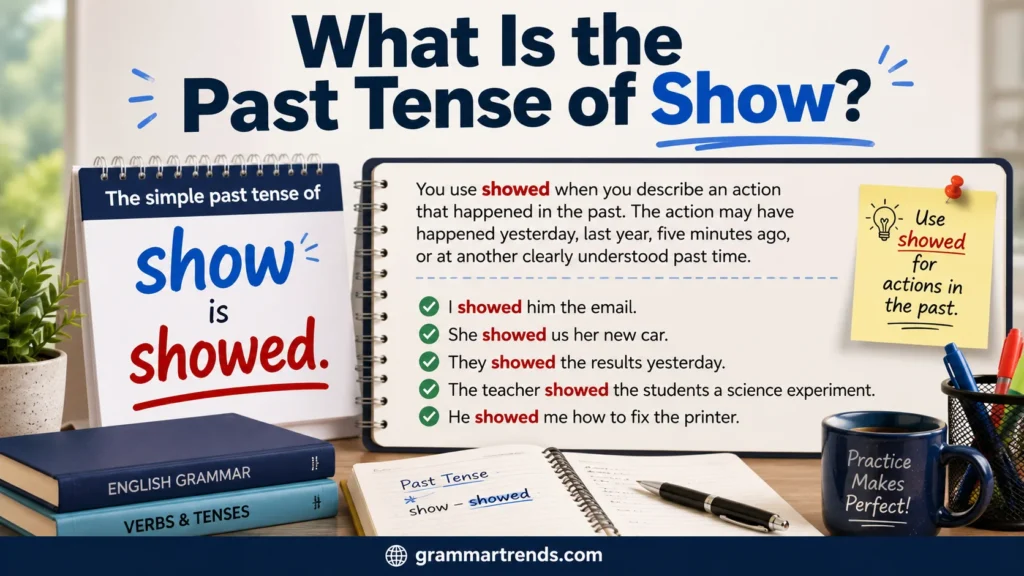
The simple past tense of show is showed.
You use showed when you describe an action that happened in the past. The action may have happened yesterday, last year, five minutes ago, or at another clearly understood past time.
For example:
- I showed him the email.
- She showed us her new car.
- They showed the results yesterday.
- The teacher showed the students a science experiment.
- He showed me how to fix the printer.
The important point is that showed can stand as the main past-tense verb.
Consider:
Daniel showed me the photograph.
The sentence is complete. You don’t need has, have, had, or another auxiliary verb.
Showed With Specific Past-Time Expressions
The simple past often appears with expressions that identify a finished past period.
Common examples include:
- yesterday
- last night
- last week
- last month
- two days ago
- an hour ago
- in 2024
- earlier this morning
- when I was younger
- during the meeting
For example:
She showed me the document yesterday.
We showed the client the final design last Friday.
He showed everyone his new office two weeks ago.
The time expression isn’t what creates the past tense by itself. Instead, it provides context that fits the simple past.
What Is the Past Participle of Show?
The standard past participle of show is shown.
Oxford Learner’s Dictionaries identifies shown as the past participle of show.
A past participle doesn’t work exactly like an ordinary past-tense verb. English commonly uses it with auxiliary verbs to create perfect tenses or passive constructions.
For example:
I have shown you the evidence.
She has shown remarkable patience.
They had shown strong interest in the proposal.
Here, have, has, and had help form perfect constructions. Shown supplies the past participle.
The Basic Pattern
Remember these three combinations:
- have + shown
- has + shown
- had + shown
Examples:
We have shown enough evidence.
The company has shown steady growth.
The researchers had shown similar results before.
This is one of the easiest ways to recognize when shown belongs in a sentence.
When to Use “Showed”
Use “Showed” for a Completed Past Action
Choose showed when you’re simply describing something that happened in the past.
For example:
I showed my friend the new website.
The action happened in the past. Nothing else is required to establish the verb tense.
Another example:
The manager showed us the updated schedule.
Again, showed directly expresses the past action.
Use “Showed” When the Sentence Uses “Did”
This is a particularly common mistake.
After did, use the base form show, not showed.
Correct:
Did she show you the report?
Incorrect:
Did she showed you the report?
Why?
Because did already carries the past-tense marking. Adding showed would effectively mark the past twice.
The same principle applies to negative sentences:
She didn’t show me the message.
Not:
She didn’t showed me the message.
Think of did as the tense carrier. Once it appears, the main verb returns to its base form.
Showed in Questions
The same rule applies to questions:
- Did he show you the picture?
- Did they show the results?
- Why did she show him the document?
- When did the teacher show you the example?
The verb remains show, even though the sentence refers to the past.
When to Use “Shown”
Use “Shown” With Have, Has, or Had
The most familiar use of shown appears in perfect constructions.
Have shown
Use have shown with I, you, we, and they in the present perfect.
Examples:
We have shown that the method works.
They have shown considerable improvement.
You have shown excellent judgment.
Has shown
Use has shown with third-person singular subjects such as he, she, it, or a singular noun.
Examples:
She has shown great determination.
The study has shown a clear pattern.
The new system has shown promising results.
Had shown
Use had shown when one past event happened before another past event.
For example:
The company had shown signs of trouble before the announcement.
The phrase had shown places the showing earlier in the past relative to another past reference point.
Use “Shown” in Passive Constructions
Shown also appears frequently in passive voice.
Examples include:
- was shown
- were shown
- is shown
- are shown
- has been shown
- had been shown
- will be shown
For example:
The results were shown to the committee.
The documentary was shown at the festival.
The data has been shown to be reliable.
The instructions are shown on the screen.
In these examples, the subject receives the action rather than performing it.
Compare:
Active:
The teacher showed the students the results.
Passive:
The results were shown to the students.
The verb form changes because the sentence structure changes.
Cambridge Dictionary gives shown as the past participle and includes passive examples such as things being “shown” on a map or displayed for viewing.
Showed vs. Shown in Side-by-Side Examples
A direct comparison often makes the distinction click.
| Sentence | Why it works |
| She showed me the photo. | Simple past |
| She has shown me the photo. | Present perfect |
| She had shown me the photo. | Past perfect |
| The photo was shown to us. | Passive voice |
| They showed the results yesterday. | Simple past |
| The results have been shown to everyone. | Perfect passive |
| Did they show you the results? | Did takes the base verb |
| They didn’t show us the results. | Didn’t takes the base verb |
The key isn’t the meaning of show. The meaning stays broadly connected to displaying, revealing, explaining, demonstrating, or making something known.
The difference lies mainly in how the verb functions grammatically.
Can “Showed” Be Used as a Past Participle?
Here’s where the topic gets more interesting.
Many grammar explanations present the rule as:
show → showed → shown
That is the safest pattern for learners, especially in formal writing.
However, major dictionaries acknowledge that showed can also occur as a past participle in some usage.
That doesn’t mean the two forms are equally useful in every situation.
For standard formal US English, shown is generally the clearest and most conventional choice when a past participle is required.
Compare:
She has shown me the results.
This sounds natural and standard.
You may also encounter:
She has showed me the results.
Some speakers use this form, particularly in informal or regional varieties. Yet shown remains the safer choice for professional writing, academic work, edited content, and formal communication.
The important lesson is not to pretend that real-world English has no variation. It does.
Instead, understand the standard pattern first:
show → showed → shown
Then you’ll recognize less common variants when you encounter them.
Why “Shown” Can’t Usually Stand Alone
One of the biggest errors is treating shown as if it were simply another form of showed.
For example:
She shown me the picture.
This doesn’t work in standard English because shown is functioning as a past participle without the grammatical structure that normally supports it.
Instead, write:
She showed me the picture.
Or:
She has shown me the picture.
Or:
She had shown me the picture.
The difference becomes easier when you think of shown as a component inside a larger verb phrase.
Correct Patterns
- She showed me.
- She has shown me.
- She had shown me.
- It was shown to me.
- It has been shown to me.
Incorrect Standard Pattern
- She shown me.
The last sentence lacks the required auxiliary structure.
Common Mistakes With Showed and Shown
“I Have Showed You”
This is one of the most common mistakes.
Incorrect in standard formal English:
I have showed you the answer.
Correct:
I have shown you the answer.
Because have requires the past participle in a present-perfect construction.
“She Shown Me the Picture”
Incorrect:
She shown me the picture.
Correct:
She showed me the picture.
If you want to use shown, add an appropriate auxiliary:
She has shown me the picture.
The choice depends on the intended tense.
“They Were Showed the Results”
This construction often trips people up because were already appears.
Incorrect:
They were showed the results.
Standard form:
They were shown the results.
Here, were shown forms a passive construction.
You can also use an active structure:
The manager showed them the results.
Both sentences communicate a similar event, but their structures differ.
“Did He Showed You?”
Incorrect:
Did he showed you?
Correct:
Did he show you?
The auxiliary did already marks the past tense.
This rule also applies to verbs beyond show:
Did she go?
Not:
Did she went?
Likewise:
Did he see it?
Not:
Did he saw it?
The same grammatical principle is at work.
“He Had Showed Me”
For standard formal writing, use:
He had shown me.
The structure had + past participle creates the past perfect.
For example:
He had shown me the document before the meeting started.
The first action happened before the second past event.
Showed vs. Shown in Active and Passive Sentences
The active-passive distinction gives you another useful way to understand these forms.
Active Voice
In an active sentence, the subject performs the action.
The scientist showed the students the results.
The scientist performs the showing.
Passive Voice
In a passive sentence, the subject receives the action.
The results were shown to the students.
The results receive the action.
This distinction explains why showed and shown can appear in sentences describing essentially the same event.
| Voice | Example |
| Active | The instructor showed us the diagram. |
| Passive | The diagram was shown to us. |
| Active | The company showed investors the data. |
| Passive | The data was shown to investors. |
Active voice usually sounds more direct because it identifies who performed the action.
Passive voice still has an important role when the action or result matters more than the person who performed it.
Showed vs. Shown With Have, Has, and Had
This is worth memorizing because it solves many sentence-level problems.
| Auxiliary | Verb form | Example |
| have | shown | They have shown improvement. |
| has | shown | She has shown improvement. |
| had | shown | He had shown improvement. |
| did | show | Did they show improvement? |
| does | show | Does she show improvement? |
| will | show | They will show the results. |
| can | show | This can show the difference. |
Notice the pattern.
After have, has, and had, use the past participle:
have shown
After did, use the base form:
did show
After modal verbs such as will and can, use the base form:
will show
can show
This is a much broader English grammar pattern. Learning it helps with many irregular verbs.
Showed or Shown in Everyday English
Grammar becomes easier when you see it in situations you actually encounter.
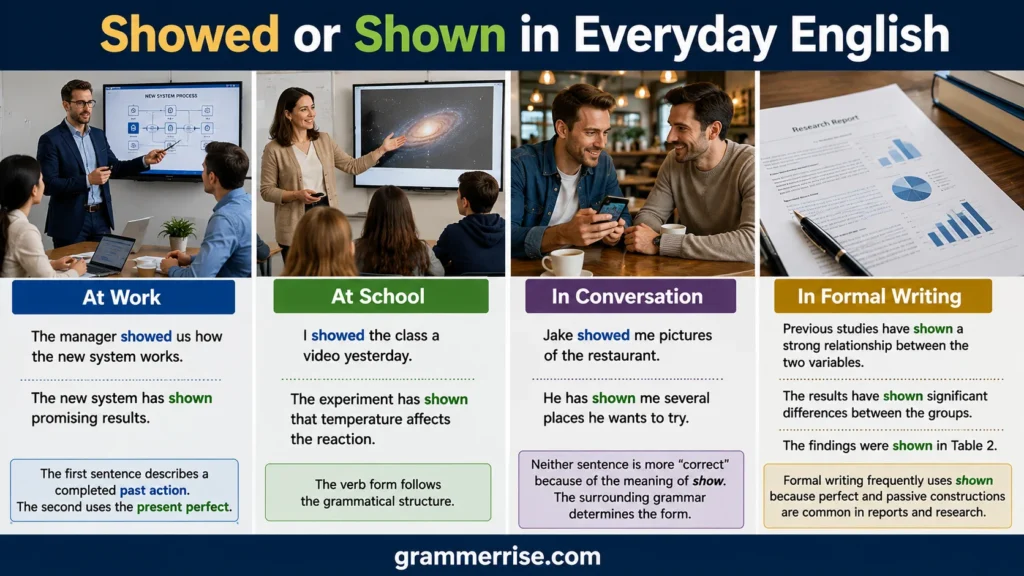
At Work
Imagine a manager explaining a new process.
The manager showed us how the new system works.
Later, someone summarizes the results:
The new system has shown promising results.
The first sentence describes a completed past action.
The second uses the present perfect.
At School
A teacher might say:
I showed the class a video yesterday.
A report might say:
The experiment has shown that temperature affects the reaction.
Again, the verb form follows the grammatical structure.
In Conversation
Imagine two friends discussing a new restaurant:
Jake showed me pictures of the restaurant.
Later:
He has shown me several places he wants to try.
Neither sentence is more “correct” because of the meaning of show. The surrounding grammar determines the form.
In Formal Writing
Formal writing frequently uses shown because perfect and passive constructions are common in reports and research.
Examples:
Previous studies have shown a strong relationship between the two variables.
The results have shown significant differences between the groups.
The findings were shown in Table 2.
Cambridge also uses show in contexts involving evidence, research, results, and measurements.
Showed vs. Shown in Research and Academic Writing
The verb show has an especially useful role in academic English because researchers often describe what evidence demonstrates.
For example:
The results showed a significant increase in sales during the final quarter.
Here, showed works because the sentence describes a completed past finding.
Now compare:
The results have shown a significant increase in sales.
This version uses the present perfect and connects the finding to the current discussion.
Another example:
The study showed that sleep affected reaction time.
Versus:
Several studies have shown that sleep affects reaction time.
The first sentence refers to one completed study.
The second refers to accumulated evidence from several studies.
The grammatical difference subtly changes the framing of the evidence.
A Practical Case Study: Editing a Business Report
Consider this draft:
The analysis have showed that customers prefer shorter checkout times.
Two problems appear immediately.
First, analysis is singular, so it takes has, not have.
Second, after has, the standard past participle is shown, not showed.
The corrected sentence is:
The analysis has shown that customers prefer shorter checkout times.
Now consider a different sentence:
The analysis showed that customers preferred shorter checkout times.
This sentence is also correct.
Why?
Because showed functions as the simple past. No perfect auxiliary appears.
The difference isn’t about one sentence being more intelligent or formal. It is about the tense and structure you choose.
Read more: Drank or Drunk: What’s the Difference?
Showed vs. Shown: A Simple Decision Trick
When you’re unsure, ask one question first:
What comes before the verb?
If the sentence contains has, have, or had, shown is normally the standard choice.
She has shown her work.
If the sentence simply describes a completed past action, use showed.
She showed her work yesterday.
If the sentence contains did, use show.
Did she show her work?
If the sentence uses passive voice, use shown in the relevant passive construction.
Her work was shown to the class.
The Four-Part Memory Rule
Keep this compact pattern in mind:
- Yesterday → showed
- Has/have/had → shown
- Was/were/is/are → often shown in passive constructions
- Did → show
It’s not a complete grammar textbook, but it’s an excellent practical shortcut.
Show, Showed, Shown, and Showing
Seeing all four forms together makes the system easier to remember.
| Form | Name | Example |
| show | Base form | I want to show you. |
| showed | Simple past | I showed you yesterday. |
| shown | Past participle | I have shown you before. |
| showing | Present participle | I am showing you now. |
Each form has a different job.
Show
Use show after modal verbs, do/does/did constructions, infinitives, and in the present tense.
I show my work.
Did you show him?
I want to show you something.
Showed
Use showed for the simple past.
She showed me the photograph.
Shown
Use shown as the standard past participle.
She has shown me the photograph.
Showing
Use showing as the present participle.
She is showing me the photograph.
Understanding the complete family prevents you from treating showed and shown as interchangeable spellings.
Why “Show” Is an Irregular Verb
English regular verbs usually form their past tense and past participle with -ed.
For example:
walk → walked → walked
clean → cleaned → cleaned
open → opened → opened
The verb show behaves differently.
Its traditional core pattern is:
show → showed → shown
That’s why you can’t simply assume that the past tense and past participle must match.
Compare:
| Verb | Past tense | Past participle |
| walk | walked | walked |
| work | worked | worked |
| play | played | played |
| show | showed | shown |
| write | wrote | written |
| break | broke | broken |
| speak | spoke | spoken |
This is one reason learners sometimes write showed where shown belongs. They apply the regular-verb pattern to an irregular verb.
Is “Shown” Always Used With Have, Has, or Had?
No.
That’s an important distinction.
Although shown frequently follows have, has, or had, it can also appear in passive constructions with forms of be.
For example:
The results were shown on the screen.
The movie was shown at the theater.
The figures are shown in the table.
The evidence has been shown to be unreliable.
So the more accurate rule is:
Shown is the standard past participle of show and commonly appears in perfect and passive constructions.
That’s more precise than saying simply, “shown always comes after have.”
Is “Showed” or “Shown” More Correct?
Neither word is universally “more correct.”
They are correct in different grammatical situations.
Use showed when you need the simple past:
She showed me the results.
Use shown when you need the standard past participle:
She has shown me the results.
The real mistake occurs when you use one form where the sentence requires another.
Think of them as tools in the same toolbox. You wouldn’t use a screwdriver simply because it’s the only tool you recognize.
Common Sentences: Correct or Incorrect?
| Sentence | Status | Explanation |
| She showed me the picture. | ✅ Correct | Simple past |
| She has shown me the picture. | ✅ Correct | Present perfect |
| She had shown me the picture. | ✅ Correct | Past perfect |
| The picture was shown to us. | ✅ Correct | Passive voice |
| Did she show you the picture? | ✅ Correct | Did + base verb |
| She didn’t show me the picture. | ✅ Correct | Didn’t + base verb |
| She shown me the picture. | ❌ Standard English error | Missing auxiliary |
| Did she showed you? | ❌ Incorrect | Did requires base form |
| I have showed you. | ⚠️ Avoid in formal standard English | Shown is the standard choice |
| The results were showed to us. | ❌ Standard English error | Passive construction requires shown |
Showed or Shown: Quick Quiz
Choose show, showed, or shown.
- Sarah ___ me the email yesterday.
- Sarah has ___ me the email already.
- The results were ___ during the meeting.
- Did Sarah ___ you the email?
- They had ___ strong improvement.
- He ___ us the new design last week.
- The research has ___ a clear relationship.
- Why did she ___ you the message?
- The documentary was ___ on television.
- We ___ the client the final version yesterday.
Answers
- showed
- shown
- shown
- show
- shown
- showed
- shown
- show
- shown
- showed
If you got most of these right, you’ve already mastered the central distinction.
FAQs
1. Is “showed” or “shown” correct?
Both showed and shown are correct, but they work differently. Showed is the simple past form, while shown is usually used with have, has, or had.
2. Can I say “I have showed”?
No. In standard English, you should say “I have shown.” The helping verb have requires the past participle shown.
3. When should I use “showed”?
Use showed when you’re talking about something that happened in the past. For example, “She showed me her new project yesterday.”
4. When should I use “shown”?
Use shown when it follows have, has, or had. For example, “The results have shown a clear improvement.”
5. Is “shown” always used with a helping verb?
In standard modern English, shown normally appears with a helping verb such as have, has, or had. Using it alone as the simple past form is not standard.
6. What is an easy way to remember showed vs shown?
Think of showed as the regular past form and shown as the form that usually needs a helper. If you see have, has, or had, shown is usually the right choice.
Conclusion
Choosing between showed and shown becomes much easier once you focus on the sentence structure rather than how the two words sound. Use showed for a completed action in the simple past, and use shown when it works with have, has, or had. A quick check of the helping verb can save you from a common grammar mistake. With a little practice, this small distinction will feel natural, whether you’re writing an email, finishing an assignment, or polishing a professional document.



[…] Read more: Showed or Shown: When Should You Use Each? […]