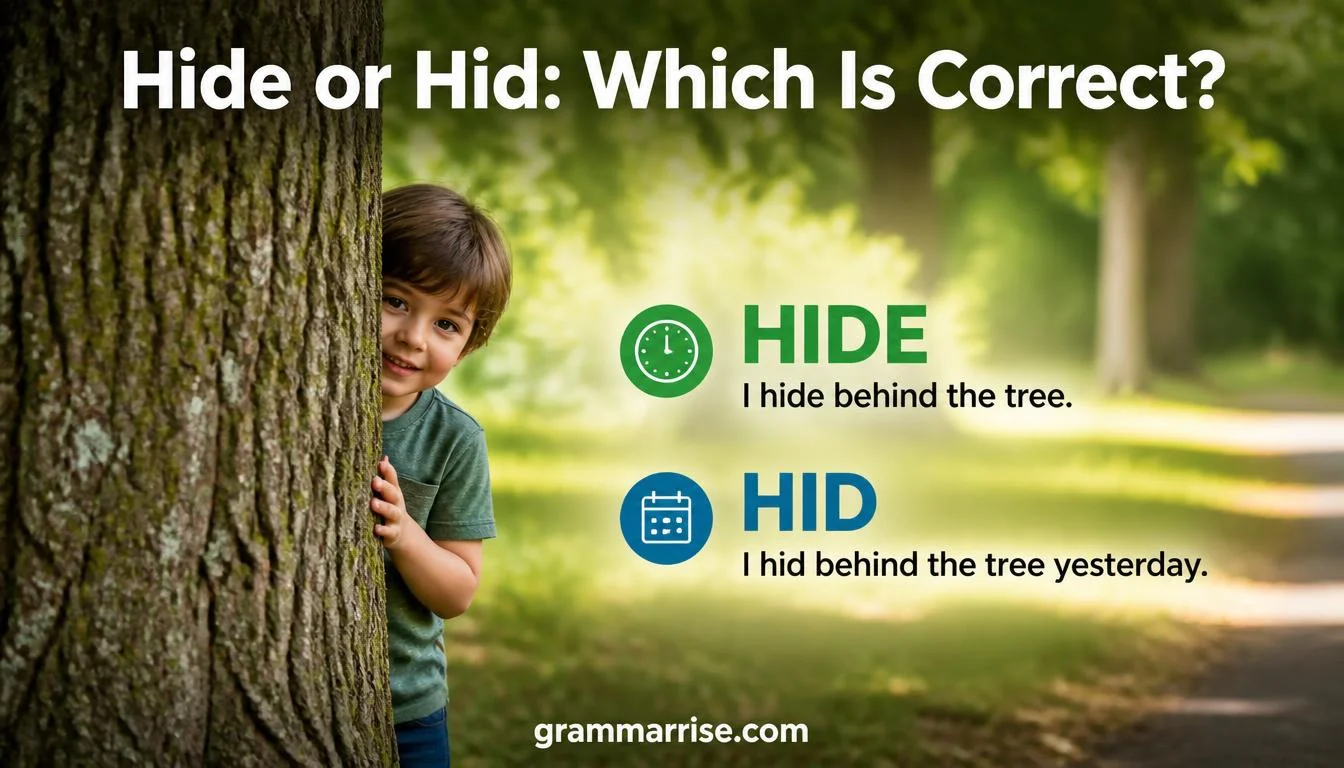
The Hide or Hid question often causes confusion because both words look similar, yet each serves a different grammatical purpose.
The simple difference is that hide is the base form, while hid is the past form. In my experience helping English learners, writers, and native speakers, I’ve found that understanding this logical system removes much of the second-guessing. You can connect hide with a present action, while hid describes a completed action in the past. This basic distinction also makes sentences, emails, social media posts, essays, and professional writing easier to handle.
Irregular verbs don’t always follow typical -ed patterns, so learning the rules, usage, conjugation, tenses, passive constructions, adjective forms, idioms, and real-life examples gives you a clearer picture. Once you know the right word and form, common mistakes become easier to recognize, and you can feel more confident without unnecessary hesitation.
Quick Answer
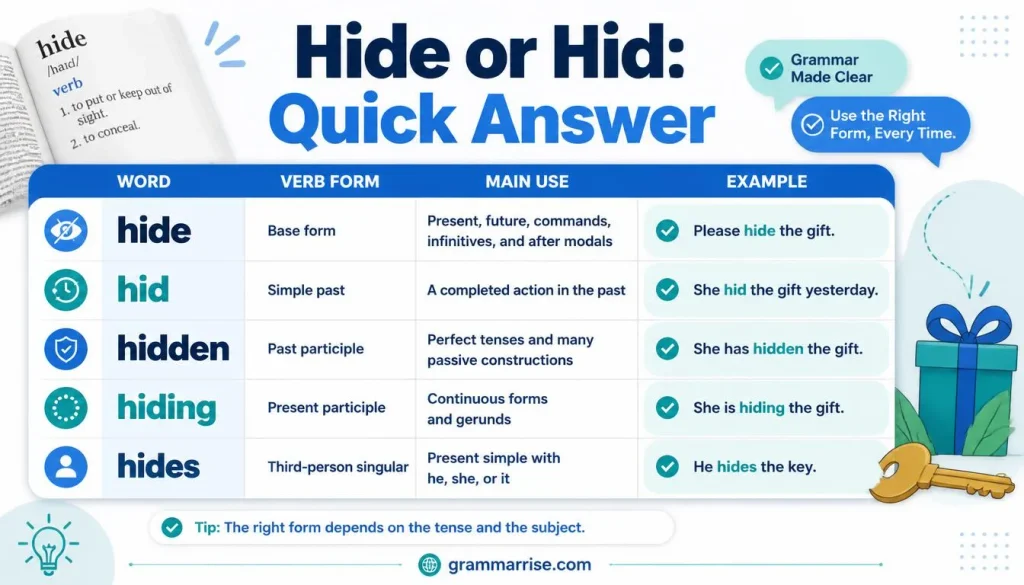
The difference between hide and hid comes down to tense.
| Word | Verb Form | Main Use | Example |
| hide | Base form | Present, future, commands, infinitives, and after modals | Please hide the gift. |
| hid | Simple past | A completed action in the past | She hid the gift yesterday. |
| hidden | Past participle | Perfect tenses and many passive constructions | She has hidden the gift. |
| hiding | Present participle | Continuous forms and gerunds | She is hiding the gift. |
| hides | Third-person singular | Present simple with he, she, or it | He hides the key. |
So, is hide or hid correct?
Both are correct. The sentence determines which form you need.
Consider these three sentences:
I hide my wallet here.
This describes a present habit or general action.
I hid my wallet here yesterday.
This describes a completed past action.
I have hidden my wallet here before.
This uses the past participle with the present perfect tense.
That small change in verb form carries a lot of grammatical information.
What Does “Hide” Mean?
The verb hide means to put someone or something somewhere it cannot easily be seen, found, or noticed. It can also describe keeping information, feelings, intentions, or problems from other people.
You can hide a physical object:
- She hid the keys under the cushion.
- Please hide the birthday present.
- He hid the documents in a cabinet.
You can also hide something less tangible:
- She tried to hide her disappointment.
- He hid the truth from his parents.
- The company cannot hide the problem forever.
The word therefore has a broader meaning than simply putting an object behind another object.
Hide as a Base Verb
Hide is the base form of the verb. You’ll see it in several common grammatical structures.
For example:
Present simple:
I hide important papers in this drawer.
Infinitive:
She wants to hide the surprise.
After a modal:
You should hide the password.
Future:
We will hide the presents before the guests arrive.
Command:
Hide behind the door!
Notice something important. The word remains hide even when the sentence refers to the future or follows a modal verb.
That’s because English generally uses the base form after modal verbs such as:
- can
- could
- may
- might
- must
- shall
- should
- will
- would
So these are correct:
- You should hide it.
- She can hide the evidence.
- They will hide the gifts.
- He might hide the letter.
These aren’t correct:
- ❌ You should hid it.
- ❌ She can hid the evidence.
- ❌ They will hid the gifts.
The helping verb already establishes the grammatical structure. The main verb stays in its base form.
What Does “Hid” Mean?
Hid is the simple past form of hide.
Use hid when you’re describing an action that happened and finished in the past.
For example:
I hid the letter yesterday.
The word yesterday clearly places the action in the past.
Other examples include:
- She hid behind the curtain.
- He hid the keys under the table.
- They hid the present before the party.
- The child hid when the dog entered.
- I hid my disappointment during the meeting.
The important point is that hid doesn’t normally need a helping verb in an affirmative simple past sentence.
You can simply say:
She hid the money.
You don’t need:
She did hid the money.
That structure is incorrect.
Past-Time Words Often Work With “Hid”
Certain words and phrases make the simple past especially clear.
Common examples include:
- yesterday
- last night
- last week
- last month
- earlier
- a few minutes ago
- two days ago
- when I was younger
- before the meeting
- during the party
- this morning, when referring to a completed past event
For example:
I hid the package yesterday.
He hid behind the tree a few minutes ago.
She hid her diary when she was younger.
These examples show why hid is the natural choice for completed past actions.
Hide vs. Hid: The Main Difference
The easiest way to distinguish hide from hid is to ask yourself one question:
Is the action happening now or did it happen in the past?
If you’re talking about a present habit, a command, an infinitive, or a future action, hide often works.
If you’re describing a completed action in the past, use hid.
| Situation | Correct Form | Example |
| Present habit | hide | I hide my valuables here. |
| Completed past action | hid | I hid my valuables yesterday. |
| Future | hide | I will hide them later. |
| After a modal | hide | You should hide them. |
| Infinitive | hide | She wants to hide them. |
| Simple past question | hide | Did you hide them? |
| Simple past negative | hide | I didn’t hide them. |
| Present perfect | hidden | I have hidden them. |
This table reveals an important detail: a sentence can refer to the past without using “hid.”
That happens in questions and negative sentences with did.
For example:
I hid the keys.
But:
Did you hide the keys?
Why does the verb change?
Because did carries the past tense. The main verb returns to its base form.
That rule causes many mistakes, so it deserves special attention.
Hide, Hid, and Hidden: The Complete Verb Forms
Learning only hide vs. hid can leave you with another common problem: hidden.
The full pattern is:
Hide → Hid → Hidden
Here’s how the three forms work:
| Form | Grammatical Name | Example |
| hide | Base form | I want to hide the gift. |
| hid | Simple past | I hid the gift yesterday. |
| hidden | Past participle | I have hidden the gift. |
Think of the forms as three different tools.
Hide handles the base structure.
Hid handles the simple past.
Hidden works with perfect tenses and certain passive constructions.
For example:
I hide the documents in a locked cabinet.
Yesterday, I hid the documents there.
The documents have been hidden somewhere secure.
Each sentence describes hiding. The grammatical construction determines the form.
When to Use “Hidden”
Use hidden as the past participle.
It commonly appears after:
- have
- has
- had
Examples:
I have hidden the keys.
She has hidden the letter.
They had hidden the presents before the guests arrived.
Using hid after these helping verbs is a common mistake.
Incorrect:
❌ I have hid the keys.
Correct:
✅ I have hidden the keys.
Incorrect:
❌ She had hid the letter.
Correct:
✅ She had hidden the letter.
There’s another important use of hidden in passive constructions:
The documents were hidden in a locked room.
The treasure was hidden beneath the floor.
In these sentences, hidden functions as the past participle.
When to Use “Hide”
Understanding when hide appears makes the entire hide-or-hid question much easier.
Present Simple
Use hide for habits, routines, general truths, or repeated actions.
I hide my spare keys in a drawer.
Some animals hide when they feel threatened.
She usually hides her personal documents at home.
Remember that hides appears with he, she, and it in the present simple.
He hides his wallet in the cabinet.
Not:
❌ He hide his wallet in the cabinet.
After “To”
The infinitive uses to + base verb.
Therefore:
She wants to hide the surprise.
He decided to hide the letter.
They tried to hide the mistake.
Not:
❌ She wants to hid the surprise.
The word to signals the infinitive structure here, so the verb remains hide.
After Modal Verbs
After modal verbs, use the base form:
You should hide the documents.
He might hide the evidence.
They will hide the presents.
She can hide the box.
Never change hide to hid simply because the sentence refers to the past, present, or future.
The structure matters.
In Commands
Commands also use the base form:
Hide behind the wall!
Before she sees it, hide the gift.
You should also hide your personal information.
Commands don’t use hid.
When to Use “Hid”
Use hid for completed past actions.
Simple Past Statements
I hid the keys under the sofa.
She hid behind the door.
We hid the gift in the closet.
He hid his feelings during the conversation.
These sentences describe actions that occurred in the past.
Past Questions
Here’s where things get interesting.
You might think the past question should use hid because the question refers to a past action.
However, English uses did + base verb.
Therefore:
Did you hide the keys?
Not:
❌ Did you hid the keys?
Other examples:
Did she hide the letter?
Where did they hide the package?
Why did he hide the truth?
The past tense sits in did, not in hide.
Past Negative Sentences
The same principle applies to negative sentences.
Use:
didn’t + base verb
For example:
I didn’t hide the letter.
She didn’t hide the keys.
They didn’t hide the evidence.
Not:
❌ I didn’t hid the letter.
The word didn’t is already the past form of do in this structure. Adding another past-tense verb creates the wrong grammatical pattern.
Why “Did You Hide?” Is Correct
This is one of the most useful rules to remember when learning hide or hid.
The basic structure is:
Did + subject + base verb
So:
Did you hide the keys?
I wonder if she hid the gift.
Were the documents hidden by them?
The same pattern works with many other irregular verbs:
Did you go?
Was she able to see it?
And did he take the money?
English doesn’t normally put the simple past form after did.
That’s why Did you hid? sounds wrong to fluent speakers.
A Simple Comparison
| Statement | Question |
| I hid the keys. | Did you hide the keys? |
| She hid the gift. | Did she hide the gift? |
| They hid the documents. | Did they hide the documents? |
Notice the pattern.
The affirmative sentence uses hid. The question uses did + hide.
Once you see that pattern, the rule becomes much easier to remember.
Why “Have Hid” Is Incorrect
Another frequent mistake occurs with perfect tenses.
Some learners say:
❌ I have hid the keys.
The standard form is:
✅ I have hidden the keys.
Why?
Because perfect tenses use:
have/has/had + past participle
The past participle of hide is hidden.
So:
- I have hidden
- She has hidden
- They have hidden
- We had hidden
Examples:
I have hidden the documents.
She has hidden the present.
They had hidden the evidence before anyone arrived.
The word hid doesn’t fill that grammatical position.
Perfect Tense Comparison
| Tense | Correct Example |
| Present perfect | I have hidden it. |
| Present perfect | She has hidden it. |
| Past perfect | They had hidden it. |
| Simple past | They hid it. |
This distinction is small in appearance but significant in grammar.
Common Mistakes With Hide and Hid
Several errors appear repeatedly when learners confuse the different forms.
| Incorrect | Correct | Reason |
| I hid my keys every day. | I hide my keys every day. | The sentence describes a present habit. |
| Yesterday, I hide the gift. | Yesterday, I hid the gift. | “Yesterday” signals the simple past. |
| Did you hid the file? | Did you hide the file? | “Did” takes the base verb. |
| I have hid the letter. | I have hidden the letter. | Perfect tenses need the past participle. |
| She has hid it. | She has hidden it. | “Has” requires the past participle. |
| They will hid the presents. | They will hide the presents. | “Will” takes the base form. |
| She wants to hid the box. | She wants to hide the box. | Infinitives use the base form. |
A useful editing trick is to look for a helper verb before the main verb.
If you see did, check whether the main verb needs its base form.
If you see have, has, or had, check whether you need hidden.
That quick scan can catch several errors before you publish or submit your writing.

Hide or Hid in Real-Life Examples
Grammar becomes easier when you connect it to situations you actually encounter.
At Home
Imagine that someone asks where you keep your spare key.
You might say:
I hide it in the kitchen drawer.
That suggests a regular practice.
If the person asks what happened yesterday, you could say:
I hid it in the kitchen drawer yesterday.
If you’re talking about an action that has already happened but matters now, you might say:
I have hidden it in the kitchen drawer.
The location may stay identical. The tense changes the meaning.
At Work
Suppose an employee temporarily puts a confidential report somewhere safe.
I hid the report in the locked cabinet.
That sentence describes a completed past action.
If the employee describes a general security habit:
I hide sensitive reports in the locked cabinet.
If the employee discusses a completed action with present relevance:
I have hidden the report in the locked cabinet.
The grammar follows the timeline.
In School
A student might say:
I hid my notes before the teacher entered.
A teacher could ask:
Did you hide your notes?
The student might respond:
Yes, I hid them under my book.
The question uses hide because it follows did. The answer uses hid because it’s a simple past statement.
In Everyday Conversation
Consider this short exchange:
A: Where are the keys?
B: I hid them in the drawer.
A: Why did you hide them there?
B: Because the children were playing with them.
This tiny conversation contains both forms naturally.
Hid appears in the past statement.
Hide appears after did.
That’s exactly the distinction learners need to recognize.
Hide vs. Hid in Questions and Negative Sentences
Questions and negatives deserve special attention because they often change the verb form.
Present Questions
Use do or does with the base form.
Do you hide your valuables here?
Does she hide the keys?
Notice the third-person form:
Does he hide it?
Not:
❌ Does he hides it?
The auxiliary does carries the present-tense marking, so the main verb returns to hide.
Past Questions
Use did + hide.
Did you hide the letter?
Did she hide the gift?
Where did they hide the box?
Present Negatives
Use don’t or doesn’t + hide.
I don’t hide important documents here.
She doesn’t hide anything from me.
Past Negatives
Use didn’t + hide.
I didn’t hide the keys.
He didn’t hide the evidence.
They didn’t hide the truth.
These structures follow a consistent rule. The auxiliary handles the tense while the main verb stays in its base form.
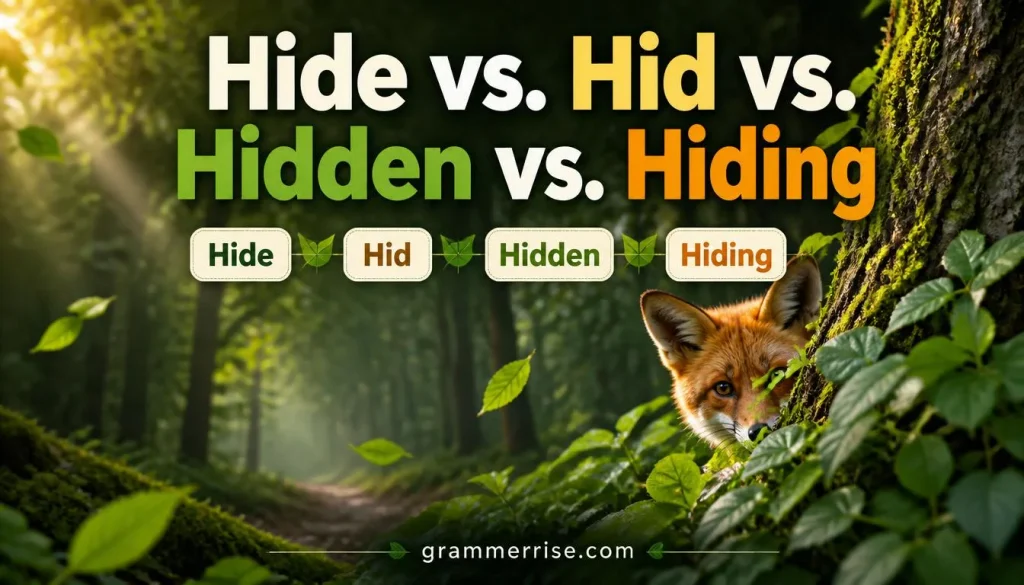
Hide vs. Hid vs. Hidden vs. Hiding
Stopping at hide, hid, and hidden still leaves one useful form out of the picture: hiding.
The complete set includes several forms.
| Form | Function | Example |
| hide | Base verb | I want to hide. |
| hides | Present simple, third person | She hides the keys. |
| hid | Simple past | She hid the keys. |
| hidden | Past participle | She has hidden the keys. |
| hiding | Present participle/gerund | She is hiding the keys. |
“Hiding” in Continuous Tenses
Use hiding after forms of be in continuous constructions.
I am hiding the present.
She is hiding behind the door.
They were hiding when we arrived.
Here, hiding describes an action in progress.
Compare:
She hid behind the door.
This describes a completed past action.
She was hiding behind the door.
This emphasizes the ongoing activity at that past moment.
That difference can add useful detail to your writing.
Is “Hided” Correct?
For the ordinary verb hide, the standard past tense is hid.
The standard past participle is hidden.
So the normal pattern is:
hide → hid → hidden
Not:
hide → hided → hided
Examples:
✅ I hid the letter.
✅ I have hidden the letter.
❌ I hided the letter.
If you’re learning everyday English, remember hid and hidden. Those are the forms you need.
Pronunciation of Hide and Hid
Pronunciation can also help you keep the two forms separate.
Hide sounds like wide.
Hid sounds like did.
The vowel changes:
- hide has the long i sound.
- hid has the short i sound.
Try saying these pairs aloud:
hide — wide
hid — did
Then practice them in sentences:
I hide the key.
I hid the key.
The spelling changes only slightly, but the vowel sound changes noticeably.
A Simple Trick to Remember Hide vs. Hid
If grammar rules feel abstract, use a timeline.
Now or general → hide
Finished past → hid
Have/has/had → hidden
For example:
Today I hide the key.
Yesterday I hid the key.
I have hidden the key.
That three-step pattern covers a huge number of everyday sentences.
Another useful memory sentence is:
Hide today. Hid yesterday. Hidden with have, has, or had.
It isn’t a complete grammar lesson, but it gives you a quick mental shortcut when you’re writing.

A Practical Case Study: One Action, Three Verb Forms
Consider a person preparing a surprise birthday gift.
First, the person describes a regular habit:
I usually hide gifts in the closet.
Later, the person describes what happened yesterday:
I hid the birthday gift in the closet yesterday.
Then the person tells a friend about the completed action:
I have hidden the birthday gift in the closet.
The physical action is almost identical. The grammatical perspective changes.
This example shows why memorizing isolated definitions isn’t enough. You need to understand how time and sentence structure control the verb form.
What Happens in a Question?
The friend asks:
Did you hide the gift?
The answer:
Yes, I hid it.
That’s the pattern worth remembering:
Did + hide
but
I + hid
What Happens in a Negative Sentence?
The person could say:
I didn’t hide it in the closet.
Again, didn’t + hide takes the base form.
The same grammar appears in many irregular verbs:
- Did you go?
- Did you see him?
- Did you take it?
- Did you hide it?
Once this pattern becomes familiar, hide or hid becomes much easier.
Hide or Hid: Quick Reference Chart
| If you want to say… | Use | Example |
| A general or present action | hide | I hide my valuables here. |
| A future action | hide | I will hide the gift. |
| A command | hide | Hide the package. |
| An infinitive | hide | I want to hide it. |
| Something after a modal | hide | You should hide it. |
| A completed past action | hid | I hid it yesterday. |
| A past question with “did” | hide | Did you hide it? |
| A past negative with “didn’t” | hide | I didn’t hide it. |
| Present perfect | hidden | I have hidden it. |
| Past perfect | hidden | I had hidden it. |
| Continuous action | hiding | I am hiding it. |
| Present third person | hides | She hides it. |
This chart works as a quick reference when you’re proofreading an email, assignment, article, or everyday message.
Common Sentence Patterns With Hide
Here are several useful structures worth remembering:
Subject + hide + object
I hide my documents here.
Subject + wants to + hide
She wants to hide the present.
Subject + modal + hide
You should hide the password.
Subject + will + hide
They will hide the evidence.
Did + subject + hide?
Did you hide the keys?
Subject + hid + object
He hid the letter.
Subject + have/has/had + hidden
She has hidden the letter.
Subject + be + hiding
They are hiding behind the wall.
Learning these patterns gives you something more useful than memorizing a single rule. You start recognizing the grammar automatically.
Read more: Showed or Shown: When Should You Use Each?
Why Context Matters More Than Memorization
A common mistake among English learners involves memorizing one form without understanding the sentence around it.
Someone may remember that hid is the past tense and then use it everywhere:
❌ I will hid the gift.
✅ Tomorrow, I will hide the gift.
❌ Did you hid the gift?
✅ Where did you hide the gift?
❌ I want to hid the gift.
✅ She wants to hide the gift.
The problem isn’t a lack of vocabulary. The problem is ignoring the surrounding grammar.
English verbs often change depending on what comes before them.
Compare:
I hid it.
Actually, I did hide it.
The item has already been hidden.
Right now, I am hiding it.
The same basic verb appears in four different forms because the sentence structures differ.
That’s why context should guide your choice.
Hide or Hid in Formal and Informal Writing
Both forms work in formal and informal English when used correctly.
For example, a formal report might say:
The records were hidden from investigators.
An informal conversation might say:
I hid the keys somewhere safe.
A business email could say:
Please hide confidential information before sharing the document.
The verb itself isn’t formal or informal. The surrounding vocabulary and sentence structure determine the overall tone.
My Personal Experience as an English Specialist
As an English specialist, I’ve often seen learners confuse hide and hid. I explain it with a simple example: “I hide my documents here” describes a regular action, while “I hid my documents yesterday” describes a completed past action.
Another common mistake is saying, “Did you hid the keys?” I teach students that did already shows the past, so the correct form is “Did you hide the keys?” I also remind them that have, has, and had take hidden, as in “I have hidden the keys.”
In my experience, remembering hide → hid → hidden makes this grammar point much easier. Once learners focus on the sentence structure instead of memorizing words separately, they become more confident using these forms in everyday English.
FAQs
1. Is “hide” or “hid” correct?
Both are correct, but they have different uses. Hide is the base or present form, while hid is the simple past form.
2. What is the past tense of “hide”?
The simple past tense of hide is hid. For example: “She hid the keys under the table.”
3. When should I use “hide” in a sentence?
Use hide for present actions, commands, and after helping verbs such as “will,” “can,” or “should.” For example: “Please hide the gift.”
4. Is “hidden” the past tense of hide?
Hidden is the past participle, not the simple past. It usually appears with helping verbs, as in “The documents have been hidden.”
5. Why do people confuse hide and hid?
The two words have the same basic meaning and come from the same verb, but their forms change with tense. This makes them easy to mix up when writing quickly.
6. What is an easy way to remember hide vs. hid?
Think of hide as an action happening now or one that may happen, while hid describes something that happened before. This simple time-based trick can help you choose the correct form.
Conclusion
Understanding hide or hid becomes much easier once you connect each word with its tense. Hide works as the base form, while hid describes a completed action in the past. The key is to focus on when the action happens, rather than how similar the words look. With a little practice, you’ll recognize the correct form naturally in everyday writing, conversations, emails, and professional communication.



[…] Read more: Hide or Hid: Which Is Correct? Meaning, Grammar, and Examples […]