
Therefor or Therefore can confuse writers, but their different meanings, usage, and context show which English word fits each sentence correctly.
In English writing, I often see students, bloggers, professionals, and native speakers become confused because these English words have similar sounds, identical endings, and related roots. However, they are not alternate spellings and have different jobs. Therefore is usually the right word for showing a result, consequence, or logical conclusion, while therefor means “for that” or “for it” and mainly appears in legal writing or highly formal formal language. This difference affects sentence structure, word choice, grammar, spelling, and writing quality.
The quick answer is that therefore is common in formal communication, essays, emails, reports, and articles, while therefor has a narrower usage. A sentence such as “The road was closed; therefore, we took another route” shows a clear result and logic. Using therefor in that sentence would sound wrong or unprofessional. This common grammar issue is easier to understand when readers focus on meaning, context, and correct usage instead of only how the words sound when spoken. Learning their origin, British English, American English usage, and real-life examples can improve effective writing, clear communication, writing accuracy, and confidence, while reducing second-guessing. For a practical tip, remember therefore as a connector of logic, and therefor as “for that.”
Quick Answer
The short answer is simple:
- Therefore means for that reason, as a result, or consequently.
- Therefor means for that or for it.
Quick Comparison Table
| Word | Meaning | Common Usage | Example |
| Therefore | For that reason | Everyday English | It was raining; therefore, we stayed inside. |
| Therefor | For that or for it | Legal and formal writing | The buyer paid therefor. |
If you are writing a normal email, article, blog post, essay, or social media update, you will almost always need therefore.
What Is the Difference Between Therefor and Therefore?
The difference between therefor and therefore comes down to meaning and usage.
Although the words look alike, they serve completely different purposes in a sentence.
Therefore Means “As a Result”
Therefore introduces a conclusion based on a reason.
Example:
The roads were icy; therefore, schools closed early.
The school closure happened because of the icy roads.
Therefor Means “For That”
Therefor refers back to something already mentioned.
Example:
The contract required payment therefor.
Here, therefor means payment for that obligation.
Side-by-Side Comparison
| Feature | Therefore | Therefor |
| Meaning | As a result | For that |
| Common Today | Yes | Rare |
| Used in Conversation | Frequently | Almost never |
| Used in Legal Documents | Sometimes | Often |
| Easy Replacement | Consequently | For it |
The easiest way to remember the difference is that therefore explains a result, while therefor refers to something previously mentioned.
What Does Therefore Mean?
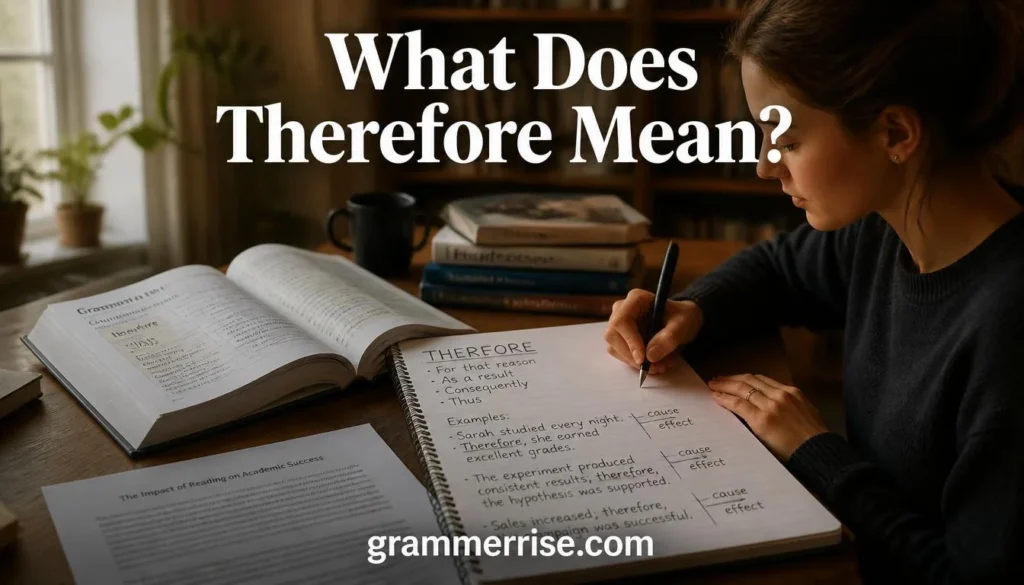
Therefore is an adverb that means:
- For that reason
- Consequently
- As a result
- Thus
It connects a cause with an effect.
Why Writers Use Therefore
Good writing often requires showing logical relationships between ideas.
That’s where therefore shines.
It helps readers understand that one event happened because another event occurred.
Consider this example:
Sarah studied every night. Therefore, she earned excellent grades.
The second sentence naturally follows from the first.
Therefore in Everyday Conversation
People use therefore more often in writing than speech, but it still appears in formal conversations.
Examples:
- The store is closed; therefore, we can’t buy groceries there today.
- He missed the deadline; therefore, the project launch was delayed.
- The weather improved; therefore, the event moved outdoors.
Therefore in Academic Writing
Academic papers rely heavily on logical connections.
Examples:
- The experiment produced consistent results; therefore, the hypothesis was supported.
- Data collection ended early; therefore, researchers adjusted their analysis.
Therefore in Business Writing
Business professionals often use therefore when presenting conclusions.
Examples:
- Sales increased by 20%; therefore, the marketing campaign was considered successful.
- Costs exceeded projections; therefore, management revised the budget.
Common Synonyms for Therefore
Instead of repeating therefore, writers often use alternatives.
| Therefore | Alternative |
| Therefore | Consequently |
| Therefore | Thus |
| Therefore | Hence |
| Therefore | As a result |
| Therefore | Accordingly |
Using different transition words improves readability and keeps writing fresh.
How to Use Therefore Correctly
Many grammar mistakes happen because writers misunderstand punctuation rules.
Therefore Between Two Independent Clauses
Correct:
The meeting ended early; therefore, everyone left before noon.
The semicolon connects two complete thoughts.
Therefore at the Beginning of a Sentence
Correct:
Therefore, we decided to postpone the launch.
This format is common in formal writing.
Therefore After a Period
Correct:
The evidence was convincing. Therefore, the jury reached a quick verdict.
Both sentences stand independently.
Common Punctuation Pattern
A widely accepted structure is:
Independent Clause; therefore, Independent Clause
Example:
The bridge was damaged; therefore, traffic was rerouted.
Incorrect Usage
Incorrect:
The bridge was damaged, therefore traffic was rerouted.
This creates a comma splice.
Correct:
The bridge was damaged; therefore, traffic was rerouted.
What Does Therefor Mean?
Unlike therefore, the word therefor is uncommon.
It means:
- For that
- For it
- In exchange for that
Why Therefor Sounds Strange Today
Modern English favors clearer wording.
Instead of writing:
Compensation therefor shall be issued.
Most writers now prefer:
Compensation for it shall be issued.
The meaning stays the same while becoming easier to understand.
Where Therefor Still Appears
You are most likely to encounter therefor in:
- Legal contracts
- Government regulations
- Historical documents
- Property agreements
- Formal business records
Legal Example
The purchaser shall pay therefor within thirty days.
This means the purchaser must pay for the item within thirty days.
Contract Example
The company shall receive compensation therefor.
In plain English:
The company shall receive compensation for it.
Why Therefore Is Much More Common Than Therefor
A quick look at modern writing reveals a huge difference in usage frequency.
You can find therefore in:
- Newspapers
- Books
- Academic journals
- Business reports
- Blogs
- Emails
Meanwhile, therefor appears mostly in legal documents.
Why Modern Writers Prefer Therefore
There are several reasons:
- It expresses cause and effect clearly.
- Readers understand it immediately.
- It fits modern communication styles.
- It appears in educational materials.
Why Therefor Declined
Language evolves.
Over time, speakers chose simpler alternatives such as:
- For it
- For that
- In exchange for it
As a result, therefor gradually disappeared from everyday English.
Therefore vs Therefor Examples
Seeing both words side by side makes the distinction easier.
Correct Usage Examples
| Therefore | Therefor |
| He was tired; therefore, he went home. | Payment therefor was received. |
| It snowed overnight; therefore, school closed. | Compensation therefor was approved. |
| She practiced daily; therefore, she improved. | Fees therefor were collected. |
Example Analysis
Sentence:
She practiced daily; therefore, she improved.
The second event happened because of the first.
Sentence:
Fees therefor were collected.
The word means fees for that service.
The meanings are completely different despite the similar spelling.

Therefore vs Therefor vs There For
Many learners encounter a third variation: there for.
Comparison Table
| Term | Meaning |
| Therefore | As a result |
| Therefor | For that |
| There for | Present or available |
Examples
Therefore
The team trained hard; therefore, they won.
Therefor
The payment therefor was completed.
There For
I will always be there for my friends.
Notice that there for consists of two separate words.
Its meaning is completely unrelated to therefor.
Grammar Rules for Therefore
Using therefore properly improves clarity and professionalism.
Rule: Show Cause and Effect
Correct:
Fuel prices increased; therefore, transportation costs rose.
Rule: Use Proper Punctuation
Correct:
The application was incomplete; therefore, it was rejected.
Incorrect:
The application was incomplete, therefore it was rejected.
Rule: Place Therefore Naturally
These formats work well:
- Therefore, we proceeded cautiously.
- We proceeded cautiously; therefore, no problems occurred.
- We proceeded cautiously. Therefore, no problems occurred.
Quick Grammar Chart
| Structure | Correct |
| Sentence; therefore, sentence | Yes |
| Sentence. Therefore, sentence | Yes |
| Sentence, therefore sentence | No |
Common Mistakes Writers Make
Understanding common errors helps prevent them.
Mistake: Using Therefor Instead of Therefore
Incorrect:
It was raining; therefor, we stayed home.
Correct:
It was raining; therefore, we stayed home.
Mistake: Assuming Therefor Is a Misspelling
Many people believe therefor is wrong.
It isn’t.
It’s a legitimate English word.
It’s simply rare.
Mistake: Ignoring Punctuation
Incorrect punctuation often causes confusion.
Incorrect:
Sales improved, therefore profits increased.
Correct:
Sales improved; therefore, profits increased.
Mistake: Overusing Therefore
Transition words lose impact when repeated too often.
Instead of writing:
Therefore… Therefore… Therefore…
Mix in alternatives such as:
- Consequently
- Thus
- Accordingly
- As a result
- Hence
Case Study: A Real Writing Example
Consider this paragraph:
The company invested heavily in employee training. Workers developed stronger technical skills. Productivity increased significantly.
The logical connection exists, but it feels incomplete.
Improved version:
The company invested heavily in employee training. Workers developed stronger technical skills. Therefore, productivity increased significantly.
The addition creates a clear cause-and-effect relationship.
Readers instantly understand why productivity improved.
Why Lawyers Still Use Therefor
Legal writing often preserves older language.
Many legal terms remain in use because changing them could create ambiguity.
Examples include:
- Therein
- Thereof
- Hereby
- Thereunder
- Therefor
Although these words sound old-fashioned, they still appear in contracts and statutes.
Example
The seller shall receive payment therefor.
Modern version:
The seller shall receive payment for the goods.
The second version is easier for most readers to understand.

Historical Origins of Therefor and Therefore
Understanding the history helps explain the difference.
Origins of Therefore
Therefore developed from combining:
- There
- Fore
The word eventually came to mean for that reason.
Writers have used it for centuries to express conclusions.
Origins of Therefor
Therefor developed from:
- There
- For
Its meaning became for that thing previously mentioned.
Why One Survived Better
The answer is simple.
People need to express cause and effect frequently.
Therefore became useful in everyday communication.
The meaning of therefor could easily be replaced with simpler phrases.
As a result, usage declined.
Read more: Hide or Hid: Which Is Correct? Meaning, Grammar, and Examples
Memory Tricks to Remember the Difference
Trick One: Look for “Fore”
The word therefore contains fore.
Think of moving forward.
A result moves forward from a reason.
Trick Two: Replace It
Try substituting:
- As a result
- Consequently
If the sentence still works, choose therefore.
Example:
She studied hard; therefore, she passed.
Becomes:
She studied hard; consequently, she passed.
The sentence still makes sense.
Trick Three: Replace Therefor
Try replacing it with:
- For it
- For that
Example:
Payment therefor was issued.
Becomes:
Payment for it was issued.
The meaning remains intact.

American English vs British English
Some grammar differences exist between American and British English.
This isn’t one of them.
American English
Americans overwhelmingly use therefore.
Therefor remains mostly limited to legal writing.
British English
The situation is nearly identical.
British writers use therefore regularly and rarely use therefor outside specialized contexts.
Key Fact
The meanings remain the same in both varieties of English.
Quick Reference Guide
| Question | Correct Word |
| Means as a result? | Therefore |
| Means for that? | Therefor |
| Used in essays? | Therefore |
| Used in business emails? | Therefore |
| Used in legal contracts? | Often Therefor |
| Used in everyday speech? | Therefore |
| Common in modern writing? | Therefore |
Expert Writing Tip
“If you can replace the word with ‘as a result,’ use therefore. If you can replace it with ‘for it,’ use therefor.”
This simple test solves nearly every usage question in seconds.
My Personal Experience as an English Specialist
As an English specialist, I often see learners confuse therefor and therefore because the words look and sound similar. I usually explain that therefore means “as a result,” while therefor means “for that” or “for it.”
A simple trick I recommend is to replace the word with “as a result.” If the sentence still makes sense, use therefore. If you mean “for it,” use therefor. This quick test has helped many learners choose the correct word with greater confidence.
FAQs
1. Is therefor the same as therefore?
No. Therefor and therefore are different words with different meanings. Therefore usually introduces a result or logical conclusion, while therefor means “for that” or “for it” and is mainly used in legal or highly formal language.
2. When should I use therefore?
Use therefore when you want to connect an idea with its result or consequence. For example: “The weather was खराब, therefore the event was canceled.” It is the normal choice in everyday, academic, and professional English.
3. Why is therefor uncommon?
Therefor has a narrow meaning and is mostly found in legal documents and very formal writing. In ordinary English, using it instead of therefore can make your sentence sound incorrect or confusing.
4. Can therefor be used in everyday English?
Technically, yes, but it is rarely appropriate in everyday communication. If you mean “as a result” or “because of that,” therefore is almost certainly the word you need.
5. How can I remember the difference between therefor and therefore?
A useful memory trick is to connect therefore with result or logic. Think of therefor as “for that.” This simple distinction can help prevent mistakes in emails, essays, reports, and other writing.
6. Is therefore more common in British or American English?
Therefore is standard in both British and American English. The difference is not mainly regional; it is about meaning and usage. Therefor remains a specialized word, especially in legal and formal contexts.
Conclusion
The difference between therefor and therefore becomes much easier once you focus on meaning rather than appearance. Therefore is the word you will use most often when showing a result, reason, or logical conclusion. Therefor has a much narrower role and usually appears in legal or highly formal writing with the meaning “for that” or “for it.” In my experience, remembering this simple distinction makes writing more natural and helps avoid an easy but noticeable grammar mistake.




[…] Read more: Therefor or Therefore: Meaning, Grammar, Usage and Examples […]