
Weather or Whether can be confusing because these English words are commonly confused, sound similar, and look almost identical, but their meanings are completely different.
Weather describes the atmosphere or state of the air, including rain, sun, snow, and storms. Whether introduces uncertainty, choices, possibilities, alternatives, or options when someone is deciding. Wether is connected with a sheep. These homophones are spelled differently and belong to different situations. A useful example is “I don’t know whether to go,” where whether is the correct spelling because it expresses a choice.
From my experience teaching grammar, simple clues in the context make this difference easier to recognize. Learning the meaning and word usage of each form helps prevent common mistakes in school, work, emails, social media, and casual conversations. Careful writing, pronunciation, and regular practice with real examples can help you use each word confidently every time.
Quick Answer
If you’re in a hurry, here’s the simplest explanation:
| Word | Meaning | Example |
| Weather | Atmospheric conditions such as rain, snow, wind, or sunshine | The weather is beautiful today. |
| Whether | Expresses a choice, possibility, or uncertainty | I don’t know whether I’ll attend. |
Quick Examples
✅ The weather forecast predicts rain.
✅ We haven’t decided whether to travel tomorrow.
❌ The whether forecast predicts rain.
❌ I wonder weather she received my email.
A simple way to remember this difference is to associate weather with the outdoors and whether with decisions.
Why Do People Confuse Weather and Whether?
Many English spelling mistakes happen because certain words are homophones. Homophones sound the same but have different meanings and spellings.
Weather and whether belong to this category.
When spoken aloud, both words sound identical:
Weather = /ˈweðər/
Whether = /ˈweðər/
Because the pronunciation doesn’t change, your brain must rely entirely on context.
Why This Mistake Happens So Often
- Both words sound exactly alike.
- Spell-check software may not catch the error.
- Fast typing increases the chance of confusion.
- English learners often memorize pronunciation before spelling.
- Both words appear frequently in everyday writing.
Consider this sentence:
I don’t know weather we should leave.
The sentence sounds correct when spoken. However, the meaning involves uncertainty rather than climate conditions. Therefore, whether is the correct choice.
What Does Weather Mean?
The word weather usually refers to atmospheric conditions at a specific place and time.
People discuss weather every day because it affects travel, sports, agriculture, construction, outdoor events, and daily routines.
Weather as a Noun
As a noun, weather describes conditions in the atmosphere.
This includes:
- Rain
- Snow
- Sunshine
- Humidity
- Wind
- Temperature
- Storms
- Fog
Examples of Weather as a Noun
- The weather turned cold overnight.
- Sunny weather attracts more tourists.
- Bad weather delayed the flight.
- The weather forecast predicts thunderstorms.
Types of Weather
| Weather Type | Description |
| Sunny | Clear skies and sunshine |
| Cloudy | Sky covered by clouds |
| Rainy | Frequent rainfall |
| Snowy | Snowfall conditions |
| Windy | Strong air movement |
| Stormy | Thunderstorms or severe weather |
| Foggy | Reduced visibility from fog |
Weather and Climate Are Not the Same
Many people mistakenly use weather and climate interchangeably.
They are different.
| Weather | Climate |
| Short-term conditions | Long-term patterns |
| Changes daily | Changes over decades |
| Local conditions | Regional trends |
| Today’s rain forecast | Average rainfall over years |
For example:
- Weather: It’s raining today.
- Climate: This region receives heavy rainfall every year.
Weather as a Verb
Many writers overlook the fact that weather can also function as a verb.
In this form, weather means:
- To survive
- To endure
- To withstand difficulties
Examples
- The ship weathered the storm.
- The company weathered the recession.
- They weathered several financial challenges.
In these examples, weather has nothing to do with rain or sunshine. Instead, it means successfully surviving a difficult situation.
What Does Whether Mean?
Unlike weather, the word whether deals with choices, alternatives, possibilities, and uncertainty.
Whether acts as a conjunction.
It introduces situations where something may or may not happen.
Examples of Whether
- I don’t know whether he called.
- She can’t decide whether to stay.
- We are discussing whether the project should continue.
In each example, uncertainty exists.
The speaker doesn’t know the answer yet.
Whether Shows a Choice
One of the most common uses of whether involves alternatives.
Examples:
- Whether tea or coffee is available doesn’t matter.
- He couldn’t decide whether to buy the red car or the blue one.
- Students must choose whether to study online or in person.
Whether Shows Uncertainty
Sometimes no explicit alternatives appear.
Examples:
- I wonder whether she received the package.
- Nobody knows whether the meeting will happen.
- Scientists are studying whether the treatment works.
The word signals doubt or uncertainty.
Whether in Professional Writing
Formal writing often uses whether because it sounds precise and clear.
Examples:
- Please confirm whether payment has been received.
- Let us know whether you plan to attend.
- Management will determine whether additional staff are needed.
Business communication frequently relies on this structure.
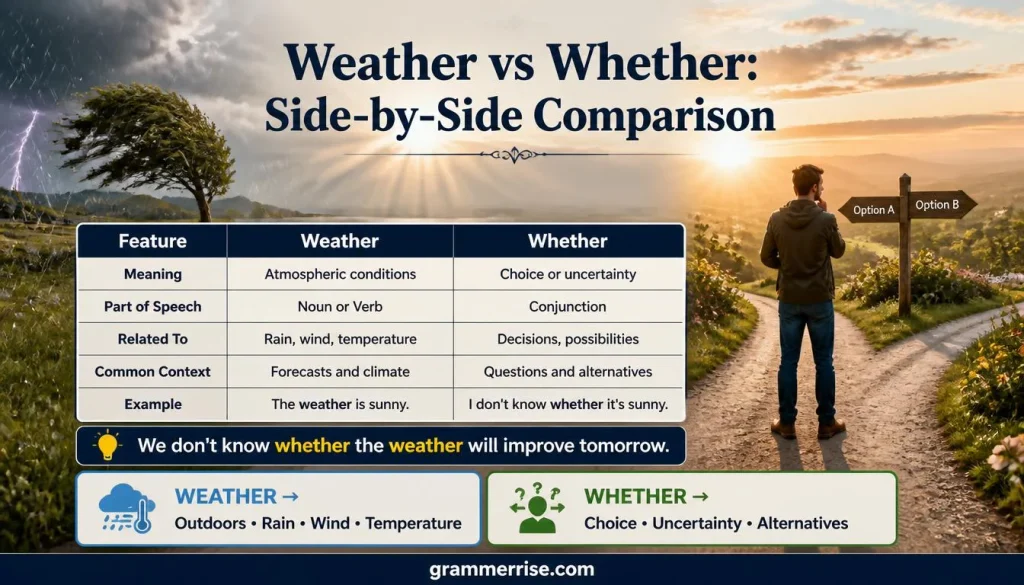
Weather vs Whether: Side-by-Side Comparison
The easiest way to understand these words is to compare them directly.
| Feature | Weather | Whether |
| Meaning | Atmospheric conditions | Choice or uncertainty |
| Part of Speech | Noun or Verb | Conjunction |
| Related To | Rain, wind, temperature | Decisions, possibilities |
| Common Context | Forecasts and climate | Questions and alternatives |
| Example | The weather is sunny. | I don’t know whether it’s sunny. |
One Sentence Showing Both Words
A classic example uses both words correctly:
We don’t know whether the weather will improve tomorrow.
This sentence highlights their different meanings perfectly.
Easy Tricks to Remember the Difference
Memory tricks help eliminate confusion.
Think About the Outdoors
The word weather relates to the outside world.
Examples:
- Weather forecast
- Weather report
- Weather station
- Severe weather warning
If you’re discussing nature or atmospheric conditions, choose weather.
Think About Choices
The word whether often introduces alternatives.
Examples:
- Whether yes or no
- Whether to stay or leave
- Whether it happens or not
If you’re discussing decisions, use whether.
The “Or” Trick
Notice how whether frequently appears with “or.”
Examples:
- Whether this works or fails
- Whether you agree or disagree
- Whether now or later
The presence of alternatives often signals whether.
Quick Memory Phrase
Weather concerns the sky. Whether concerns the choice.
Many learners find this phrase easy to remember.
Common Weather and Whether Mistakes
Let’s look at some frequent errors.
Mistake: Using Weather for Decisions
Incorrect:
❌ I don’t know weather to apply.
Correct:
✅ I don’t know whether to apply.
The sentence expresses uncertainty, not atmospheric conditions.
Mistake: Using Whether for Forecasts
Incorrect:
❌ The whether forecast predicts snow.
Correct:
✅ The weather forecast predicts snow.
Forecasts discuss climate conditions.
Mistake: Mixing Them in Emails
Incorrect:
❌ Please tell us weather you can attend.
Correct:
✅ Please tell us whether you can attend.
Professional communication often requires whether.
Mistake: Choosing the Wrong Word During Fast Typing
Many mistakes occur because writers focus on pronunciation rather than meaning.
Before submitting important documents, pause briefly and ask:
Am I discussing climate or a choice?
The answer reveals the correct spelling.
Whether vs If: Are They Always Interchangeable?
Many people wonder whether and if mean the same thing.
Sometimes they do.
However, not always.
Situations Where Either Works
Examples:
- I don’t know whether he’s coming.
- I don’t know if he’s coming.
Both versions sound natural.
Situations Where Whether Is Better
Certain grammatical structures strongly favor whether.
Before “Or Not”
Correct:
- Whether or not you agree
- Whether or not it rains
Less natural:
- If or not you agree
Before an Infinitive
Correct:
- Whether to leave
- Whether to wait
- Whether to continue
Incorrect:
- If to leave
- If to wait
Formal Writing
Professional and academic writing often prefers whether.
Examples:
- Researchers examined whether the treatment was effective.
- The committee debated whether the proposal should proceed.
Quick Comparison
| Situation | Whether | If |
| Formal writing | Preferred | Sometimes acceptable |
| Before “or not” | Preferred | Usually avoided |
| Before infinitive | Required | Incorrect |
| Casual conversation | Common | Common |
Popular Expressions Using Weather
English contains many weather-related idioms.
These phrases often have meanings unrelated to actual climate.
Under the Weather
Meaning:
Feeling ill or unwell.
Example:
I’m feeling under the weather today.
Weather the Storm
Meaning:
Survive a difficult situation.
Example:
The company weathered the storm after several financial setbacks.
Fair-Weather Friend
Meaning:
Someone who only supports you during good times.
Example:
A fair-weather friend disappears when problems arise.
Make Heavy Weather of Something
Meaning:
To make a task seem harder than it actually is.
Example:
He’s making heavy weather of a simple assignment.
Weather Eye
Meaning:
A careful watch for potential problems.
Example:
Keep a weather eye on market changes.
These expressions appear regularly in books, business discussions, and everyday speech.
Popular Expressions Using Whether
Whether doesn’t appear in as many idioms as weather, but several common constructions exist.
Whether or Not
Examples:
- Attend whether or not you receive confirmation.
- The event will proceed whether or not it rains.
Whether You Like It or Not
Meaning:
Something will happen regardless of personal preference.
Example:
The deadline arrives whether you like it or not.
Whether…Or
Examples:
- Whether rich or poor, everyone deserves respect.
- Whether early or late, she always finishes the work.
This structure highlights alternatives.

Weather and Whether in Real-Life Writing
Understanding theory is useful. Applying it in real situations matters even more.
In Emails
Correct:
- Please confirm whether payment was received.
- Severe weather may affect delivery schedules.
In Business Reports
Correct:
- Analysts are evaluating whether demand will increase.
- Weather disruptions affected shipping operations.
In School Assignments
Correct:
- The study examined whether exercise improves concentration.
- Extreme weather influences agricultural production.
In News Articles
Correct:
- Meteorologists issued a weather warning.
- Officials have not decided whether schools will close.
In Social Media Posts
Correct:
- Beautiful weather today.
- Still deciding whether to go hiking.
Real-world writing becomes much easier when you focus on meaning rather than pronunciation.
Read more: Bare or Bear: Grammar Usage and Examples
Real-World Case Study: How One Wrong Word Changes Meaning
Consider a customer service email.
Incorrect Version
Please let us know weather you wish to continue your subscription.
Although readers understand the intended meaning, the sentence appears unprofessional.
Correct Version
Please let us know whether you wish to continue your subscription.
The correction improves clarity and professionalism instantly.
Small spelling mistakes can affect credibility in business communication.
Mini Quiz: Can You Choose the Correct Word?
Fill in each blank with weather or whether.
- The _____ forecast predicts heavy rain.
- I don’t know _____ she accepted the offer.
- Severe _____ delayed the flight.
- We must decide _____ to expand the business.
- The _____ became colder after sunset.
- Scientists are studying _____ the treatment works.
- Bad _____ damaged several roads.
- She couldn’t choose _____ to stay or leave.
- The local _____ report predicts sunshine.
- Nobody knows _____ the project will succeed.
Quiz Answers
Answer Key
- Weather
- Whether
- Weather
- Whether
- Weather
- Whether
- Weather
- Whether
- Weather
- Whether
Why These Answers Are Correct
Every sentence involving:
- Climate
- Rain
- Temperature
- Forecasts
- Atmospheric conditions
requires weather.
Every sentence involving:
- Choices
- Alternatives
- Uncertainty
- Possibilities
requires whether.
My Personal Experience as an English Specialist
As an English specialist, I have often seen learners confuse weather and whether because they sound the same. I usually teach them to focus on meaning: weather relates to the atmosphere, while whether relates to choices or uncertainty. Using simple real-life examples has helped my students understand the difference quickly and use both words more confidently.
FAQs
1. What is the easiest way to remember weather and whether?
Think of weather when you are talking about rain, sunshine, snow, wind, or the atmosphere. Use whether when you are talking about a choice, possibility, or uncertainty.
2. Is weather the same as whether?
No. They sound the same in many accents, but they have different meanings. Weather relates to atmospheric conditions, while whether introduces choices or possibilities.
3. Is wether a spelling mistake?
Not always. Wether is a real English word, but it is uncommon. It traditionally refers to a castrated male sheep, so it appears much less often than weather or whether.
4. How can I tell if I should use whether?
Try replacing it with if. If the sentence still makes sense, whether may be the correct choice. For example, “I don’t know whether she will come” can become “I don’t know if she will come.”
5. Why do people confuse weather and whether?
The main reason is pronunciation. They are homophones in many varieties of English, meaning they sound alike even though their spellings and meanings are different.
6. What is a simple example of weather versus whether?
You could say, “The weather is rainy today,” because you are describing atmospheric conditions. You could also say, “I don’t know whether to go,” because you are expressing uncertainty about a choice.
Conclusion
Weather and whether may look and sound confusing at first, but their meanings become much clearer once you pay attention to the context. Weather is connected to the atmosphere, such as rain, sunshine, snow, and storms, while whether is used when you are talking about choices, possibilities, or uncertainty. Wether is a different and much less common word related to a male sheep.
The best way to remember the difference is to focus on what your sentence is actually saying. If you are describing conditions outside, choose weather. If you are considering two possibilities or asking about a choice, choose whether. With a little practice and attention to spelling, these commonly confused words become much easier to use correctly in everyday writing.

Hussain Abid is an English language writer with over 10 years of experience in grammar, spelling, vocabulary, and writing. He specializes in creating clear, well-researched content that helps readers improve their English with confidence. At GrammarRise, Hussain writes practical guides, grammar explanations, and word comparison articles based on trusted language sources and real-world usage. His mission is to make English learning simple, accurate, and accessible for everyone

[…] Read more: Weather or Whether: Which One Should You Use? […]