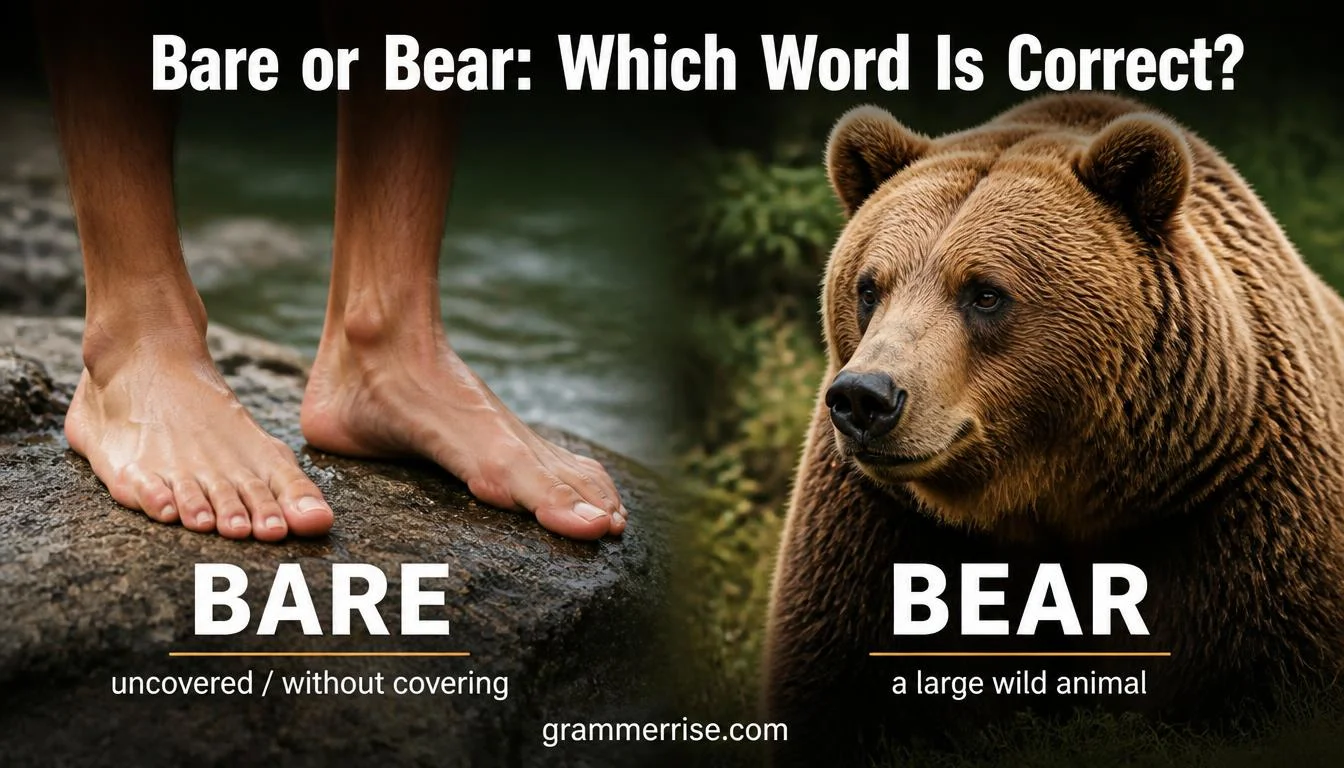
Bare or Bear are homophones that sound the same but have different meanings, which can be confusing for English language learners and native speakers.
Their exact pronunciations are alike, but their spelling shows the difference. Bare can mean uncovered or plain, while bear can refer to an animal or mean carrying, tolerating, or enduring something. These are very different things, so simple explanations can help a student, writer, or professional improve accurate writing, speaking, and communication.
Choosing the wrong word can change a sentence entirely. For example, bear your soul and bare your soul have different meanings and uses. Knowing the correct usage helps you avoid common mistakes, clarify spelling mistakes, and improve writing. This matters in writing emails, school essays, social media posts, and everyday situations. British English and American English use the same spellings.
Quick Answer
Here’s the simplest explanation.
| Word | Meaning | Example |
| Bare | Exposed, uncovered, revealed, minimal | She walked across the beach with bare feet. |
| Bear | Carry, endure, support, produce, remember, or the animal | I can’t bear the noise. |
The Fast Rule
Use bare when something is uncovered, exposed, or revealed.
Use bear when you mean:
- Carry
- Support
- Endure
- Tolerate
- Produce
- Remember
- The large furry animal
Quick Examples
| Correct Usage | Why It Works |
| bare feet | Feet are uncovered |
| bare walls | Walls are plain or empty |
| bear responsibility | Carry responsibility |
| bear fruit | Produce results |
| bear with me | Be patient with me |
| black bear | The animal |
If you’re talking about exposure, choose bare.
If you’re talking about carrying, enduring, supporting, producing, remembering, or the animal, choose bear.
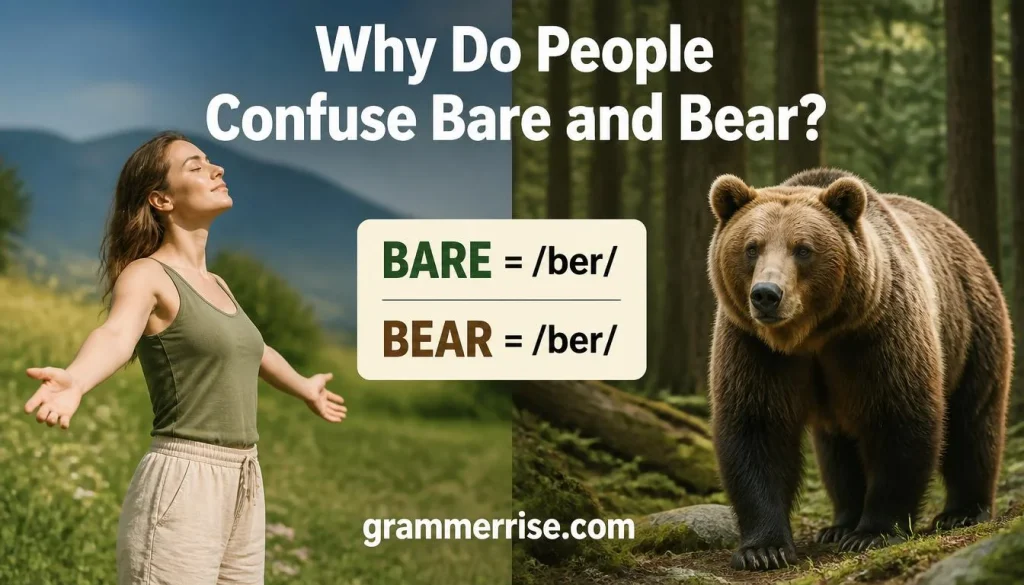
Why Do People Confuse Bare and Bear?
The confusion comes from pronunciation.
Both words are pronounced exactly the same:
/ber/
When spoken aloud, there’s no difference.
As a result, many people rely on sound instead of spelling. That’s where mistakes happen.
They Sound Identical
Consider these sentences:
- I can’t bear the pain.
- His bare hands were freezing.
When spoken, both words sound identical.
Your ears won’t help you choose the correct spelling. Context becomes essential.
English Is Full of Similar Traps
Bare and bear belong to a larger group of commonly confused words:
- Their, there, and they’re
- To, too, and two
- Principal and principle
- Affect and effect
- Lose and loose
Because English developed from multiple language sources, many words share pronunciations while carrying completely different meanings.
Even Native Speakers Make This Mistake
Search social media, blogs, forums, and comment sections and you’ll find examples like:
- “Bare with me.”
- “Bear feet.”
- “Bear minimum.”
These errors happen because writers type quickly and trust what sounds right rather than what means the right thing.
What Does Bare Mean?
The word bare usually relates to something that is uncovered, exposed, plain, or minimal.
It functions primarily as an adjective, although it can also act as a verb.
Bare as an Adjective
Most uses of bare describe something exposed or uncovered.
Uncovered or Naked
This is the most common meaning.
Examples:
- She walked with bare feet.
- His bare arms were covered in mud.
- The baby had bare skin exposed to the sun.
In these examples, nothing covers the body part being described.
Empty or Plain
Bare can also describe something lacking decoration or content.
Examples:
- The apartment had bare walls.
- The shelves looked bare after the sale.
- The room felt cold and bare.
The idea is simplicity, emptiness, or absence.
Minimal Amount
Sometimes bare means the smallest possible amount.
Examples:
- We survived on the bare minimum.
- She packed only the bare essentials.
- The project received bare support.
This usage emphasizes scarcity.
Bare as a Verb
As a verb, bare means to reveal, expose, uncover, or make visible.
Examples:
- He bared his teeth.
- She bared her soul during the interview.
- The investigation bared the truth.
In each case, something hidden becomes visible.
Common Expressions With Bare
The word appears in many everyday phrases.
| Expression | Meaning |
| bare minimum | The least amount required |
| bare essentials | Only necessary items |
| bare feet | Feet without shoes |
| bare hands | Hands without protection |
| bare bones | Basic version |
| bare truth | Complete truth |
| bare your soul | Reveal personal feelings |
Example in Context
Imagine moving into a new home.
The furniture hasn’t arrived yet.
The walls are empty.
The floors have no rugs.
You might describe the house as bare.
That single word immediately creates a vivid picture.
What Does Bear Mean?
The word bear has several meanings.
It can be both a noun and a verb.
Most grammar mistakes happen because people forget how many different jobs this word performs.
Bear as a Verb
Let’s explore the most common meanings.
To Carry or Support
This meaning involves carrying weight, responsibility, or pressure.
Examples:
- The bridge can bear heavy traffic.
- She bears responsibility for the project.
- The pillars bear the building’s weight.
In each example, something supports something else.
To Endure or Tolerate
This usage appears frequently in everyday conversation.
Examples:
- I can’t bear the heat.
- She couldn’t bear the sadness.
- We can barely bear the noise.
Here, bear means tolerate or withstand.
To Produce
Plants, businesses, and actions often bear results.
Examples:
- Apple trees bear fruit.
- Hard work bears results.
- Investments may bear interest.
This meaning focuses on producing or generating something.
To Move in a Direction
Navigation often uses bear.
Examples:
- Bear left at the intersection.
- Bear right after the bridge.
- The road bears north.
This usage appears frequently in maps and driving instructions.
To Remember
A less obvious meaning appears in the phrase bear in mind.
Examples:
- Bear in mind that prices may change.
- Please bear this advice in mind.
- Bear in mind the deadline.
In this context, bear means keep or remember.
Bear as a Noun
As a noun, a bear is the large mammal known for strength and size.
Examples include:
- Black bear
- Brown bear
- Polar bear
- Grizzly bear
Interesting Bear Facts
| Fact | Details |
| Largest bear | Polar bear |
| Fastest speed | Up to 35 mph |
| Strong sense of smell | Better than many dogs |
| Habitat | Forests, mountains, tundra, and arctic regions |
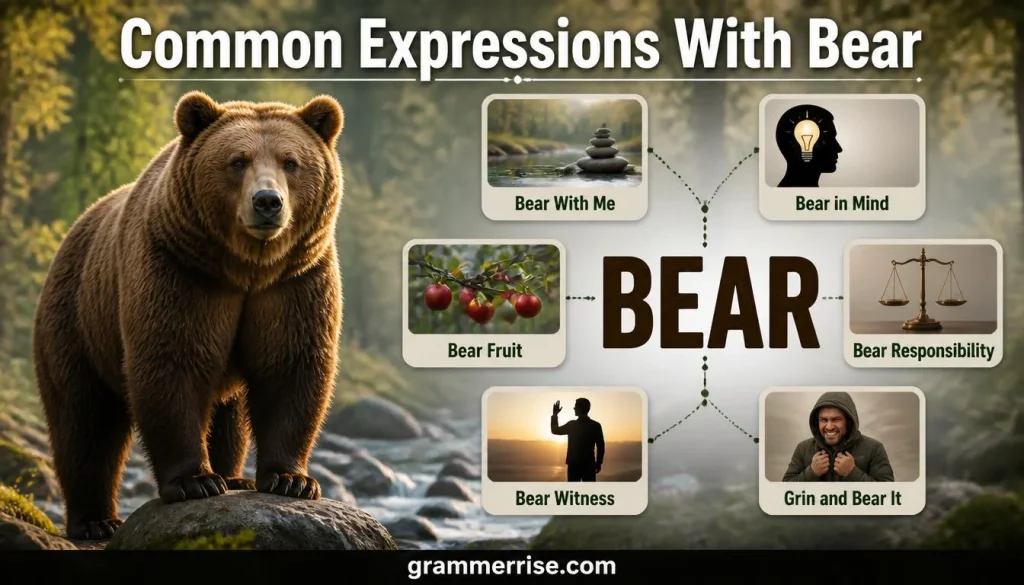
Common Expressions With Bear
English uses bear in many idioms and expressions.
Bear With Me
Meaning: Please be patient.
Examples:
- Bear with me while I find the file.
- Bear with me for a moment.
This is one of the most frequently misspelled expressions in English.
Bear in Mind
Meaning: Remember.
Examples:
- Bear in mind that traffic may cause delays.
- Bear this rule in mind.
Bear Fruit
Meaning: Produce results.
Examples:
- The marketing campaign bore fruit.
- Years of training finally bore fruit.
Bear Responsibility
Meaning: Accept accountability.
Examples:
- Managers bear responsibility for team performance.
- Parents bear responsibility for their children.
Bear Witness
Meaning: Testify or provide evidence.
Examples:
- Several people bore witness to the event.
- Documents bear witness to history.
Grin and Bear It
Meaning: Endure something unpleasant without complaining.
Examples:
- The weather was terrible, but we grinned and bore it.
- Sometimes you simply have to grin and bear it.
Bare vs. Bear: Side-by-Side Comparison
A direct comparison makes the distinction easier.
| Feature | Bare | Bear |
| Primary Meaning | Exposed or uncovered | Carry or endure |
| Part of Speech | Adjective, Verb | Noun, Verb |
| Refers to Animal | No | Yes |
| Used in Idioms | Yes | Yes |
| Related to Exposure | Yes | No |
| Related to Responsibility | No | Yes |
| Related to Tolerance | No | Yes |
Visual Memory Trick
Think about this:
Bare = Skin
Both words relate to exposure.
Bear = Burden
Both words start with “B” and involve carrying or enduring.
Many learners remember the difference using this simple association.
Bare or Bear in Common Phrases
Context matters more than memorization.
Let’s examine phrases people often misspell.
Bear With Me or Bare With Me?
✅ Correct: Bear with me
❌ Incorrect: Bare with me
Why?
Because the phrase means:
Please be patient with me.
The verb bear means tolerate or endure.
Examples:
- Bear with me while I finish this report.
- Please bear with me during the update.
Bare Minimum or Bear Minimum?
✅ Correct: Bare minimum
The phrase refers to the smallest acceptable amount.
Examples:
- He did the bare minimum.
- We brought the bare minimum supplies.
Bare Feet or Bear Feet?
✅ Correct: Bare feet
Bare means uncovered.
Examples:
- She walked across the sand with bare feet.
- The child ran outside barefoot.
Bear Fruit or Bare Fruit?
✅ Correct: Bear fruit
The phrase means produce results.
Examples:
- Their efforts bore fruit.
- The new strategy should bear fruit soon.
I Can’t Bear It or I Can’t Bare It?
✅ Correct: I can’t bear it
This expression means:
I can’t tolerate it.
Examples:
- I can’t bear the noise.
- She couldn’t bear the stress.
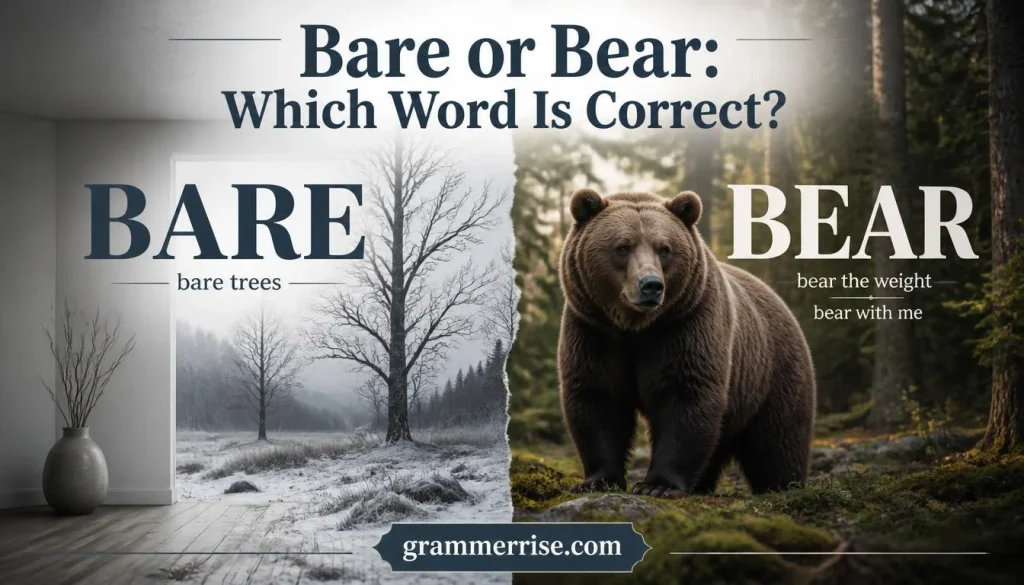
Real-Life Examples of Bare and Bear
Learning from actual sentences improves retention.
Examples Using Bare
- The trees stood bare during winter.
- The walls looked bare after the pictures were removed.
- She revealed the bare truth.
- His bare hands were freezing.
- The company operates with bare resources.
Examples Using Bear
- I can’t bear the pain.
- The bridge can bear enormous weight.
- She bears responsibility for the project.
- The tree will bear fruit next year.
- Please bear in mind the deadline.
Workplace Example
Incorrect:
Please bare with me while I review your application.
Correct:
Please bear with me while I review your application.
In professional communication, using the correct spelling helps maintain credibility.
Academic Example
Incorrect:
The experiment will bare results soon.
Correct:
The experiment will bear results soon.
Even small errors can distract readers from your message.
Common Mistakes Writers Make
Some mistakes appear so often that they deserve special attention.
Mistake: Bare With Me
Wrong:
- Bare with me.
Correct:
- Bear with me.
Mistake: Bear Feet
Wrong:
- Bear feet.
Correct:
- Bare feet.
Unless actual bears have feet, this phrase doesn’t work.
Mistake: Bear Minimum
Wrong:
- Bear minimum.
Correct:
- Bare minimum.
Mistake: Bare Fruit
Wrong:
- Bare fruit.
Correct:
- Bear fruit.
Mistake: I Can’t Bare It
Wrong:
- I can’t bare it.
Correct:
- I can’t bear it.
Why These Errors Matter
Research in communication consistently shows that spelling mistakes affect credibility.
Readers often associate accurate writing with professionalism, attention to detail, and expertise.
One wrong word can create doubt even when the rest of the content is excellent.
Easy Memory Trick to Remember the Difference
Memorization becomes easier when you connect words to images.
Remember Bare = Exposed
Think of:
- Bare skin
- Bare feet
- Bare walls
- Bare branches
Everything is visible.
Everything is uncovered.
Remember Bear = Carry
Think of:
- Bear responsibility
- Bear weight
- Bear the burden
- Bear the cost
Everything involves carrying or enduring something.
The Letter Trick
The word bear contains the word:
ear
Imagine a bear carrying something on its shoulders while whispering in your ear.
It sounds silly, but memorable images stick.
Simple Formula
| Meaning | Word |
| Exposed | Bare |
| Uncovered | Bare |
| Revealed | Bare |
| Carry | Bear |
| Endure | Bear |
| Produce | Bear |
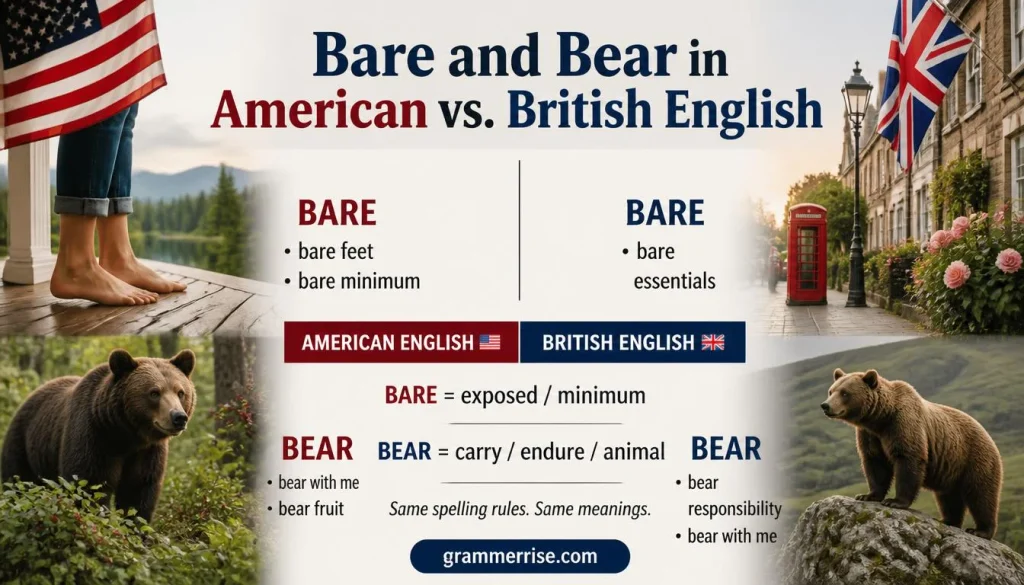
Bare and Bear in American vs. British English
Many grammar questions involve differences between American and British English.
This isn’t one of them.
American English
Americans use:
- bare feet
- bare minimum
- bear with me
- bear fruit
exactly as described above.
British English
British English follows the same rules.
You’ll find:
- bare feet
- bear responsibility
- bear with me
- bare essentials
used in identical ways.
Is There Any Regional Difference?
No.
The meanings remain consistent across major English-speaking countries.
Whether you’re writing in:
- The United States
- Canada
- The United Kingdom
- Australia
- New Zealand
the distinction stays the same.
Read more: Lended or Lent: Which Is Correct Meaning and Common Mistakes?
Mini Case Study: The Cost of One Letter
A customer service representative once sent this message:
Please bare with me while I check your account.
The customer responded jokingly:
I’d rather keep my clothes on.
The interaction remained friendly, but it demonstrates how a single spelling error can accidentally change meaning.
Intended Meaning
- Please be patient.
Accidental Meaning
- Uncover yourself.
One letter completely transformed the sentence.
That’s why mastering homophones matters.
Bare vs. Bear Quiz
Test your knowledge.
Choose the correct word.
Questions
- I can’t _____ this noise anymore.
- The room looked _____ after the furniture was removed.
- Please _____ with me while I investigate.
- The apple tree will _____ fruit next season.
- She walked across the beach with _____ feet.
- Managers must _____ responsibility.
- We packed only the _____ essentials.
- The pillars _____ the roof’s weight.
- He decided to _____ his soul during the interview.
- _____ in mind that deadlines can change.
Answers
- Bear
- Bare
- Bear
- Bear
- Bare
- Bear
- Bare
- Bear
- Bare
- Bear
Score Guide
| Score | Result |
| 9-10 | Excellent |
| 7-8 | Very Good |
| 5-6 | Good Start |
| Below 5 | Review the guide again |
My Personal Experience as an English Specialist
As an English specialist, I have often seen learners confuse Bare or Bear because both words sound the same.I regularly correct mistakes such as “bare with me” and “bear feet.” When teaching these words, I explain that bare means uncovered or exposed, whereas bear means to carry, tolerate, or endure something. In my experience, this simple connection helps students remember the difference quickly. In my experience, understanding the context rather than relying only on pronunciation makes choosing the correct word much easier.
FAQs
1. What is the main difference between bare and bear?
Bare usually means uncovered, exposed, or plain. Bear can refer to the animal or mean to carry, support, tolerate, or endure something.
2. Are bare and bear pronounced the same?
Yes. Bare and bear are homophones, so they have the same pronunciation but different spellings and meanings.
3. Is “bare your soul” or “bear your soul” correct?
Bare your soul is the usual expression when you mean to reveal your deepest feelings or thoughts. Bare means to uncover or reveal.
4. How can I remember when to use bare?
Think of bare as something being uncovered. For example, “He walked on the bare floor” means the floor had no covering.
5. When should I use bear?
Use bear when you mean to carry, tolerate, or endure something. For example, “I cannot bear the noise” means you cannot tolerate it.
6. Do British and American English use bare and bear differently?
No. Bare and bear have the same spellings and basic meanings in both British and American English. The key is choosing the word that fits the sentence.
Conclusion
Understanding Bare or Bear becomes much easier once you connect each word with its meaning instead of relying only on pronunciation. Bare usually describes something uncovered, empty, or plain, while bear can describe the animal or the act of carrying, accepting, or enduring something. Because these homophones sound alike, paying attention to the surrounding words is the simplest way to choose correctly.
A little practice can prevent many common mistakes in everyday writing and speaking. Whether you are preparing a school essay, writing an email, or posting on social media, choosing bare or bear correctly makes your message clearer and more professional. Once the difference becomes familiar, these two words no longer need to be a source of confusion.



[…] Read more: Bare or Bear: Grammar Usage and Examples […]