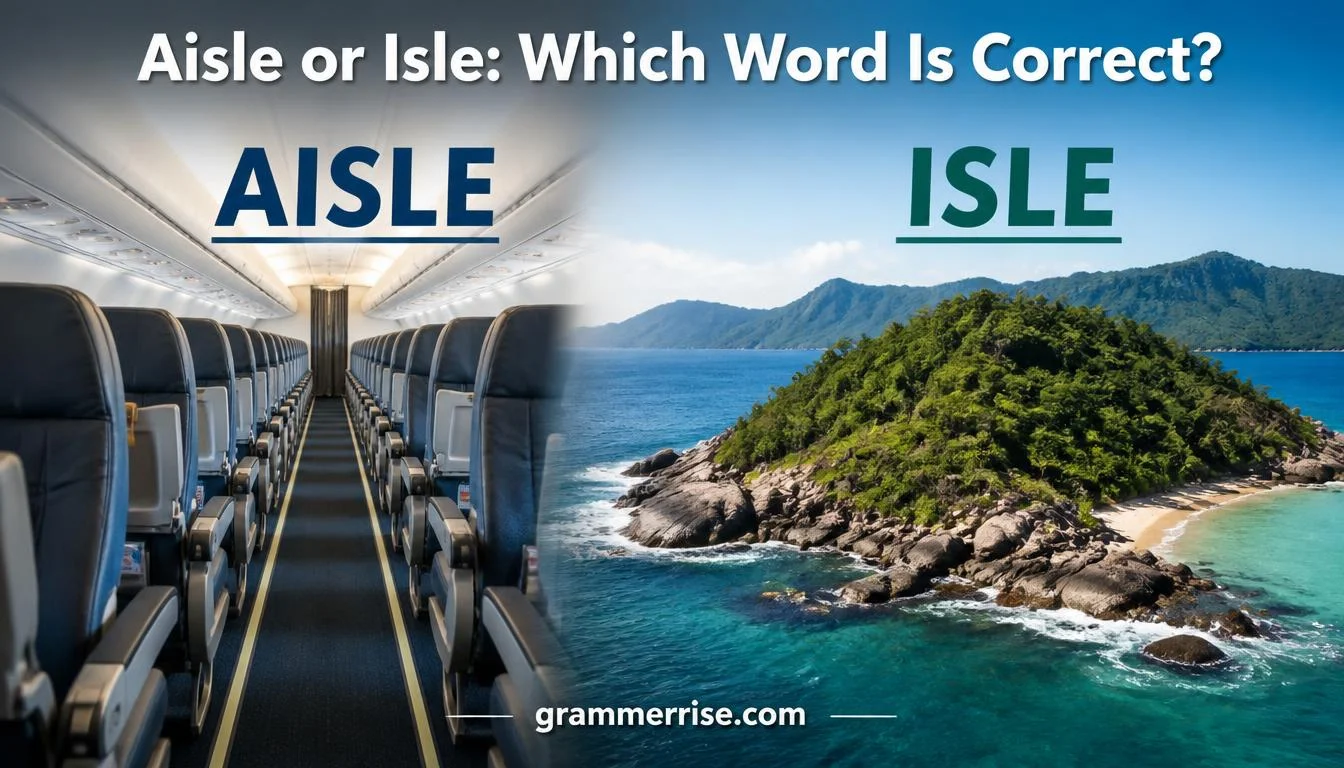
When Aisle or Isle causes confusion, remember that aisle means a passage or walkway, while isle means an island.
These two English words are homophones, so they sound exactly alike even though their meanings are completely different. An aisle is a passage between rows of seats, shelves, or other objects, making it common in airplanes, churches, theaters, trains, shops, and supermarkets. For example, you might walk down the aisle at a wedding or look for products in the grocery aisle. An isle, on the other hand, describes an island, as in a desert isle. The easiest way to remember the distinction is to connect the spelling with the meaning and setting.
English learners and native speakers sometimes find these confusing words difficult because they look and sound alike. Understanding their pronunciation, usage, grammar, and origins can help you choose the right word in everyday and formal writing. A mistake such as “walked down the isle” changes the meaning because it suggests walking on an island instead of through a passageway.
Quick Answer
Here’s the distinction at a glance:
| Word | Meaning | Common Examples | Example Sentence |
| Aisle | A passage between rows | Plane, theater, church, supermarket | “Please keep the aisle clear.” |
| Isle | An island | Geography, literature, place names | “They visited a remote isle.” |
Both words are nouns, but they describe completely different things.
Aisle refers to a physical passage that lets people move between rows. Cambridge defines it as a long, narrow space between rows of seats or shelves.
Isle means an island. It commonly appears in place names and can sound more literary than the everyday word island.
So, if you’re talking about a supermarket, airplane, theater, church, or rows of seats, choose aisle.
If you’re talking about land surrounded by water, choose isle when that word fits the style or name.
The easiest rule
Aisle = walkway.
Isle = island.
That one distinction solves most spelling questions immediately.
What Does “Aisle” Mean?
The word aisle describes a passage that runs between rows of seats, shelves, or similar structures.
Think about walking through a supermarket. Shelves stand on either side of you. The open space in the middle gives you a route from one part of the store to another. That’s an aisle.
The same idea applies to airplanes and theaters. Seats form rows, while the aisle creates a path through those rows. Cambridge also uses the word for passages between seats in places such as aircraft, theaters, and churches.
Aisle in a Store
One of the most familiar uses of aisle appears in grocery stores.
You might hear someone say:
- “The bread is in the third aisle.”
- “Check the cleaning-products aisle.”
- “I couldn’t find the cereal because I was in the wrong aisle.”
- “The supermarket has wide aisles.”
- “There’s a long line blocking the aisle.”
In retail settings, aisle can refer to the walking space between shelves. In some contexts, people also use it when referring more generally to a particular section of shelves or products.
For example:
“You’ll find the pasta in aisle five.”
Here, aisle doesn’t mean the pasta itself. It identifies the section of the store where you can find it.
Aisle on an Airplane
Air travel gives us another extremely common use.
An airplane aisle separates rows of seats and provides a walking path through the cabin.
For example:
- “I’d like an aisle seat, please.”
- “The flight attendant walked down the aisle.”
- “He placed his bag under the seat instead of leaving it in the aisle.”
- “The child stood in the aisle during the flight.”
The phrase aisle seat is especially important because people sometimes spell it incorrectly as “isle seat.”
The correct expression is always aisle seat when you’re referring to the seat next to the passage.

Aisle in a Theater or Church
The same meaning applies when seats appear in organized rows.
Consider these examples:
- “We walked down the center aisle.”
- “She chose an aisle seat at the theater.”
- “The ushers asked everyone to keep the aisles clear.”
- “The church has two narrow aisles.”
The basic idea remains unchanged: aisle identifies the space people use to move between rows.
Aisle in a Wedding
The phrase walk down the aisle is one of the most recognizable expressions containing this word.
For example:
“The bride walked slowly down the aisle.”
Here, aisle refers literally to the passage between rows of seats.
The expression also has a broader cultural meaning. Saying that someone is “getting married” can sometimes be replaced by the informal phrase “walking down the aisle.”
For example:
- “They’re getting married next spring.”
- “They’re walking down the aisle next spring.”
The second sentence uses the physical aisle as a metaphor for marriage.
What Does “Isle” Mean?
Now consider isle.
An isle is an island. In everyday American English, island is usually the more natural word. Isle often appears in geographical names or writing that has a literary, poetic, or slightly old-fashioned tone. Cambridge specifically labels the word as literary and notes its frequent use in place names.
An island is land completely surrounded by water.
So when you write:
“They sailed to a distant isle.”
you’re talking about a piece of land surrounded by water.
Examples of “Isle”
Here are several natural examples:
- “The sailors reached a distant isle.”
- “They spent the summer on a quiet isle.”
- “The tiny isle was surrounded by clear blue water.”
- “A small fishing community occupies the remote isle.”
- “The novel describes a mysterious isle in the middle of the sea.”
Notice how different these sentences feel from examples involving aisle.
You don’t walk through an isle.
You travel to an isle, around an isle, on an isle, or from an isle.
That distinction gives you another useful clue.
Aisle vs. Isle: What’s the Difference?
The easiest way to understand aisle vs. isle is to focus on what each word represents.
| Feature | Aisle | Isle |
| Meaning | A passage or walkway | An island |
| Pronunciation | /aɪl/ | /aɪl/ |
| Part of speech | Noun | Noun |
| Common settings | Stores, planes, theaters, churches | Geography and place names |
| Everyday usage | Very common | Less common than “island” |
| Typical phrase | Aisle seat | Tropical isle |
| Example | “The aisle is crowded.” | “The isle is remote.” |
The most important difference isn’t pronunciation.
It’s meaning.
If the word refers to a path between rows, use aisle.
If it refers to an island, use isle.
Compare These Sentences
Consider these two sentences:
“The children ran down the aisle.”
“The children sailed toward the isle.”
The first sentence describes movement through a passage.
The second describes movement toward an island.
Changing one letter isn’t enough to explain the difference. The entire meaning changes.
Why Are Aisle and Isle So Easy to Confuse?
The problem comes from pronunciation.
Aisle and isle are homophones. A homophone is a word that sounds like another word but has a different spelling or meaning.
Other familiar homophone pairs include:
- sea / see
- right / write
- flower / flour
- there / their
- brake / break
- to / two
Aisle / isle belongs to the same family.
When someone says:
“I’ll take the aisle seat.”
you hear the sound /aɪl/. You don’t hear the letters a-i-s-l-e.
That’s why speaking doesn’t reveal the spelling.
The Silent Letters Make Things Trickier
Neither spelling looks exactly like its pronunciation.
Aisle contains several letters that aren’t pronounced individually.
Isle contains a silent s.
Both eventually produce the same simple sound:
/aɪl/
This creates a classic English spelling trap. The written forms preserve distinctions that pronunciation doesn’t reveal.
That’s why context matters so much.
A Simple Trick to Remember Aisle vs. Isle
If you want one memory trick that actually works, keep it visual.
Remember “Aisle” With Seats and Shelves
Picture a supermarket.
You see shelves on both sides.
You walk between them.
That’s an aisle.
You can also picture an airplane.
Inside, seats line both sides of the cabin, leaving a clear walkway in the middle.
Passengers use this space to move between the rows.
That’s an aisle.
Think:
Aisle = access for walking.
Remember “Isle” With Water
Now picture an island surrounded by water.
That’s an isle.
Think:
Isle = island.
The two words become much easier when you attach them to different mental pictures.
A Three-Second Test
When you’re unsure, ask:
“Am I walking through something or traveling to something?”
- Walking between shelves → aisle
- Walking between seats → aisle
- Sitting beside a passage → aisle
- Traveling to an island → isle
- Describing an island → isle
This simple question can prevent most mistakes.
Aisle or Isle in Common Sentences
Seeing the words in context is one of the fastest ways to learn the difference.
Airplane Examples
- “I’d prefer an aisle seat.”
- “The passenger left a bag in the aisle.”
- “The flight attendant moved down the aisle.”
- “He switched from a window seat to an aisle seat.”
Every example describes the passage beside the seats.
Therefore, aisle is correct.
Grocery Store Examples
- “The cereal is in the fourth aisle.”
- “She walked down every aisle looking for coffee.”
- “The shopping cart blocked the aisle.”
- “The frozen-food aisle was crowded.”
Again, the word describes a passage between shelves or a store section associated with those shelves.
Wedding Examples
- “The bride walked down the aisle.”
- “Everyone stood as she entered the aisle.”
- “The flower girl scattered petals along the aisle.”
These sentences describe the passage between rows of seats.
Island Examples
- “They discovered a beautiful tropical isle.”
- “The fishermen returned to the isle before sunset.”
- “A small village sits on the remote isle.”
- “The travelers spent several days exploring the isle.”
Here, isle means island.

Aisle vs. Isle vs. Island
There’s another useful distinction worth understanding.
Isle and island have closely related meanings.
Aisle does not.
| Word | Basic Meaning | Example |
| Aisle | Passage between rows | “Walk down the aisle.” |
| Isle | Island | “They visited a remote isle.” |
| Island | Land surrounded by water | “They visited a remote island.” |
In ordinary conversation, island is usually the more straightforward choice.
For example:
Natural everyday wording:
“We stayed on a small island.”
More literary wording:
“We stayed on a small isle.”
Neither sentence has the same meaning as:
“We walked down a small aisle.”
The first two describe land surrounded by water. The third describes a passage.
When Should You Use “Isle” Instead of “Island”?
Use isle when the word appears in a recognized proper name or when its literary tone suits the context.
Examples include:
- Isle of Skye
- Isle of Man
- Isle of Wight
- Isle Royale
- Emerald Isle
- British Isles
Cambridge specifically notes that isle is used especially in place names.
For ordinary writing, however, island often sounds more natural.
Compare:
“The island has 5,000 residents.”
with:
“The isle has 5,000 residents.”
The second sentence sounds more literary. That’s not wrong. It simply has a different tone.
Common Mistakes With Aisle and Isle
Because these words sound identical, spelling mistakes can slip into otherwise polished writing.
Mistake: “The milk is in the fifth isle.”
Incorrect:
“The milk is in the fifth isle.”
Correct:
“The milk is in the fifth aisle.”
Milk sits on store shelves. The word describes the passage between those shelves.
Mistake: “They sailed to a remote aisle.”
Incorrect:
“They sailed to a remote aisle.”
Correct:
“They sailed to a remote isle.”
The sentence describes an island, so isle works.
Mistake: “I want an isle seat.”
Incorrect:
“I want an isle seat.”
Correct:
“I want an aisle seat.”
An aisle seat sits beside a passage.
Mistake: “She walked down the isle.”
Incorrect:
“She walked down the isle.”
Correct:
“She walked down the aisle.”
The wedding ceremony takes place along a passage between rows of seats.
Mistake: “The supermarket has narrow isles.”
Incorrect:
“The supermarket has narrow isles.”
Correct:
“The supermarket has narrow aisles.”
A supermarket has passages between shelves. It doesn’t have islands.
“Walk Down the Aisle” or “Walk Down the Isle”?
This is one of the most common questions about aisle or isle.
The correct expression is:
walk down the aisle
not:
walk down the isle
Why?
Because the phrase refers to walking along a passage between rows of seats.
For example:
“The bride walked down the aisle toward the altar.”
The same spelling applies even when the phrase has a figurative meaning connected with marriage.
You might say:
- “They’ll walk down the aisle next month.”
- “After years together, they finally decided to walk down the aisle.”
- “She dreamed about walking down the aisle as a child.”
The word remains aisle because the underlying image is still the passage in a ceremony.

“Aisle Seat” or “Isle Seat”?
The correct phrase is aisle seat.
An aisle seat is next to the passage between rows of seats. Cambridge lists aisle seat as the standard collocation for seats on aircraft, trains, buses, and in theaters.
For example:
“Could I have an aisle seat?”
That’s correct.
You can contrast it with:
- aisle seat
- window seat
- middle seat
A useful memory trick is simple:
The aisle seat is beside the aisle.
The word isle has no connection with seating.
Aisle or Isle: Pronunciation
Both aisle and isle have the same pronunciation.
They are pronounced:
/aɪl/
You can think of the sound as the word “I’ll.”
For example:
- aisle → “I’ll”
- isle → “I’ll”
- I’ll → “I’ll”
That creates a three-way sound connection.
However, the spellings and meanings remain different.
| Word | Pronunciation | Meaning |
| aisle | /aɪl/ | Passage |
| isle | /aɪl/ | Island |
| I’ll | /aɪl/ | Contraction of “I will” |
This is why listening alone can’t solve the spelling problem.
Context has to do the heavy lifting.
Why Context Matters More Than Pronunciation
Imagine someone says:
“I walked down the aisle.”
You know the intended spelling because walked down naturally fits a passage.
Now imagine someone says:
“We sailed toward the isle.”
The verb sailed gives you a strong clue that the speaker means an island.
This is a broader lesson about English.
When two words sound identical, the surrounding words often reveal the intended meaning.
Consider these clues:
| Context Clue | Correct Word |
| seat | aisle |
| shelf | aisle |
| supermarket | aisle |
| airplane | aisle |
| theater | aisle |
| church | aisle |
| island | isle |
| ocean | isle |
| tropical | isle |
| remote land | isle |
| place name | often isle |
The words around the blank can almost act like a spelling compass.
Case Study: Choosing the Correct Word From Context
Imagine an editor reviewing this sentence:
“The traveler walked through the crowded isle of the supermarket.”
At first glance, the sentence might seem understandable.
But isle doesn’t fit the meaning.
A supermarket has rows of shelves with passages between them. The correct sentence is:
“The traveler walked through the crowded aisle of the supermarket.”
Now consider a different sentence:
“The boat approached a small aisle.”
The context tells you something is wrong. A boat doesn’t normally approach a passage between supermarket shelves or airplane seats.
The better sentence is:
“The boat approached a small isle.”
The surrounding nouns and verbs provide enough information to select the correct spelling.
What This Case Study Shows
The lesson is simple:
Don’t choose between aisle and isle by sound. Choose by meaning.
That strategy works even when you’re writing quickly.
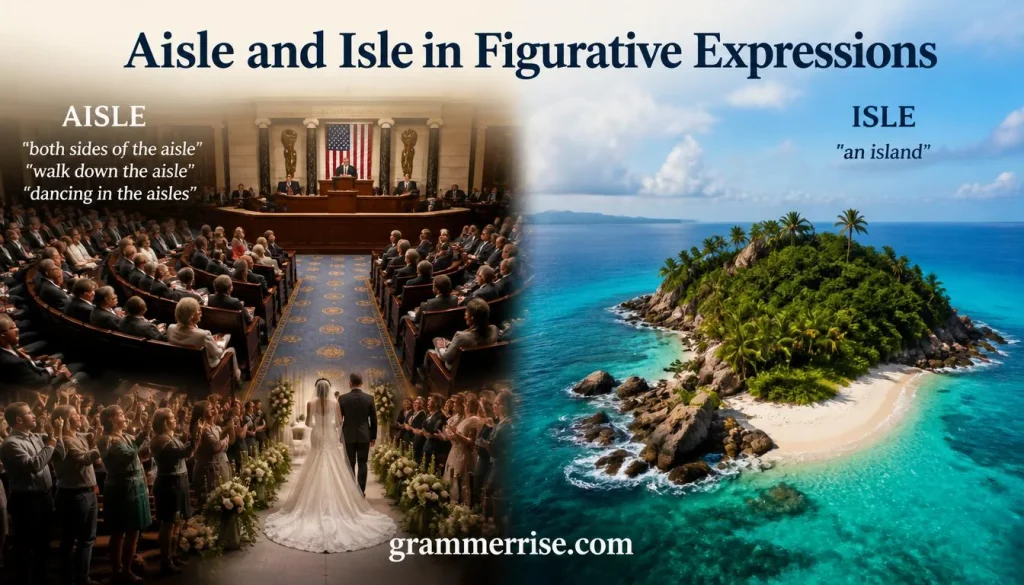
Aisle and Isle in Figurative Expressions
Aisle also appears in expressions where its physical meaning expands into something figurative.
“Both Sides of the Aisle”
The phrase both sides of the aisle commonly refers to opposing political groups, especially in legislative settings.
For example:
“The proposal received support from both sides of the aisle.”
The phrase draws on the physical arrangement of lawmakers sitting on different sides of a legislative chamber.
Here, aisle still evokes a dividing passage. The meaning simply extends beyond a literal walkway.
“Walk Down the Aisle”
As discussed earlier, walk down the aisle can refer literally to moving through a wedding venue.
It can also function as a familiar expression for getting married.
“Dancing in the Aisles”
You may also encounter dancing in the aisles, especially when describing an audience that’s extremely excited or enthusiastic.
For example:
“The band’s performance had fans dancing in the aisles.”
The expression can be literal or exaggerated depending on the situation.
None of these expressions uses isle because none refers to an island.
Aisle or Isle: Quick Comparison Examples
Here are some side-by-side examples that make the distinction clear.
| Incorrect or Confusing | Correct | Why |
| “The bread is in the fifth isle.” | “The bread is in the fifth aisle.” | Store passage |
| “I booked an isle seat.” | “I booked an aisle seat.” | Seat beside a passage |
| “She walked down the isle.” | “She walked down the aisle.” | Passage between seats |
| “They sailed to a remote aisle.” | “They sailed to a remote isle.” | Island |
| “The tropical aisle was beautiful.” | “The tropical isle was beautiful.” | Island |
| “The supermarket has narrow isles.” | “The supermarket has narrow aisles.” | Store passages |
A quick glance at the meaning usually exposes the mistake.
Facts About Aisle and Isle
A few useful facts can make the distinction easier to retain.
- Aisle is a noun.
- Isle is a noun.
- Both are pronounced /aɪl/ in standard dictionary pronunciations.
- Aisle refers to a passage between rows of seats or shelves.
- Isle means an island.
- Isle often appears in geographical names.
- Island is the more common everyday word for land surrounded by water.
- Aisle seat is the correct expression.
- Walk down the aisle is the correct spelling.
- The two words are homophones because they share the same pronunciation but differ in spelling and meaning.
Read more: Therefor or Therefore: Meaning, Grammar, Usage and Examples
Aisle or Isle: A Short Practice Quiz
Test yourself before moving on.
Choose “aisle” or “isle”
The passengers waited beside the ___.
They discovered a tiny ___ far from the mainland.
I prefer an ___ seat on long flights.
The shampoo is in the third ___.
The sailors spent the night on a remote ___.
The bride slowly walked down the ___.
The supermarket’s frozen-food ___ was crowded.
The photographs showed a beautiful tropical ___.
Answers
- aisle — passengers move through an airplane aisle.
- isle — the sentence describes an island.
- aisle — an aisle seat sits beside the passage.
- aisle — supermarkets have aisles between shelves.
- isle — sailors can stay on an island.
- aisle — wedding ceremonies take place along an aisle.
- aisle — store sections have aisles.
- isle — a tropical isle means a tropical island.
The Fastest Way to Score Perfectly
Before choosing the spelling, replace the word mentally.
If island works, choose isle.
If passage or walkway works, choose aisle.
For example:
“They sailed to a remote ___.”
Replace the blank with island.
“They sailed to a remote island.”
That works.
So isle is correct.
Now try:
“The cereal is in the fourth ___.”
Replace the blank with passage.
“The cereal is in the fourth passage.”
The meaning works, so aisle is the correct spelling.
My Personal Experience With Aisle or Isle
As an English specialist, I have often seen learners confuse Aisle or Isle because both words sound exactly the same. I usually explain that aisle means a passage or walkway, while isle means an island.
What helped me most was using simple mental pictures. I associate aisle with supermarket shelves, airplane seats, and wedding rows. I connect isle with land surrounded by water. This simple method makes the difference much easier to remember.
In my experience, context is the best guide. If you can walk through it, use aisle. If you can sail to it, use isle. Once learners understand this simple rule, mistakes such as “walk down the isle” and “isle seat” become much easier to avoid.
FAQs
1. What is the main difference between aisle and isle?
Aisle means a passage or walkway between rows of seats, shelves, or other objects. Isle means an island. Although they sound the same, their meanings and spellings are different.
2. Is it correct to say “walk down the isle”?
No. When you mean a passageway, the correct expression is “walk down the aisle.” For example: “The bride walked down the aisle.”
3. How can I easily remember aisle and isle?
Think of the “a” in aisle as standing for access or a place where you can walk. Isle is connected with an island. This simple association can help you remember the difference.
4. Where is the word aisle commonly used?
You can use aisle for passageways in many places, including airplanes, supermarkets, churches, theaters, trains, and stores. For example, “She found the cereal in the third aisle.”
5. Can isle be used for any island?
Yes. Isle is another word for an island, although it often sounds more literary or descriptive than the everyday word island. For example, “They spent their vacation on a beautiful tropical isle.”
6. Are aisle and isle homophones?
Yes. Aisle and isle are homophones because they have the same pronunciation but different spellings and meanings. This is why writers sometimes confuse them, especially when relying on how a word sounds.
Conclusion
Understanding Aisle or Isle becomes much easier once you connect each spelling with its meaning. Aisle refers to a passage or walkway between rows, whether you are in a supermarket, airplane, church, theater, or at a wedding. Isle, meanwhile, means an island and often appears in descriptive or literary writing. Because these words sound identical, it is easy to mix them up when writing. The best way to avoid the mistake is to pause and consider what you are describing. If you can walk through it, you probably need aisle; if you can sail around it, you probably mean isle. With a little practice, choosing the correct word will become natural.

Hussain Abid is an English language writer with over 10 years of experience in grammar, spelling, vocabulary, and writing. He specializes in creating clear, well-researched content that helps readers improve their English with confidence. At GrammarRise, Hussain writes practical guides, grammar explanations, and word comparison articles based on trusted language sources and real-world usage. His mission is to make English learning simple, accurate, and accessible for everyone

[…] Read more: Aisle or Isle: Which Word Is Correct? […]